Pulse
Inspiration
We started with a simple observation: people leave conversations all the time not really knowing how they felt during them. You walk out of a 1:1 with your manager and think "that was fine," but your chest is tight and you're replaying one sentence over and over. Or you keep canceling on a friend and can't articulate why. The emotional data is there — your heart was racing, your voice got clipped, you stopped pausing between sentences — but none of it reaches your conscious awareness in the moment.
We asked ourselves: what if AR glasses, which are already capturing audio and sitting on your face next to a pulse sensor, could give you that missing layer? Not to analyze the other person. Not to win arguments. Just to show you what was actually happening inside you while you were too busy talking to notice.
That's where Pulse came from — the idea that emotional self-awareness shouldn't depend on how good your memory is after the fact.
What it does
Pulse turns AR smart glasses (Meta Ray-Ban) into an emotional interoception tool across three modes:
Reflect — After a conversation ends, Pulse generates a personal emotional report on your phone. It maps your heartbeat data against the conversation timeline, flags the exact moments your body reacted strongest, and shows how your voice shifted throughout. Thirty minutes later, it checks in: are you still carrying this interaction, or have you moved on?
Track — Over days and weeks, Pulse builds a relationship dashboard. It identifies who you talk to (via facial recognition matched to your own contacts), tracks how your emotional baseline shifts around specific people over time, and surfaces patterns you'd never catch on your own — like the fact that your resting heart rate before meetings with one particular colleague has been climbing steadily for three weeks.
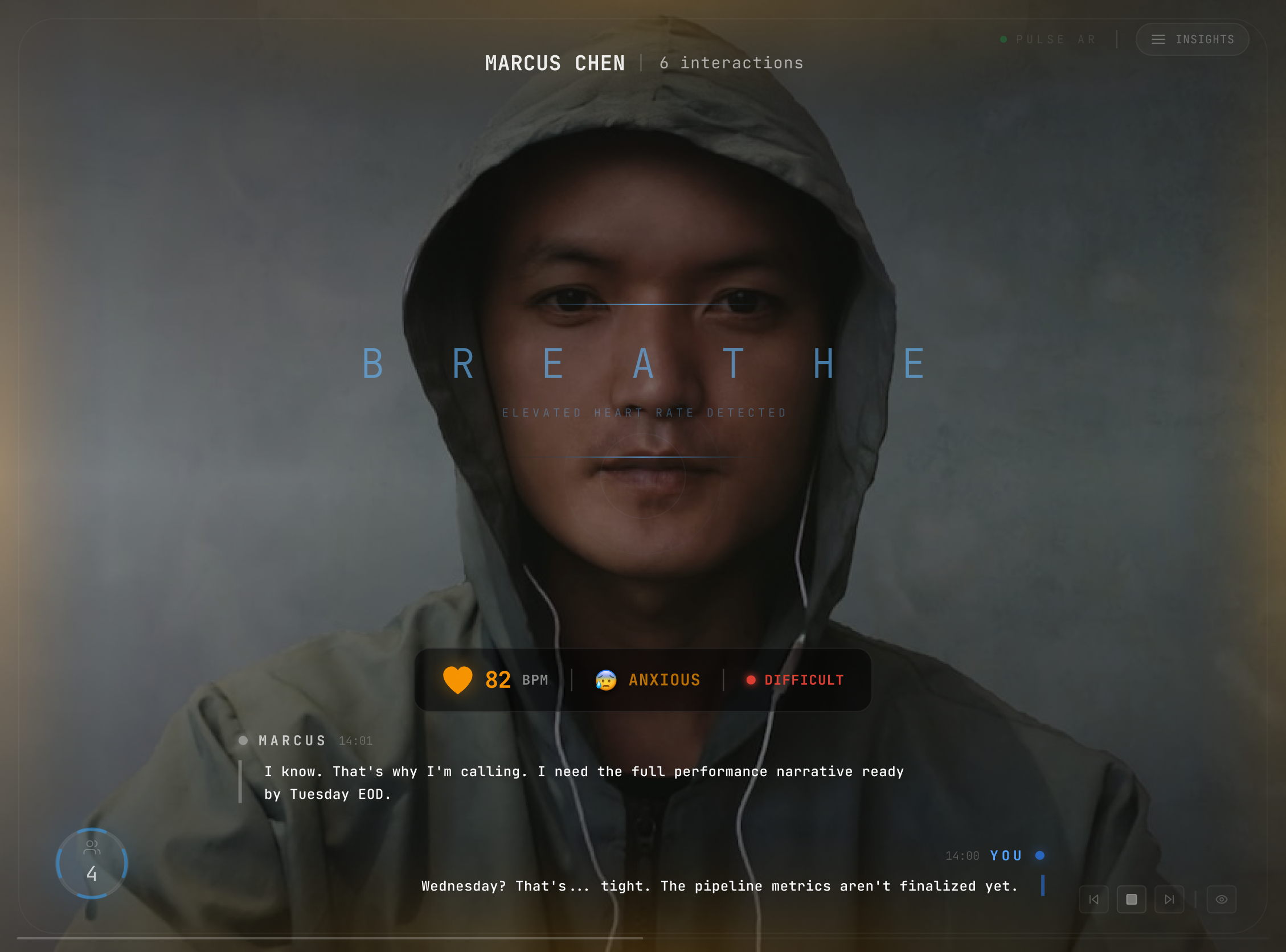
Guide — During a live conversation, when your biometrics cross a threshold you've set yourself, the glass gives you a subtle, private nudge. A soft glow at the edge of your vision. A brief "Breathe." A suggestion to pause. Nothing the other person can see. Just your own early warning system, calibrated to your own body.
How we built it
We designed and prototyped Pulse in Figma Make, building a fully interactive prototype driven by structured mock data.
The data layer came first. We created 20 synthetic person profiles with varying relationship types and interaction frequencies, then generated 70 conversation records across 7 days — each with realistic dialogue, 30-second heartbeat slices aligned to transcript segments, vocal affect annotations, and emotional state labels. We wrote these as JSON files structured to bind directly to Figma Make's variable system, so the prototype feels data-driven rather than static.
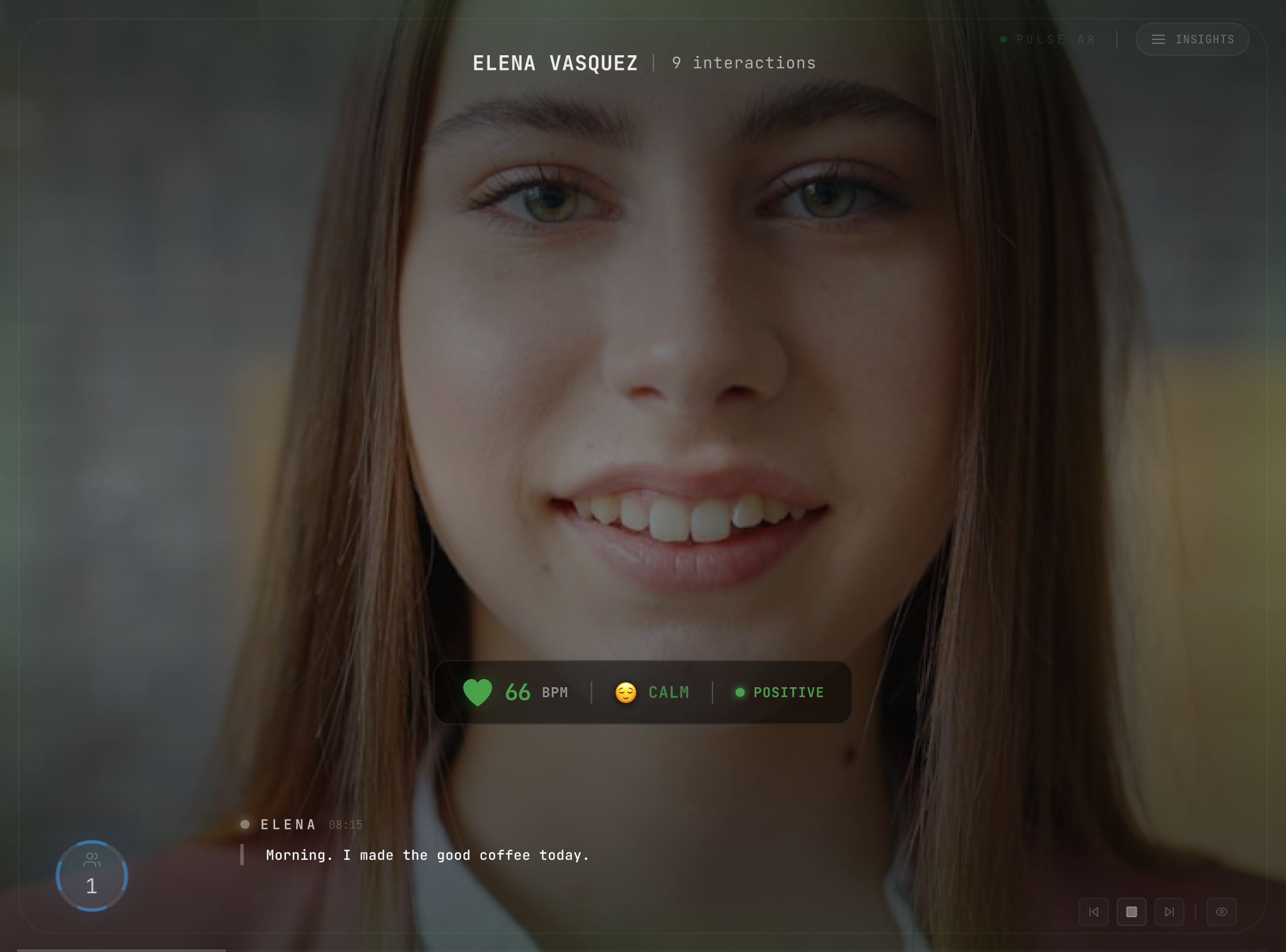
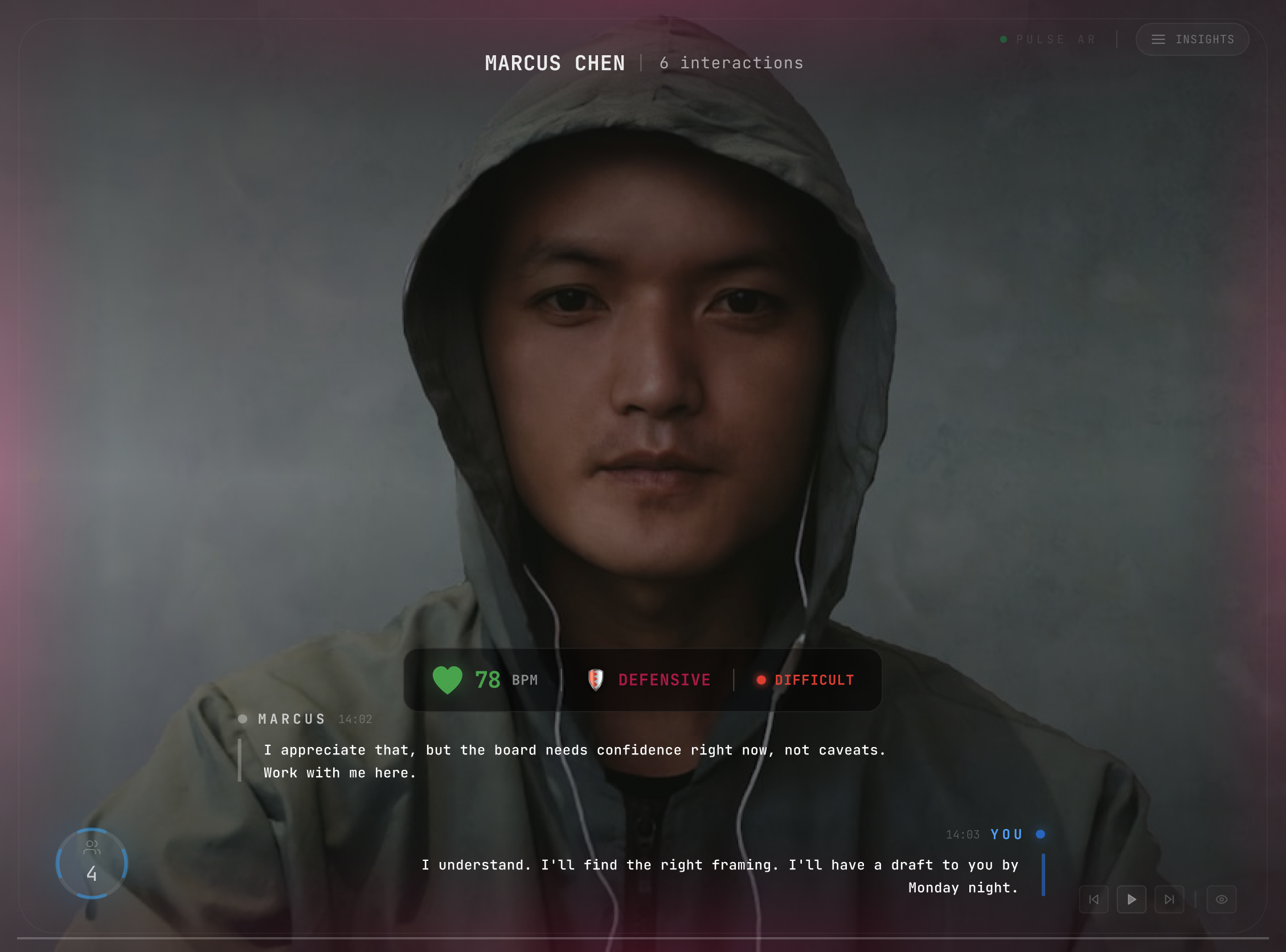
For the glass HUD, we designed a minimal overlay system — no menus, no text-heavy UI, just ambient color cues and 3-to-5-word prompts that appear in the peripheral vision zone and fade after a few seconds. We prototyped this as a screen overlay that triggers at specific timestamps during mock conversation playback.
The companion app covers the full experience: a daily interaction feed with emotional arc thumbnails, detailed interaction reports with heartbeat wave overlays and transcript highlights, a people dashboard with relationship trend cards, and a settings screen for threshold tuning and privacy controls.
We anchored every design decision in a detailed PRD that specified data architecture, processing pipeline, interface hierarchy, and ethical safeguards before we touched a single frame.
Challenges we ran into
Making heartbeat data meaningful, not noisy. Raw BPM numbers don't mean much to people. We had to figure out how to visualize cardiac data in a way that feels intuitive and emotional rather than clinical. We went through several iterations before landing on a smooth gradient wave that underlies the conversation timeline — warm ambers for activation, cool blues for calm — instead of the jagged ECG-style chart we started with.
Designing nudges that help without distracting. The entire value of the real-time Guide feature depends on the nudge being subtle enough that it doesn't pull you out of the conversation. We kept stripping things back — less text, less color, more peripheral, shorter duration — until we found a balance where the nudge registers without demanding attention.
Drawing the ethical line clearly. It would be technically trivial to analyze the counterpart's voice for sentiment, or to predict how someone else might react. We deliberately chose not to. Every insight in Pulse is framed as "here's what was happening with you," never "here's what the other person was feeling." Drawing and holding that line shaped the entire product and ruled out features that would have been easy to build but wrong to ship.
Generating believable mock data. Seventy conversations with aligned heartbeat slices, vocal markers, and narrative arcs that span a full week is a lot of synthetic data. Getting it to feel real — with the right messy rhythms of actual human interaction — took more iteration than we expected.
Accomplishments that we're proud of
We're proud that the product concept holds together end-to-end. Pulse isn't just one feature — it's a complete loop from real-time awareness to post-interaction reflection to long-term pattern recognition, and each mode reinforces the others.
We're proud of the ethical framework. It would have been easier (and flashier) to build a tool that reads other people for you. We chose self-reflection over social x-ray, and we think that constraint actually made the product stronger and more trustworthy.
We're proud of the data architecture. The mock data system is detailed enough that every screen in the prototype is driven by realistic, structured information — not placeholder text. The emotional arcs, heartbeat slices, and relationship trends all tell coherent stories across the full 7-day prototype period.
And we're proud that the glass HUD design genuinely feels invisible. The nudges work because they don't try to do too much.
What we learned
Interoception is the underserved sense. We went into this project thinking about AR as a visual technology, but the real opportunity turned out to be about internal perception — helping people sense what their own bodies are already telling them. The most powerful "augmented reality" might not be overlaying information on the world, but overlaying information on yourself.
Ethical constraints are design constraints, and good ones. Deciding early that Pulse would never profile the counterpart forced us to think harder about what self-directed insights actually look like. That constraint pushed us toward more thoughtful framing, more careful language in the UI, and a product that feels like a mirror rather than a microscope.
Longitudinal data tells better stories than real-time data. The individual interaction reports are useful, but the relationship trends over days and weeks are where the real insight lives. People don't change in a single conversation — they drift slowly, and the most valuable thing Pulsedoes is make that drift visible before it becomes a problem.
Designing for a face-mounted display is a fundamentally different problem. You can't just shrink a phone UI. The glass HUD had to be designed for peripheral vision, zero interaction, and complete invisibility to everyone except the wearer. That constraint reshaped how we think about notification design entirely.
What's next for Pulse
Live sensor integration. The current prototype runs on mock data. The next step is connecting real PPG sensor data from the Meta Ray-Ban hardware and running actual on-device speech-to-text, so we can validate whether the emotional arc computations hold up with real, noisy biometric signals.
Adaptive thresholds. Right now, users set their own nudge thresholds manually. We want to build a system that learns the user's personal baselines over time and adjusts automatically — so the nudge fires when you are unusually activated, not when you cross an arbitrary BPM number.
Therapist/coach sharing mode. Several of our user interviews surfaced a strong desire to share Pulsereports with a therapist or coach. We want to build a privacy-preserving export that gives professionals the emotional arc data without raw transcripts — so therapy sessions can start from "here's what my body was doing this week" instead of "let me try to remember how I felt."
Broader sensor fusion. Heart rate is a strong signal but not the only one. We want to explore galvanic skin response, skin temperature, and eye movement data as additional inputs — each adding resolution to the emotional picture without requiring any new hardware beyond what smart glasses are already shipping with.
Longitudinal studies. We want to partner with behavioral health researchers to measure whether Pulse actually improves emotional regulation outcomes over 90 days, and whether the "training wheels off" week — where users go without nudges to test internalized skills — shows lasting behavior change.
Built With
- figma


Log in or sign up for Devpost to join the conversation.