PULSEBOUND
Forge the flesh. Master the pulse. Unlock your vitality.
Project Description
PULSEBOUND is a dark, cinematic bio-kinetic game that transforms health education into an immersive progression-based experience. It combines exercise physiology, functional biomechanics, sleep architecture, metabolic health, and tactical health decision-making through interactive challenges, educational dossiers, and a system of progression.
Players take on the identity of an Operative, exploring different sectors of human vitality, completing scenario-based trials, unlocking knowledge, and building a deeper understanding of how the human body works.
Rather than treating health as a collection of numbers, restrictions, or routines, PULSEBOUND approaches it as a system worth understanding, exploring, and mastering.
Inspiration
Health education is often presented through long explanations, disconnected facts, generic fitness advice, or calorie-focused applications. While these approaches can provide information, they do not always make learning engaging or help people understand the mechanisms behind their everyday health decisions.
I wanted to approach this differently.
The inspiration behind PULSEBOUND was to combine the atmosphere of a tactical, progression-based game with the science of human physiology. What if understanding cardiovascular health, muscle function, sleep, hydration, and mobility felt like completing missions rather than reading another health guide?
This led to the idea of creating a world where the human body becomes the system being explored, knowledge becomes the reward, and every completed challenge brings the player closer to understanding their own vitality.
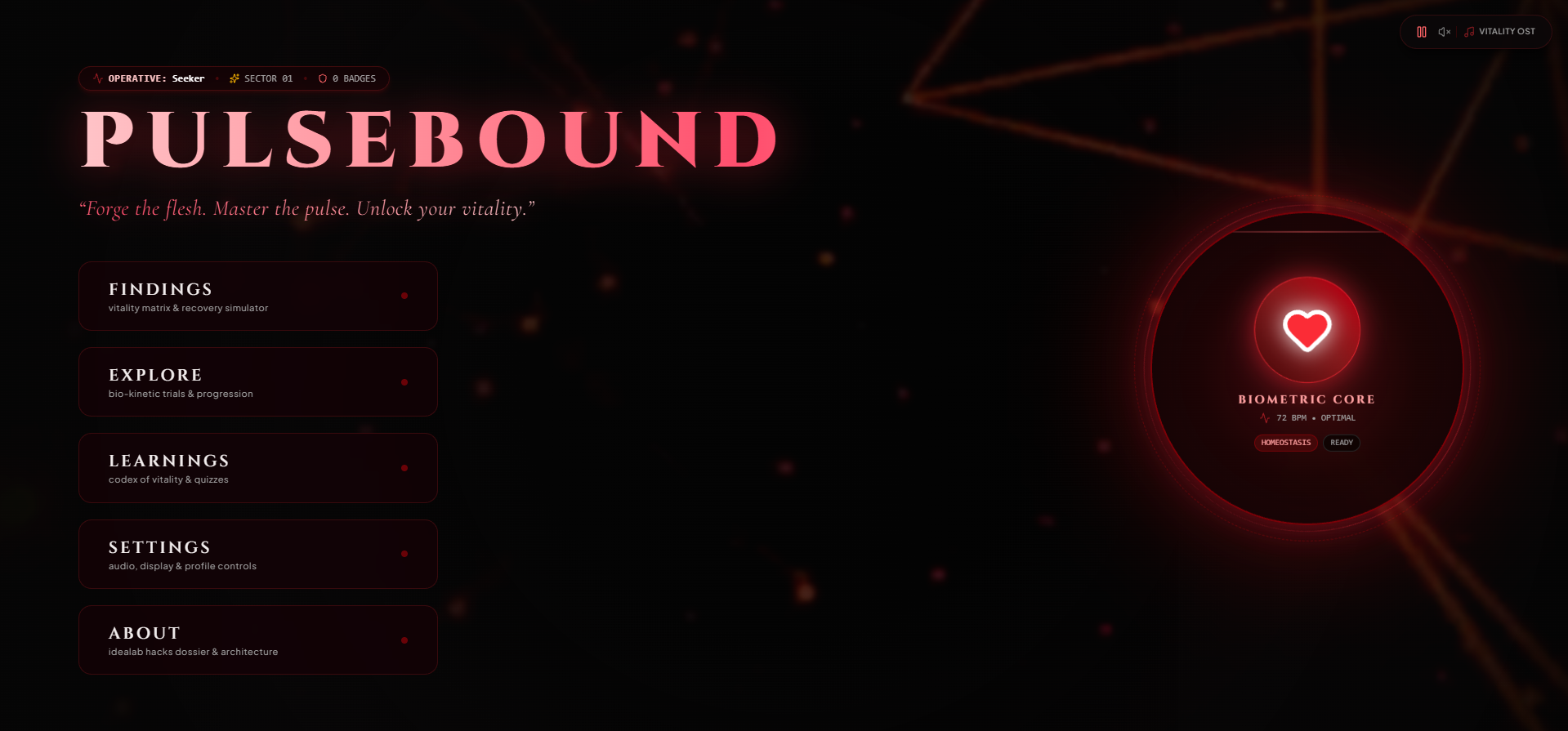
The dark, cinematic visual identity reinforces the feeling of entering a classified bio-kinetic simulation, while the educational content keeps the experience grounded in real physiological concepts.
What it does
PULSEBOUND turns health education into a structured experience built around six interconnected sections.
1. Main Menu — Biometric Core
The main menu introduces the PULSEBOUND identity through an animated biometric core, ECG-inspired visuals, cinematic background media, and a tactical interface. It establishes the Operative experience from the beginning.
2. Vitality Matrix — Findings
Players can enter meal information and explore qualitative nutrition insights across 12 bio-markers. Interactive nutrient wheels explain physiological mechanisms, food sources, and cellular pathways.
The focus is on understanding nutrition and its relationship with the body, rather than calorie counting or restrictive portion tracking.
3. Sector Trials — Explore
The Explore section contains 25 simulation sectors across five domains:
- Cardiovascular Conditioning & Mitochondrial Health
- Musculoskeletal Architecture & Strength
- Neuro-Recovery & Sleep Architecture
- Metabolic Synergy & Hydration Mechanics
- Functional Mobility & Joint Integrity
Each sector introduces scenario-based learning through challenge cards and educational dossiers. Completing sectors unlocks badges and contributes to progression through the experience.
4. Codex of Vitality — Learnings
The Learnings section connects earned sector badges with educational dossiers. Players can test their understanding through quizzes, track their scores, and progress through ranks.
This creates a connection between exploring a concept, learning its underlying mechanisms, and checking what has been understood.
5. Tactical Settings & Diagnostics
Players can independently adjust background music and sound-effect volumes, inspect local storage diagnostics, verify database schema information, export progress as JSON, and reset their progress through a confirmation flow.
6. About — Mission Briefing
The About section introduces the project's purpose, educational notices, credits, and a visual architecture overview to explain how the experience is organized.
Together, these sections create a learning loop: explore a health concept, understand its mechanisms, complete a challenge, and unlock further knowledge.
How I built it
PULSEBOUND was built as a frontend-only application using a modern React and TypeScript architecture.
We focused on keeping the experience modular, separating the interface, learning content, progression logic, and local data management.
Core technologies and implementation:
- React — Component-based user interface.
- TypeScript — Structured and type-safe application development.
- Vite — Development environment and production build tooling.
- Zustand — State management for settings, exploration, and learning progression.
- Dexie and IndexedDB — Local persistence for application data.
- SVG and CSS animations — Biometric core visuals, rings, ECG elements, and interface effects.
- Web Audio API — Synthesized sound effects and audio fallback behavior.
- Vitest — Automated testing.
The visual system was designed around an obsidian-black and tactical-crimson palette, with glassmorphism, radial layouts, motion effects, background video, and cinematic vignettes.
We also integrated background music, interface sound effects, and a layered biometric-core animation to make the experience feel more like an interactive simulation than a conventional health dashboard.
The application uses local browser storage for its data flow. It does not depend on a backend service or cloud database for its core functionality.
Challenges I ran into
One of the biggest challenges was bringing together multiple areas of health education without making the application feel like a collection of unrelated tools.
Cardiovascular health, biomechanics, sleep, hydration, and nutrition are different subjects, but they needed to fit into one coherent experience. We addressed this by organizing the content into five learning domains and connecting exploration with quizzes, badges, and progression.
Another challenge was balancing scientific explanations with accessible, engaging gameplay. We wanted to explain the mechanisms behind health concepts without overwhelming players with technical terminology or reducing the content to oversimplified advice.
The frontend architecture presented another challenge. Since the application is frontend-only, progression, settings, and learning data needed to work through local persistence. We therefore organized state management and local database functionality separately from the visual components.
Finally, achieving the intended atmosphere required more than choosing a dark color palette. The biometric core, animated elements, background media, sound effects, glassmorphism, and interface transitions needed to work together without distracting from usability or learning.
Accomplishments that I'm proud of
We are proud of transforming a conventional health-learning concept into a distinctive, game-inspired experience.
Some of the accomplishments include:
- Building a complete PULSEBOUND identity around the Operative concept.
- Creating an animated biometric core with layered SVG elements and ECG-inspired visuals.
- Organizing 25 simulation sectors into five distinct health domains.
- Developing a qualitative nutrition exploration experience with 12 bio-markers.
- Connecting sector exploration, badge unlocking, educational dossiers, quizzes, and rank progression.
- Implementing local progress persistence, diagnostics, JSON export, and progress reset functionality.
- Integrating cinematic background media, background music, and interactive sound effects.
- Building a modular frontend architecture without relying on a backend service.
Most importantly, we are proud that PULSEBOUND treats health education as something players actively explore rather than information they simply consume.
What I learned
Building PULSEBOUND helped us understand how educational content can be structured into an interactive progression system.
We learned that gamification is more meaningful when rewards are connected to actual learning. Unlocking a badge or progressing through a rank should represent more than completing an interaction; it should encourage the player to understand the underlying concept.
We also gained practical experience in modular React and TypeScript development, local-first application architecture, IndexedDB persistence, state management, SVG-based animation, and browser audio APIs.
Another important lesson was the value of visual consistency. A strong visual identity is not just about colors or effects. Typography, motion, sound, layout, and interaction patterns all contribute to whether an application feels like one coherent product.
Most importantly, we learned that complex health topics can become more approachable when they are presented through structured exploration, meaningful interactions, and accessible explanations.
What's next for PULSEBOUND
PULSEBOUND is a foundation for a larger bio-kinetic learning experience. There are several directions in which we would like to take it next:
- Expanded Learning Content: Introduce more detailed educational dossiers, scenarios, and interactive explanations across all five health domains.
- Deeper Progression: Develop more interconnected challenges, achievement systems, and meaningful progression milestones.
- Advanced Biometric Simulations: Explore interactive visual simulations that demonstrate physiological processes and how different body systems work together.
- Improved Learning Experiences: Add more varied assessment formats and ways to reinforce previously explored concepts.
- Accessibility and Localization: Improve accessibility and explore additional language support.
- Personalized Learning: Explore ways to adapt the learning journey based on a player's completed challenges and learning progress.
My long-term vision is to make PULSEBOUND a place where understanding the human body feels like mastering an evolving system.
PULSEBOUND — Forge the flesh. Master the pulse. Unlock your vitality.
Built With
- biomechanics
- css3
- dexie.js
- educational-game
- fitness
- frontend-development
- gamification
- health-education
- html5
- hydration
- indexeddb
- interactive-learning
- javascript
- local-first-architecture
- nutrition
- physiology
- react
- responsive
- sleep-architecture
- svg
- typescript
- vite
- vitest
- web-audio-api
- zustand

