Inspiration
PulseAdvisor was inspired by real-world cloud and financial system outages where engineers have access to metrics but still struggle to quickly decide what action to take. In high-stakes environments like finance, slow decisions lead to downtime, revenue loss, and compliance risk. The project explores how Gemini can support faster, clearer operational decision-making.
What it does
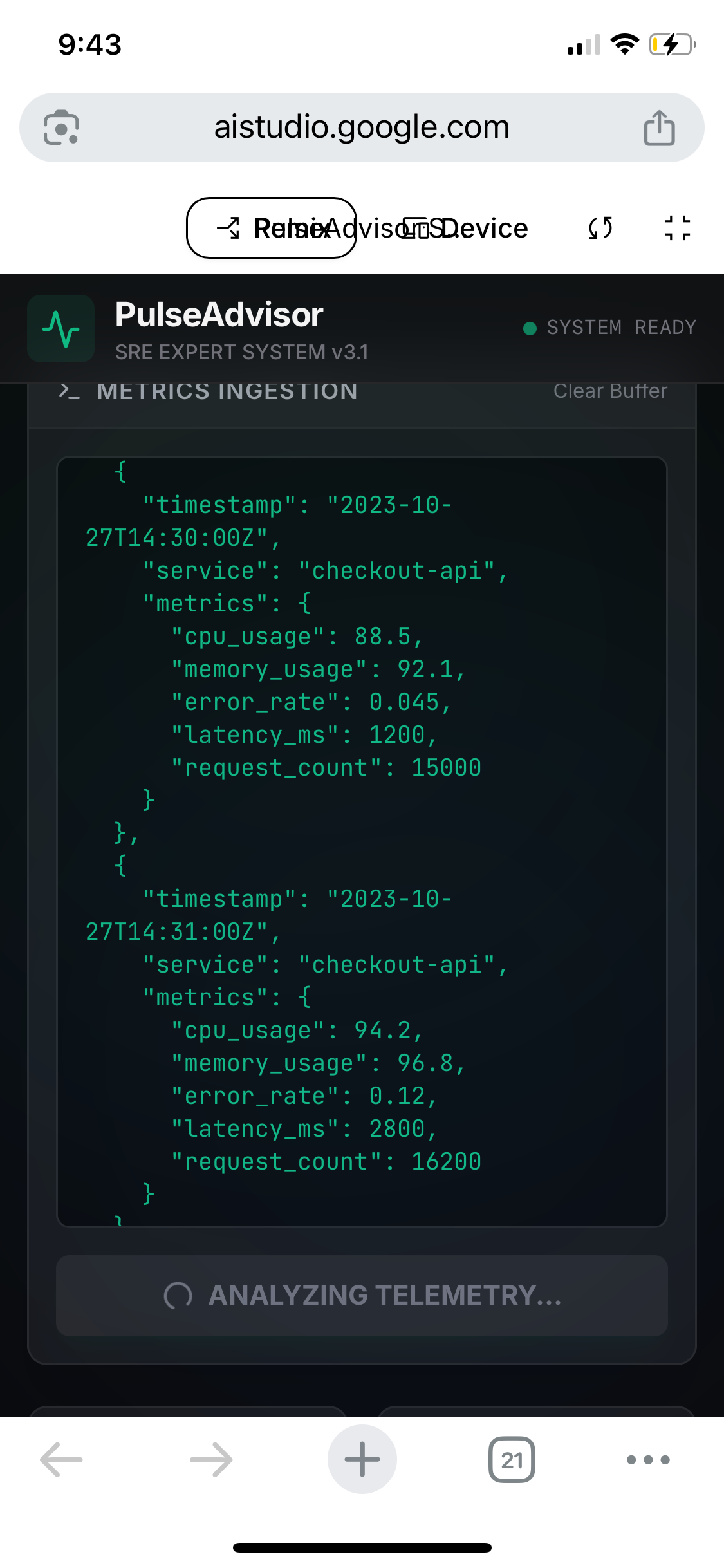
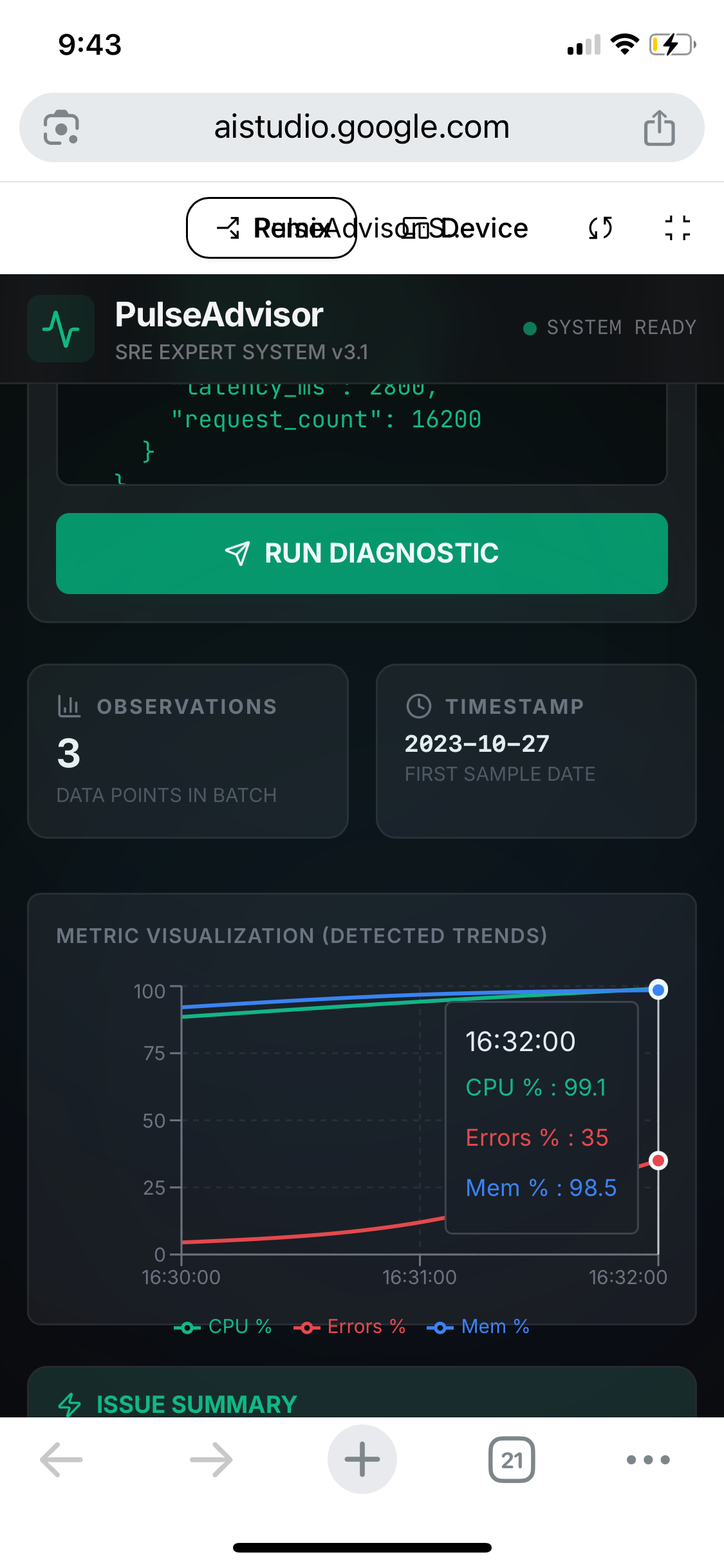
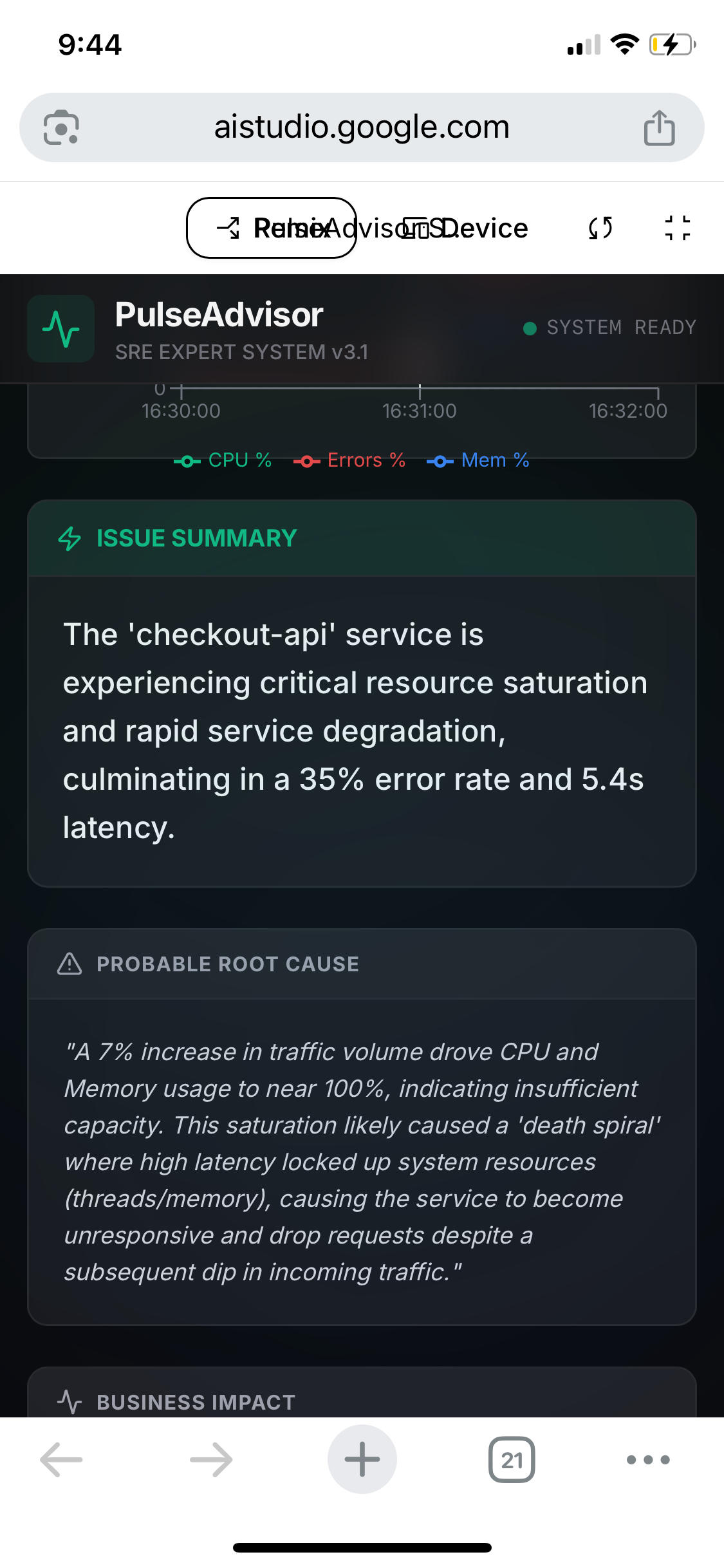
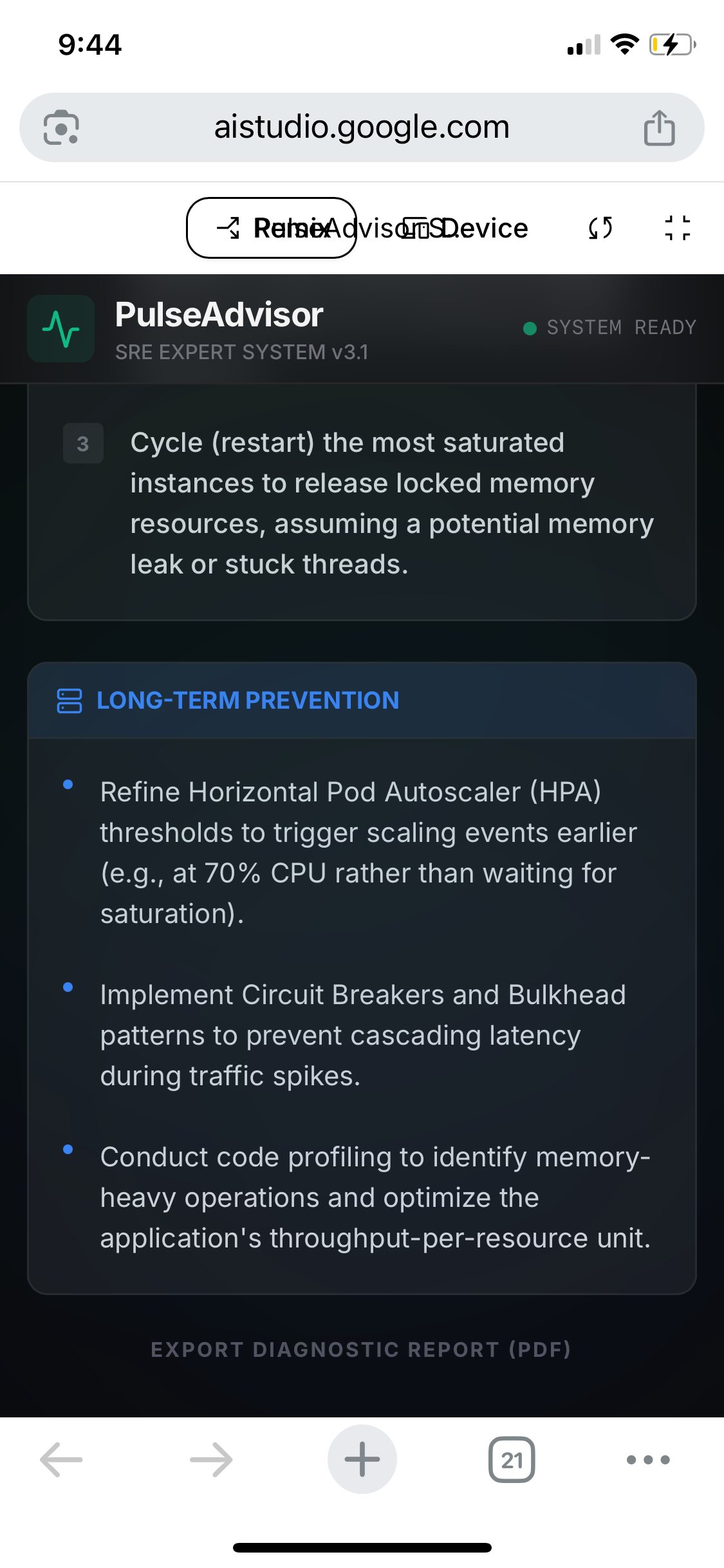
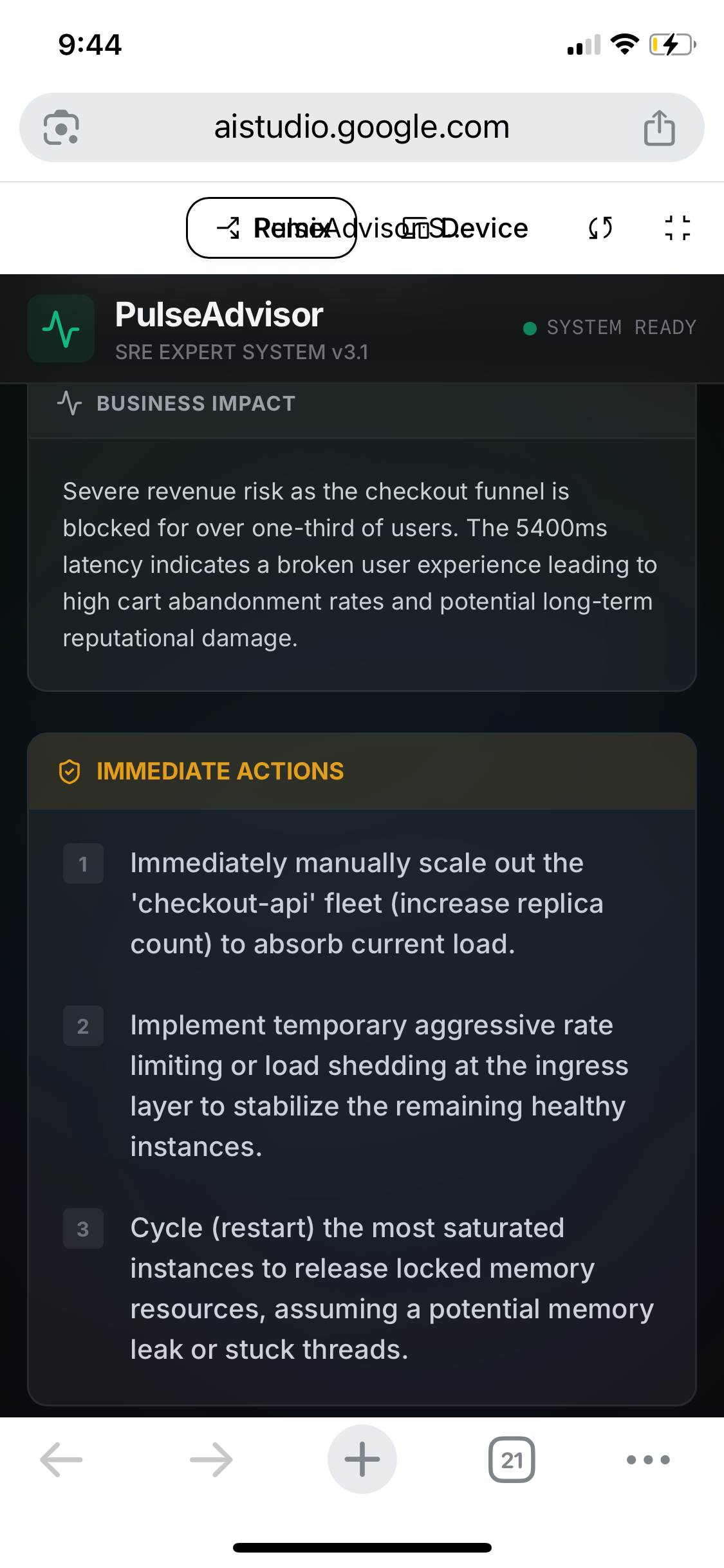
PulseAdvisor is an AI-powered SRE decision assistant that transforms raw system metrics into a complete incident intelligence report. Engineers paste their monitoring data in JSON format — including CPU usage, memory, error rate, latency, and request count — and Gemini 3 analyzes the full telemetry batch to produce six structured outputs: Issue Summary — A plain-language description of what is failing and how severely, written for both engineers and non-technical stakeholders. Probable Root Cause — Gemini reasons across all metrics simultaneously to identify the most likely failure pattern, including cascade effects such as traffic-driven memory saturation causing a death spiral of latency and thread locking. Business Impact — Translates technical degradation into business language: revenue risk, user experience impact, cart abandonment, compliance exposure, and reputational damage. Immediate Actions — A numbered, prioritized list of actions the engineer should take right now, specific to the service and failure mode identified. Long-Term Prevention — Architectural and operational recommendations to prevent recurrence, including HPA threshold tuning, circuit breaker patterns, bulkhead isolation, and code profiling guidance. PDF Export — A downloadable diagnostic report suitable for post-mortems, incident reviews, and audit trails in regulated industries. The app also renders an interactive metric visualization chart showing CPU, memory, and error rate trends over time with hover tooltips, giving engineers a visual confirmation of the degradation pattern before reading the analysis
How we built it
PulseAdvisor is built on Google AI Studio using the Gemini 3 API with three core technical decisions driving the architecture. First, a carefully engineered system instruction establishes Gemini as a senior SRE persona with deep expertise in cloud infrastructure and financial operations — this persona definition is what drives specificity over generic advice. Second, a single-prompt full-context architecture delivers all metric data holistically, leveraging Gemini 3's long context window to catch cross-metric patterns like the relationship between latency spikes and memory exhaustion. Third, structured JSON output ensures consistent six-section diagnostic formatting every time, making the tool reliable enough for enterprise operational workflows. The app is deployed publicly on AI Studio with PDF export for audit-ready documentation.
Challenges we ran into
Key challenges included prompt tuning to ensure consistent, practical responses and working within API quota limits. Ensuring outputs were enterprise-appropriate and decision-focused required careful iteration and testing.
Accomplishments that we're proud of
I delivered a working, publicly accessible AI application that demonstrates how Gemini can be used for real operational decision support. The system produces clear, structured insights aligned with real SRE and financial operations workflows. The most significant accomplishment is that PulseAdvisor produces diagnostic output that matches or exceeds what a senior SRE would produce manually — in seconds rather than minutes. Specifically, the root cause reasoning engine correctly identifies cascade failure patterns from raw metric data, including the relationship between traffic volume increases, CPU and memory co-saturation, and the resulting latency death spiral that causes services to become unresponsive even as traffic drops. This level of causal reasoning — not just threshold alerting — is what separates PulseAdvisor from conventional monitoring tools. The Business Impact section, which translates technical failure into revenue risk and compliance language, was validated against real-world incident post-mortem formats used in financial services environments.
What we learned
I learned that AI adds the most value in enterprise systems when it supports human decision-making rather than replacing it. Effective prompt design and clear operational context are critical for reliable AI outputs. The most important technical lesson was that Gemini 3's reasoning quality is directly proportional to the quality of context it receives. A generic prompt produces generic output. A system instruction that precisely defines the expert persona, the output structure, and the decision-making framework produces output that is genuinely useful in production environments. The second lesson was about the value of structured outputs in enterprise AI applications — free-form responses create validation overhead that eliminates the speed advantage AI is supposed to provide. Forcing structured JSON output transforms Gemini from an assistant into a reliable component in an operational workflow.
What's next for PulseAdvisor-AI SRE Decision Assistant
The immediate roadmap for PulseAdvisor focuses on three capabilities. First, live cloud monitoring integration — connecting directly to Prometheus, Datadog, AWS CloudWatch, and Google Cloud Monitoring APIs to eliminate manual JSON input and enable real-time incident response. Second, historical incident correlation — allowing engineers to upload past incident data so Gemini can identify recurring failure patterns and proactively surface risk before thresholds are breached. Third, regulated industry reporting — expanding the PDF export into a full audit-ready incident report format compliant with financial services frameworks including SOC 2 and ISO 27001, making PulseAdvisor viable as a compliance tool in addition to an operational one. The long-term vision is a persistent SRE intelligence layer that learns from every incident an organization experiences and continuously improves its recommendations over time.

Log in or sign up for Devpost to join the conversation.