Pulse
Inspiration
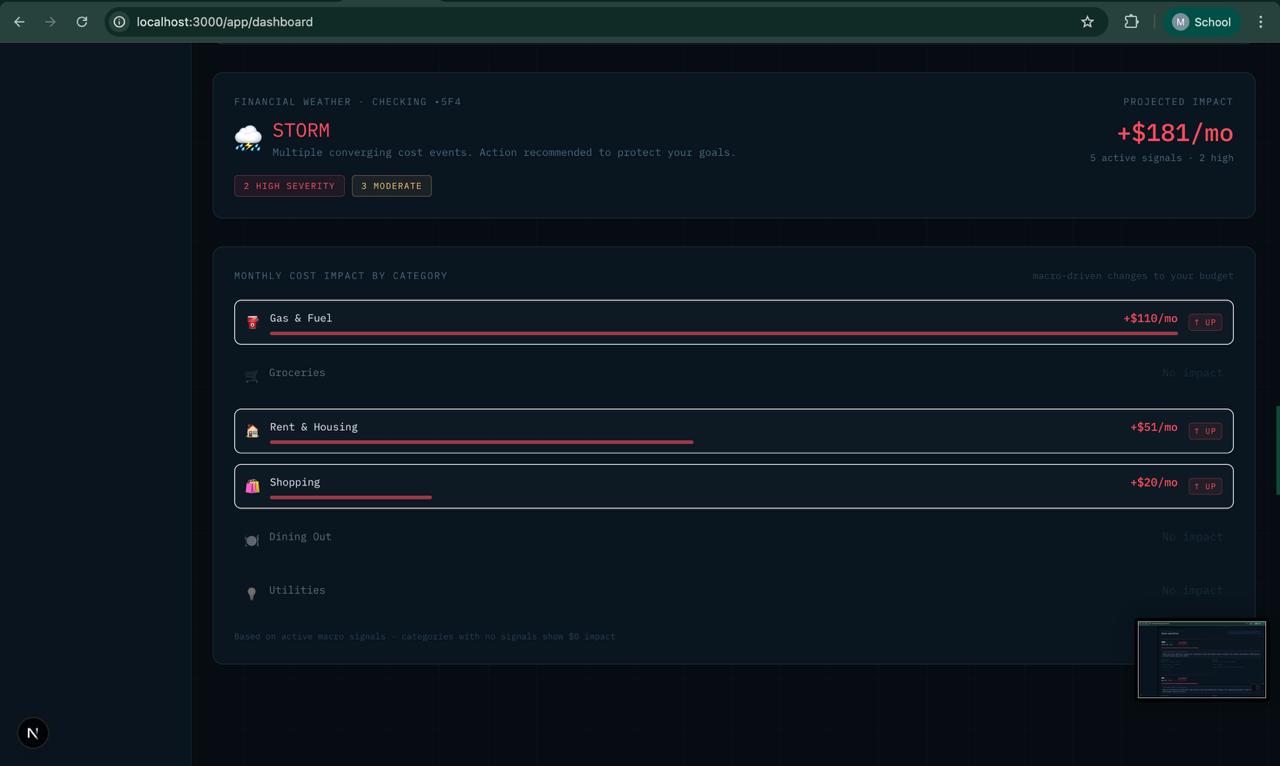
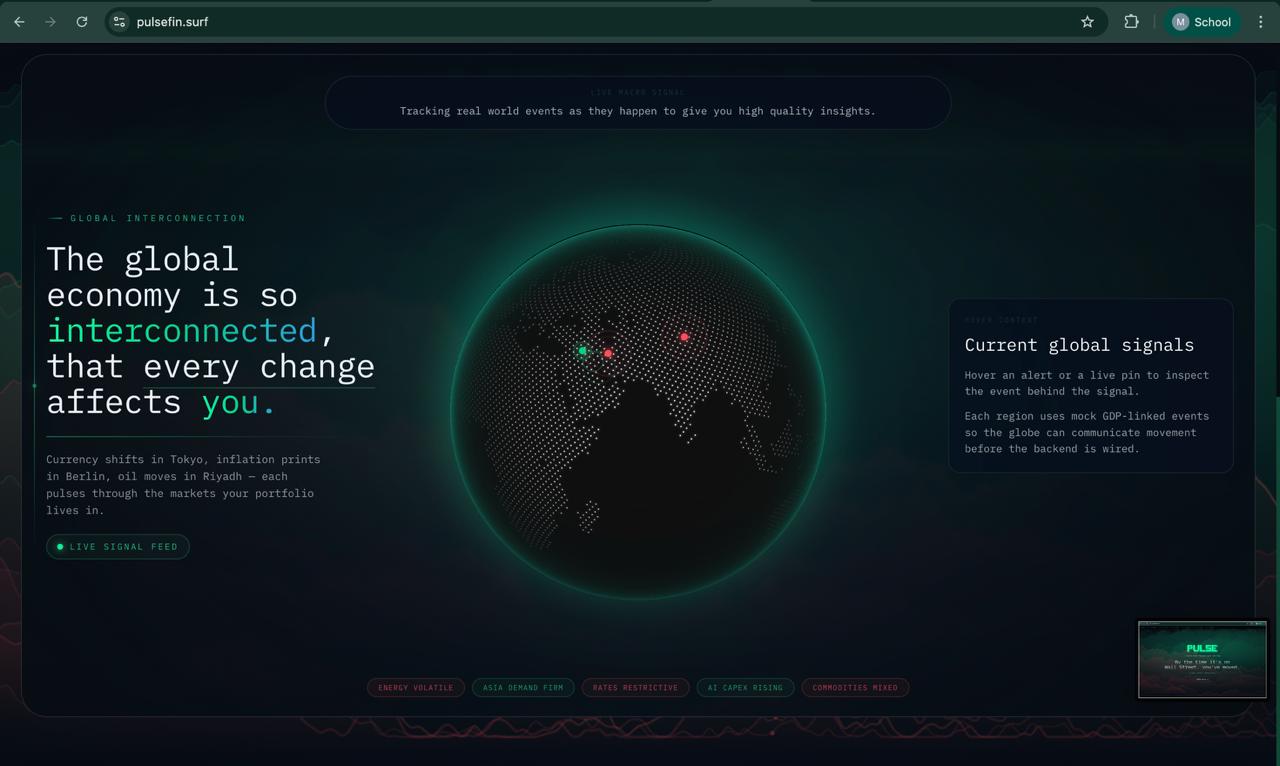
Pulse was inspired by a simple but powerful observation: major world events affect people's financial lives far more than they often realize. We kept finding ourselves talking about things happening around the world — inflation, wars, supply chain disruptions, tariffs, rising gas prices, changing interest rates — and noticing that even when these events seemed distant, they still had very real consequences for ordinary people. A spike in oil prices can mean more expensive commutes. A geopolitical conflict can move markets. A change in rates can alter borrowing costs, consumer confidence, and investment behavior. These events are not just headlines; they shape personal financial outcomes.
That realization led us to a bigger idea. Most people have access to financial data, market charts, and endless news updates, but they still struggle to answer one key question: what does this mean for me? Financial platforms often show prices, percentages, and headlines, but they do not always help users understand how external events connect to their actual lives, goals, and decisions. We wanted to build something that closes that gap.
That is where Pulse came from. We wanted to create a platform that not only helps people think about their finances, but also helps them understand how real-world events can impact them personally, even when the connection is not immediately obvious. Instead of leaving users to interpret the news on their own, Pulse aims to translate complex events into understandable, relevant insights. Our vision was to make financial intelligence feel personal, actionable, and grounded in the reality of everyday life.
What it does
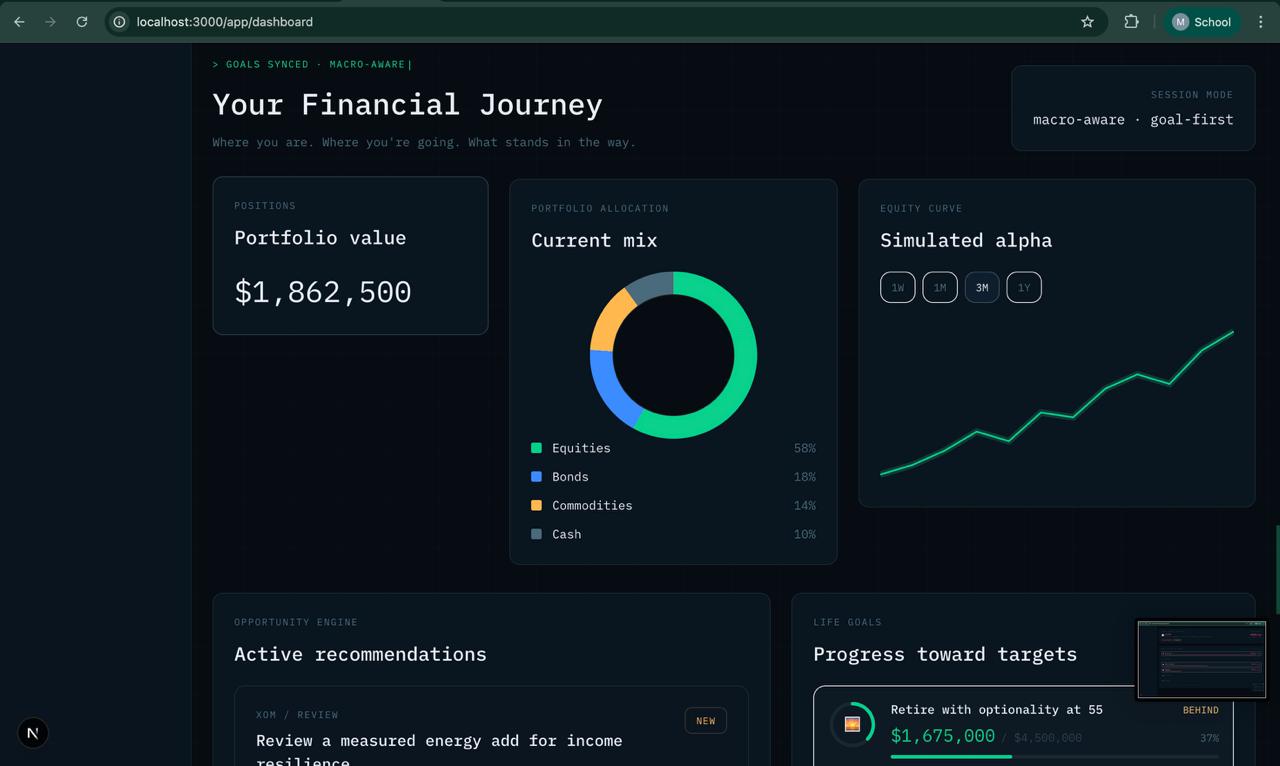
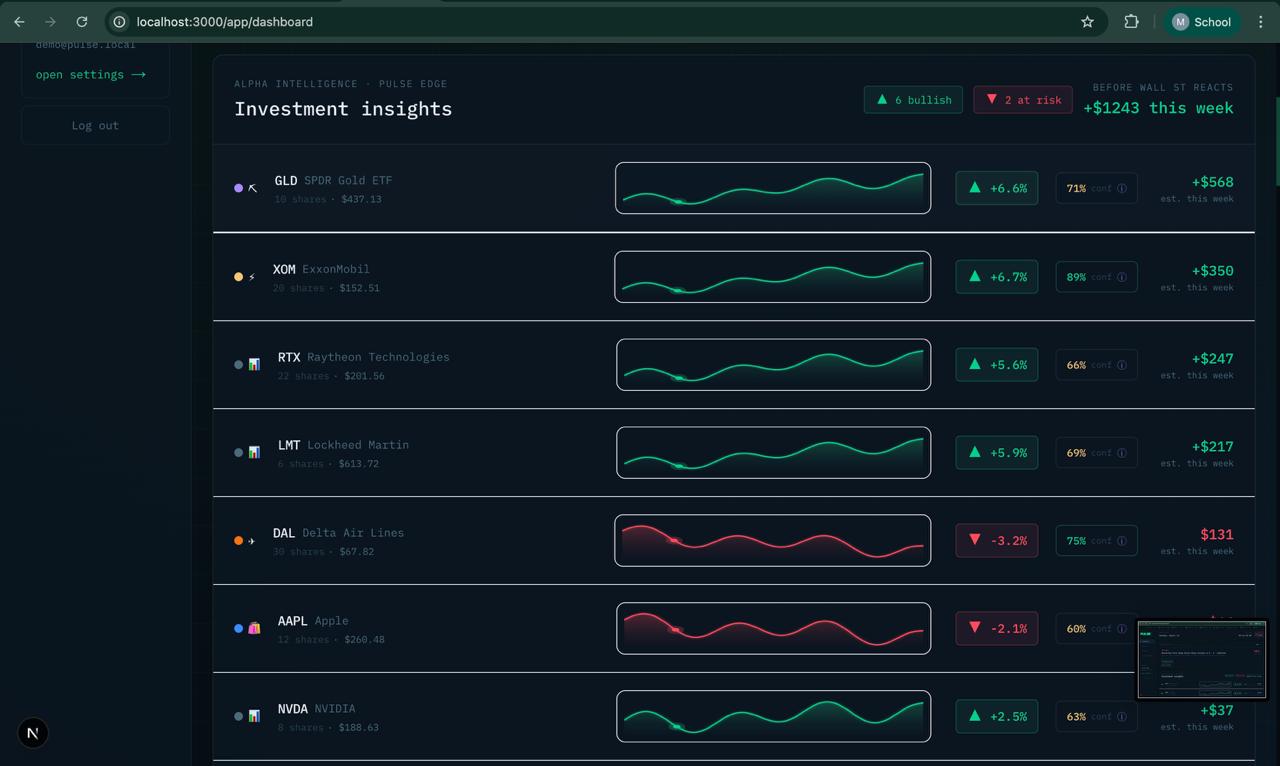
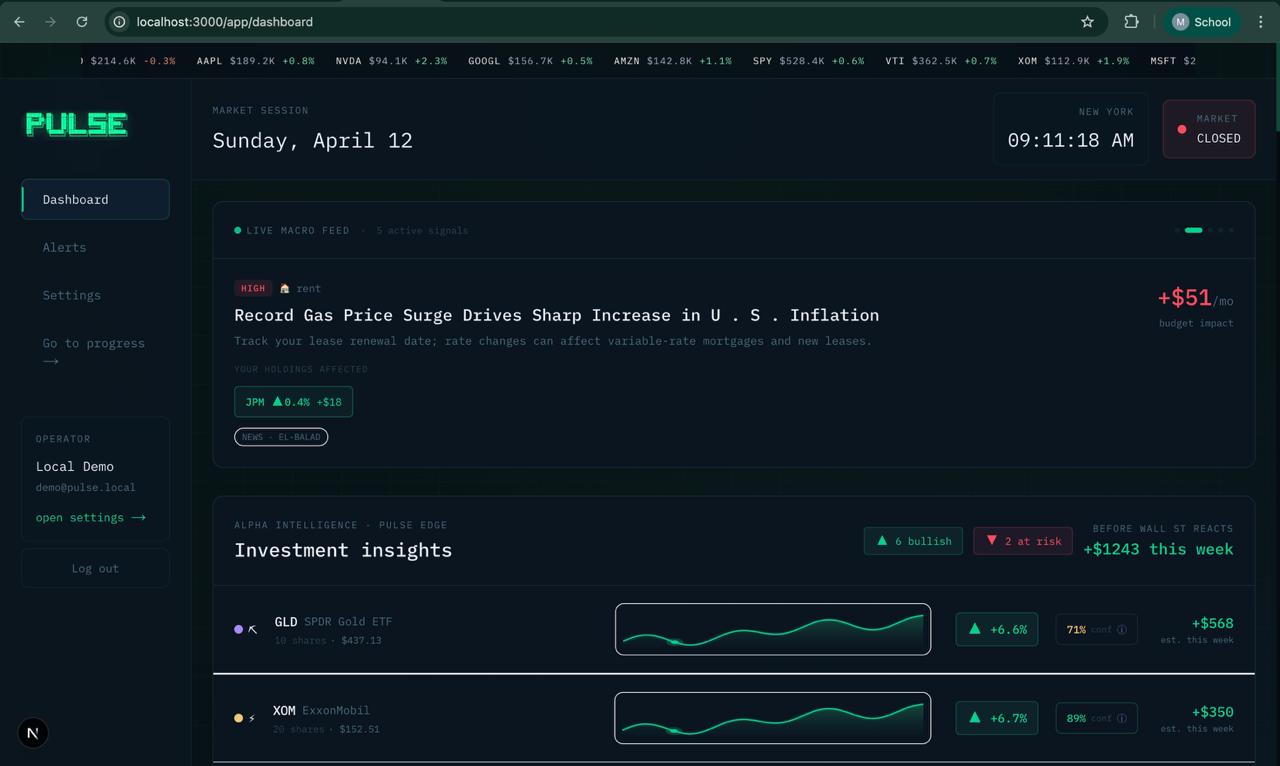
Pulse is an AI-powered financial insights platform that helps users understand how market activity, news, and global events relate to their personal finances. Rather than simply displaying raw financial information, Pulse is designed to connect the dots between outside events and individual decision-making.
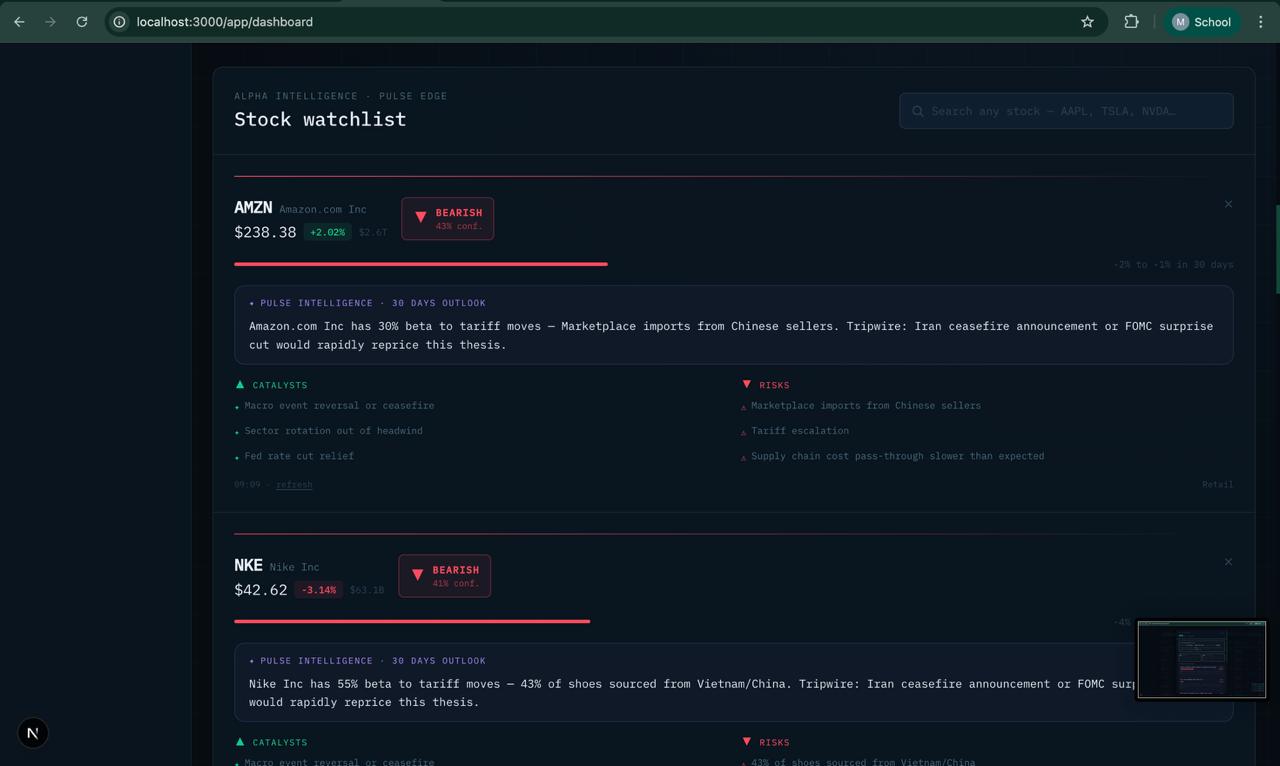
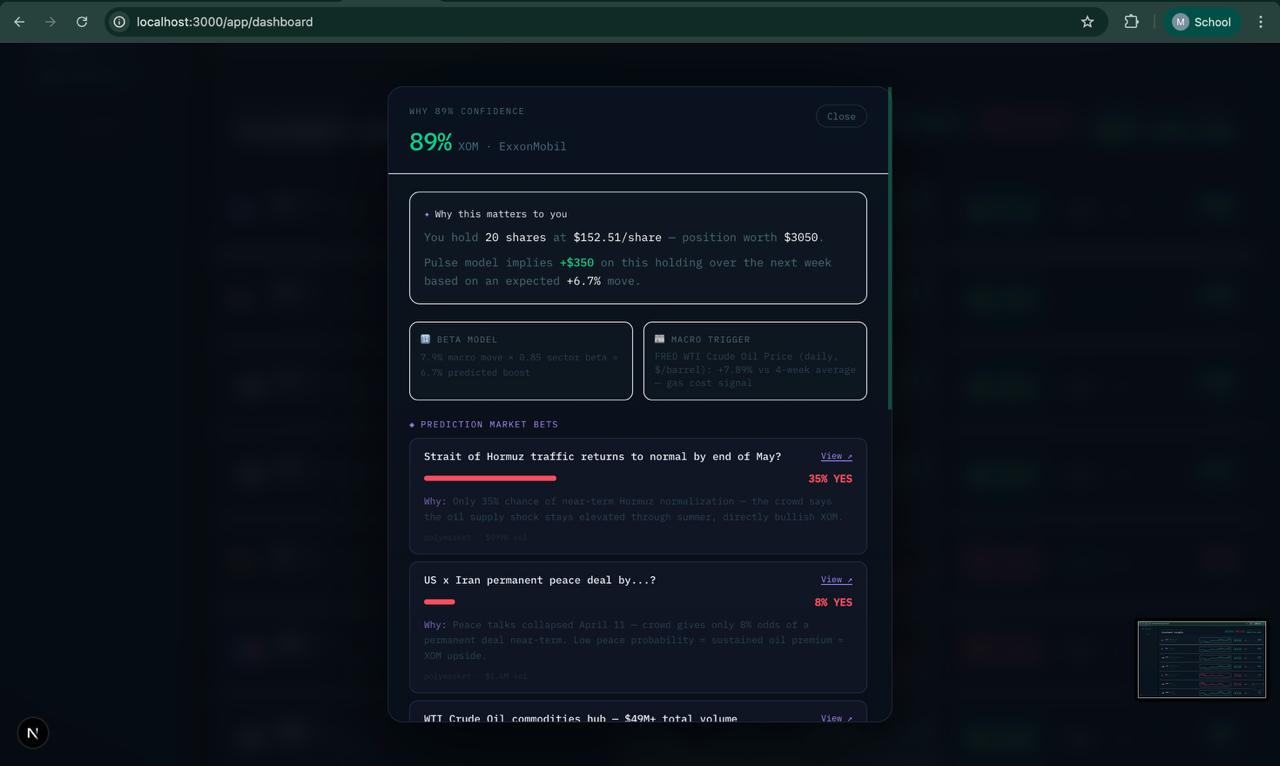
At a high level, the platform brings together multiple streams of information — including financial context, market signals, and external events — and synthesizes them into plain-English guidance. The goal is to move beyond passive data display and toward actual understanding. Instead of asking users to figure out for themselves whether a major headline matters, Pulse helps explain why it matters and what it could mean in practical terms.
We wanted the product to feel less like a dashboard full of disconnected numbers and more like an intelligent layer of interpretation. In that sense, Pulse is not just about tracking finances. It is about giving users a clearer picture of how their financial world is shaped by broader events and helping them make more informed decisions as a result.
How we built it
We built Pulse as a full-stack application, with a clear separation between the frontend and backend. The frontend was responsible for creating an experience that felt accessible, interactive, and informative. We wanted users to be able to engage with the platform in a way that felt intuitive, especially since financial tools can often become overwhelming or overly technical. A major goal on the frontend side was making sure the information was not only available, but understandable and easy to navigate.
The backend handled the heavier logic of the platform. This included connecting to external APIs, retrieving data, processing that data, and preparing it in a form that could be delivered meaningfully to the frontend. Since Pulse depends on combining multiple types of information, the backend played a central role in making the platform feel intelligent rather than fragmented.
One of the most important parts of building Pulse was working with external APIs. We pulled in different sources of information and then had to determine how to combine them into something useful. This was not just a matter of fetching data and displaying it. The real challenge was synthesizing information from different APIs in a way that produced coherent, relevant insights. A raw API response is rarely useful on its own to an end user. We had to think carefully about how to transform incoming data into something that felt unified, readable, and valuable.
On the infrastructure side, we also worked to deploy the project in a realistic way. We used Docker to containerize parts of the application so that the environment would be more consistent across development and deployment. We then worked on hosting the project using Vercel and Railway, which meant thinking not just like developers building a prototype, but like a team trying to get a real product online. This gave us hands-on experience with the deployment side of full-stack development, including configuration, environment setup, and service coordination.
Challenges we faced
One of the biggest challenges we faced was integrating the frontend and backend into one seamless system. It is one thing to have a frontend that looks good and a backend that works independently, but bringing those two pieces together introduced a whole new set of problems. We had to deal with communication between services, routing issues, request and response formatting, and making sure the data being sent from the backend could actually be used effectively on the frontend. A feature that works in isolation does not always work once it becomes part of a larger application, and we ran into that reality many times throughout development.
Another major challenge came from working with APIs. Connecting to an API is often only the first step. We also had to make sure the APIs were returning what we expected, that the responses were handled correctly, and that the data could be cleaned, organized, and combined in a meaningful way. In many cases, the hardest part was not getting the data — it was synthesizing it. Since Pulse is meant to help users understand how outside events affect them, we could not simply present information from multiple sources side by side. We needed to turn it into a single, understandable narrative. That required a lot of iteration and forced us to think carefully about structure, interpretation, and user experience.
Deployment was another significant challenge. Hosting the project across Vercel and Railway while also using Docker added layers of complexity that we had to work through. Local development is one environment; production deployment is another. We encountered issues involving environment variables, build processes, service communication, and making sure the application behaved consistently after deployment. These challenges reminded us that shipping a product is not just about writing code that works on your own machine. It is about making sure the entire system can run reliably in a hosted environment.
More broadly, this project challenged us to think about how to turn an ambitious idea into a working product. Our concept depended on multiple moving parts: a polished user-facing interface, backend logic, live data connections, and deployment infrastructure. Coordinating all of those pieces required strong problem-solving, communication, and iteration.
What we learned
One of the biggest things we learned is that building a meaningful financial product is not just about data access — it is about interpretation. There is no shortage of information in finance. The real value comes from helping users make sense of that information in a way that feels relevant to their own lives. Through Pulse, we learned how important it is to design technology around the user's perspective rather than around the data itself.
We also learned a great deal about full-stack development in practice. Integrating a frontend and backend taught us how much coordination is required across layers of an application. Working with APIs taught us that external data can be messy, inconsistent, and difficult to unify, and that creating clarity for the user often takes much more work than simply displaying what comes back from an endpoint. Deploying through Vercel and Railway using Docker gave us a deeper understanding of how development and production environments differ, and how important infrastructure decisions are in bringing a product to life.
Beyond the technical lessons, we also learned the value of persistence and iteration. Many of the hardest parts of this project were not solved immediately. We had to test, revise, troubleshoot, and rethink our approach multiple times. That process taught us how to adapt when an initial idea or implementation was not enough, and how to keep pushing a concept forward even when the technical details became complicated.
Most importantly, we learned that there is a real opportunity to make financial tools more human-centered. People do not just want more headlines or more charts — they want help understanding how the world around them connects to the choices they make. Pulse was our attempt to build toward that idea: a platform that makes finance feel less abstract and more personally meaningful.
Final reflection
At its core, Pulse is about translation. It takes complicated signals from the outside world and works to translate them into something a person can actually understand and use. That mission shaped both our product idea and our development process. We were inspired by the gap between world events and personal understanding, and we built Pulse to help close that gap.
While the project came with real technical challenges — especially around system integration, API synthesis, and deployment — those challenges also made the experience more valuable. They pushed us to think more carefully about architecture, usability, and the realities of building a product end to end. Pulse helped us grow not only as developers, but also as builders thinking about how technology can make complex systems easier for people to navigate.
Built With
- docker
- finhub
- fred
- gemini
- nessie
- next.js
- postgresql
- python
- railway
- react
- redis
- typescript
- vercel


Log in or sign up for Devpost to join the conversation.