Inspiration
In the US, the street drug supply is changing rapidly, and it is happening here in Detroit. With the rise of sedative adulterants like xylazine and medetomidine, standard overdose responses aren't always enough. When a patient doesn't wake up after getting Narcan, responders need fast, actionable guidance instead of administering more doses. I wanted to build a tool that gives fast, clinical decision support in high-pressure situations.
What it does
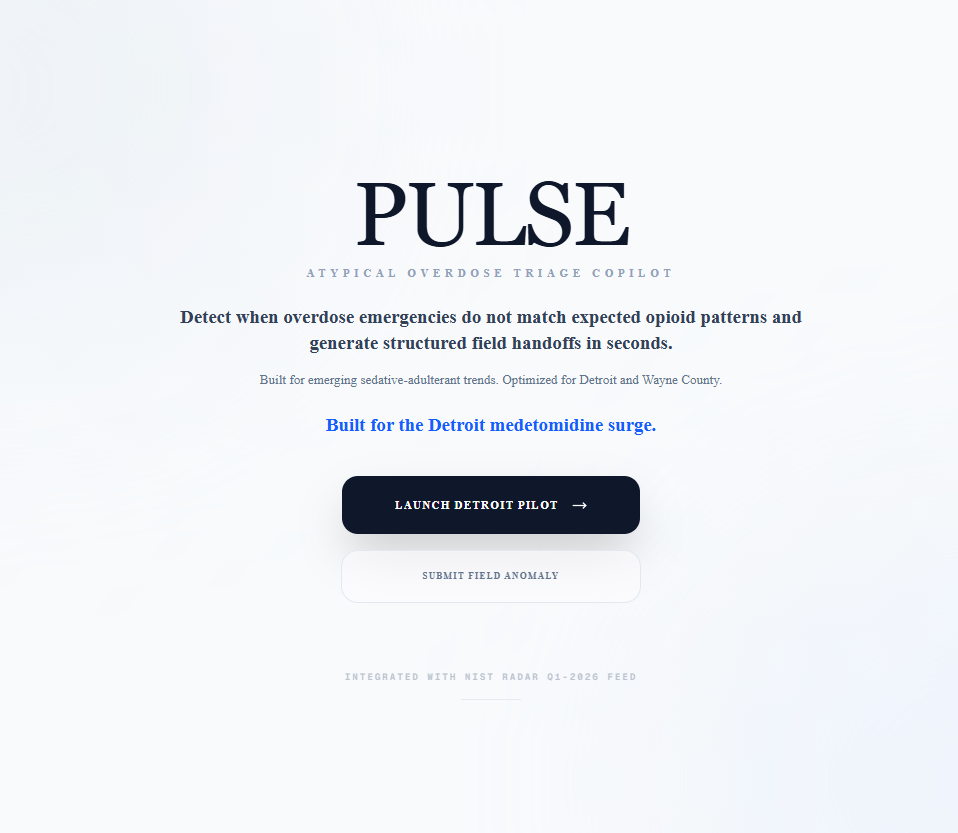
PULSE is a specialized triage system for EMTs, ER clinicians, and harm-reduction teams. It identifies atypical overdoses through five-steps:
Input: The user enters vital signs and the patient's response to Naloxone.
Check: The system evaluates if the presentation matches a typical opioid toxidrome.
Flag: It highlights non-opioid involvement (like Alpha-2 adulterant signals) if vitals show severe cardiac depression.
Guide: It directs the user toward an alternative response approach based on a weighted clinical scoring model.
Handoff: It instantly generates a structured SBAR (Situation, Background, Assessment, Recommendation) handoff note, with SNOMED and ICD-11 codes, for the next care team.
How we built it
Next.js, TypeScript, Tailwind CSS, and Shadcn UI.
The clinical scoring model (CDSS_LOGIC) evaluates variables like Narcan discrepancy, bradypnea, and regional NIST RaDAR surge data for Detroit. The react-globe.gl (Three.js) was used for geographical mapping but didn't end up getting used. AI tools were used to help debug code and find globe components efficiently.
Challenges we ran into
One of the biggest challenges was deciding how to present emergency alerts without overwhelming the user. Another challenge was making the project feel operational to real frontline workers and not a generic demo. So I had to make sure the structure allowed for simplify interaction, and every part had a clear purpose.
Accomplishments that we're proud of
It works! This is my first hackathon.
What we learned
Through the project, I learned a lot about designing in an high-pressure, high-stakes environments. I also learned how much good UX matters when time is limited since the interface needs to be fast, simple, and reliable, to be usable in an emergency. I learned how to structure a two-sided system with a field-level triage flow and a responder dashboard that clearly and responsibly present information.
What's next for PULSE: StreetMed Handoff
Expanding the system to recognize more types of emerging drugs and overdose patterns Connecting directly with hospital systems (Like EPIC/other EMR systems) so handoff notes can be shared instantly Improving offline use so the app works even with no service
Built With
- next.js
- react
- shadcn-ui
- tailwind

Log in or sign up for Devpost to join the conversation.