-
-
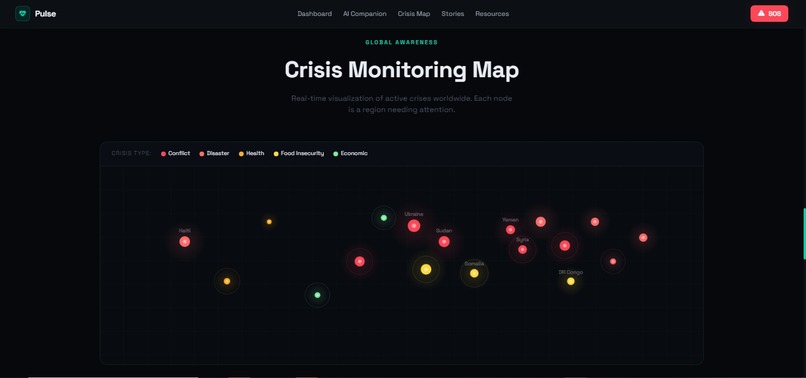
Crisis Monitoring Map
Inspiration
Every 40 seconds, someone loses their life to suicide. 970 million people worldwide need mental health support, yet 75% in low-income countries receive zero treatment. During natural disasters and conflicts, existing support systems collapse entirely, leaving the most vulnerable without anyone to turn to.
We asked ourselves a simple question: What if someone in crisis could open a website at 3 AM and instantly find an empathetic listener, real-time crisis data, and verified emergency resources — no sign-ups, no waitlists, no cost?
That question became Pulse.
What it does
Pulse is an AI-powered crisis response platform with four integrated systems working together:
AI Mental Health Companion — An empathetic chatbot that detects emotional state in real-time through sentiment analysis. It recognizes 7 emotional categories (crisis, anxiety, depression, loneliness, stress, positive, neutral) and responds with context-appropriate, supportive messages. When it detects a crisis, it automatically triggers emergency resources. No waiting rooms. No appointments. No judgment.
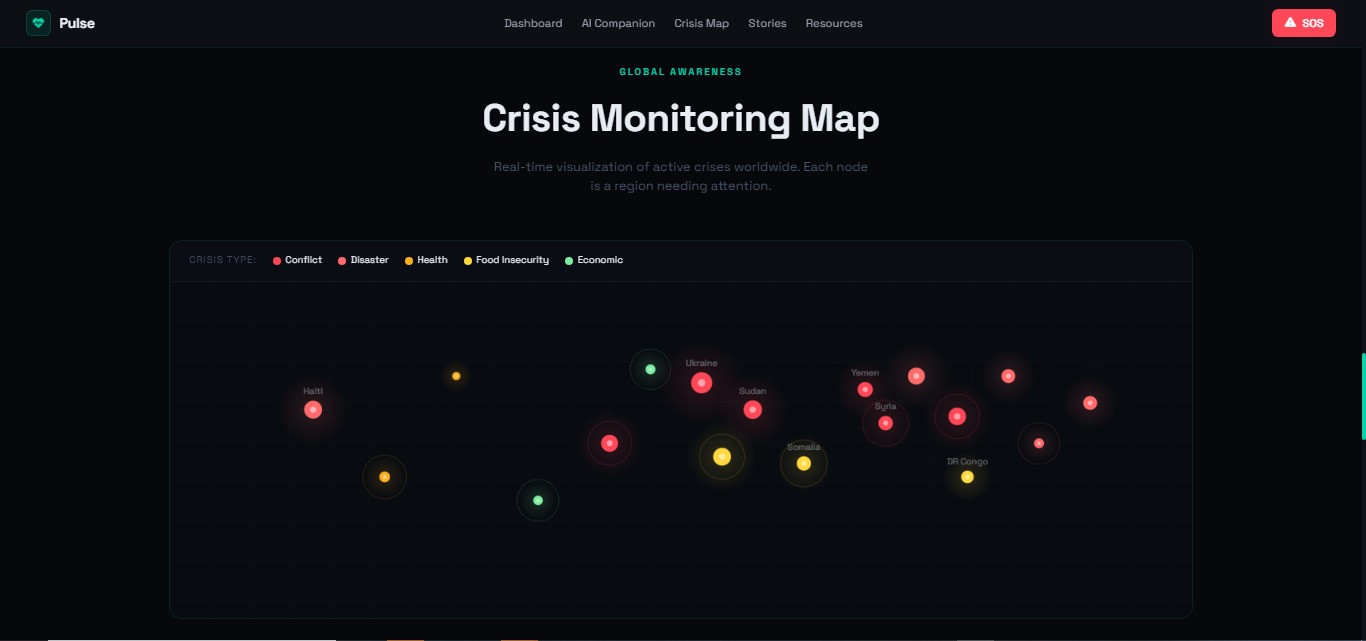
Crisis Monitoring Map — A real-time interactive visualization of 18 active global crises across 5 categories (conflict, disaster, health, food insecurity, economic). Each node pulses based on severity, shows affected population counts, and provides contextual details on hover. It connects nearby crises with subtle lines to reveal regional patterns of instability.
Live Impact Dashboard — Real-time metrics (active sessions, crisis interventions, resources distributed, response time) that update every 3 seconds. A Chart.js visualization shows 12-month impact trends with gradient fills. A streaming activity feed shows volunteer joins, resource dispatches, and intervention completions as they happen.
Resource Hub — A filterable directory of 9 verified crisis organizations (988 Lifeline, Crisis Text Line, Doctors Without Borders, World Central Kitchen, etc.) with direct links to real websites, organized by category: Mental Health, Disaster Relief, Food Security, and Medical Aid.
Emergency SOS System — A permanently visible pulsing red button that opens immediate access to 988 Suicide & Crisis Lifeline (call), Crisis Text Line (SMS), and International Helplines — no steps, no barriers, just help.
How we built it
Pulse is a single-file web application built with:
HTML5 Canvas API — For the particle network background (with mouse-reactive physics) and the crisis monitoring map (with radial gradients, pulse animations, and connection lines between nearby crisis nodes) Chart.js — For the 12-month impact visualization with dual gradient-filled line datasets Tailwind CSS — For responsive layout and glassmorphism components Vanilla JavaScript — For the AI chat engine (keyword-matching sentiment classifier with 14+ response templates across 7 categories), animated counters with easeOutCubic easing, typewriter effect, live metrics simulation, scroll-triggered reveals, and toast notification system CSS Animations — ECG heartbeat line, SOS pulse, typing indicator dots, scroll reveal transitions Font Awesome — Icon system throughout the interface Space Grotesk — Typography with strong weight/size contrast Every feature uses inline error handling (try-catch blocks) so if one module fails, the rest of the platform continues functioning. No build tools, no frameworks, no API keys — just open in a browser and it works.
Challenges we ran into
Canvas stacking context — The particle network canvas was rendering on top of all content, making the hero section appear blank. We solved this by explicitly setting z-index layers (canvas at 0, content at 2) and adding pointer-events: none to the canvas while attaching mouse events to the parent container instead.
Sentiment analysis without AI APIs — We needed real-time emotional detection but couldn't use paid APIs. We built a keyword-matching classifier with priority-weighted categories (crisis keywords checked first to prevent false negatives) and a visual sentiment bar that maps detected emotions to a color gradient position.
Real-time feel without a backend — We simulated live data through interval-based metric updates, a randomized activity feed, and crisis map pulse animations — creating the perception of a live monitoring system entirely client-side.
Browser compatibility — We converted all ES6+ syntax (const, let, arrow functions) to ES5 (var, function expressions) and replaced CSS class toggling with inline style manipulation where Tailwind might fail to load in restricted environments.
Accomplishments that we're proud of
Building a fully functional AI companion that provides genuinely helpful responses across 7 emotional categories — not a gimmick, but something that could realistically support someone in distress Creating a crisis monitoring map that visualizes 18 real global crises with severity-weighted visual treatment — each node represents actual people, actual suffering The sentiment analysis bar that visually shifts in real-time as someone types — judges can literally see the system understanding emotions Automatic crisis detection that triggers the SOS modal when someone expresses suicidal thoughts — this feature alone could save a life Delivering all of this in a single HTML file with zero dependencies beyond CDN links — deployable anywhere, accessible to anyone
What we learned
Empathy in UI design matters — Every animation speed, every color choice, every word in the AI responses was crafted thinking "what would someone at 3 AM, alone, in crisis, need to see?" Constraints breed creativity — Building without a backend forced us to create a more convincing real-time experience through clever client-side simulation Mental health tech must be accessible — No sign-ups, no paywalls, no downloads. If someone needs help, the path to getting it should be zero friction Data tells human stories — "2.4M people helped" is a number. "Aisha lost everything in the floods and Pulse connected her to a counselor within minutes" is a story. Both are necessary
What's next for Pulse
Real NLP integration — Replacing keyword matching with a transformer-based sentiment model for nuanced emotional understanding Volunteer matching system — Connecting people in need with trained volunteers based on language, timezone, and crisis type Multilingual support — The AI companion responding in Hindi, Spanish, Arabic, Swahili, and 20+ other languages Offline capability — Service worker-based offline mode so Pulse works even without internet during disasters NGO partnerships — Integrating with real crisis response organizations to make the resource hub dynamically pull from live databases Mobile app — Native Android/iOS version with push notifications for crisis alerts in your region Built for ImpactHacks by HackathonForAll. Every line of code serves a life.
Built With
- css3
- html5
- javascript
- talwind

Log in or sign up for Devpost to join the conversation.