Inspiration
We live in a world where you can buy stock in massive corporations or speculate on meme coins, but you cannot invest directly in the most valuable asset class on earth: human talent.
Every day, incredible builders, creators, researchers, and athletes grind in obscurity before breaking out. Early supporters who spot them first get nothing more than bragging rights and a "Follow" button. Meanwhile, promising creators struggle to fund their earliest, most critical milestones.
We asked ourselves: What if belief had liquidity? What if you could back a person like an early-stage startup, and grow alongside their trajectory? That sparked the creation of Pulse — a decentralized market protocol that tokenizes human potential.
What it does
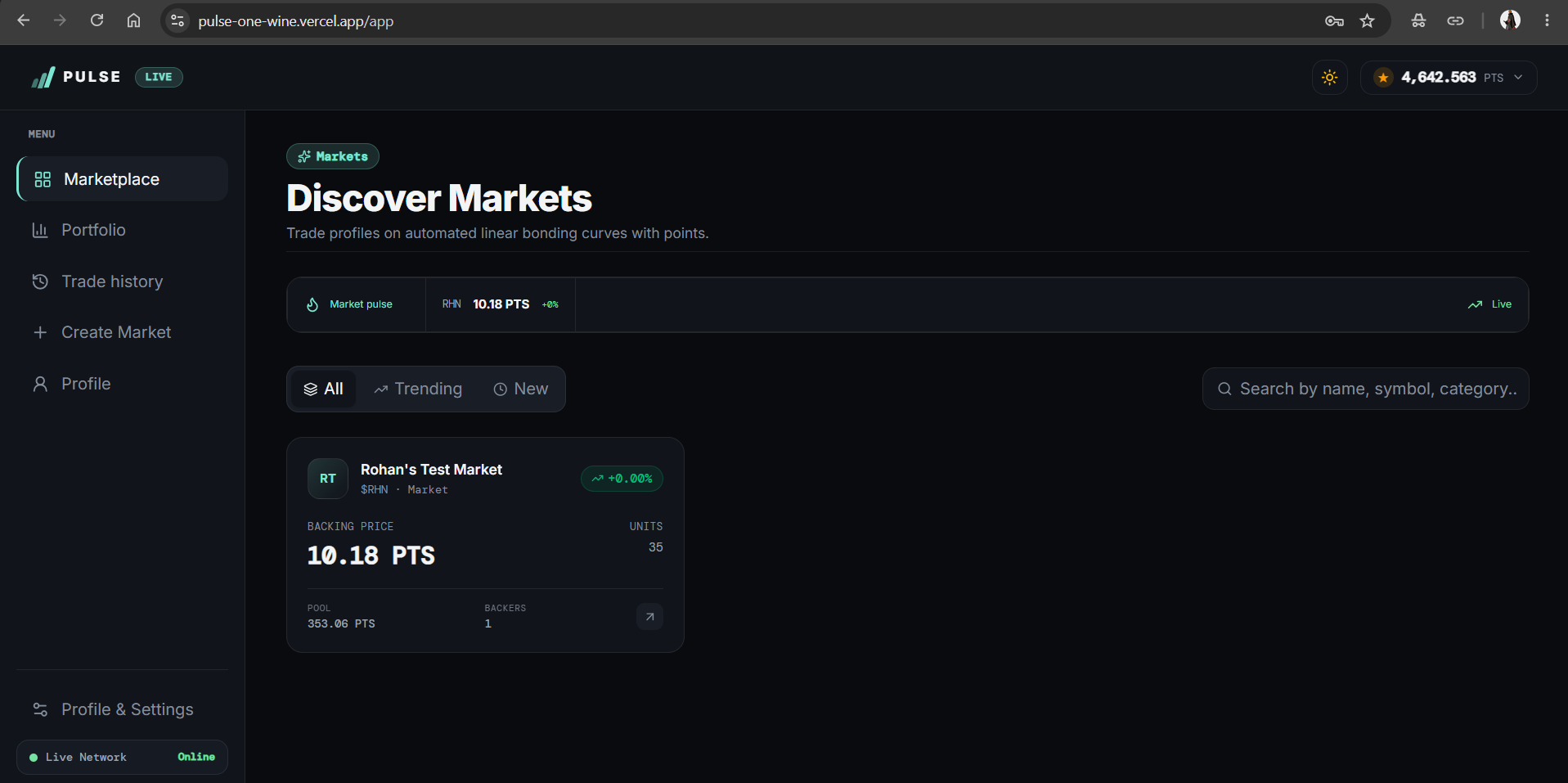
Pulse allows any creator, founder, or rising talent to launch their own personal market in seconds, giving early believers a continuous, automated market to back their journey.
- Instant Tokenized Markets: Creators launch an individual token on Hedera without needing deep capital reserves or complex liquidity pools.
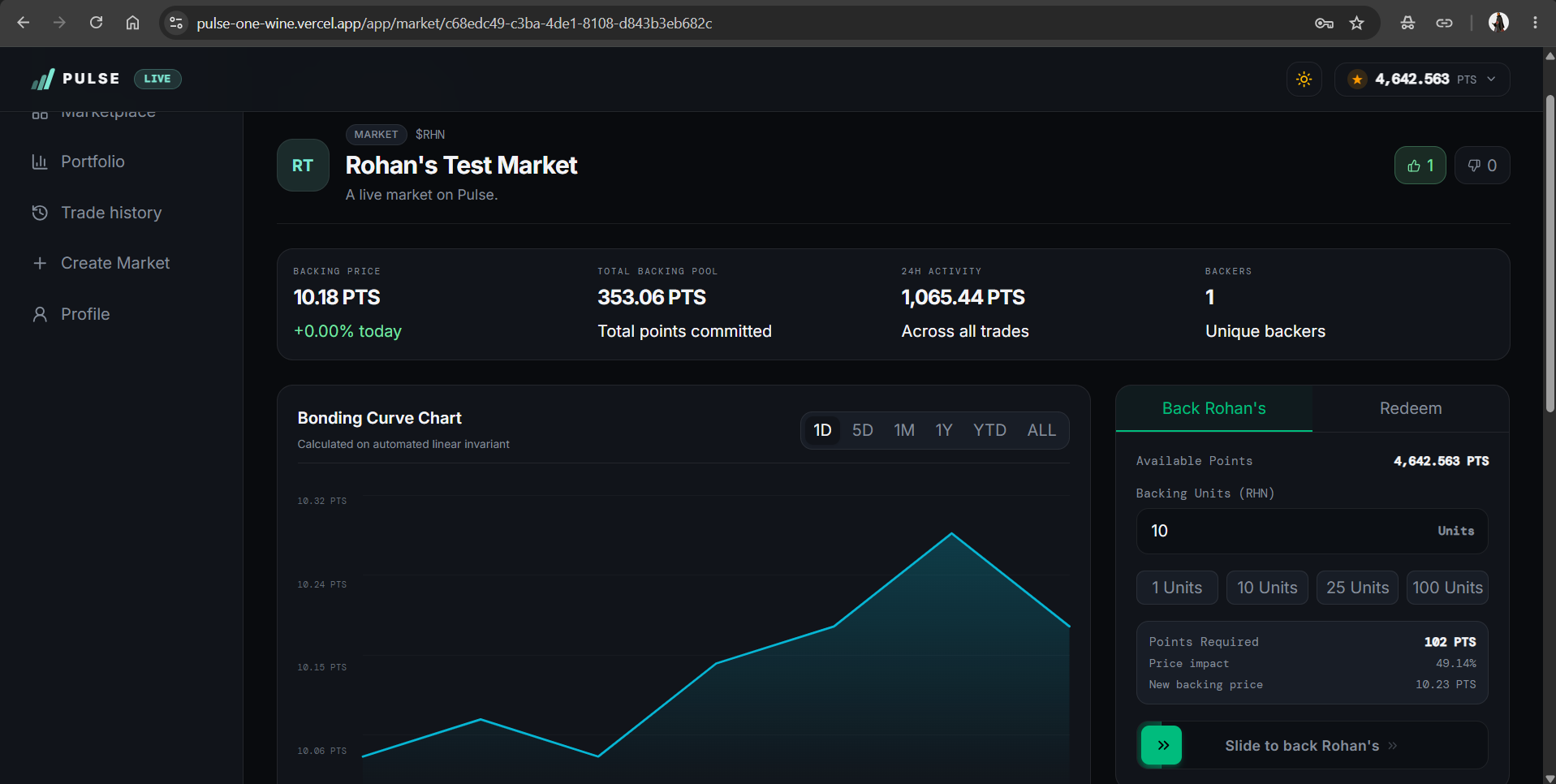
- Automated Bonding Curve Liquidity: There are no dead order books. Pulse uses an autonomous bonding curve smart contract that acts as an instant counterparty for every buy and sell.
- Dynamic Pricing on Belief: As more believers discover a creator and buy tokens, the price moves predictably upward along the curve; when backers take profit or exit, tokens are burned and the reserve returns the underlying asset.
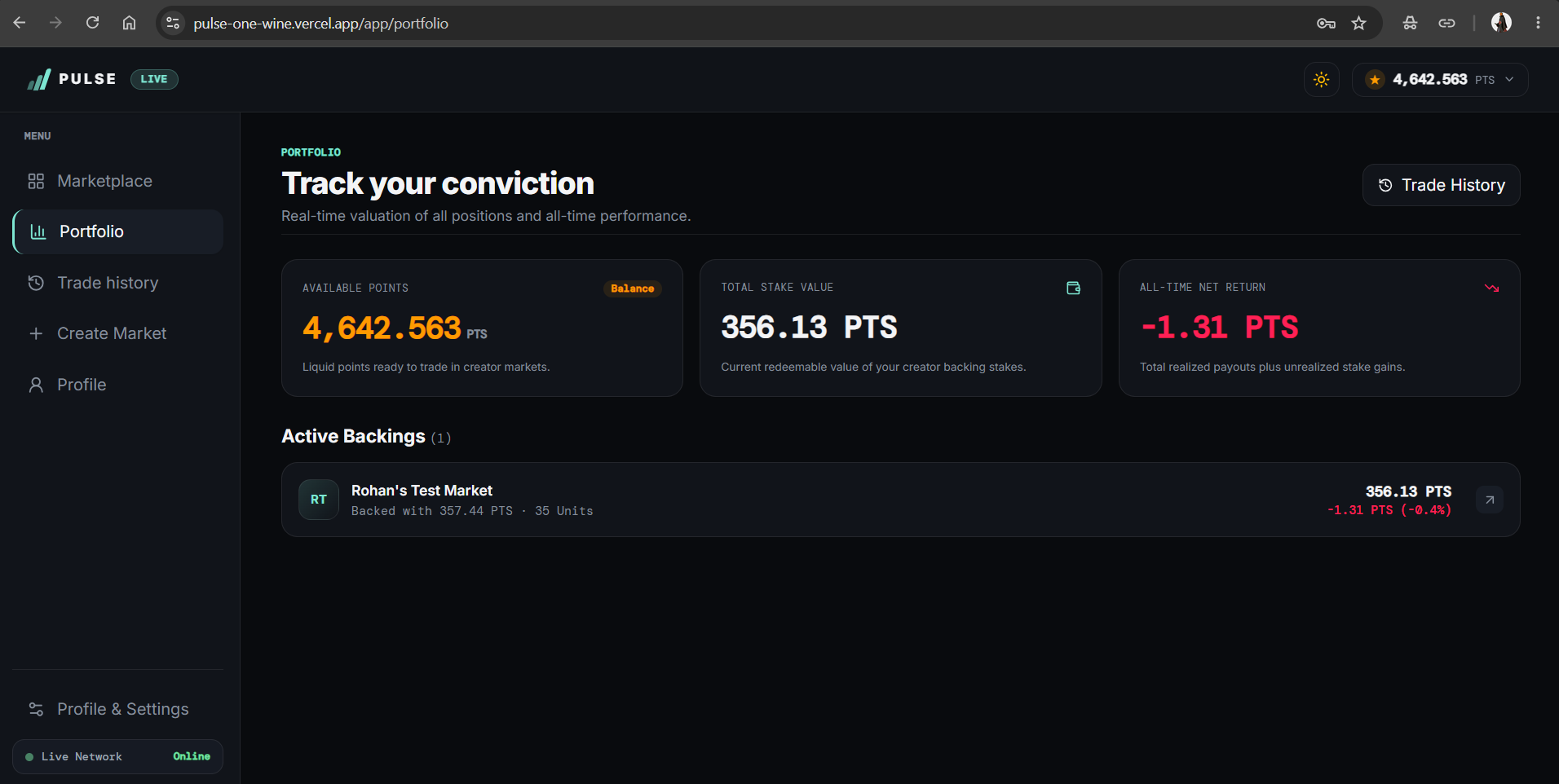
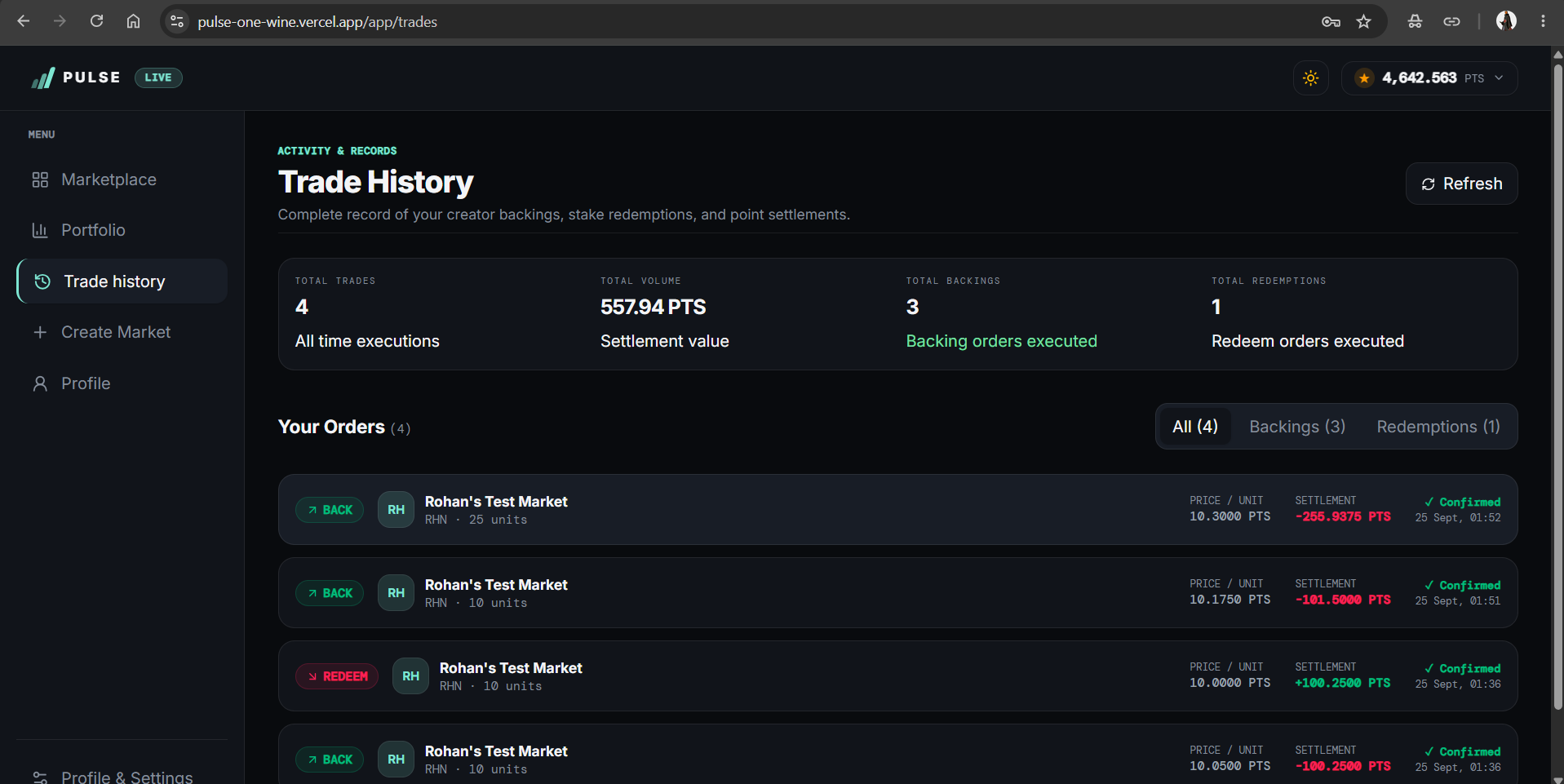
- Creator Discovery & Portfolio Tracking: Believers can explore rising talent, view real-time price charts and milestone updates, and track their talent portfolio all in one sleek dashboard.
How we built it
Pulse was built across three tightly integrated layers:
1. Smart Contracts & Bonding Curves (Hedera)
We developed our core market contracts in Solidity (SharedBondingCurve.sol and PulseMarketFactory.sol) deployed to the Hedera Testnet, interfacing directly with the Hedera Token Service (HTS precompile at 0x167).
Instead of discrete price slippage, pricing is computed continuously using the exact definite integral of a linear bonding curve:
$$P(S) = a + bS$$
Where $S$ is the circulating supply, $a$ is the base starting price, and $b$ is the slope parameter. When a user buys $\Delta S$ tokens starting from supply $S_0$, the exact reserve required is calculated via:
$$\text{Cost} = \int_{S_0}^{S_0 + \Delta S} (a + bs)\,ds = a \cdot \Delta S + \frac{b}{2}\left((S_0 + \Delta S)^2 - S_0^2\right)$$
This guarantees fair pricing, mathematical solvency of the reserve at all times, and zero counterparty risk.
2. High-Performance Backend
- Node.js & Express with a relational PostgreSQL schema tracking user profiles, activity streams, and historical order ticks.
- In-Memory Bloom Filter: To handle thousands of rapid-fire handle lookups and avoid database contention during peak user surges, we engineered an in-memory Bloom filter providing $O(k)$ membership checks with zero false negatives.
- Autonomous Market Maker Bots: We wrote simulation bots (
runBots.js) that continuously generate organic trade momentum and test liquidity stress points across active creator markets.
3. Frontend Experience
- Built with React 18, Vite, and Tailwind CSS, designed with a modern cyberpunk-fintech aesthetic featuring responsive charts, instant wallet connection, profile milestone timelines, and portfolio PnL breakdowns.
Challenges we ran into
- Hedera HTS Precompile Integration: Interfacing Solidity contracts with Hedera’s native precompiled contracts (like token creation and mint/burn via
0x167) required navigating specific gas allocations, return code decodings (responseCode == 22), and managing token treasury delegations within EVM calls. - Fixed-Point Precision Math in Solidity: Computing integral areas with fractional token decimals and settlement units ($10^8$ HBAR scale) without risking integer overflow or rounding drain required meticulous fixed-point scale factor arithmetic.
- Simulating Live Market Dynamics: Replicating realistic price discovery in a testnet environment prompted us to build our own autonomous trading bot engine that models fluctuating buyer sentiment and liquidity swings.
Accomplishments that we're proud of
- Flawless Bonding Curve Solvency: Mathematically verified that the reserve balance is strictly $\ge$ the total redeemable value of all circulating tokens at any point on the curve.
- Sub-Second Native HTS Minting: Leveraging Hedera’s lightning-fast finality and minimal gas fees to make micro-investments in people feasible without $\$50$ gas spikes.
- Probabilistic Data Structure in Production: Successfully deploying a custom Bloom filter into the API pipeline to speed up user discovery and handle validation.
- End-to-End Fluid UX: Going from zero to a live, tradeable market with interactive price charts in under 3 clicks.
What we learned
- The power of Hedera Token Service (HTS) for creating high-throughput, low-fee fungible tokens compared to traditional ERC-20 factory deployments.
- How bonding curve mathematics fundamentally democratize liquidity for long-tail, niche assets where traditional market makers would never participate.
- Designing trust-minimized economic incentives where early discoverers and creators are organically aligned toward long-term achievement rather than short-term hype.
What's next for Pulse
- Milestone-Gated Creator Escrows: Allowing creators to unlock portions of the bonding curve reserve as they hit verified career milestones (e.g., GitHub releases, startup launches, academic publications).
- Reputation Oracles & Social Attestations: Integrating decentralized identity (DID) and verifiable credentials to back price growth with real-world credentials and peer endorsements.
- Mobile Native App & Push Notifications: Instant mobile alerts whenever a creator you back announces a new milestone or experiences major market volume.
- Mainnet Launch & DAO Governance: Bringing Pulse to the Hedera Mainnet and handing protocol parameter governance over to the community of builders and believers.
Built With
- express.js
- hedera
- react
- solidity

Log in or sign up for Devpost to join the conversation.