-
-
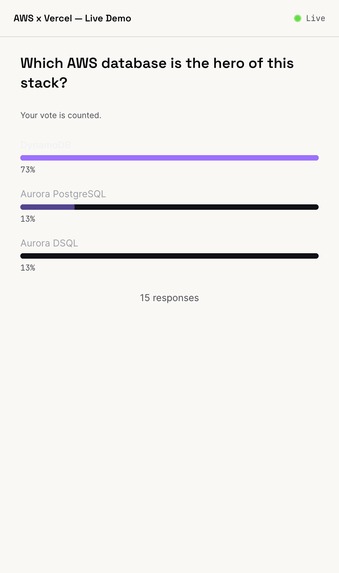
audience results
-
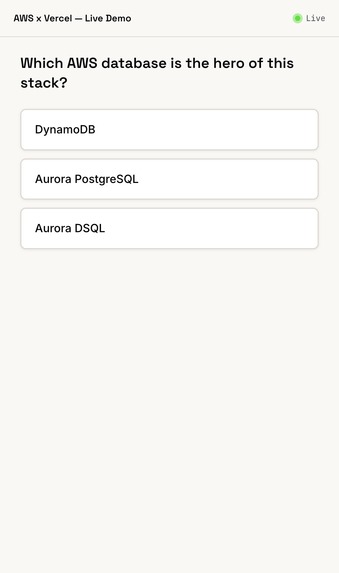
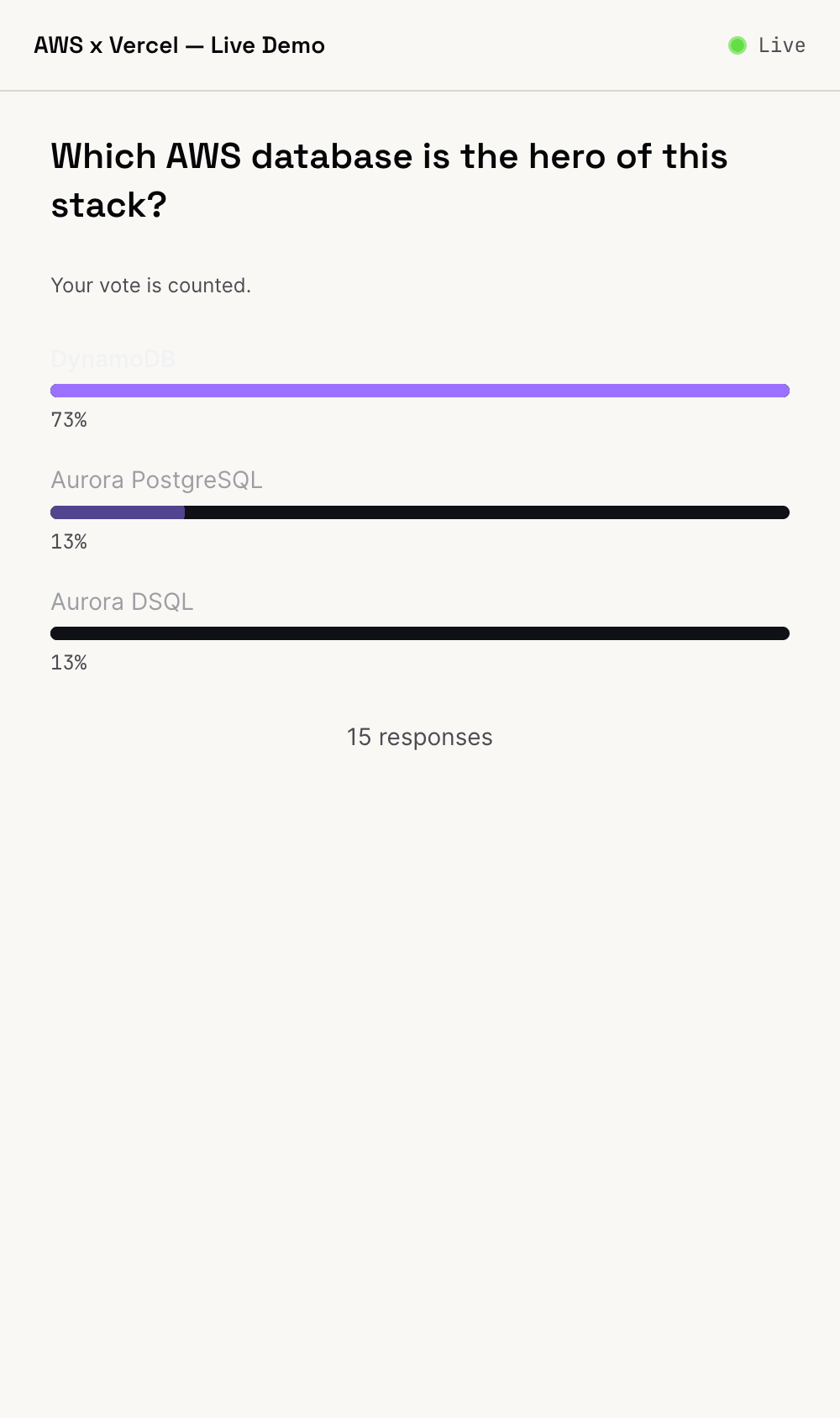
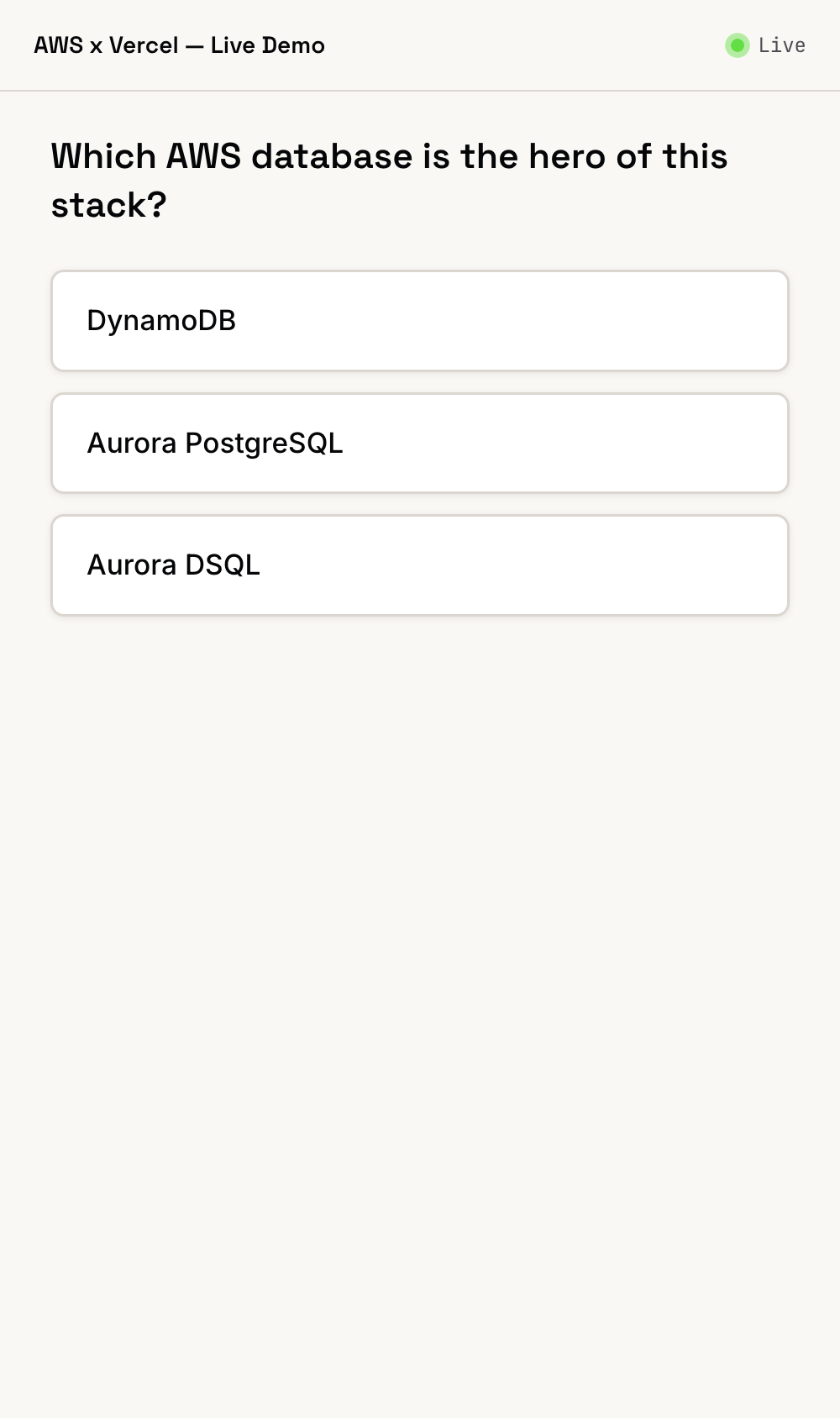
audience vote
-
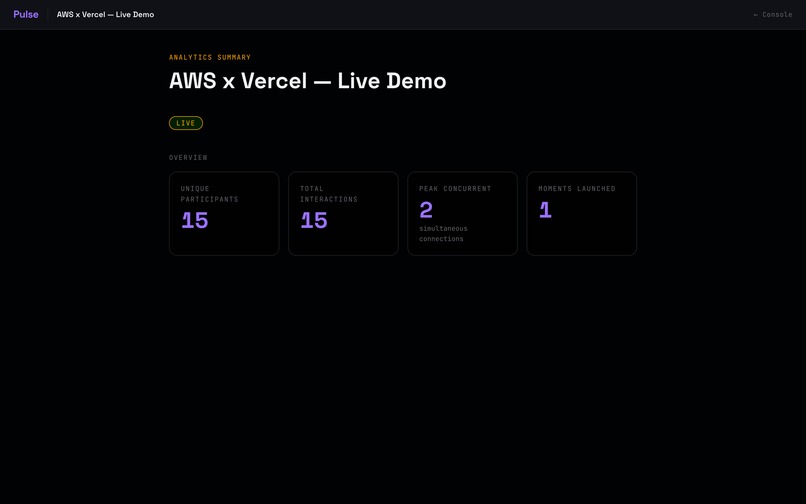
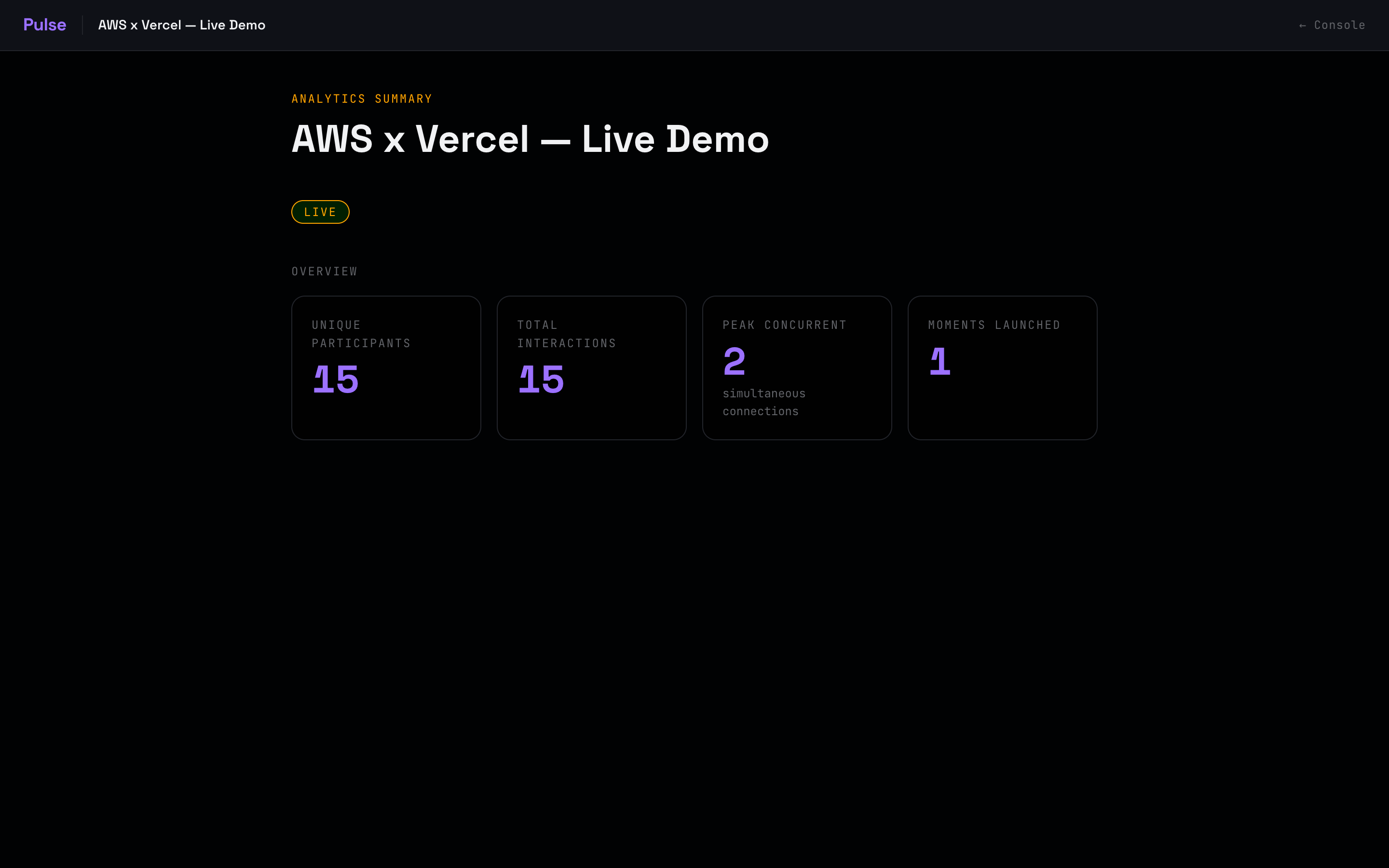
analytics
-
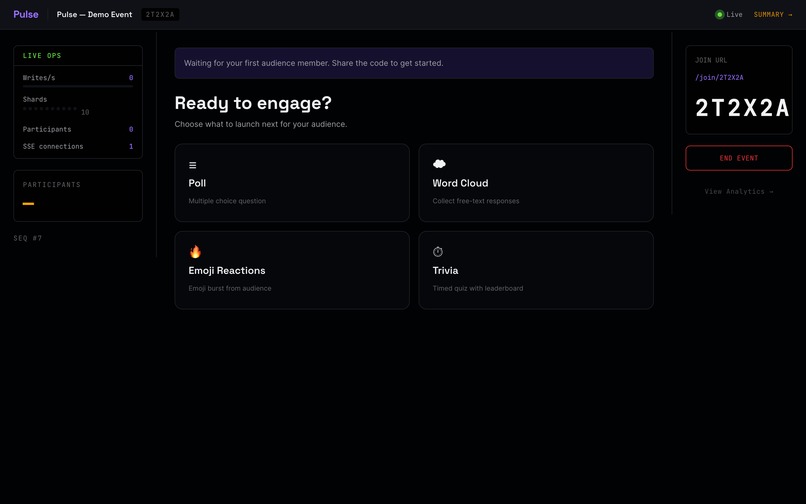
host launcher
-
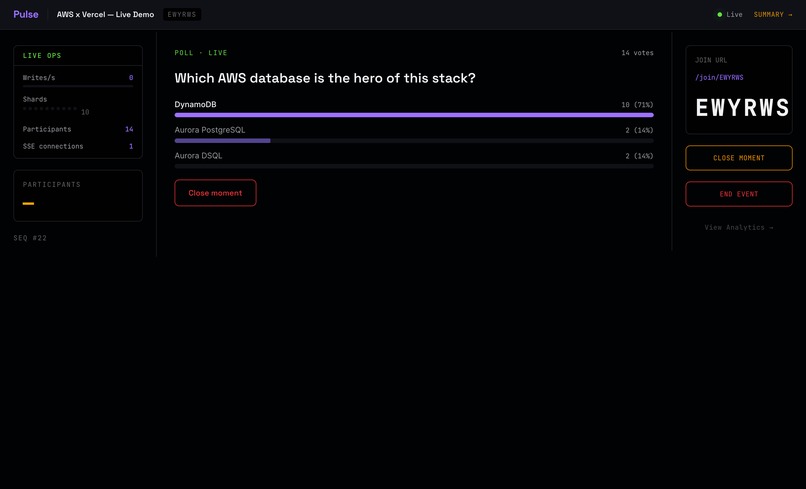
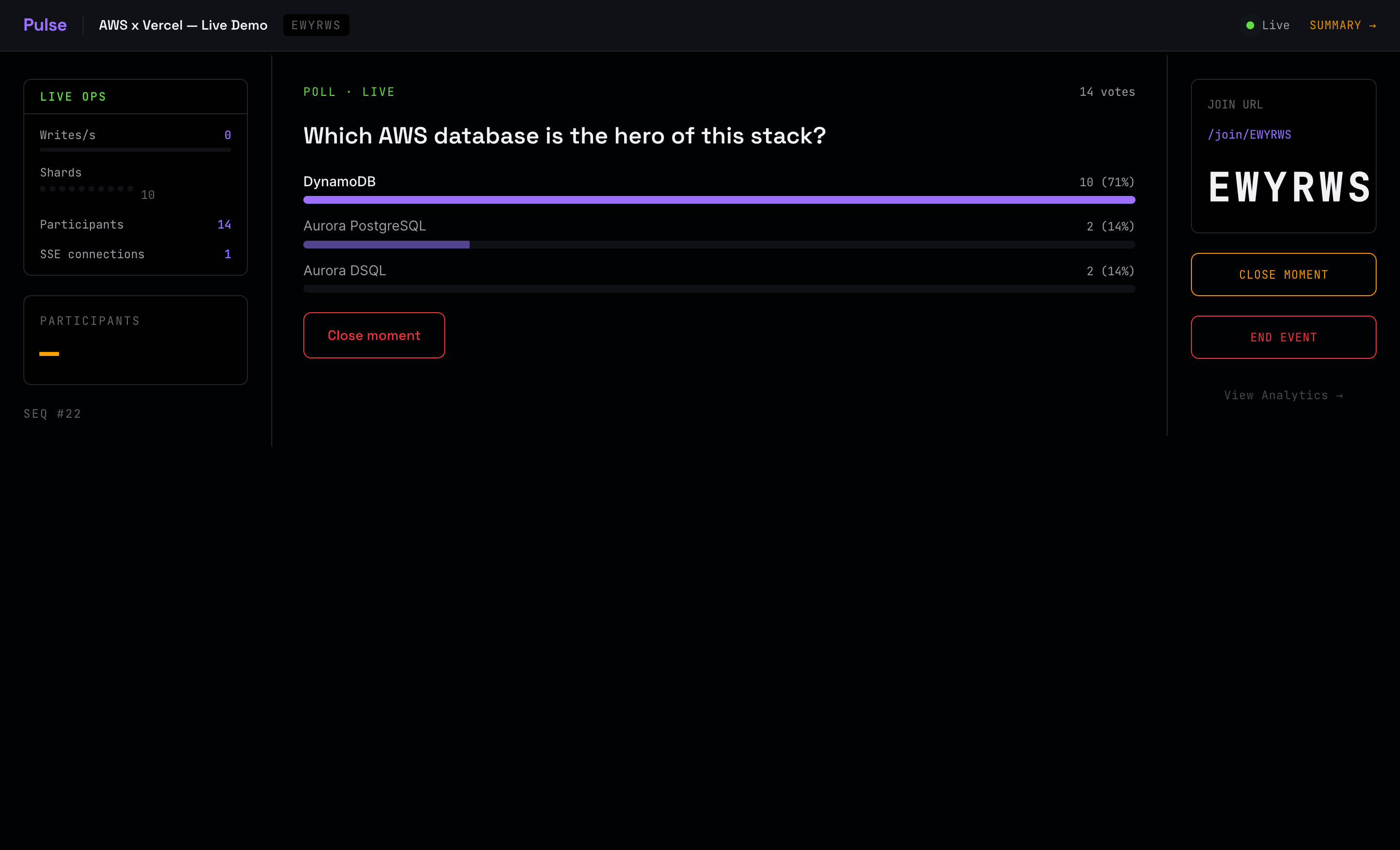
host console
-
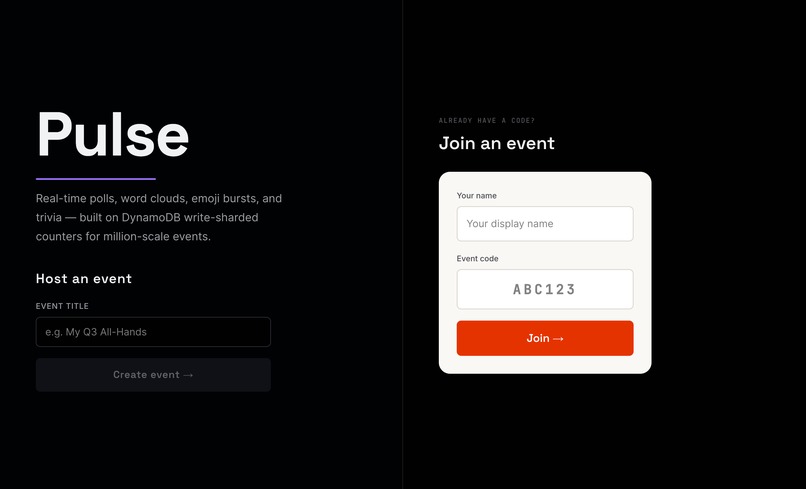
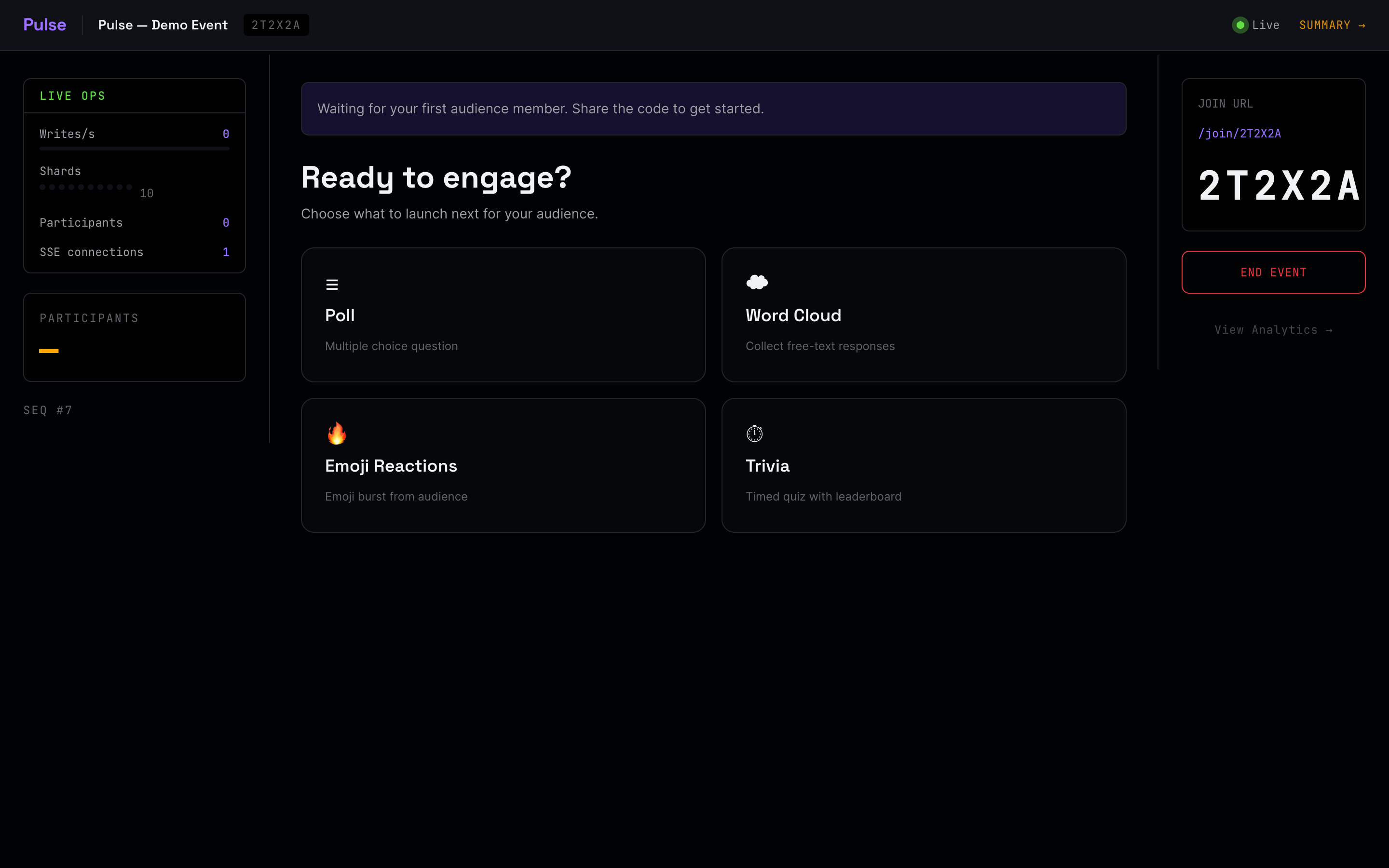
landing
-
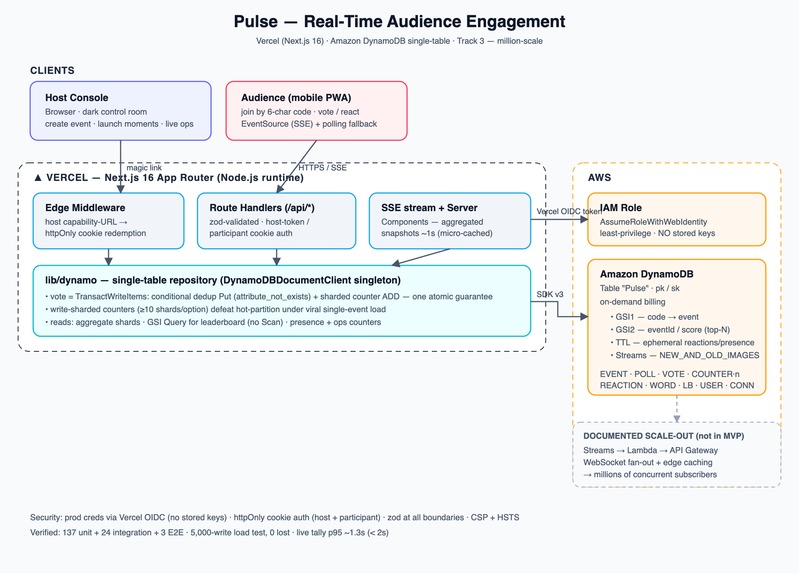
architecture
Pulse — About the project
Real-time audience engagement that scales to millions, built on Amazon DynamoDB + Vercel. Live demo: https://pulse-ochre-six.vercel.app · Code: https://github.com/SebAustin/pulse
Inspiration
Every conference, classroom, and livestream wants the same thing: turn a passive crowd into part of the show. The tools that do this today (Slido, Mentimeter, Kahoot) are paid, closed, and — most tellingly — they treat the database as something to hide. You never actually know whether they'd survive the moment a session goes viral and ten thousand people tap "vote" in the same second.
This hackathon's premise flipped that for us: prototype on the same data foundation startups and enterprises run in production. So instead of bolting a database onto a CRUD app, we asked the opposite question — what if the database were the hero of the product? What if you could see it absorbing a burst of traffic, and prove that you can't oversell a limited slot or double-count a vote, even under a stampede? That idea — making correctness-at-scale a visible feature — became Pulse.
What it does
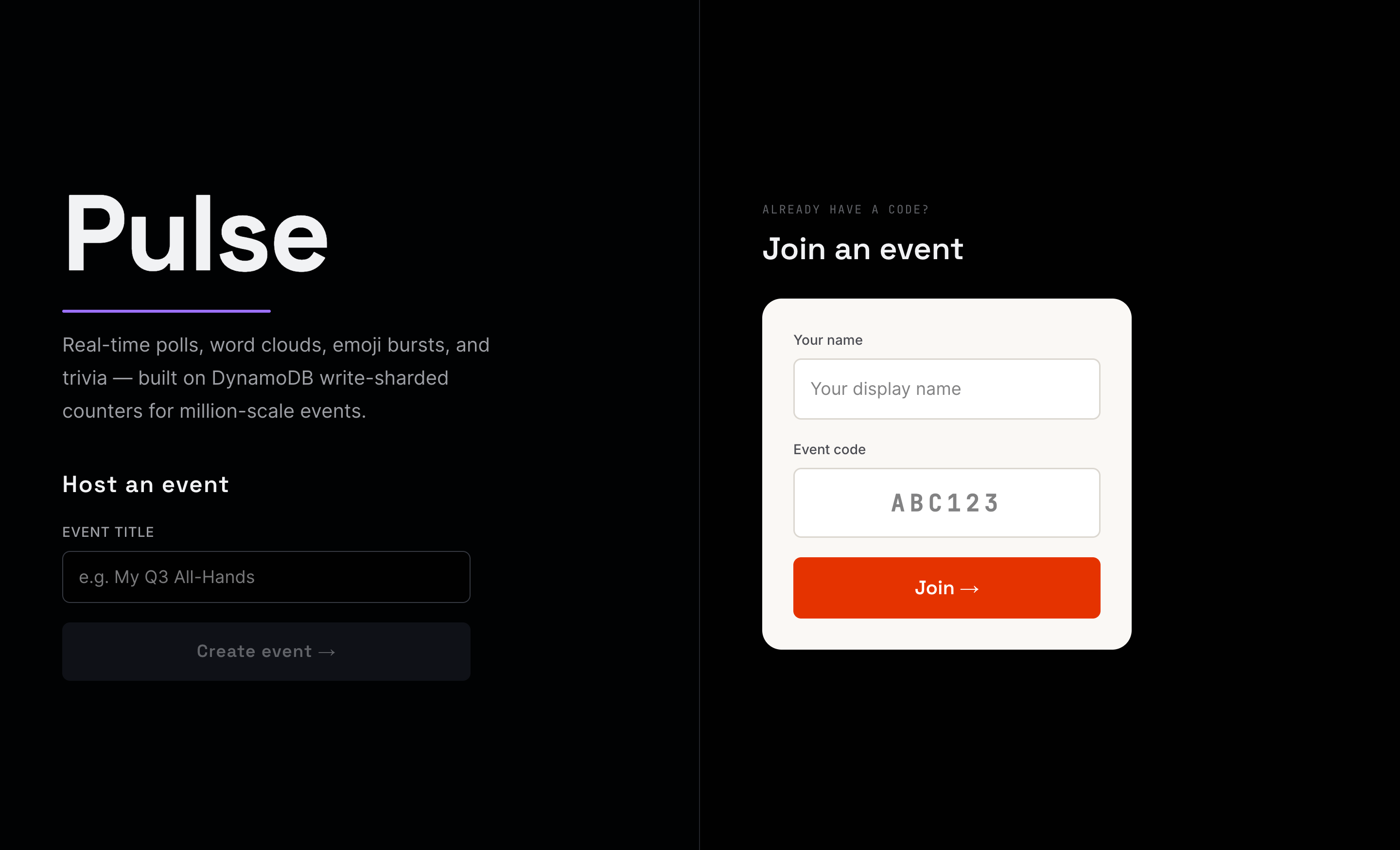
A host creates an event in seconds and gets a 6-character join code. The audience joins anonymously from any phone — no app, no account, just a name. The host then launches live moments:
- Multiple-choice polls with tallies that animate in real time
- Word clouds from open-text submissions
- Emoji reaction bursts
- Trivia with a live leaderboard (server-authoritative scoring)
Every connected screen updates within ~1–2 seconds. Double-voting is impossible. When the event ends, the host gets an analytics summary. The host console also has a LIVE OPS panel that exposes the DynamoDB write-sharding as it happens — writes/second, shard count, live participants — the database, made visible.
How we built it
- Frontend: Next.js 16 (App Router, TypeScript) deployed on Vercel; a deliberate "live broadcast / control room" design system (dark host console, bright mobile-first audience surface).
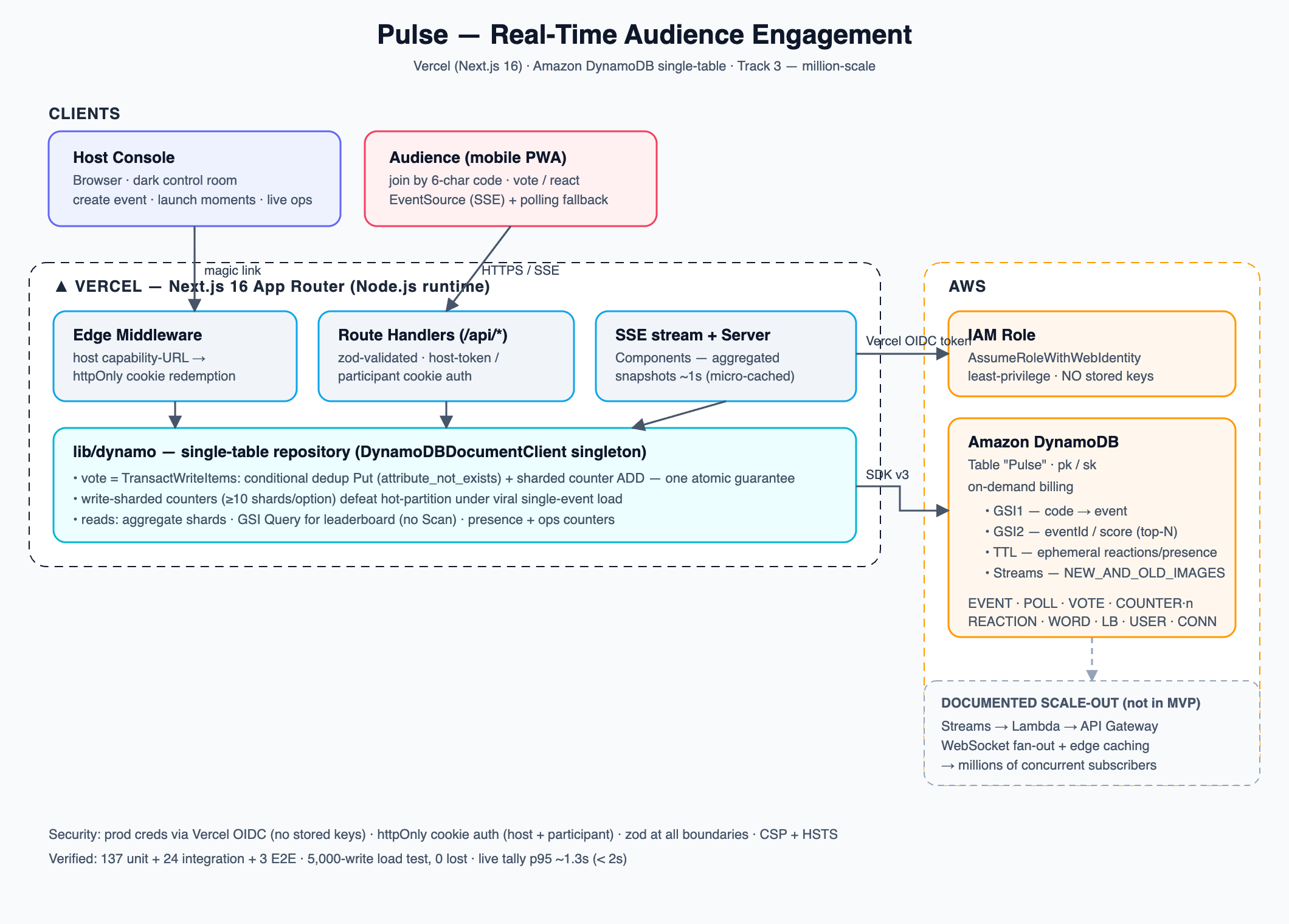
- Data: Amazon DynamoDB, single-table design. One table (
Pulse,pk/sk) holds every entity — events, polls, votes, sharded counters, reactions, leaderboard, presence — withGSI1(code → event) andGSI2for top-N leaderboards (no table scans, ever). - The hero pattern — one atomic guarantee. A vote is a single
TransactWriteItemsthat does two things together:- a conditional
Putof a dedup record withattribute_not_exists(sk), and - an
ADDto a write-sharded counter.
- a conditional
Because they commit atomically, "you can't double-vote" and "the tally is always correct" aren't two features that can drift apart — they're the same guarantee.
- Beating the hot partition. A viral event sends all its writes to one
EVENT#<id>partition. A single DynamoDB partition sustains roughly 1,000 write units/second, so one shared counter would throttle. We spread each option's counter across N ≥ 10 shards. With an arrival rate of λ writes/second, each shard sees only:
$$\lambda_{\text{shard}} \approx \frac{\lambda}{N}$$
(plain text: writes_per_shard ≈ λ / N )
At λ = 5,000 writes/s and N = 10, that's 5000 / 10 = 500 writes/s per shard — comfortably under the ceiling. Reads recombine the shards by summing them:
$$\text{total}(o) = \sum_{i=1}^{N} c_{o,i}$$
(plain text: total(option) = c₁ + c₂ + … + c_N — the sum of that option's shard counts )
We pay a small fan-out read to buy effectively unbounded write throughput — the right trade for a write-heavy live event.
- Real-time: Server-Sent Events stream aggregated snapshots, with automatic polling fallback — a pragmatic path that works on serverless without standing up a socket fleet.
- Security by design: production AWS credentials come from Vercel OIDC via
AssumeRoleWithWebIdentity— zero stored keys. Host and participant identities are HMAC-signedhttpOnlycookies; every input is validated with Zod; CSP + HSTS are set. - Ops: AWS CDK for a gated, one-command provision; GitHub Actions CI; 137 unit + 24 integration + 3 end-to-end tests, plus a 5,000-write load harness.
Challenges we ran into
Almost every bug shared a theme: "it compiles and the tests are green" is not the same as "it works."
- The invisible serialization bug. The data layer passed every build, type-check, lint, and unit test — yet every real DynamoDB call failed. A lazily-evaluated
TableNameproxy looked like a string but didn't serialize like one under the AWS SDK's newer schema serializer. Only running against a real DynamoDB surfaced it. - Edge runtime ≠ Node. Our host-link "capability URL →
httpOnlycookie" redemption ran in Edge middleware, which can't loadnode:crypto. The fix was simpler than the bug: store the raw token in the cookie and verify it against the stored hash server-side — no crypto on the edge at all. - A CSP that killed hydration. A strict
script-srcblocked Next.js's inline bootstrap scripts; the page rendered but was completely dead. Nonces don't play nicely with static rendering, so we chose a pragmatic CSP that preserves performance while the real XSS surface stays closed (nodangerouslySetInnerHTML, React escapes everything). - The OIDC trust-policy mismatch (the one that actually broke production). After deploying, "create event" returned 500s even though every environment variable was set. Federation only works when the IAM trust policy's
iss/aud/submatch the token exactly. We'd assumed "Team ID" meant theteam_…identifier — but Vercel's real token is keyed on the team slug, project name, and audiencehttps://vercel.com/<slug>. We confirmed it by reading the actual token, then rewrote the trust policy. Lesson: get the real token before touching IAM again. - Localhost in production. Share links were built from a hardcoded
http://localhost:3000. Fixed by deriving the origin from the request's forwarded headers.
Accomplishments that we're proud of
- It's genuinely live, not a mock — create → join → vote → dedup → live tally all verified against real DynamoDB through OIDC, with no stored credentials.
- The atomic dedup-plus-counter design that turns two correctness properties into one.
- We made the backend part of the UX — the LIVE OPS readout shows the sharded writes happening, so the database's behavior is something the audience can see.
- Verified scale + speed: a 5,000-write burst with zero lost votes, and a live-tally p95 ≈ 1.3 s (under our 2 s gate).
- An independent verifier scored the build 92/100 with no open critical/high security findings.
What we learned
- Trust the runtime, not the green checkmark. Each layer of "passing" hid a defect that only the next-deeper check — real I/O, a real browser, a real production token — could expose. Verification has to exercise the actual path.
- DynamoDB rewards intentional modeling. Single-table design plus write-sharded counters is how you scale writes; the read-side sum (
Σ cᵢ) is the conscious trade. Naming your access patterns first makes the schema fall out. - OIDC federation is exact-match. The cleanest way to debug "AWS won't authorize" is to decode the real token's claims instead of guessing identifiers.
- The best fixes remove moving parts. Dropping the edge HMAC layer and the CSP nonce both made the system simpler and correct.
What's next for Pulse
- True million-subscriber fan-out: DynamoDB Streams → Lambda → API Gateway WebSockets so reads scale past the current SSE-per-connection ceiling (designed and documented; Streams already enabled).
- AI assist: poll-question generation and post-event sentiment summaries (already wired behind a feature flag).
- Global low latency: DynamoDB global tables for multi-region active-active.
- Accounts & anti-abuse: optional Cognito identity for stronger Sybil resistance beyond the current anonymous model.
- Monetization: hosted tiers, custom branding, and analytics export — the path from hackathon demo to a shippable product.
Built With
- amazon-dynamodb
- amazon-iam
- amazon-web-services
- aws-cdk
- aws-cloudformation
- aws-sdk
- css
- docker
- github-actions
- html
- nanoid
- next.js
- node.js
- oidc
- openai
- playwright
- react
- server-sent-events
- tailwind-css
- typescript
- vercel
- vitest
- zod

Log in or sign up for Devpost to join the conversation.