-
-
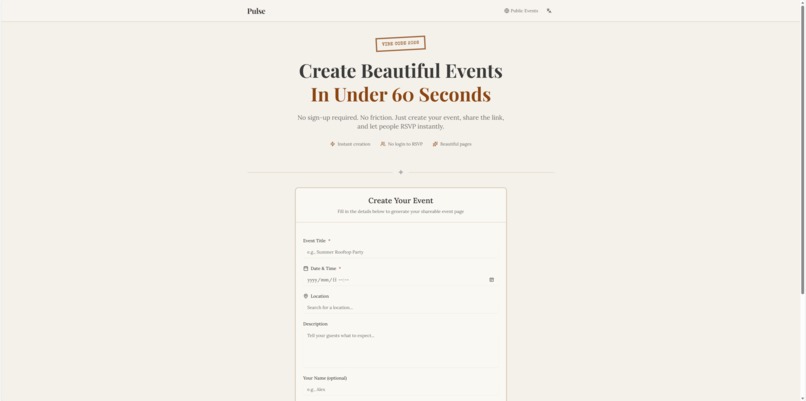
Home
-
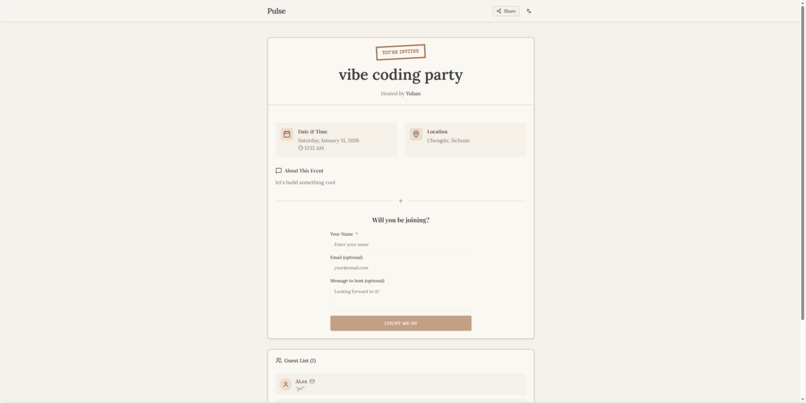
Detail
-
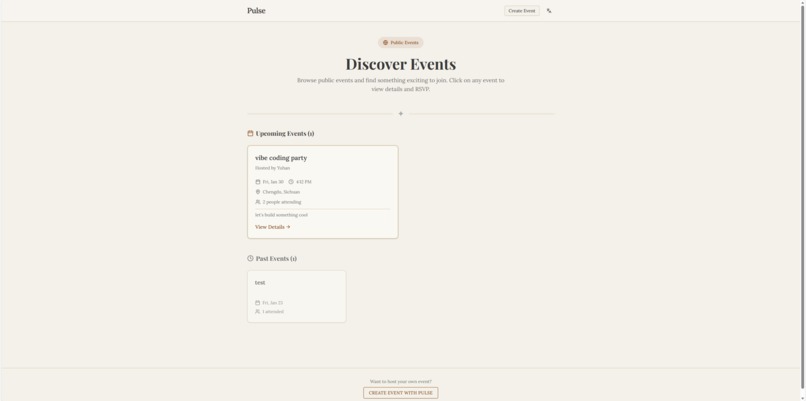
Public
Inspiration
We were frustrated. Every time we wanted to organize a casual meetup — a coffee chat, a sunset hike, a board game night — we faced the same choice: spam a group chat with fragmented details, or wrestle with bloated event platforms that demand accounts, payments, and 20 minutes of configuration. Luma is powerful, but it's built for professional community managers, not spontaneous humans. We wanted something as fast as posting a tweet, as simple as sharing a link. Pulse was born from the belief that bringing people together should take seconds, not minutes.
What it does
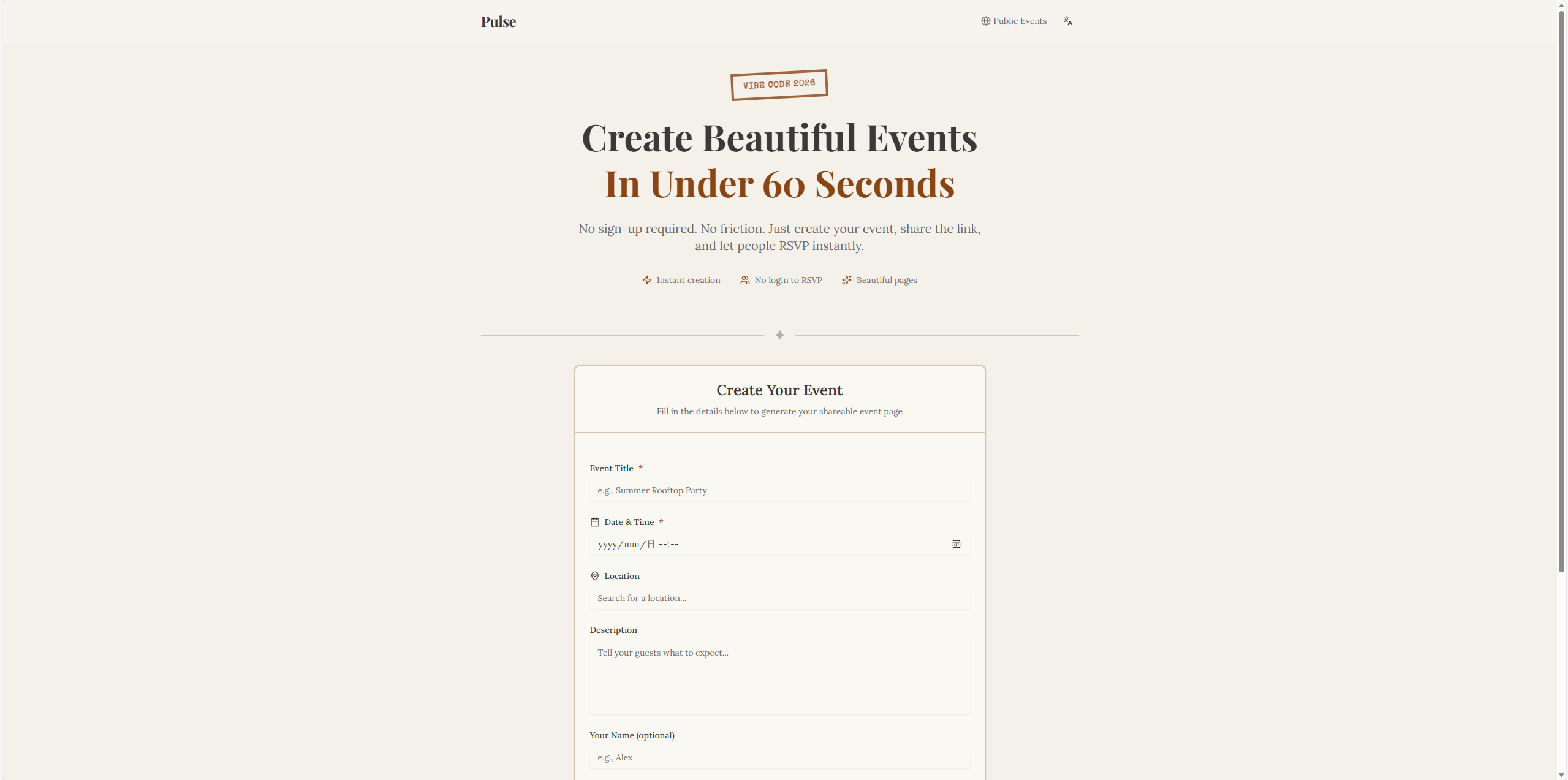
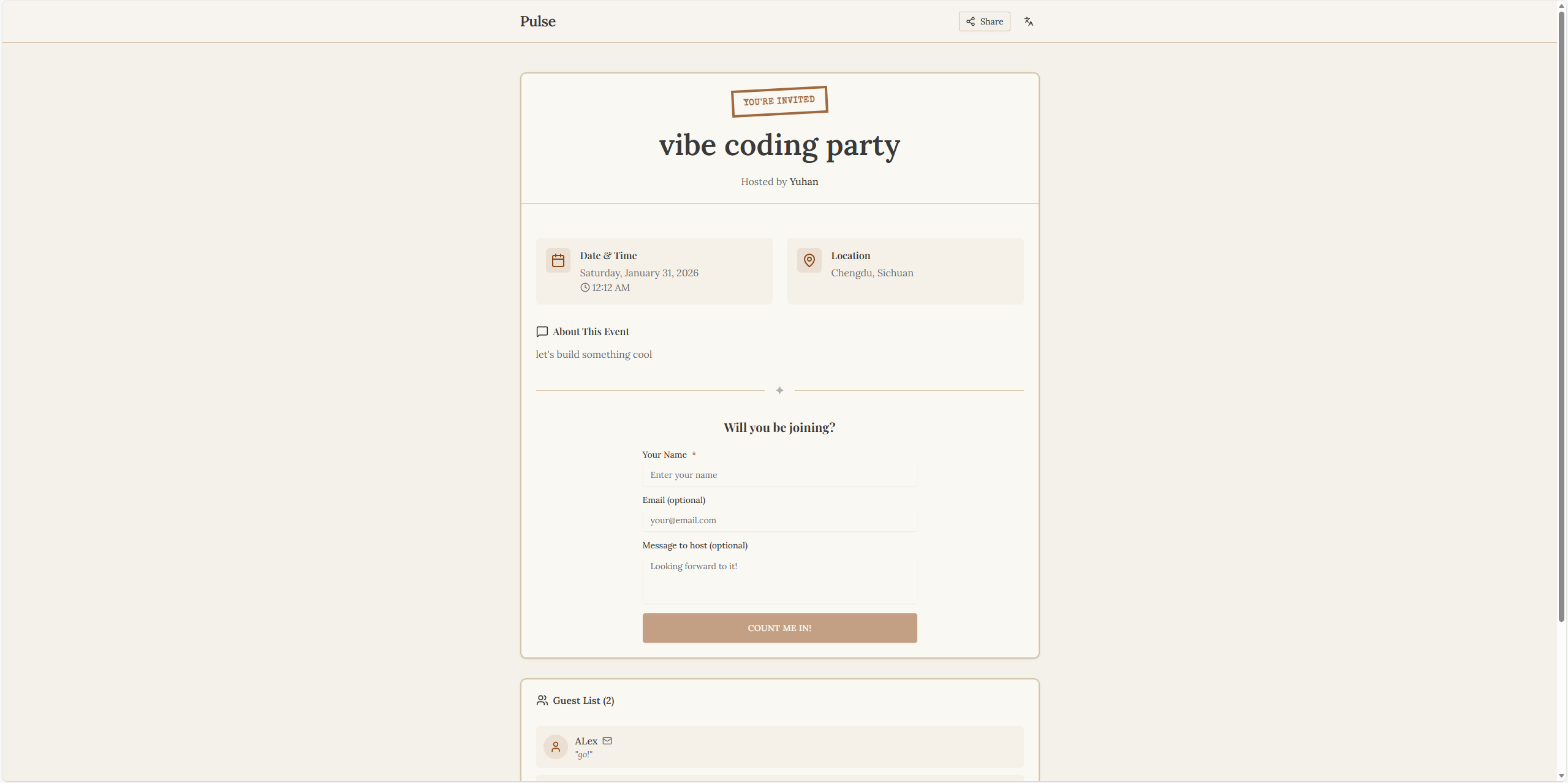
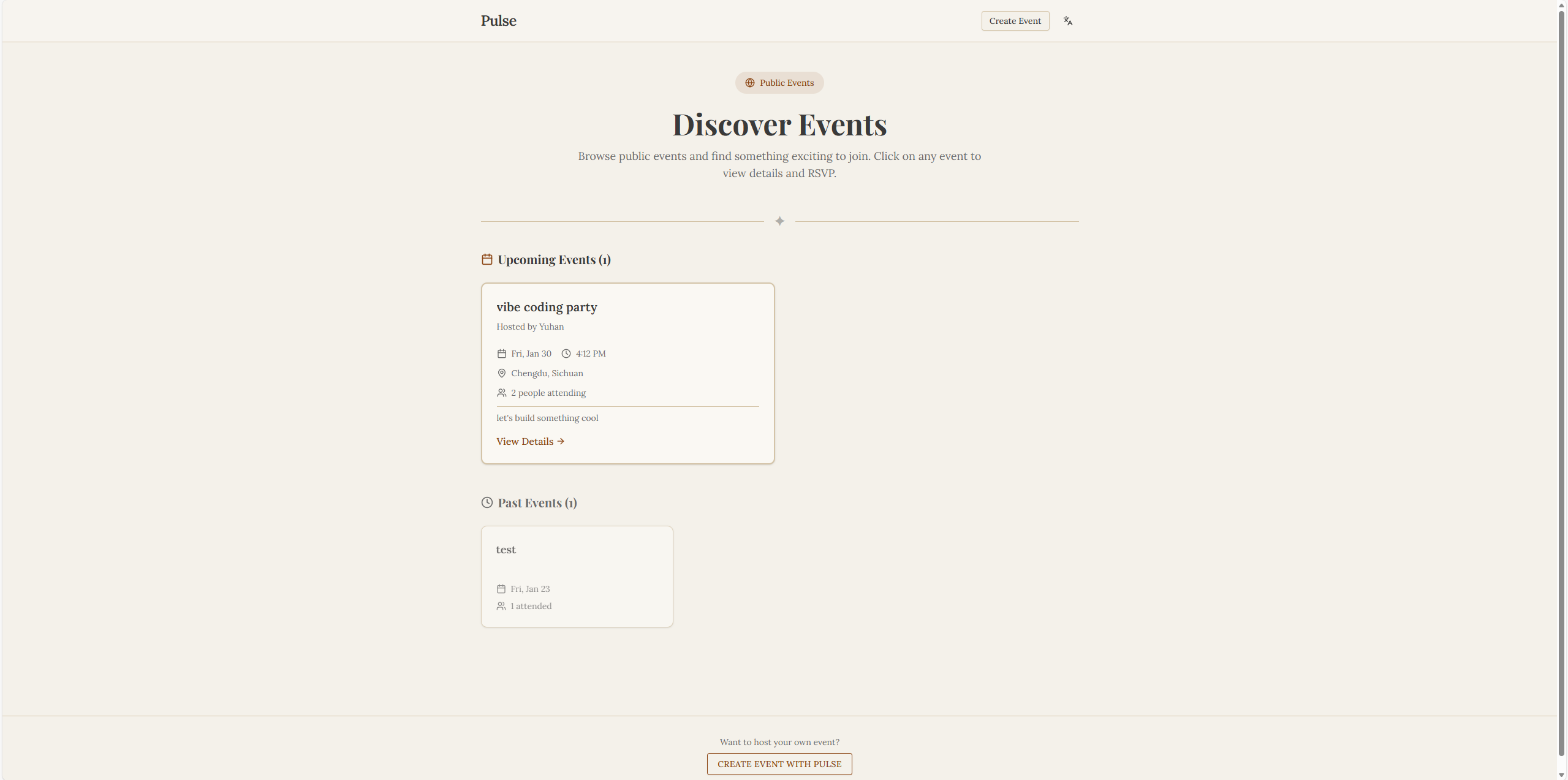
Pulse is a frictionless event creation platform. Anyone can create a beautiful, shareable event page in under 60 seconds — no account required. Creators pick a time, place (with Google Maps autocomplete), and description; Pulse generates a clean, unique URL instantly. Attendees RSVP with just their name and email — no login, no app download, no friction. Events can be private (invite-only via link) or listed publicly for community discovery. It's the fastest path from "let's meet up" to "see you there."
How we built it
We chose TanStack Start for its full-stack React capabilities and file-based routing, letting us move fast without sacrificing type safety. Neon PostgreSQL gave us a serverless database that scales to zero, perfect for a hackathon project. Drizzle ORM kept our database interactions clean and fully typed. For the UI, we leaned on Tailwind CSS and shadcn/ui to build a polished, responsive interface without writing custom CSS. Google Maps Platform powers location search and display. We deployed to Vercel for instant, zero-config hosting. The entire stack was chosen for one reason: speed of development without compromising user experience.
Challenges we ran into
The RSVP paradox: We wanted zero friction for attendees, but needed to prevent spam and handle waitlists. We solved this by requiring only email (no verification for MVP) and implementing simple status tracking ('confirmed' vs 'waitlist') server-side. Map integration complexity: Google Maps API keys and billing setup consumed more time than expected. We added clear error states and graceful fallbacks when maps fail to load. Database schema decisions: Balancing flexibility (optional fields) with query performance. We kept the schema flat and indexed aggressively on start_at and location fields. Time constraints: With only 24 hours, we had to ruthlessly cut features — no recurring events, no payments, no email notifications. This constraint actually sharpened the product focus.
Accomplishments that we're proud of
Sub-60-second event creation — we timed it. From landing page to shareable link, it really works. Zero-login RSVP flow — attendees never hit a auth wall, yet creators still get clean RSVP lists. Real-time map discovery — the public events page shows live gatherings on an interactive map, creating genuine "what's happening near me" serendipity. Mobile-first polish — the entire experience feels native on phones, where most spontaneous planning happens. Type safety end-to-end — with TanStack Router and Drizzle, we caught bugs at build time, not runtime, crucial for rapid iteration.
What we learned
Friction is the enemy of social software. Every additional click, every forced account creation, kills momentum. We learned to measure success in seconds-to-shareable-link, not feature count. Serverless databases are hackathon gold — Neon's auto-scaling and branching let us focus on product, not infrastructure. File-based routing accelerates development — no route configuration, no boilerplate, just create a file and ship. Constraints drive clarity — cutting notifications, payments, and complex auth forced us to nail the core loop. We also learned that good error messages matter more than perfect uptime — when APIs fail, users need to know why and what to do next.
What's next for Pulse
Smart notifications — Email and SMS reminders 24 hours before events, plus waitlist promotion when spots open up. Recurring events — "Every Thursday" meetups without recreating each week. Payment integration — Optional ticket sales for creators who need it, keeping free events as the default. Mobile app — A lightweight PWA for push notifications and offline ticket access. Community features — Follow creators, event series, and interest-based recommendations. Icebreakers — Auto-generated conversation starters based on attendee profiles ("Ask Sarah about her photography project"). Analytics dashboard — Track social velocity (RSVPs per hour), referral sources, and repeat attendance rates.
The vision remains unchanged: technology that disappears, leaving only human connection.
Built With
- drizzle
- postgresql
- react
- tailwindcss
- tanstack
- typescript
- vitest

Log in or sign up for Devpost to join the conversation.