-
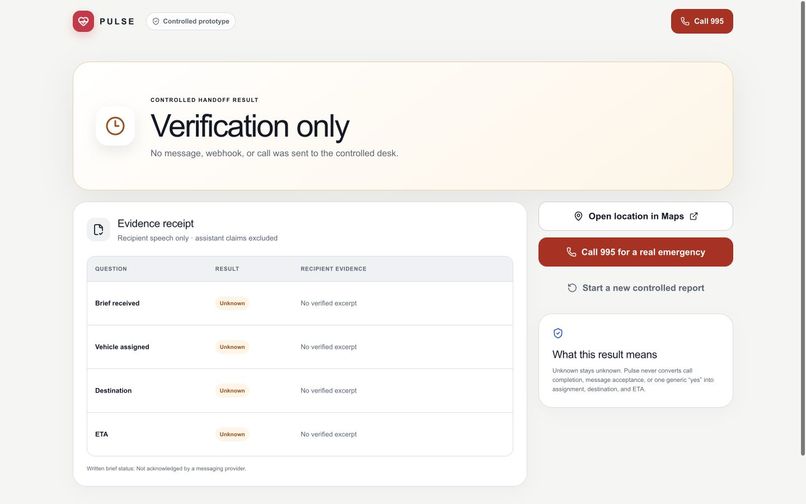
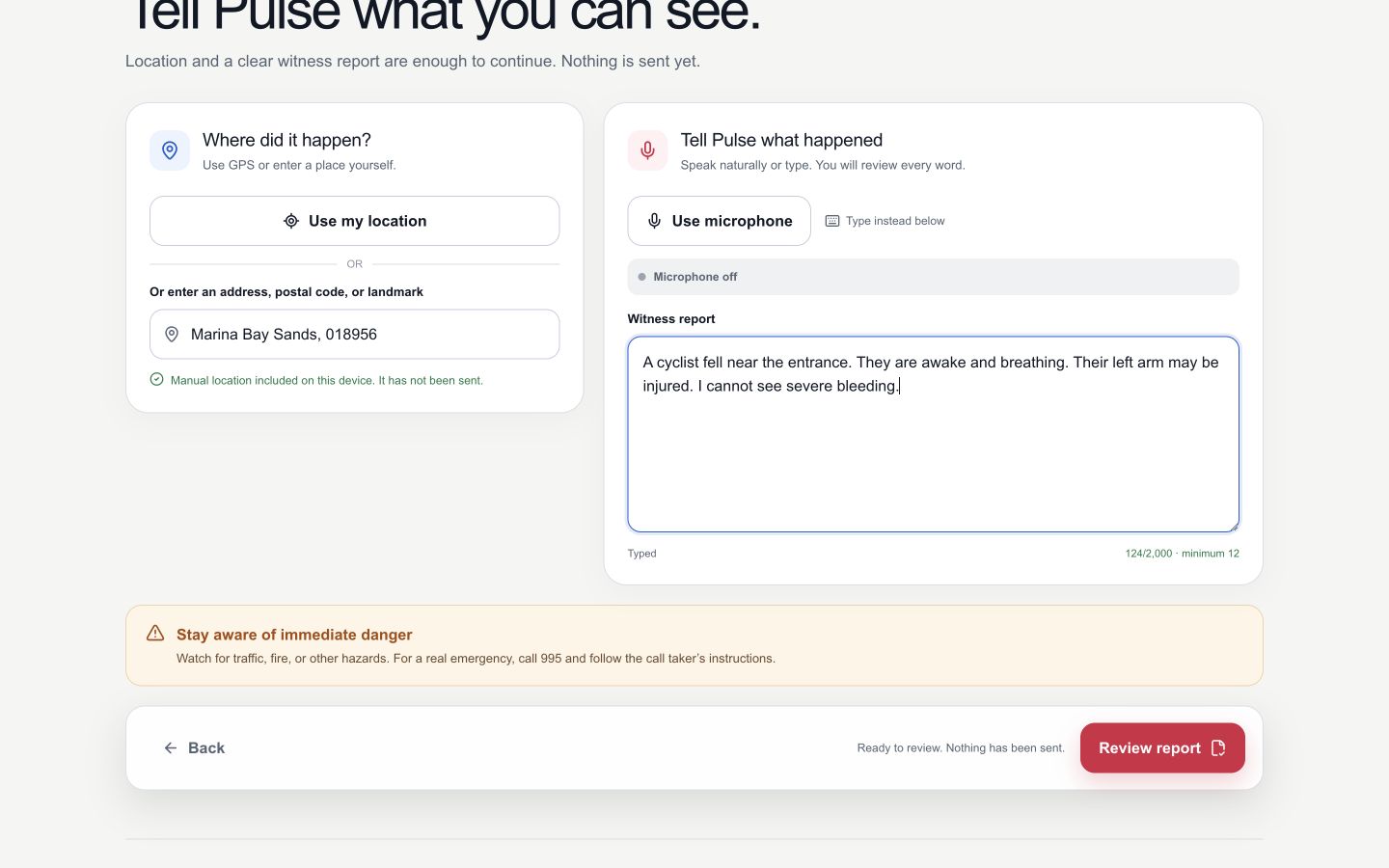
Capture the incident with manual location and an editable witness report.
-
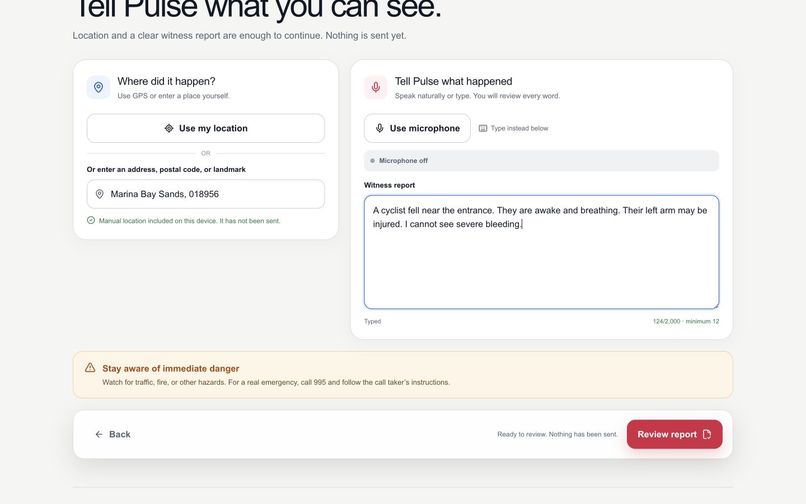
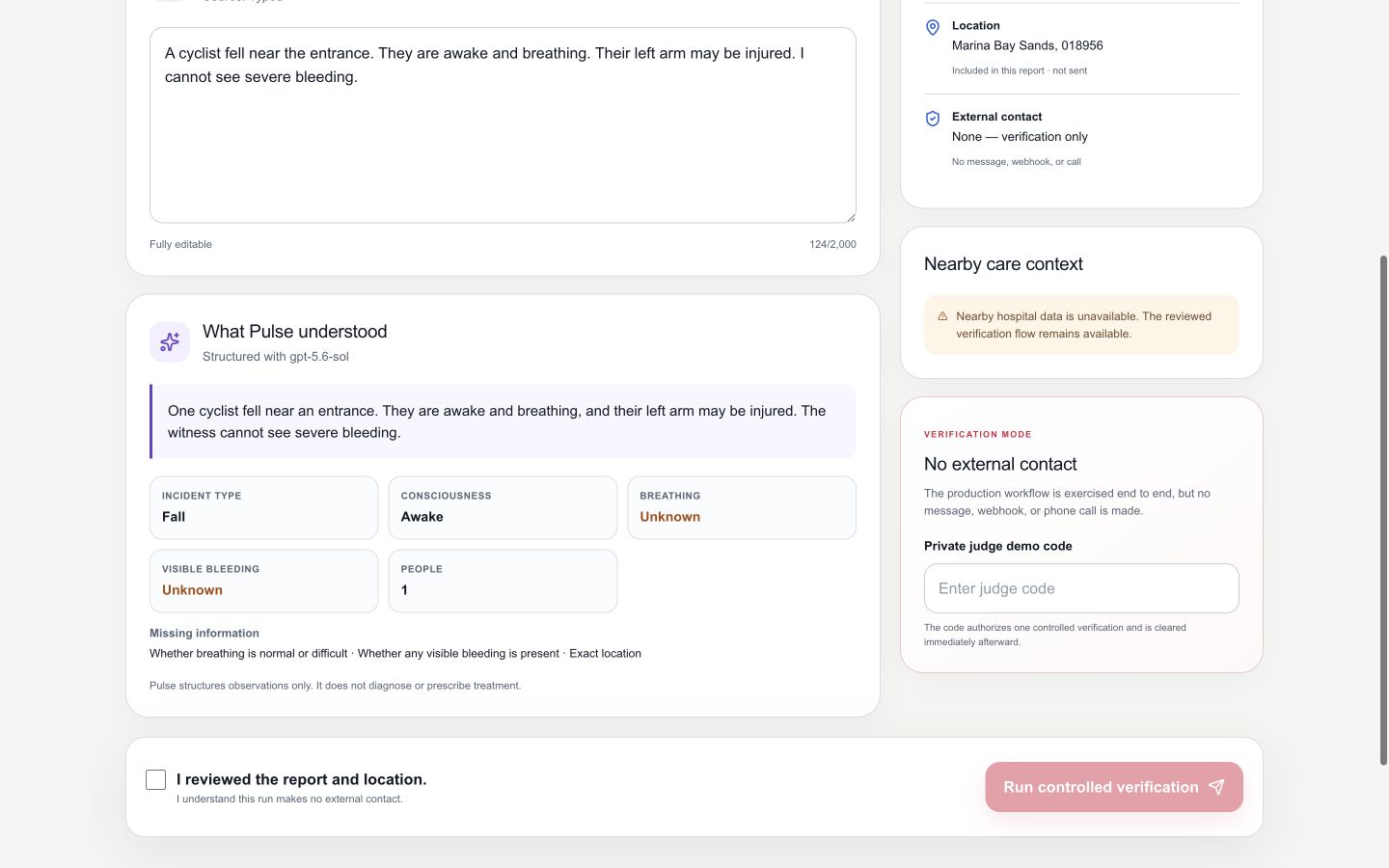
GPT-5.6 structures observed facts and preserves unknowns.
-
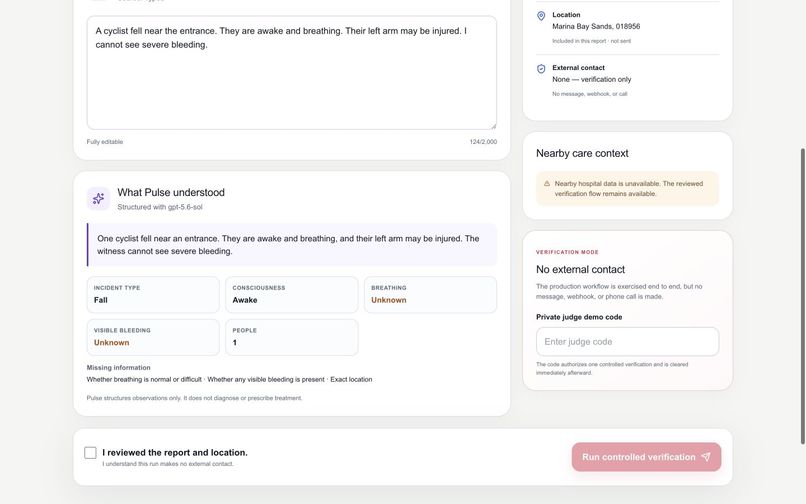
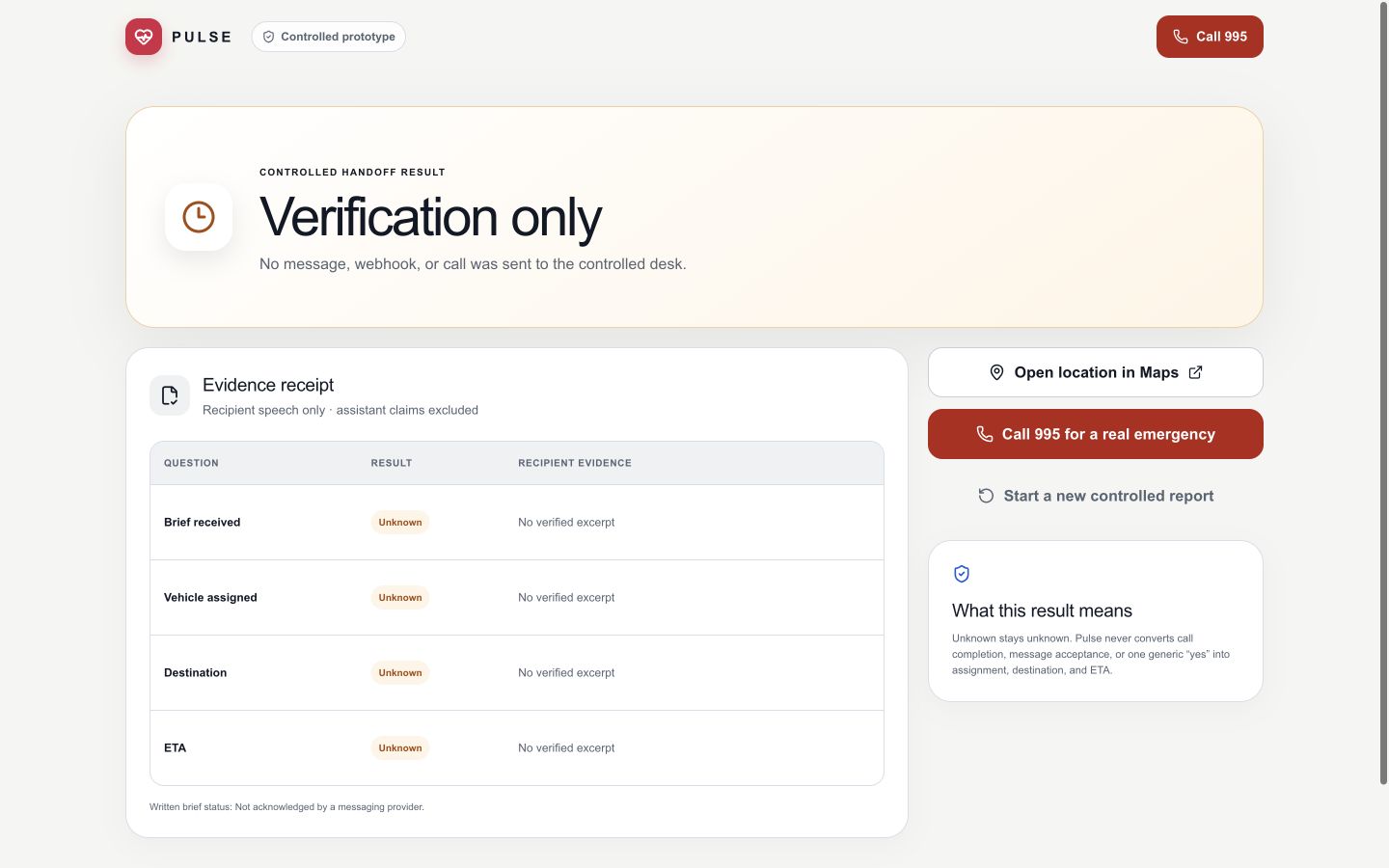
Verification-only result keeps unsupported dispatch evidence Unknown.
Inspiration
In the first minutes after an accident, a bystander can face several urgent questions at once: Should I stay with the person? What details should I report? Who should I call? How do I explain the location? The result is often not a lack of willingness to help, but confusion at the moment when clarity matters most.
Pulse explores a focused idea: help a witness capture a clear account, review it before any handoff, and preserve the difference between an observation, a transport event, and verified operational evidence. It is designed to reduce coordination friction without pretending to be an official emergency service.
The problem
Unstructured witness reports can omit a precise location or mix observation with assumption. Emergency-domain software creates another risk when a delivered message, completed call, or generic “yes” becomes an unsupported claim that a vehicle, destination, or ETA was confirmed.
Pulse addresses both problems. It helps the witness form a concise incident brief, then keeps receipt, assignment, destination, and ETA as separate facts. Unknown stays unknown.
What Pulse does
The user can speak or type what they observed and provide either browser location or a Singapore address, postal code, or landmark. The witness report stays editable before the final confirmation.
GPT-5.6 structures the reviewed report into observations such as incident type, consciousness, breathing, visible bleeding, number of people, and missing facts. It does not diagnose the person or invent treatment instructions. If the model is unavailable, the witness's reviewed words remain usable.
The live-capable implementation accepts only one fixed, server-side, authorized
Singapore +65 controlled-desk destination and protects the operation with a
private code and an incident-bound token. The current production deployment is
deliberately verification-only because the existing configured destination
did not pass that Singapore authorization check. It sends no SMS or webhook and
starts no call. Its terminal receipt says that no desk contact was made and keeps
every unsupported field Unknown.
For a real emergency in Singapore, the interface directs the user to call 995. Pulse does not contact SCDF, public emergency services, a hospital, an ambulance provider, a patient, or a family member.
The controlled dispatch boundary
Pulse is a controlled prototype, not an emergency-service integration. Public
users cannot supply a destination number. A private judge/demo code gates the
final operation, the server validates a Singapore-format fixed destination, and
dry_run sends no message, webhook, or call.
Vapi and Twilio passed non-mutating production health probes, but provider configuration is not evidence that an outbound operation occurred. No production message or call was made for this release.
Nearby hospital context is optional. The Google production query is currently unavailable, so the UI shows an honest non-blocking unavailable state. Pulse does not infer clinical capability, availability, hospital acceptance, ambulance assignment, or bed capacity from a listing.
How the user journey works
- Capture: enter a location and describe observable facts by voice or text.
- Review: correct the witness report and inspect the structured GPT-5.6 brief.
- Authorize: confirm the incident-bound package through the private demo gate.
- Verify: in this production release, reach a no-contact terminal receipt in
which receipt, assignment, destination, and ETA remain
Unknown.
The interface also preserves a direct Call 995 escape for real emergencies.
How we used GPT-5.6
Pulse uses GPT-5.6 through the OpenAI Responses API with Structured Outputs for a
narrow, user-visible task: converting the reviewed witness report into a compact
observation brief. The schema favors explicit unknown values and prohibits
diagnosis, medical instructions, provider capability claims, and dispatch claims.
Production health and the visible production journey verified the GPT-5.6
integration. The observation brief reported the exact model gpt-5.6-sol.
The code also contains a live-mode evidence path that uses GPT-5.6 to extract separate recipient answers, then verifies exact recipient-side excerpts and speaker attribution. A generic “yes” cannot populate several independent fields. That live path was not exercised in this release because there is no authorized Singapore-format desk destination.
OpenAI Realtime provides optional live voice transcription. Voice audio is sent to OpenAI only when the user chooses microphone capture; the report remains editable before the final operation.
How we used Codex
Shreyansh supplied the real-world problem, target context, product direction, and controlled-testing boundary. Codex audited the existing repository and production behavior, identified false-success and integration failure modes, developed the Build Week extension, explored the visual direction, implemented the interface and backend changes, ran local browser-led QA, prepared documentation, and prepared the demo materials.
This is a human-directed, Codex-executed collaboration. It would be inaccurate to claim that the human had no role.
Architecture
- Next.js and React: mobile-first workflow and server routes.
- OpenAI Realtime: optional browser speech transcription.
- GPT-5.6 Responses API: structured observation brief and live-mode evidence extraction.
- Twilio/Vapi: fixed-destination transport adapters; production health-verified but inactive while verification-only mode is enabled.
- Signed and encrypted tokens: bind reviewed incident data to short-lived authorization and redacted status access.
- Google context: optional and non-blocking; currently unavailable in production and omitted from Built with tags.
Evidence instead of assumptions
The hardest product requirement was not making a call; it was representing every state truthfully. Pulse separates provider transport status from operational evidence. A completed call would not mean a responder was assigned. Receipt, assignment, destination, and ETA remain independently unknown until supported by recipient evidence.
The current production result demonstrates the same discipline from the opposite direction: because outbound contact is disabled, it explicitly says no desk contact occurred and leaves every evidence field unknown.
What we rebuilt during Build Week
Before the eligible period, the repository already contained a Next.js prototype
with voice/text intake, geolocation, AI triage, hospital search, configurable
messaging/calling, status polling, and an initial UI. Its last pre-extension
commit was a83e85c on June 5, 2026.
During Build Week, Codex and Shreyansh created a meaningful extension focused on truthful controlled dispatch:
- migrated the structured observation path to GPT-5.6 Responses;
- redesigned the complete mobile and desktop interface;
- added manual location and non-blocking care context;
- protected the final operation with a private demo gate and incident-bound token;
- made dry-run fail closed before any SMS, webhook, or call;
- prevented transcript overwrite and stale-audio leakage;
- replaced generic acceptance with field-specific evidence validation;
- added bounded polling, refresh recovery, accessibility states, and production hardening;
- added an MIT license, accurate project documentation, a QA ledger, and Build Week media plans.
The eligible-period backend commit is 047c79d, the interface commit is
782a2a4, the documentation commit is f73d0cc, and application commit
e7e4bd9 is deployed.
Challenges
The primary challenge was designing for urgency without overstating certainty. Speech, mapping, transport, and model responses fail independently. The workflow had to remain understandable when location permission is denied, the model times out, hospital search is unavailable, or the safe destination gate rejects an unapproved line.
A second challenge was preserving user control over transcription. A late model or audio response must never erase a witness correction. Incident IDs, recording IDs, cancellation boundaries, and explicit edit ownership keep stale asynchronous work from changing the active report.
Real user testing
Visible production QA covered the manual-location and typed-report path, witness
edit persistence, a user-visible gpt-5.6-sol brief, Google unavailable state,
private-code gate, verification-only completion, deliberate double activation,
keyboard focus, and responsive layouts at desktop, 390×844, and 320×568. The
manual/typed journey passed without horizontal loss, and every unsupported
evidence field remained Unknown.
Production health separately verified GPT-5.6, Realtime, Vapi, and Twilio while reporting Google unavailable and the controlled desk fail-closed. Chrome's native microphone permission prompt remained pending, so the voice path is documented as blocked rather than presented as passed. Lint, production build, and six narrow token/evidence safeguards also passed. Mocked DOM flows are not presented as production proof.
Privacy and safety
Pulse identifies when data moves between systems. Microphone audio is streamed to OpenAI only after the user chooses voice capture. In the current verification-only release, the reviewed package reaches Pulse's server after confirmation but is not sent to messaging or calling providers. Public responses expose no phone number, access code, call ID, provider log, or full transcript.
The live-capable call configuration disables recording. Incident routes use bounded input, short-lived tokens, fixed server-side destinations, no-store responses, and a fail-closed Singapore destination check.
What we learned
In an emergency-domain interface, an honest unknown is more useful than an impressive but unsupported green checkmark. The strongest role for GPT-5.6 here is disciplined structure and evidence extraction—not diagnosis, invented certainty, or replacing official responders.
We also learned that refusing an unapproved destination is a successful safety outcome. A deadline is not a reason to route a test call outside the declared Singapore boundary.
What's next
Pulse's next step is partnership work, not a broader public calling loop. An authorized Singapore controlled desk would be required before live transport is enabled. With appropriate clinical, legal, privacy, dispatch, and emergency-service partners, the evidence model could then be evaluated against real operating procedures.
Built With
- api
- codex
- gpt-5.6
- next.js
- openai
- react
- realtime
- responses
- twilio
- typescript
- vapi
- vercel