

Inspiration
As a student in Tiruppur managing limited pocket money and frequent UPI transactions for daily expenses, I witnessed firsthand how easily small mistakes or scams can wipe out hard-earned savings. With UPI recording a staggering 22.64 billion transactions worth ₹29.53 lakh crore in March 2026 alone, digital payments have become effortless — yet fraud has surged alongside. Government data shows over 12.64 lakh UPI fraud cases in FY 2024-25 with losses nearing ₹981 crore, and more than 10.64 lakh cases worth ₹805 crore reported in the first eight months of FY26. Students and young users are disproportionately affected due to irregular income, impulse spends, and sophisticated tactics like fake collect requests, QR swaps, and mule accounts.
Existing banking apps offer generic, reactive alerts that often create fatigue rather than real protection. I wanted to build something proactive — a personal AI guardian that understands individual spending behavior, catches anomalies before money moves, and turns security into a habit for better financial health. This inspired Pulse Credit: real-time behavioral intelligence for safer UPI usage.
What it does
Pulse Credit is an intelligent web platform that acts as a pre-transaction risk intelligence layer for UPI-style payments. Users maintain a personal financial profile and log/simulate transactions. The system instantly analyzes each one using a hybrid AI engine and delivers:
- A clear Risk Score (0-100) with color-coded indicators
- Contextual LLM explanations in plain English (e.g., “This ₹7,500 transfer at 3 AM to a new UPI ID deviates significantly from your usual evening food and transport spends and matches common mule account patterns”)
- Actionable recommendations (“Allow”, “Block & Educate”, or “Review”)
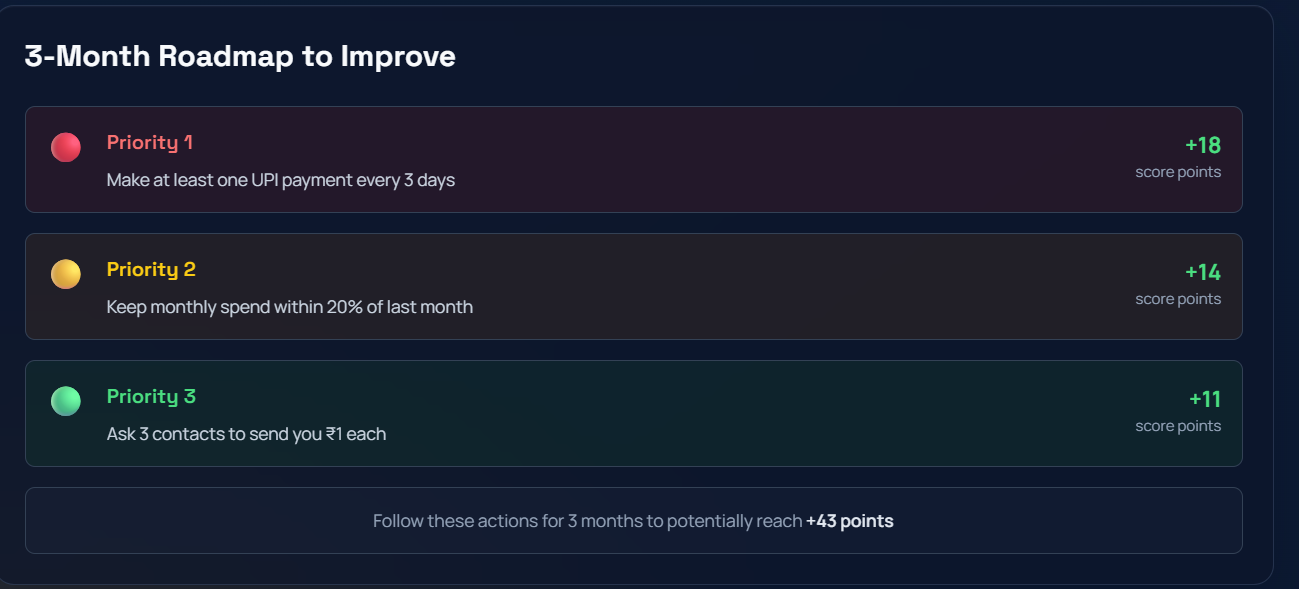
- Integrated budget guardian with proactive nudges linking spending limits to fraud risk
- Fraud Lab Simulator — an interactive module to test real scam scenarios and see how the system responds
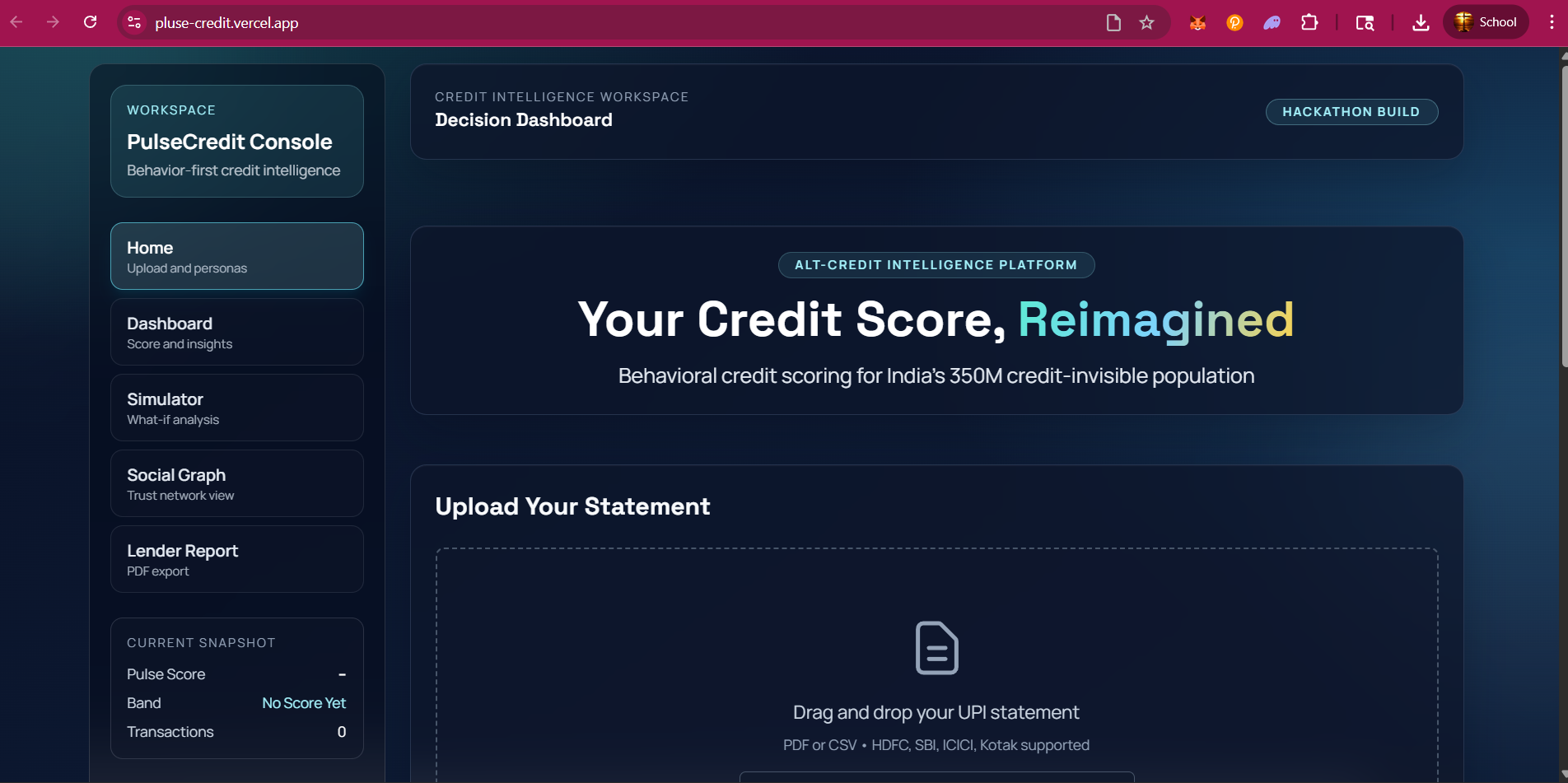
- Visual dashboard with spending charts, anomaly timeline, and transaction graph visualization
It protects students from fraud while simultaneously building disciplined financial habits.
How we built it
I built Pulse Credit solo in 72 hours of intense development.
Tech Stack:
- Frontend: Next.js 14 (App Router) + TypeScript + Tailwind CSS + Shadcn/ui + Recharts + React Flow (for transaction graph)
- Backend: FastAPI (Python) with Pydantic
- AI/ML Core:
- Rule-based heuristics engine
- scikit-learn Isolation Forest for outlier detection on 15+ engineered features (amount deviation, velocity, temporal patterns, recipient novelty, micro-splitting, etc.)
- PyTorch Autoencoder for deep reconstruction-error anomaly scoring
- Weighted ensemble scoring
- Groq LLM (Llama-3 family) for generating natural, actionable explanations
- Database: Supabase (PostgreSQL)
- Deployment: Vercel (frontend) + Render (backend)
I started by generating a rich synthetic dataset of 1,200+ realistic student transactions (normal patterns + injected fraud cases). Feature engineering was done carefully to capture behavioral signals. The hybrid model combines fast rules with unsupervised ML and LLM reasoning for both accuracy and explainability. The entire risk analysis runs in real time via FastAPI endpoints. The UI focuses on clarity — clean risk cards, interactive charts, and smooth onboarding.
Challenges we ran into
- Balancing model accuracy with low false positives was tricky. Pure ML models can be overly sensitive; combining rules, Isolation Forest, and Autoencoder helped, but required multiple iterations and careful ensemble weighting.
- Crafting effective LLM prompts that consistently produce clear, non-technical, and trustworthy explanations without hallucination took several refinements.
- Integrating React Flow for transaction graph visualization under tight time pressure while keeping the UI responsive and beautiful.
- Generating a high-quality synthetic dataset that realistically mimics Indian student spending behavior (irregular pocket money, frequent small UPI transfers, category patterns) without real user data.
- Managing full-stack deployment and ensuring seamless frontend-backend communication within 72 hours of non-stop work.
Accomplishments that we're proud of
- Successfully implemented a three-layer hybrid AI risk engine (rules + Isolation Forest + Autoencoder + LLM reasoning) that delivers both high detection capability and transparent explanations.
- Built a polished, production-like UI with interactive elements (Fraud Lab, real-time risk scoring, transaction graph) that feels like a real fintech product.
- Achieved end-to-end functionality — from onboarding to instant risk analysis to educational simulation — entirely as a solo developer.
- Created measurable components: model performance metrics on the synthetic test set are clearly documented.
What we learned
This project reinforced that explainable AI is far more valuable than black-box models, especially in sensitive domains like finance and security. Combining multiple techniques (rules for speed + unsupervised ML for pattern discovery + LLMs for communication) produces better real-world outcomes than any single approach.
I also learned the importance of scoping aggressively under extreme time constraints while still pushing technical depth. Most importantly, solving a genuine pain point I experience daily made the entire build far more motivating.
What's next for Pulse Credit
In the future, I plan to:
- Extend it into a browser extension that works alongside real UPI apps for live protection.
- Add multi-user benchmarking and anonymized insights to help students compare safe spending patterns.
- Explore integration as an open API layer for fintechs or educational institutions.
- Fine-tune models with more diverse patterns and add mobile responsiveness for broader accessibility.
- Open-source parts of the hybrid detection engine to contribute to student safety tools in India.
Pulse Credit started as a hackathon project but has the potential to become a meaningful tool for safer digital finances among young users.

Log in or sign up for Devpost to join the conversation.