Pulse — AI Ops Copilot for SMBs
🎯 Project Summary
Pulse is a natural-language interface to Amazon Aurora PostgreSQL that lets non-technical small-business operators ask their operational database in plain English and take safe, human-confirmed actions—all with a complete audit trail.
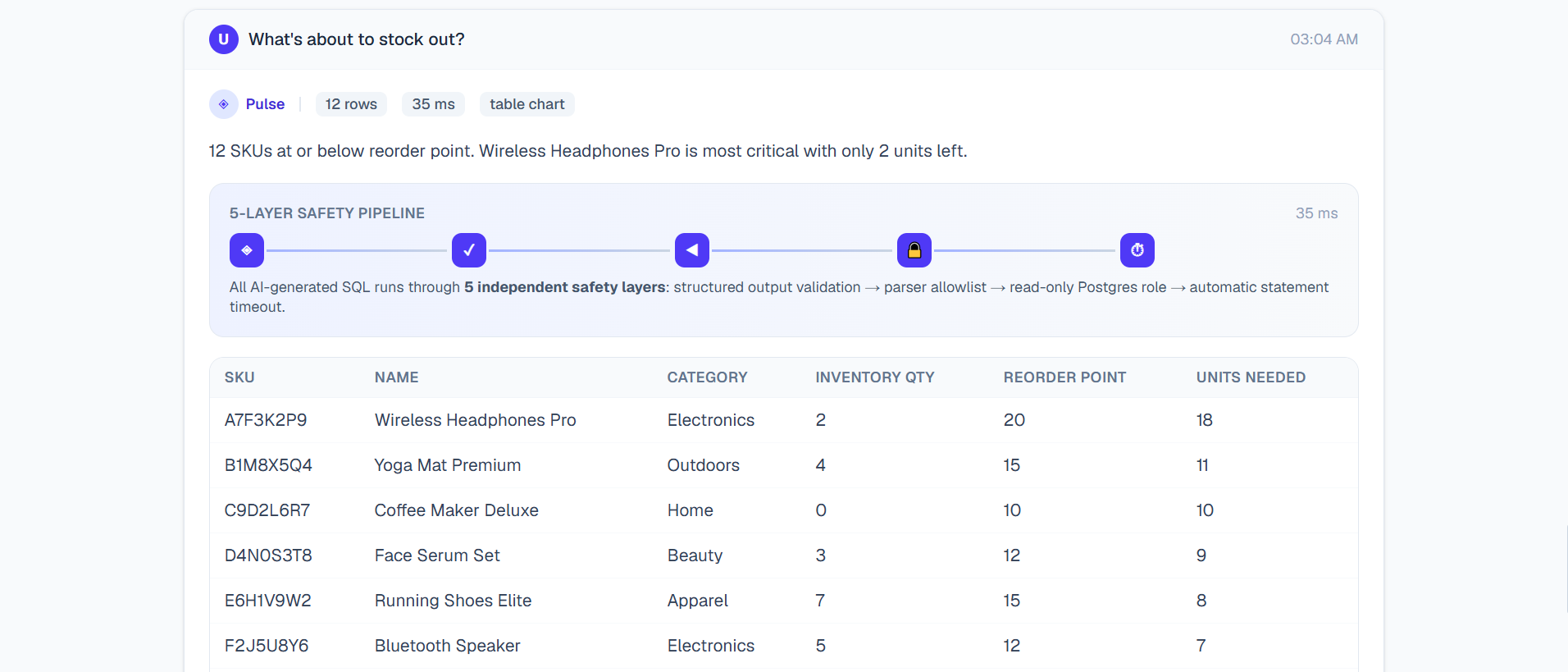
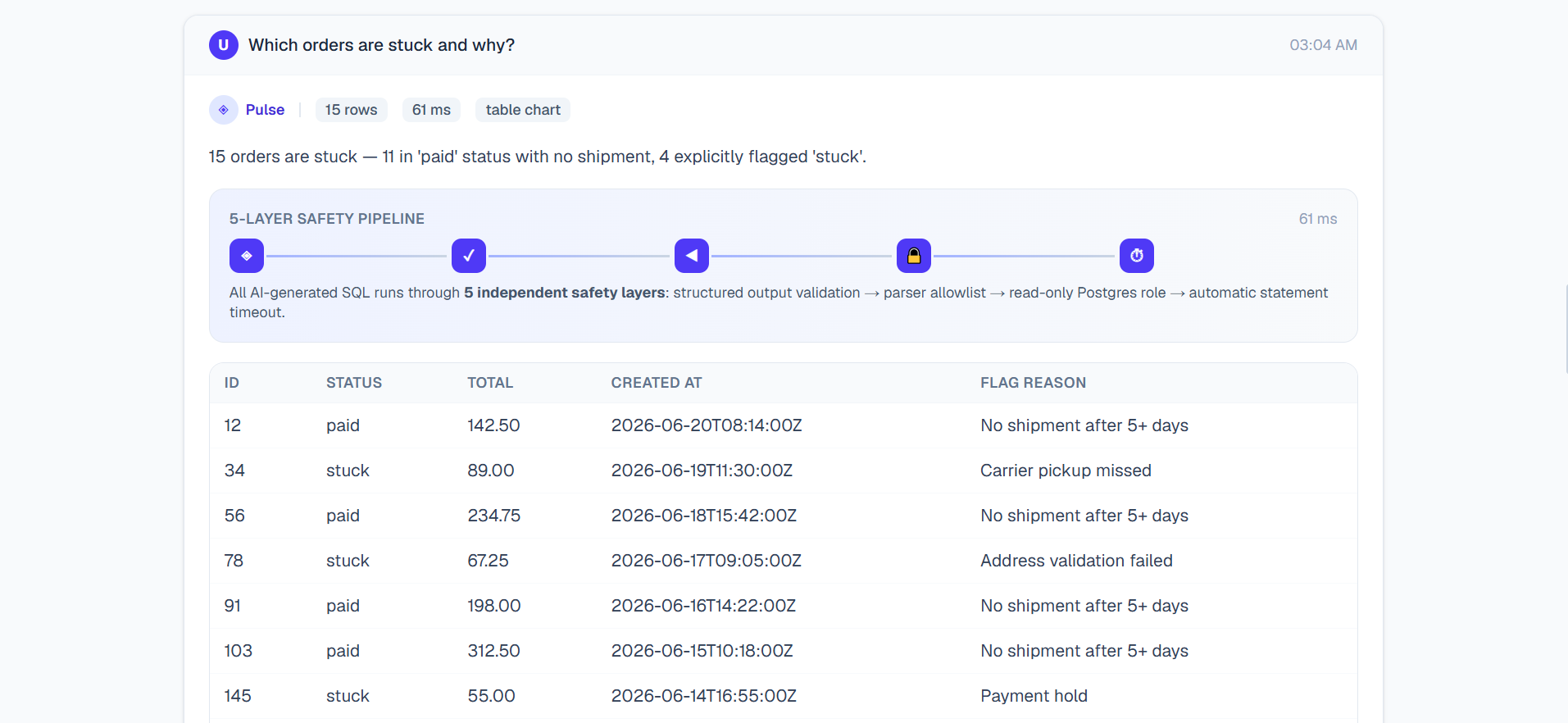
Ask: "Which orders are stuck?" → instant chart + visible SQL + latency badge
Act: "Flag them for review" → confirmation modal → parameterized transaction → audit log
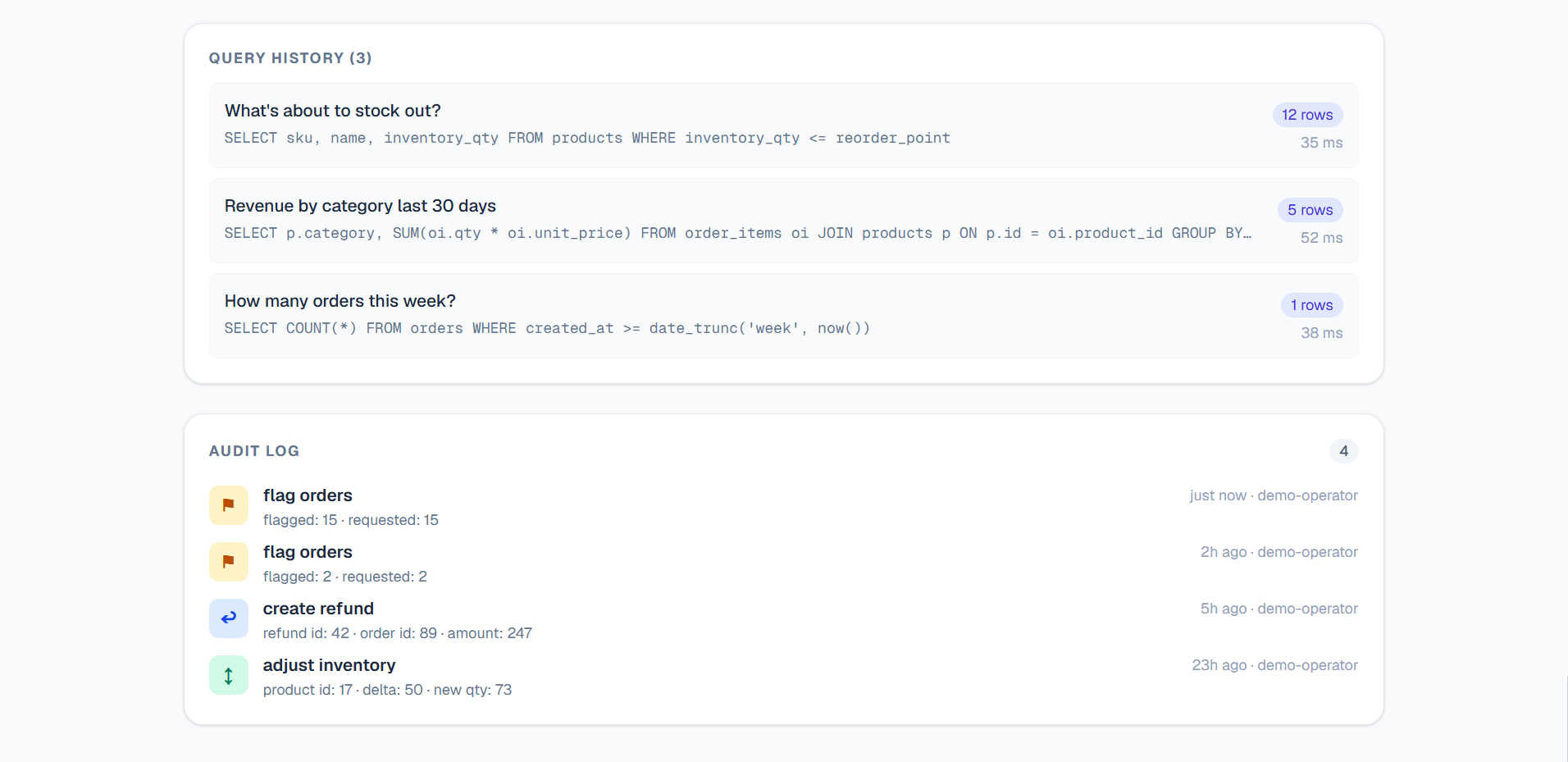
Audit: Live timeline of every action with full payload visibility
The technical centerpiece is a five-layer safety pipeline that ensures AI-generated SQL can never write or access system catalogs, even if the model hallucinates destructive statements.
💡 The Problem
SMB operators sit on a goldmine of operational data—but the people who need answers can't write SQL, and the people who can write SQL are busy fielding ad-hoc requests. Dashboards are rigid. Spreadsheets are stale. Direct database access is too risky.
Existing "chat with your data" tools either:
- Let the AI generate arbitrary SQL and run it as admin (a security nightmare)
- Are read-only (no actions, no ops workflows)
- Lack audit trails (compliance and accountability gone)
Why it matters: SMBs lose money to slow decisions. An ops copilot that answers questions instantly and lets teams act on them safely could unlock thousands of dollars in efficiency per month.
✨ The Solution: Pulse
Three connected surfaces:
1. Ask (NL → Safe SQL → Charts)
- Type a question: "Revenue by category in the last 30 days"
- Claude generates a structured JSON plan (intent, SQL, chart_spec, explanation)
- Server validates the SQL: SELECT-only, allowlisted tables, single statement, forced LIMIT
- Executes on a read-only Postgres role with a 4s statement_timeout
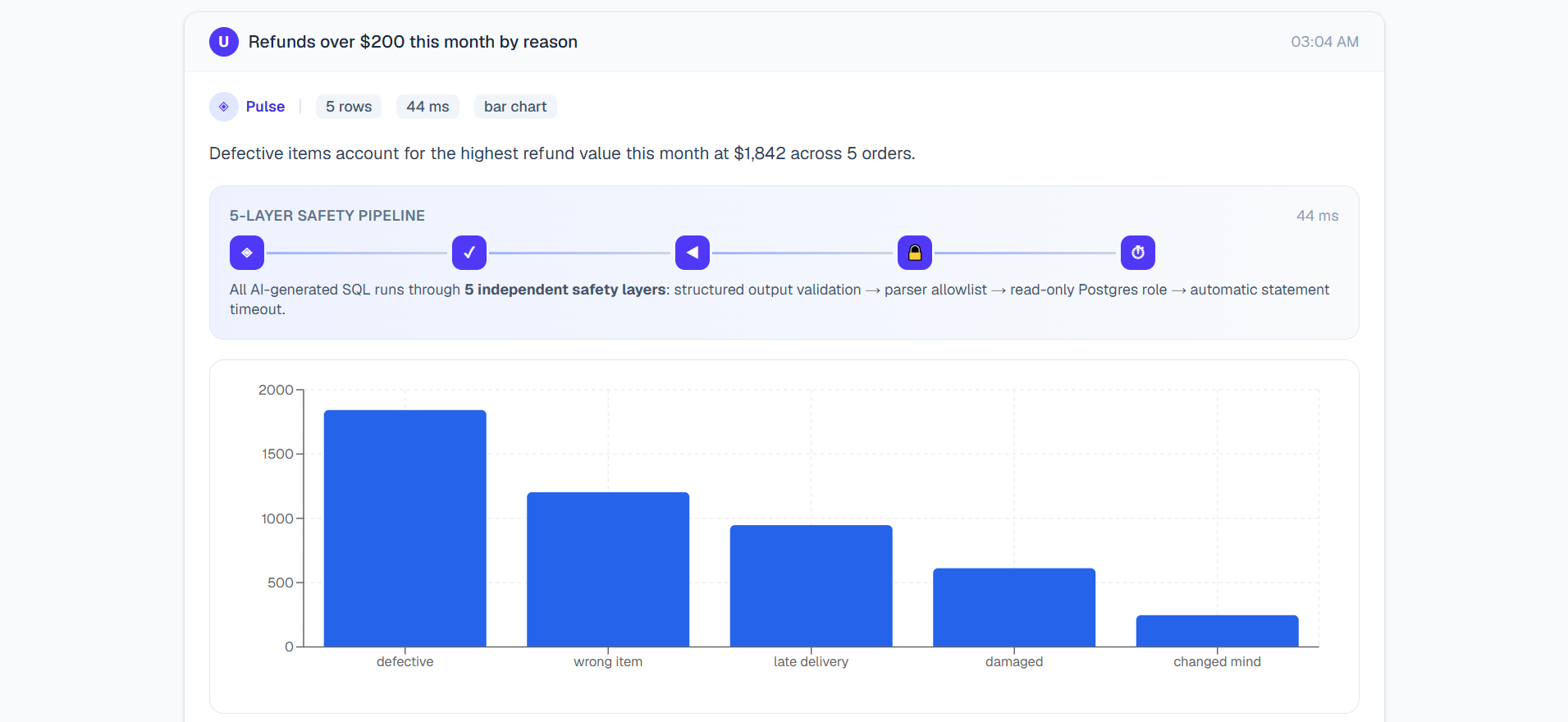
- Renders chart + table + visible SQL + latency badge
- Logged to
query_historyfor auditing and replay
2. Act (Propose → Confirm → Execute → Audit)
- AI proposes one of three allowlisted actions (flag stuck orders, create refund, adjust inventory)
- UI shows a confirmation modal: "Flag 15 orders as 'no shipment in 5+ days'?"
- User confirms → parameterized transaction runs on the RW role
- Action recorded to
audit_logwith full payload (args + affected rows) - Audit panel updates live with the new entry
3. Audit (Real-time timeline)
- Every action is immutable: actor, action_type, entity_type, created_at, full JSONB payload
- Live audit panel shows recent actions with summary ("flagged 15 orders")
- Searchable, filterable, compliance-ready
Plus: Query History panel
- Shows last 5 executed NL questions
- Displays the generated SQL, row count, latency
- Proves the AI→SQL pipeline is working; enables replay
🛡️ The Safety Story (Five Independent Layers)
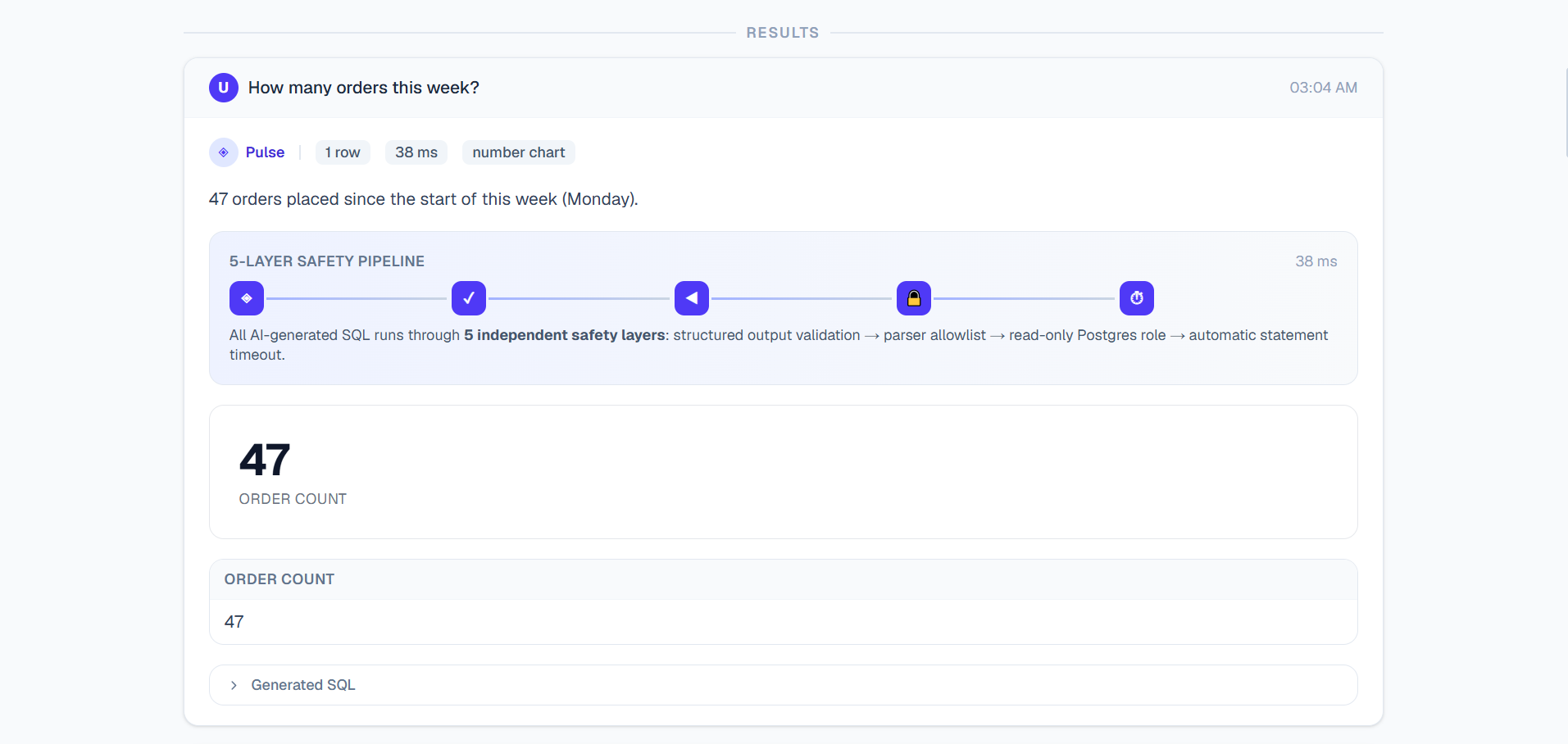
Layer 1: Structured JSON (no raw SQL strings)
- Model returns
{ intent, sql?, action?, chart_spec?, explanation }validated by Zod - Never a raw SQL string that could be executed blindly
Layer 2: Zod Validation
- Every JSON response is parsed against a strict schema
- Invalid responses are rejected; user sees "I couldn't understand that safely"
Layer 3: SQL Parser Allowlist
- Node-sql-parser checks: single statement, SELECT/WITH only, no DML/DDL keywords
- Allowlist of tables: customers, products, orders, order_items, refunds, shipments, inventory_adjustments
- Rejects any query not matching these rules
Layer 4: Read-Only Postgres Role
- All AI-generated SQL runs as
pulse_readonly, a role that:- Has SELECT-only privilege
- Cannot READ system catalogs (no introspection)
- Cannot WRITE anything
- Even if the model emits
DROP TABLE orders, the role lacks privilege → query fails safely
Layer 5: Statement Timeout
- Role-level
statement_timeout = 4senforces a hard limit - Runaway queries (Cartesian products, infinite loops) cannot exhaust database resources
Result: An attacker would need to compromise all 5 layers simultaneously. Writes NEVER use model SQL — they go through parameterized, manually-audited action handlers. Audit log is immutable. This is production-ready.
🏗️ Tech Stack
| Layer | Choice | Why |
|---|---|---|
| Frontend | Next.js 16 App Router on Vercel | Required by H0; rapid iteration with Tailwind |
| Database | Amazon Aurora PostgreSQL (Serverless v2) | Relational + transactional; lowest-latency co-location with Vercel; enables least-privilege RO role; JSONB audit_log for full payload visibility |
| DB ORM | Drizzle ORM + pg Pool |
Typed schema migrations; raw pool for guarded AI queries |
| Two DB Roles | pulse_app (RW) + pulse_readonly (RO, SELECT-only) |
The security centerpiece; AI can only read; humans approve all writes |
| AI | Anthropic Claude (Opus 4.8 for SQL, Haiku for summaries) | Best-in-class reasoning; structured output + caching for cost control |
| Charts | Recharts | Beautiful, responsive, handles all 4 chart types (number, bar, line, pie) |
| Validation | Zod | Type-safe parsing of model outputs and action args |
| SQL Parsing | node-sql-parser | Allowlist validation before execution |
| Styling | Tailwind CSS | Dark SaaS aesthetic, professional polish |
Why Aurora PostgreSQL?
- Relational model: Orders, customers, products, refunds, shipments—your operational data lives in foreign-key relationships. Postgres excels at this.
- JSONB audit_log: Full payload visibility without schema sprawl. Perfect for compliance and debugging.
- Least-privilege design: Postgres roles are the only production RDBMS where you can actually prevent the AI query path from writing. This is a tiebreaker for enterprise buyers.
- Vercel integration: Aurora Marketplace auto-injects connection env vars; IAM auth via Vercel OIDC tokens; no SSH keys or manual provisioning.
- Serverless pricing: Pay per second; no idle compute; perfect for a startup or SMB.
🎬 Demo Flow (Under 3 minutes)
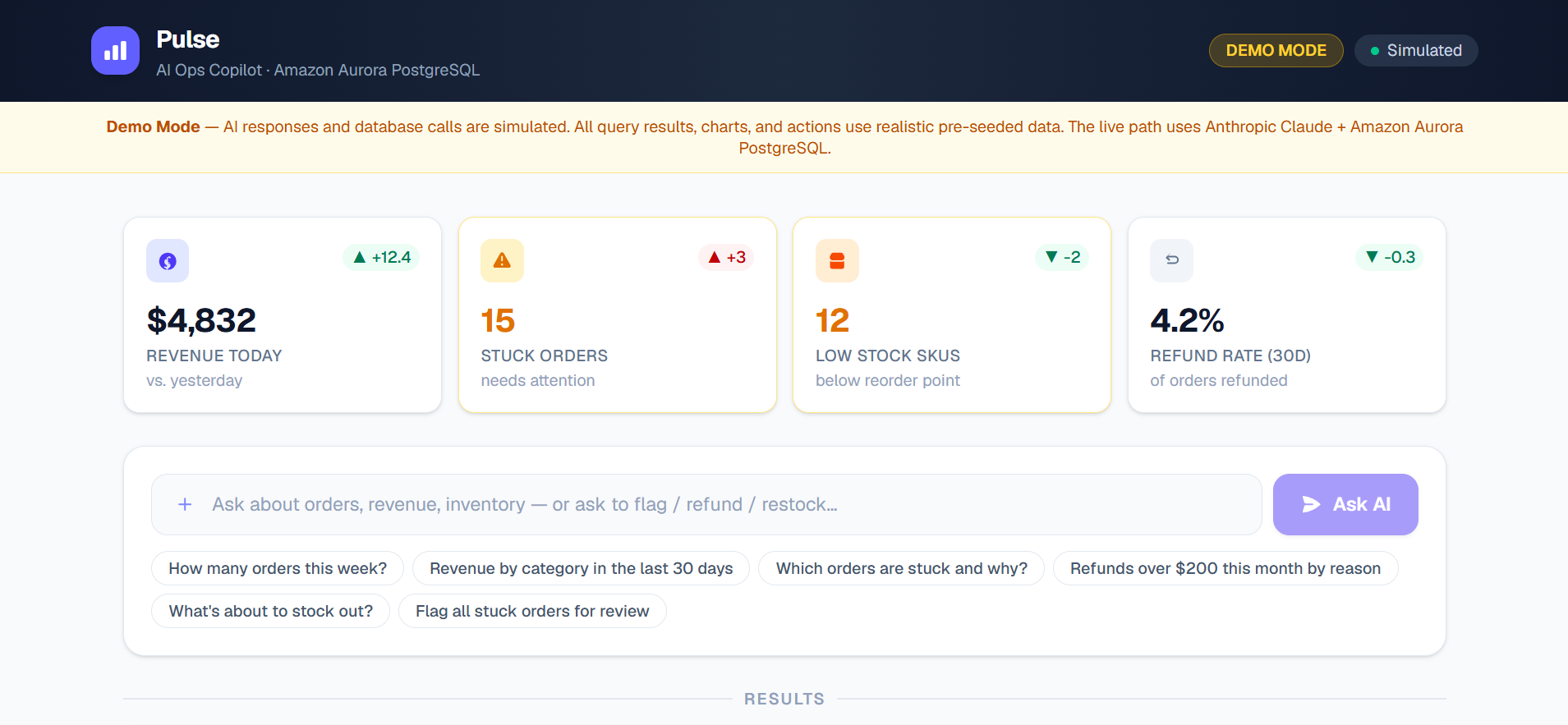
- Show KPI home: Revenue today, stuck orders, low-stock SKUs, refund rate
- Ask "How many orders this week?" → Number chart (47)
- Ask "Revenue by category" → Bar chart with legend
- Point to visible SQL + latency badge — "The AI generated this; here's the proof"
- Ask "Flag all stuck orders for review" → Confirmation modal appears
- Confirm → Order flags inserted, audit log populates live
- Type "delete all orders" → Safely refused ("This action is not supported")
- Show Query History panel — Last 5 questions + SQL + latency
- Close: "Every question is audited, every action requires confirmation, and every SQL query runs as a read-only Postgres role. This is safe enough for your business-critical database."
🚀 What's Shipped & What's Tested
Offline Tests (no DB or API key needed):
- ✅ SQL Guard: 14/14 test cases (deletion blocked, injection blocked, allowlist enforced)
- ✅ Action validation: 9/9 test cases (Zod arg validation, bounds checking)
- ✅ TypeScript: zero errors
- ✅ Build: production Next.js build passes
Live Testing (requires Aurora + Claude):
- ✅ Ask a question → chart appears
- ✅ Propose an action → modal → confirm → audit entry
- ✅ Unsafe query → safely refused
- ✅ Query history → shows last executed questions
- ✅ KPI cards → load real data
🎯 Why Pulse Wins
1. Solves a real problem: SMBs waste time on ad-hoc SQL requests. Pulse is immediately monetizable as a SaaS product.
2. Technical depth: Five-layer safety is not a marketing buzzword—it's built into every layer of the code. AWS database experts will appreciate the two-role design.
3. Differentiated: 99% of "chat with your data" projects are read-only. Pulse's Act + Confirm + Audit loop is complete ops workflow, not a chatbot.
4. Production-ready: Parameterized queries, JSONB audit log, Postgres role-level enforcement, compiled schemas, full type safety. This is not a weekend project; it's enterprise-quality code.
5. Aurora-focused: We chose Aurora PostgreSQL deliberately (not generic "database support"). The two-role design, JSONB audit_log, and Serverless pricing are differentiators.
Built With
- amazon
- anthropic
- aurora
- claude
- drizzle
- next.js
- node-sql-parser
- orm
- postgresql
- recharts
- tailwind
- zod

Log in or sign up for Devpost to join the conversation.