-
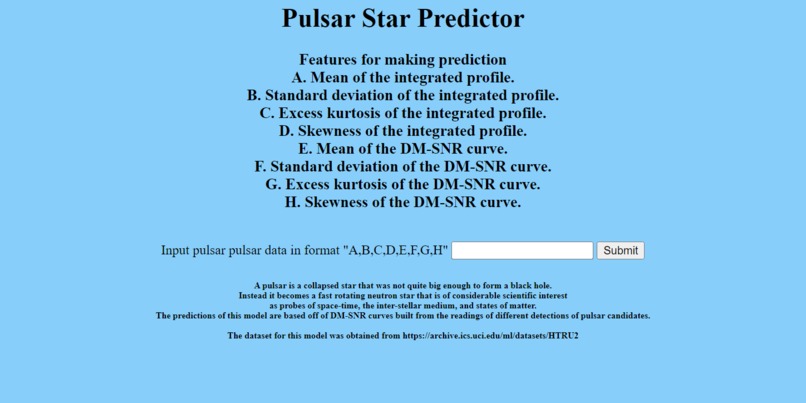
Main page for the web application.
Inspiration
Having taken classes studying astrophysics and astrobiology, I have always had an interest in the sky. My background knowledge and interest in the subject led me to be interested in how machine learning could play a role in the field.
What it does
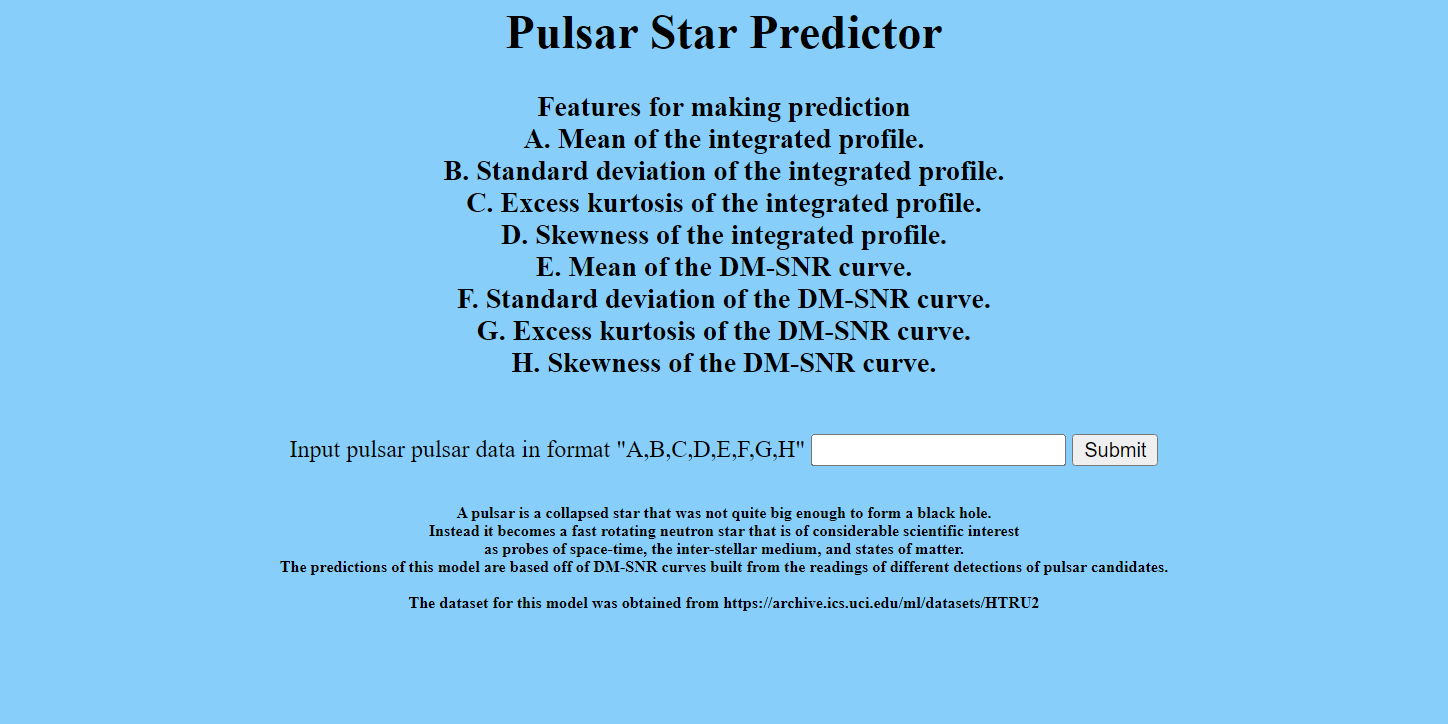
It takes as input readings that would be collected from strong telescopes and indicates the likelihood of those readings being that of a pulsar star.
How we built it
This model was built using logistic regression to classify each data point as either a pulsar or not a pulsar.
Challenges we ran into
The main challenge was the rarity of pulsars, resulting in a dataset consisting of over 90% negative test cases. This resulted in some fine tuning of hyperparameters in order to minimize the impact of this fact.
Accomplishments that we're proud of
Getting a near 99% accuracy on the validation set.
What we learned
Through this project, the key information on how to actually save and reuse a trained model was learned along with how to implement that model in a web application.
What's next for Pulsar Predictor
At this point, it is likely that the Pulsar Predictor will not be able to get much more effective using logistic regression. Moving forward, if one wants to get an accuracy above about 98%, then a different model will likely have to be used. However, the web app could be improved in the future.

Log in or sign up for Devpost to join the conversation.