-
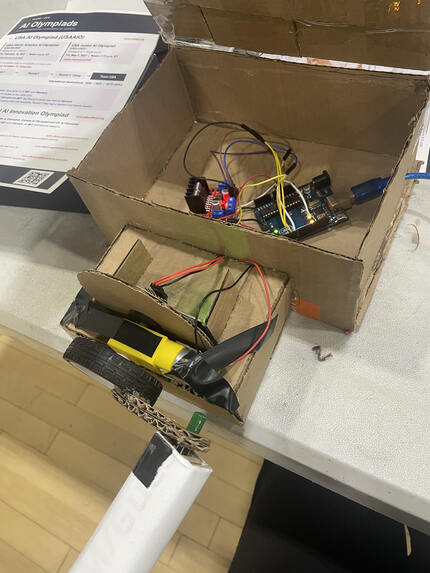
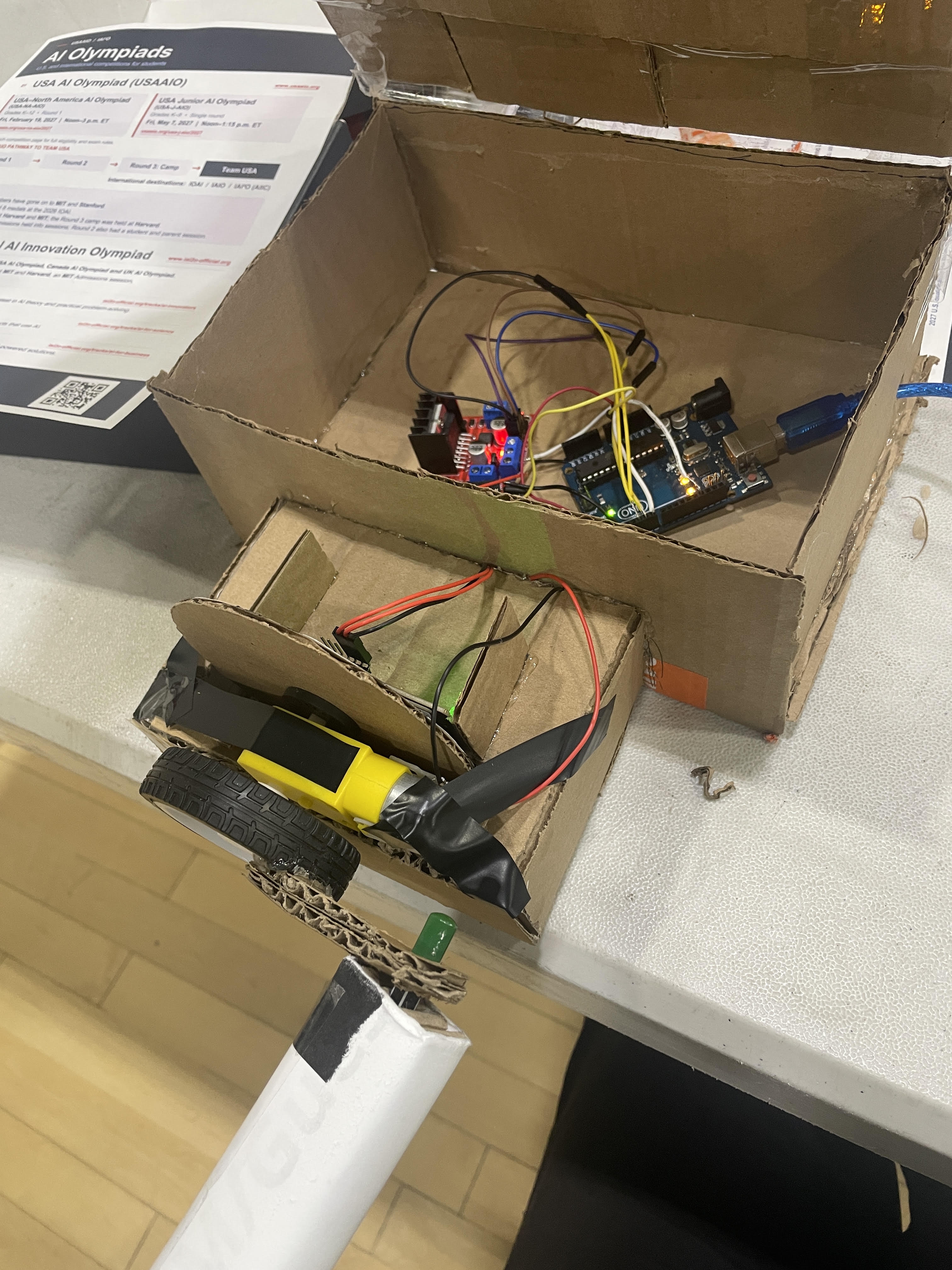
The hardware
-
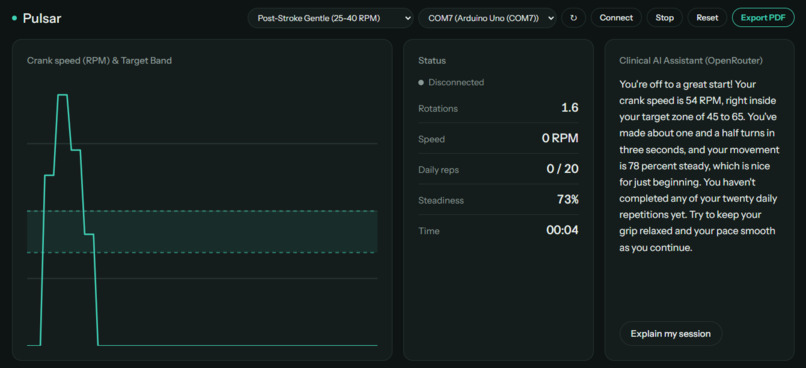
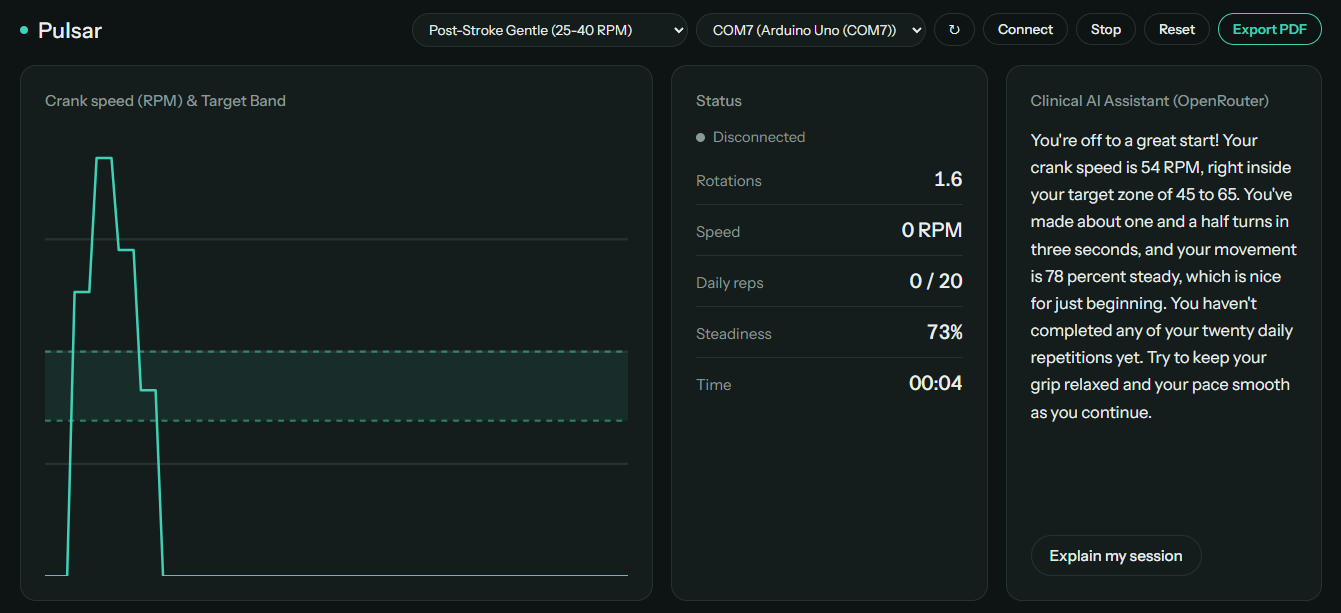
The website
Inspiration
My friend in India was run over by a car. His arm was paralyzed and the doctor said he needed physical rehabilitation. He couldn't afford these services in the hospital, so they gave him home remedies. However, he had a tough time improving via these remedies, so he was stuck in a place where he didn't know how to get better.
What it does
PULSAR is a system designed around the idea of removing the uncertainty around whether a patient is improving via treatments such as home remedies. PULSAR in its simplest form uses a motor, IR tracker, and Arduino to help check and monitor the progress of patients who engage in home remedies for rehabilitation and need confirmation that it works.
How we built it
First, we started with the hardware, wiring together the motor, Arduino, IR tracker, and motor driver. Next, we had to make our own encoder disk with black and white wedges so that the IR tracker's beam could be open and closed to count RPM. After that, we made a way to save and transmit the data via the USB wire to a computer. We then shifted to the software side where we made a website whose purpose is to show this data. On the website we put graphs, data, and an ask AI button for the user to interpret the data. We made the website as easy as possible because the patients that use this will need ease of use.
Challenges we ran into
The biggest challenge was aligning the IR tracker with the encoder disk as it was really sensitive to the shaking and friction that occurs from rotating the disk. Another challenge was scaling the graph correctly to reveal what's actually happening without making it look like an exaggeration. The last challenge we faced was with the cloud integration, where we unfortunately can't host the website because the port and Arduino only work locally.
Accomplishments that we're proud of
After hours of work, we got the encoder disk to be aligned with the IR tracker and count the revolutions per minute accurately. We were also proud of the fact that we were able to make all of this with items costing less than $30.
What we learned
How to use an IR tracker and encoder disk to count RPM. Understanding how all the hardware and software connect to each other and how to transmit data via USB wire.
What's next for Pulsar
We want to add a data transmitter with Bluetooth so that the user does not need to connect a USB wire to the Arduino every use. We also want to add an NFC tag and give multiple users individual accounts so that this product can be shared in case people in poverty-stricken communities can't afford it. We also want to use cheaper parts, like an ESP32 instead of Arduino to decrease the cost enough so that everyone who needs it can definitely afford it.
