-
-
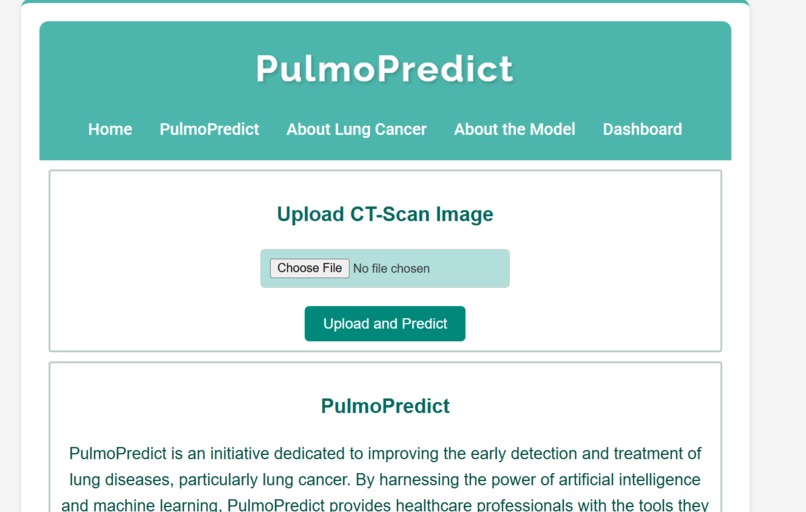
web application screenshot
Inspiration
The inspiration for PulmoPredict came from the high number of lung cancer cases around the world and the urgent need for early detection. In regions with limited access to specialized healthcare, many patients go undiagnosed until it's too late. By leveraging advanced machine learning, I aimed to provide a powerful tool that assists doctors and individual in identifying lung cancer early, ultimately saving lives and making healthcare more accessible
What it does
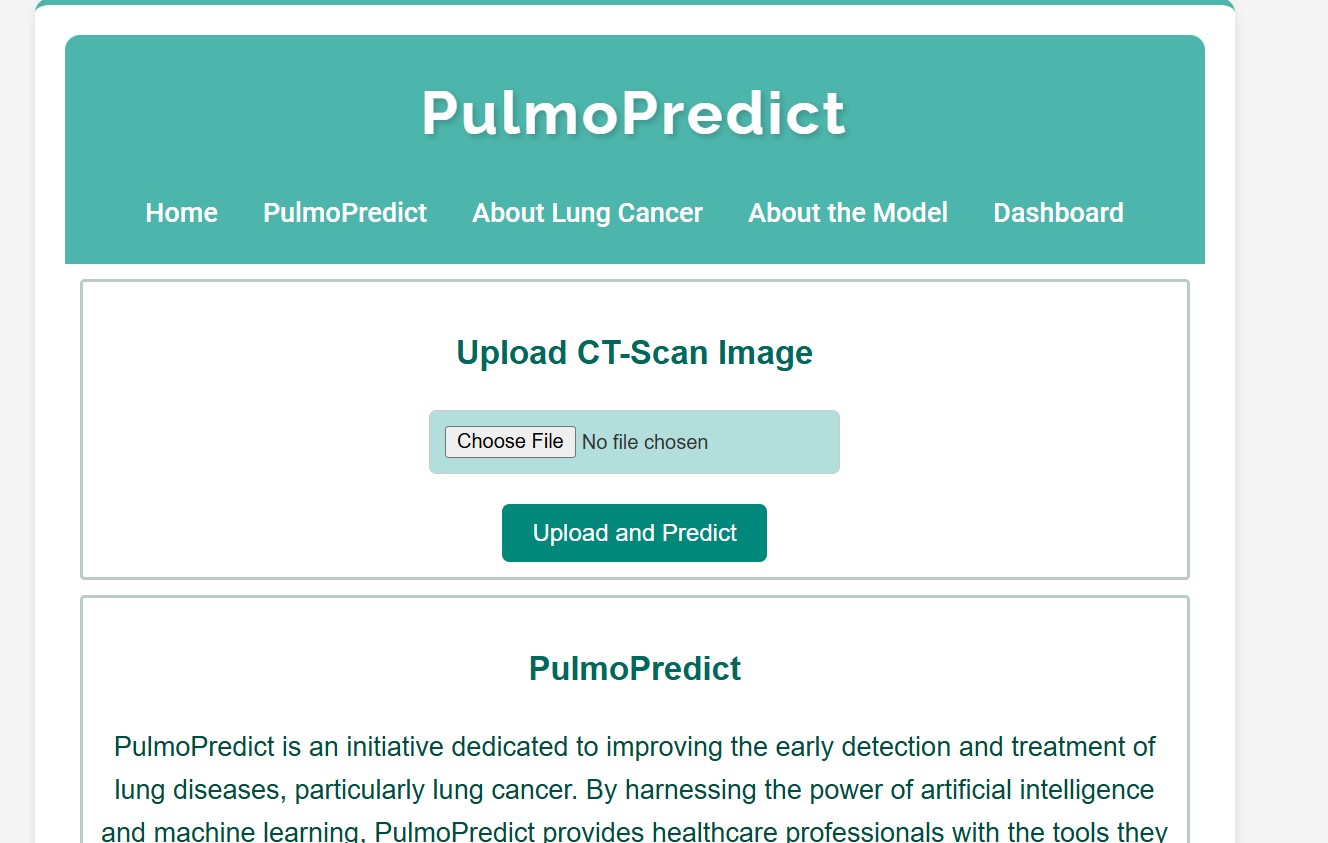
PulmoPredict allows users to upload CT-Scan image, which are then analyzed by my sophisticated machine learning model to predict the likelihood and the type of cancer. The application provides a detailed report, including the predicted class and a brief explanation of the model's decision, helping doctors make informed decisions quickly and efficiently.
How I built it
I developed PulmoPredict, a lung condition prediction web app, using React.js for the frontend and Flask for the backend. The app utilizes a pre-trained TensorFlow model for real-time predictions, with Flask-CORS managing cross-origin requests. The entire setup was completed in a local development environment, enabling seamless image uploads and predictions.
Challenges we ran into
Throughout the development of PulmoPredict, I encountered several challenges particularly in integrating the machine learning model with the front-end and back-end posed technical hurdles, particularly with API communication. Ensuring the training data was clean and representative of various lung cancer cases was crucial. Another major challenge was Model Accuracy, Initial models showed low accuracy, prompting extensive experimentation with different architectures and hyperparameters to achieve satisfactory performance.
Accomplishments that we're proud of
I am immensely proud of several accomplishments with PulmoPredict, I achieved a high prediction accuracy of 98%, enabling early detection and reliable results. I developed a fully functional web application with a robust machine learning backend in a short timeframe, all by myself. I also created an intuitive interface that makes it easy for users to upload images and receive predictions.
What we learned
I figured out how to build a complete web-app by combining different technologies. I learned to leverage APIs to enhance functionality and learned how to integrate ML model in backend to the frontend. I realized the importance of user experience, ensuring that health tech solutions are intuitive and easy to adopt.
What's next for PulmoPredict
PulmoPredicthas a bright future ahead, with many exciting plans. These include: -Adding new capabilities to detect more lung conditions and provide more detailed results. -Making the app available to healthcare providers everywhere by hosting it on a strong server. -Creating a mobile app so users can get predictions anywhere, anytime. -Working with hospitals and clinics to integrate PulmoPredict into their diagnosis processes, helping more patients get early detection.
Built With
- axios
- chatgpt
- css
- flask
- git
- javascript
- python
- react.js
- tensorflow
- vscode


Log in or sign up for Devpost to join the conversation.