-
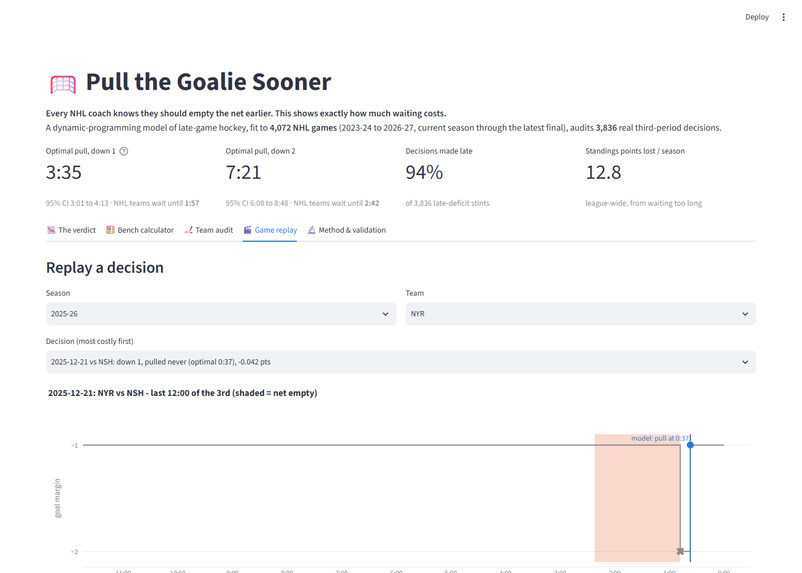
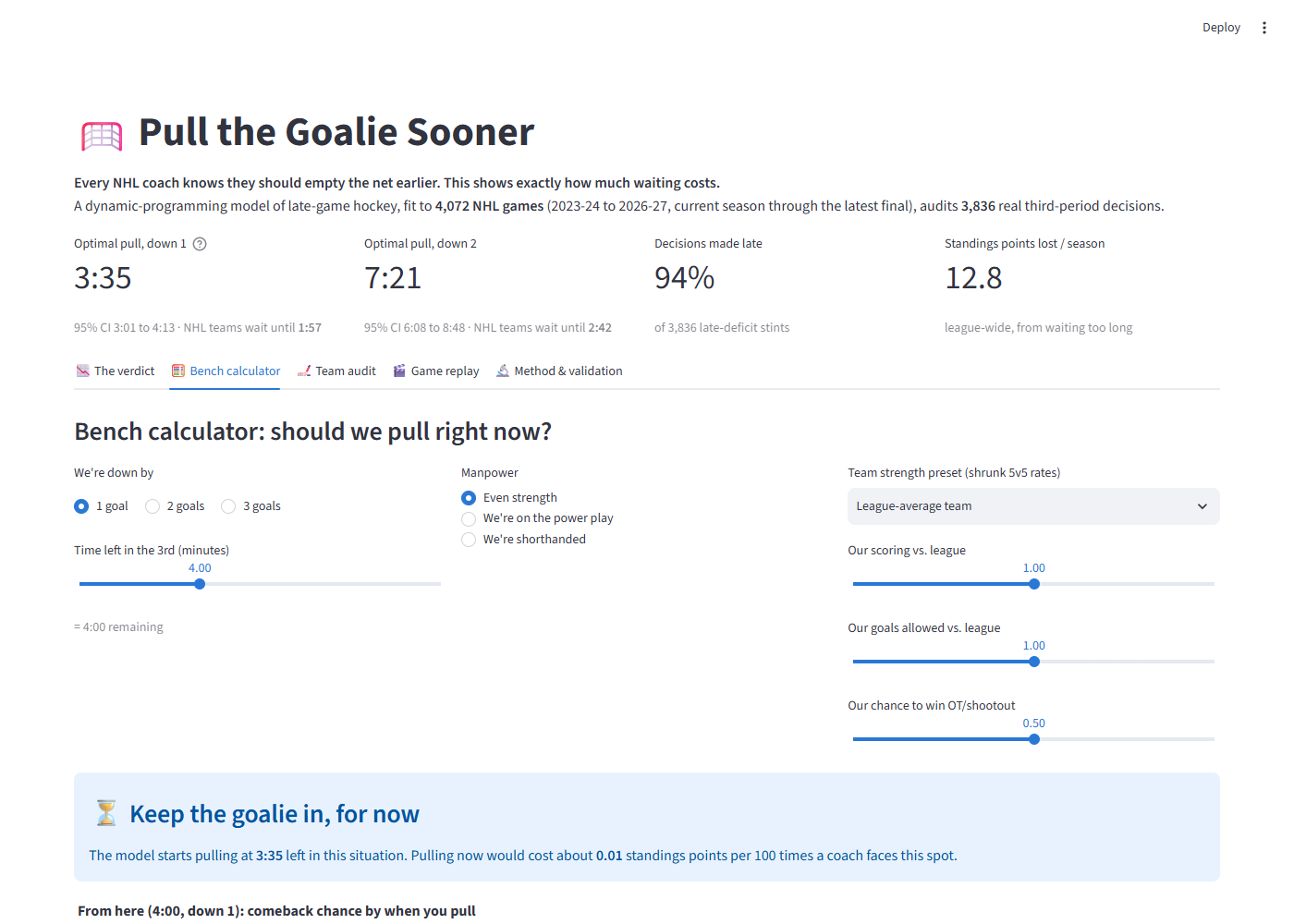
Bench Calculator: enter the score, time left and power-play situation to get a clear "pull now" or "wait" answer.
-
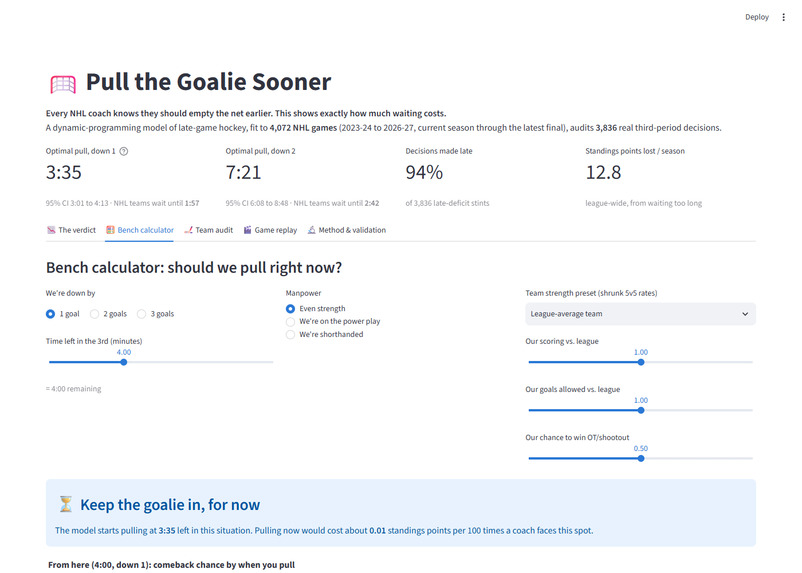
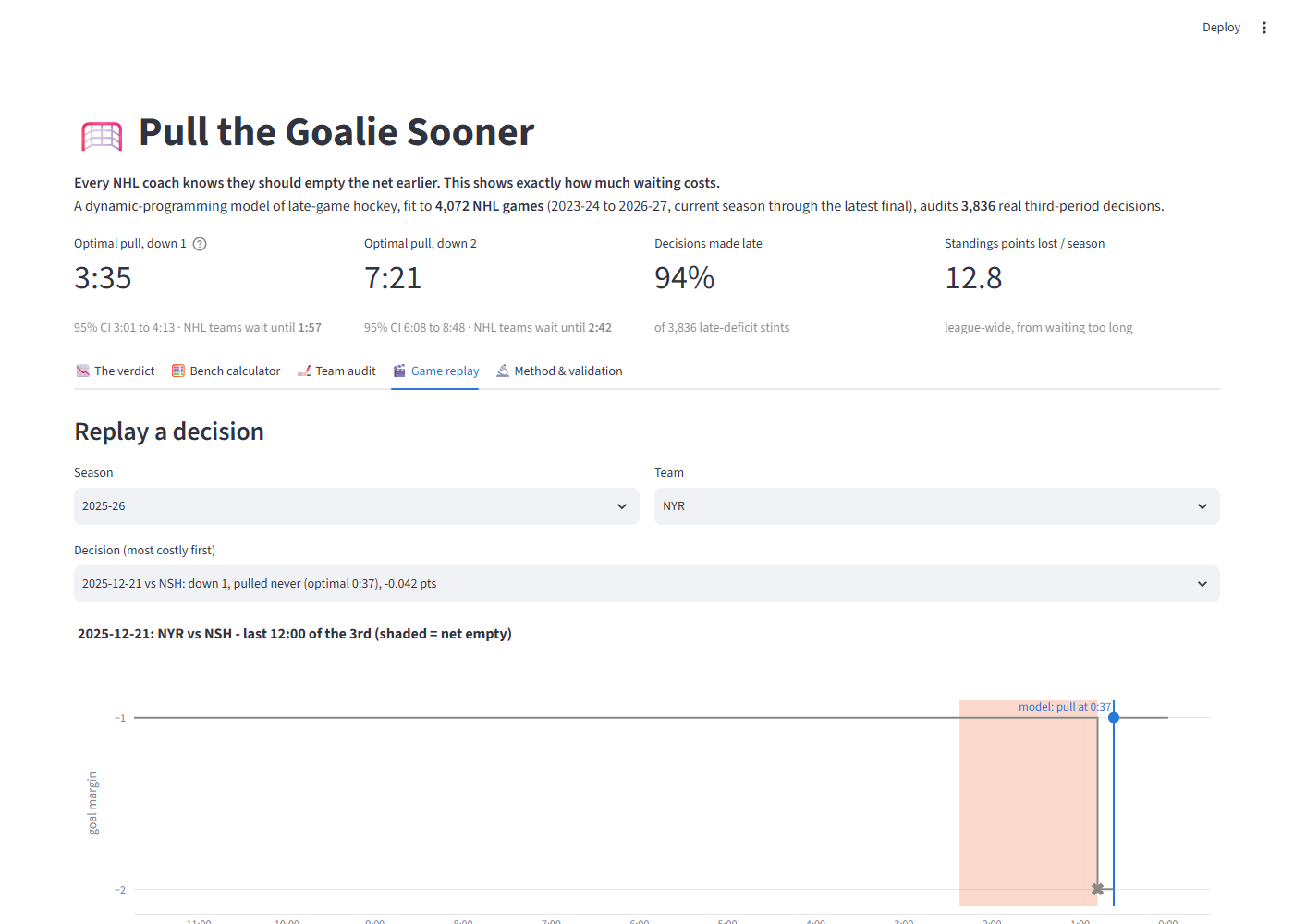
Game Replay: when a real team pulled its goalie vs. when the model says it should have.
-
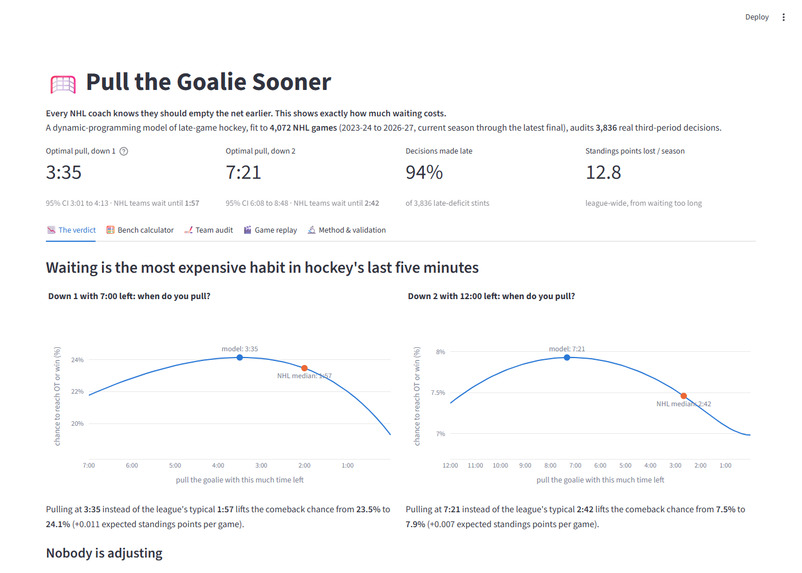
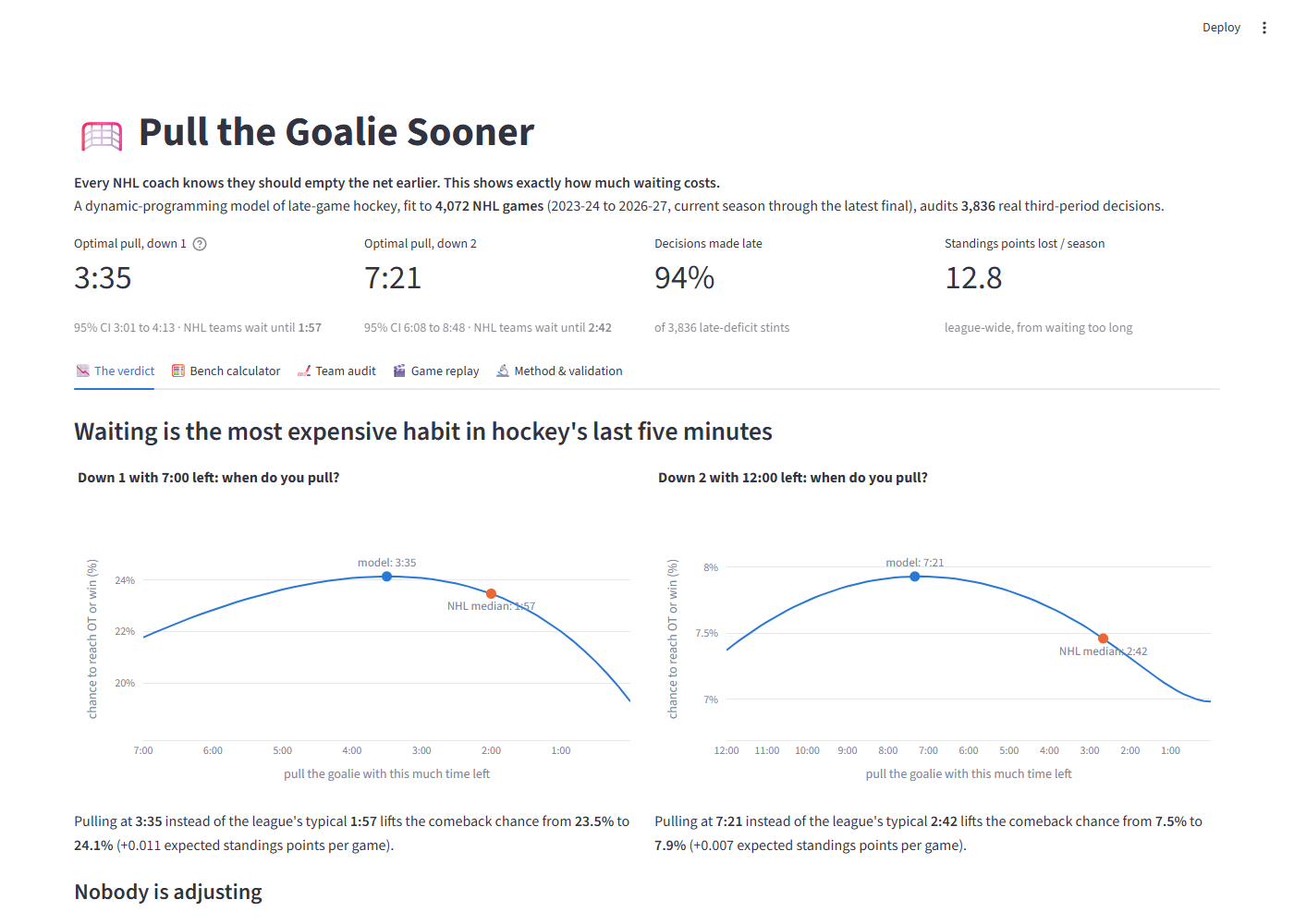
The Verdict: the best time to pull is 3:35 left when down 1 and 7:21 when down 2. NHL teams wait until 1:57 and 2:42.
-
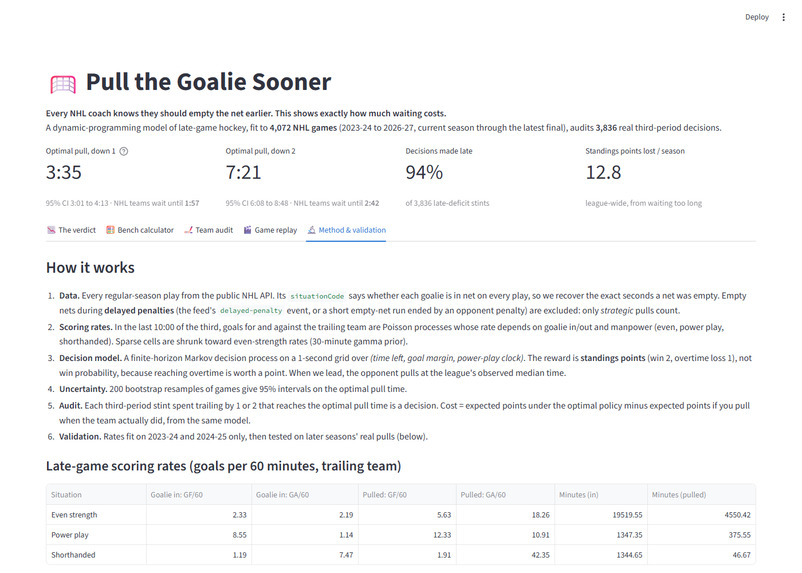
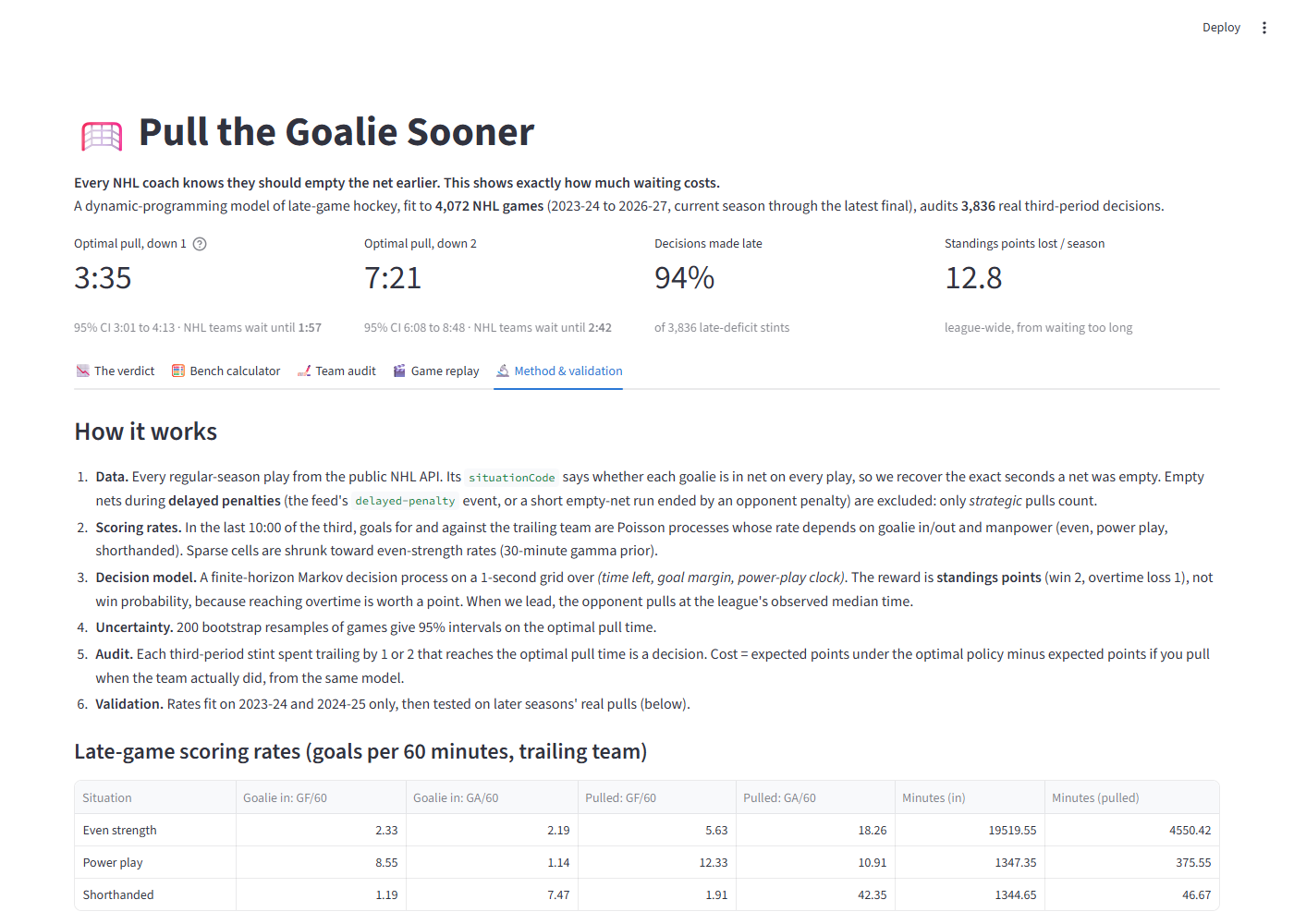
Method & Validation: the scoring rates behind the model, how certain it is, and how it performed on games it wasn't trained on.
-
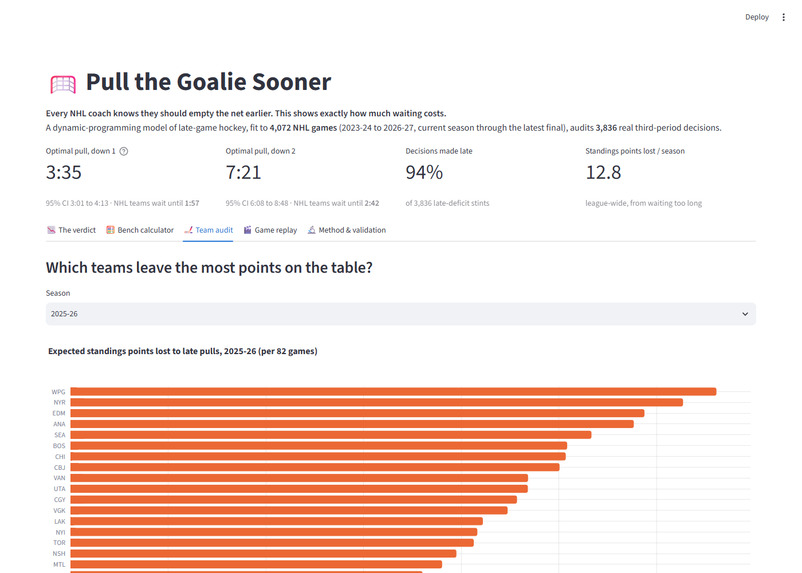
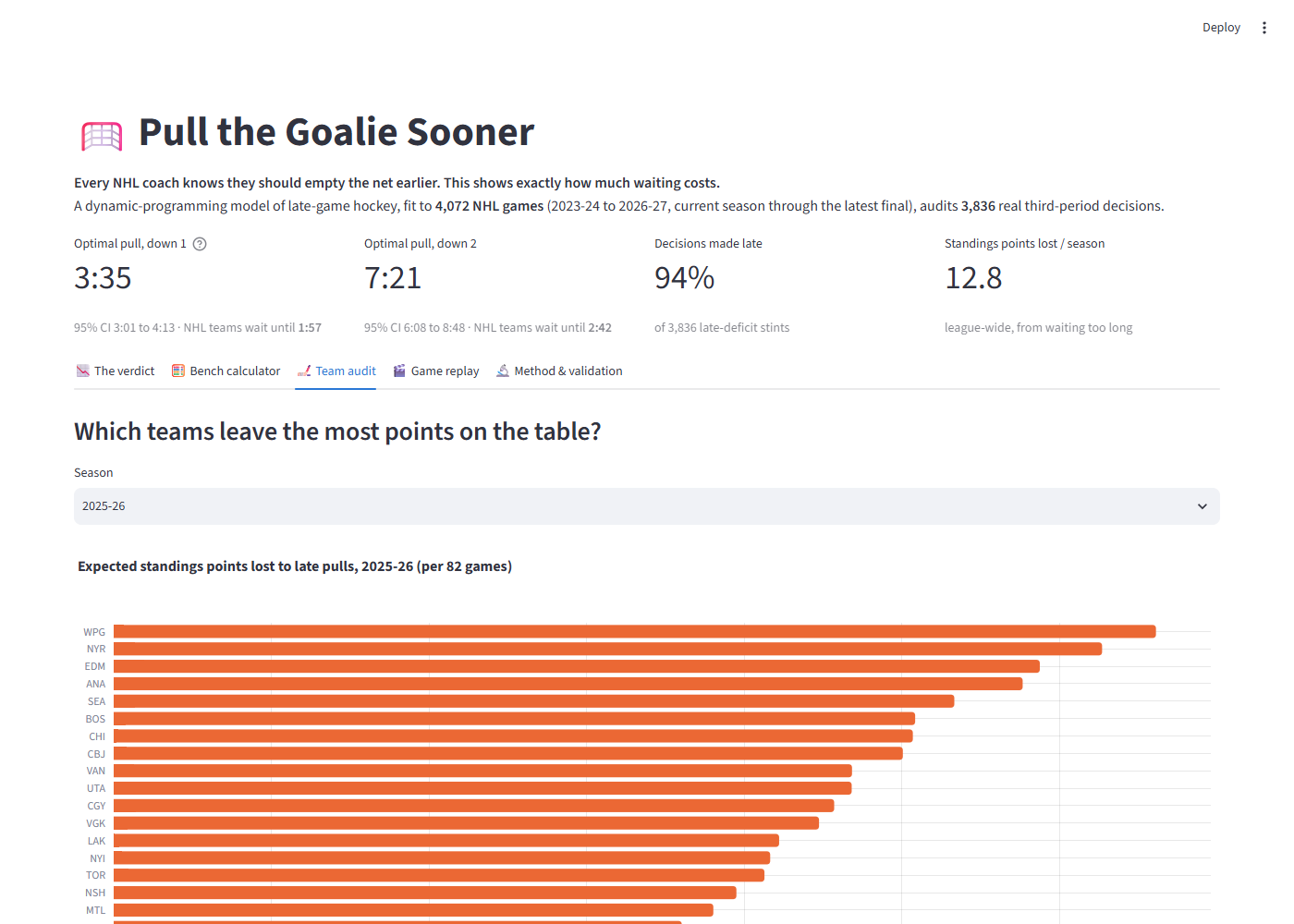
Team Audit: every NHL team ranked by the standings points it lost by pulling the goalie too late.
Live app: https://waazy-w.github.io/pull-the-goalie/ (runs in your browser, first load ~30 seconds) Code: https://github.com/waazy-w/pull-the-goalie
The problem
When a hockey team is losing late in a game, the coach can pull the goalie and add an extra attacker. It's a gamble: you're more likely to score, but the other team can shoot into an empty net. Analysts have said for years that coaches wait too long, but coaches have never had a simple answer to "when exactly should I pull?"
What we built
A web app that answers that question, using every play from 4,072 NHL games (2023-24 to today).
- The Verdict: the best time to pull vs. what NHL teams actually do.
- Bench Calculator: enter the score, time left, and power-play situation, and it tells you "PULL NOW" or "WAIT until 3:35".
- Team Audit: ranks every team by how many standings points they lost by pulling too late.
- Game Replay: pick a real game and see when the team pulled vs. when they should have.
What we found
| Situation | Best time to pull | When NHL teams actually pull |
|---|---|---|
| Down by 1 goal | 3:35 left | 1:57 left |
| Down by 2 goals | 7:21 left | 2:42 left |
- 94% of these decisions were made too late, and teams haven't changed in four seasons.
- Waiting too long costs the league about 13 standings points every season.
- Stronger offensive teams should pull even earlier, as early as about 5 minutes left.
How it works
- We downloaded every play from the free NHL API, which tells us exactly when each goalie was on the bench.
- We measured how often teams score and get scored on with the goalie in vs. pulled.
- We used a dynamic programming model to simulate the rest of the game second by second and find the pull time that earns the most standings points.
- We checked our work: we trained on two seasons, tested on later seasons, and used bootstrapping to get confidence ranges (down 1: 3:01 to 4:13).
Why it matters
- Coaches get a simple rule for the bench: down 1, pull at 3:35; down 2, pull at 7:21.
- Front offices see exactly how many points the habit costs their team.
- It's free value: no trades, no salary cap space, just better timing.
Limitations
Each late pull costs only a small amount; it adds up because it happens about 1,000 times a season. The model also doesn't know where the puck is when the goalie is pulled, so its predictions for comebacks are a bit conservative.

Log in or sign up for Devpost to join the conversation.