Inspiration
Puka started with my dog, Skyler.
Skyler has recurring colitis, and feeding him often felt like detective work. A food could look healthy, have premium packaging, and still trigger diarrhoea, mucus, or days of discomfort. Ingredient labels were difficult to interpret, online advice was contradictory, and most answers ended with the same frustrating sentence: “It depends on your dog.”
That sentence became the idea.
Pet parents do not only need to know whether an ingredient is generally safe. They need to know whether a specific food is suitable for their specific dog, based on factors such as allergies, sensitivities, breed, weight, age, and health history.
There are great tools that help humans understand what they eat. I wanted to build that same layer of clarity for dogs, while recognising that dog nutrition is not as simple as labelling every ingredient good or bad.
What it does
Puka helps dog parents answer one urgent question:
“Can I feed this to my dog?”
Users create a profile for their dog, including age, breed, weight, allergies, sensitivities, and other relevant information. They can then scan packaged dog food, treats, human food, fresh ingredients, or meals they are considering feeding.
Puka analyses the available information and returns:
- A clear verdict
- A score out of 100
- The main reasons behind the result
- Ingredients or nutritional concerns to pay attention to
- Guidance on what to do next
- A confidence level when the available information is incomplete
The result is personalised to the dog rather than being a generic review of the product.
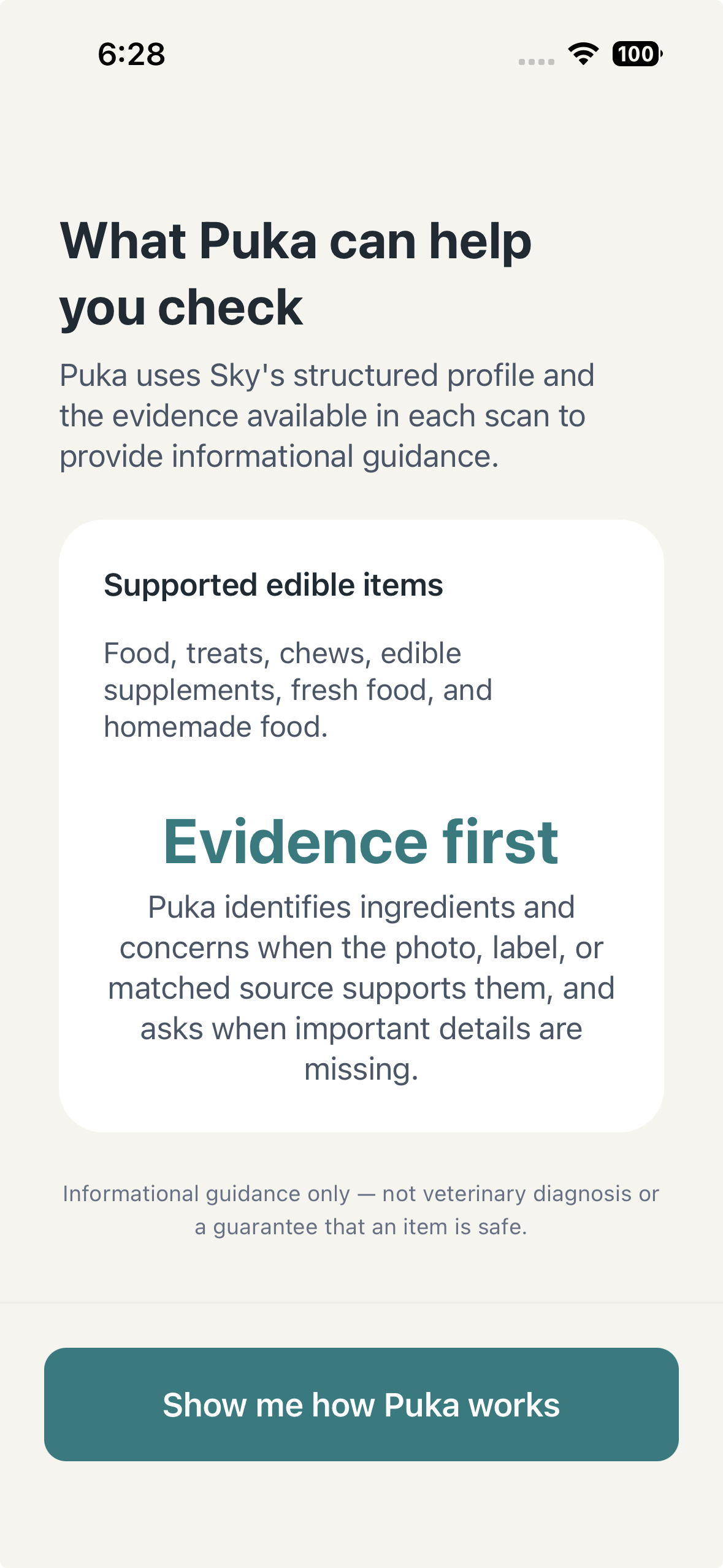
For packaged food, Puka can analyse ingredient lists and nutritional information. For fresh food, it considers the ingredient itself, the amount being fed, and the dog’s profile.
The goal is not to replace a veterinarian. The goal is to help pet parents make safer, faster, and better-informed everyday feeding decisions.
How we built it
We designed Puka as an iPhone-first product because scanning needs to feel immediate. A user should be able to take a photo in the kitchen, supermarket, pet store, or restaurant and get a useful answer without filling out a long form.
The product combines several layers:
Dog profile data Puka uses information about the individual dog to personalise each result.
Image and text extraction The app reads ingredient labels, nutrition panels, product packaging, and photos of fresh food.
Structured food analysis Extracted information is converted into a consistent format so packaged food, treats, and fresh ingredients can be evaluated through the same scan experience.
Personalised scoring Puka checks the food against known risks, the dog’s declared allergies and sensitivities, nutritional concerns, and serving context.
A simplified result experience Instead of presenting users with a wall of analysis, the result is organised around verdict, reasons, action, and confidence.
Subscriptions with RevenueCat RevenueCat powers the subscription system, entitlement management, and purchase flow. This allowed us to spend less time rebuilding payment infrastructure and more time improving the product experience around the moment a user decides Puka is worth paying for.
The broader architecture includes authentication, dog profiles, scan history, cloud data storage, and an analysis service that turns uncertain real-world inputs into structured results.
A major product decision was to create one scanning flow for all edible items instead of separate tools for packaged food, treats, and fresh food. Users should not have to understand our internal categories before asking a simple question.
Challenges we ran into
The hardest part was not recognising ingredients. It was deciding what the answer should mean.
Food safety is rarely binary. An ingredient may be safe in a small amount but harmful in a larger quantity. A food may be acceptable for most dogs but unsuitable for a dog with pancreatitis, allergies, obesity, or a sensitive stomach. A product may contain no toxic ingredients and still be a poor everyday choice.
We had to resist the temptation to make every result sound certain.
Another challenge was incomplete information. Users may photograph only the front of a packet, miss part of the ingredient list, or scan a homemade meal where quantities are unclear. Puka needed to remain useful without pretending it knew more than it did.
Latency was also important. Food analysis can involve multiple photos, text extraction, classification, dog-specific checks, and explanation generation. Even a good result feels broken when the user is left staring at a loading screen with no idea what is happening.
The paywall created a different kind of challenge. Puka needs enough free value to earn trust, but the paid product must also feel meaningfully better. We learned that monetisation cannot be treated as a screen added at the end. The trial, paywall, subscription state, and first successful scan all need to feel like one connected experience.
We also had to be careful with medical language. Puka should highlight possible concerns and suggest when professional advice may be appropriate, but it should not diagnose conditions or turn weak correlations into hard conclusions.
Accomplishments that we're proud of
We are proud that Puka turns a complicated nutritional question into something a pet parent can understand in seconds.
The biggest accomplishment is the unified scan experience. A user can scan a bag of kibble, a treat, a piece of fruit, or a cooked meal without first deciding which tool to use.
We are also proud of the personalised result system. Puka does not stop at “dogs can eat this.” It asks whether this dog should eat it.
Other milestones include:
- Building a complete onboarding flow for creating a dog profile
- Supporting both packaged and fresh food analysis
- Creating a consistent 100-point scoring system
- Turning long analysis into a clear verdict, reasons, action, and confidence
- Building subscription access with RevenueCat
- Preparing the app for real users through TestFlight and App Store release workflows
- Adding safeguards around uncertainty and medical claims
Most importantly, Puka has moved from an idea inspired by one dog’s stomach problems into a working product that can help many pet parents make better decisions.
What we learned
The clearest lesson was that users do not want an ingredient encyclopedia. They want help making a decision.
A technically impressive analysis is not useful if the user still does not know whether to feed the food.
We also learned that personalisation matters more than adding more general information. The same product can produce very different recommendations for two dogs. A dog with a known chicken sensitivity needs a different answer from a dog with no dietary history.
Trust is another product feature. Showing confidence, explaining the main reasons, and admitting when information is missing can be more valuable than producing an overly confident score.
We learned that the scan itself is only the beginning. Scanning attracts users, but the longer-term value comes from remembering the dog, saving previous decisions, learning from feedback, and becoming more useful over time.
Finally, we learned that a paywall works best when it follows a moment of genuine value. RevenueCat helped us build the infrastructure, but the real work was understanding why a pet parent would subscribe. The answer is not unlimited scans. It is confidence at the exact moment they are about to feed their dog something uncertain.
What's next for Puka: Dog Food Scanner
The next stage is focused on making Puka more useful every time a dog parent returns.
We are improving cloud sync so dog profiles and scan history remain available across sessions and devices. We are also adding support for multiple dogs, since many households need different recommendations for the same food.
Puka will become better at learning from outcomes. Users will be able to report whether a result appeared incorrect, whether their dog ate the food, and whether any symptoms followed. Over time, this can help Puka build a more useful picture of each dog’s individual sensitivities.
We also plan to improve serving guidance, food comparisons, saved foods, and recurring food tracking. Instead of only answering “Can my dog eat this?”, Puka should eventually help answer:
- Which of these two foods is better for my dog?
- How much should I feed?
- What may be causing repeated stomach problems?
- Which ingredients appear across foods that trigger symptoms?
- What food has worked well in the past?
The long-term vision is to build a personalised food intelligence layer for every dog.
The scanner is the starting point. The real product is a system that understands what a dog eats, how the dog responds, and what the pet parent should do next.
Built With
- expo.io
- openai
- react
- react-native
- revenuecat
- sentry
- supabase
- typescript
