-
-
Public Spacers
-
The Problem
-
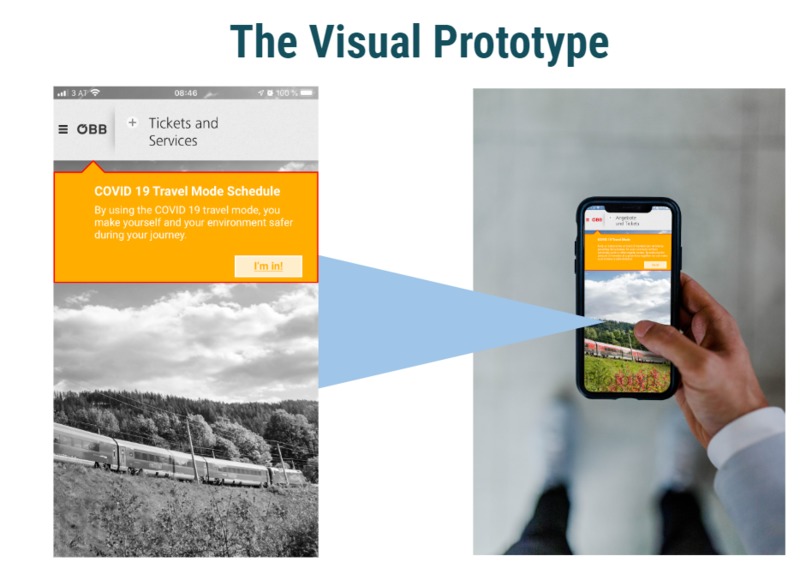
Prototype - Functional integration into a mobility app (e.g. into the mobility app of the Austrian Federal Railways for demonstration)
-
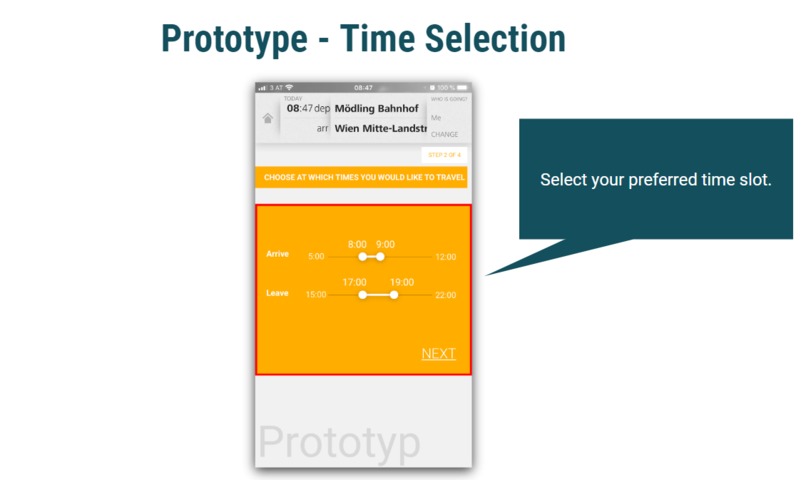
Prototype - Time selection
-
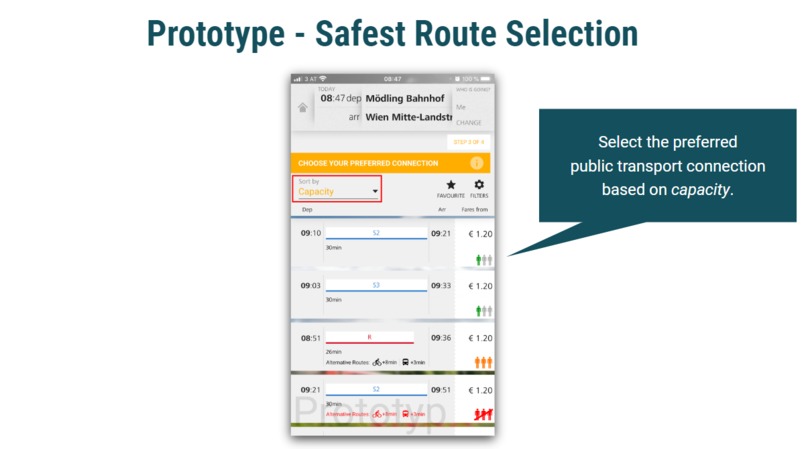
Prototype - Safest Route Selection
-
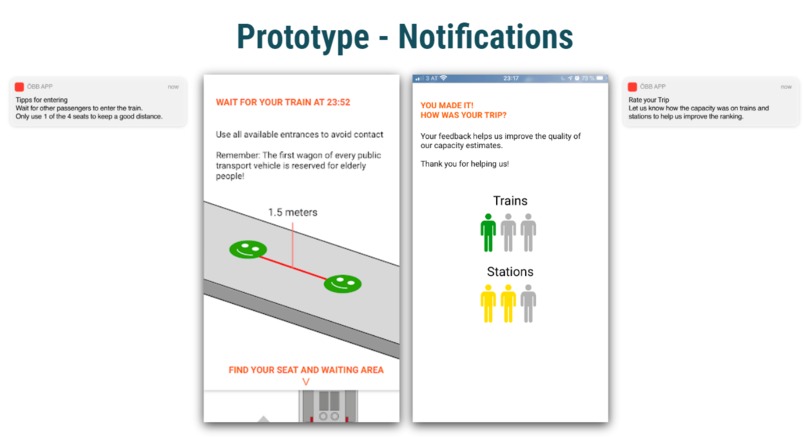
Prototype - Notifications (example)
-
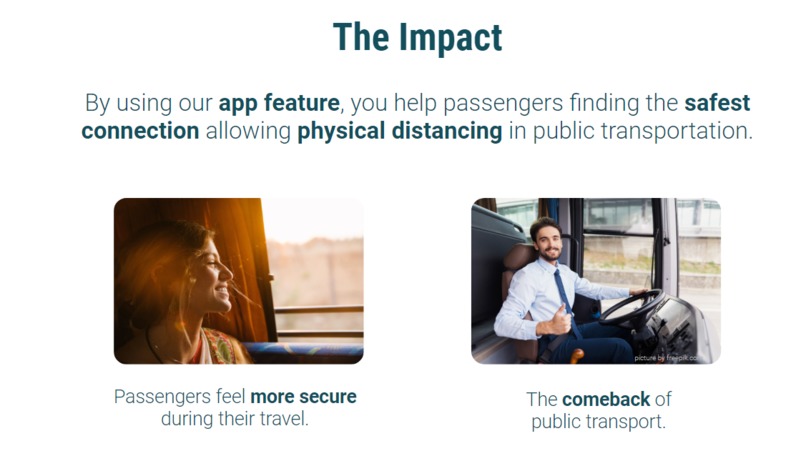
The Impact


The Problem
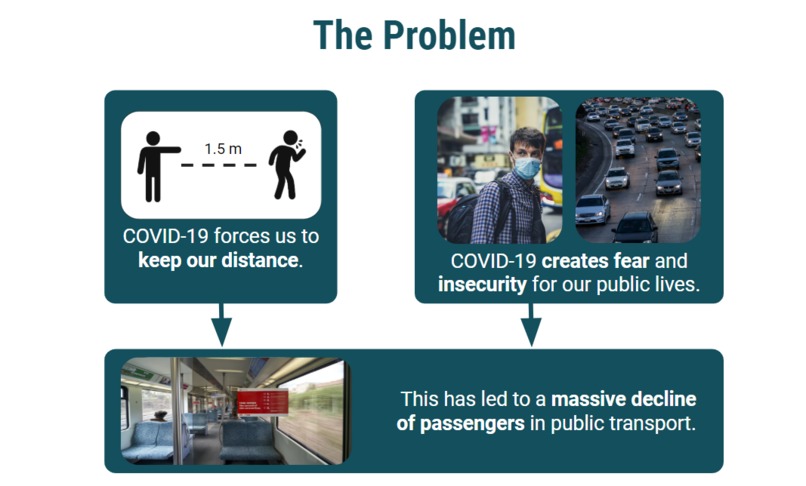
COVID 19 forces us to distance ourselves from others. Situations that make this difficult create fear and we avoid them. This applies in particular to public transport, whose user numbers have slumped by up to 80% due to the corona pandemic. This is a great damage, economically and ecologically. On the other hand, there are still crowded services at peak times, even amplified by thinning down of the public transport timetables as an answer to the decreasing number of passengers.
Are you familiar with these problems and hope there is a solution very soon? That’s exactly what inspired us to come up with an app feature for public transport that makes people feel safer again on their journey.
Our Solution / What it does
Our solution is a data-driven app feature, seamlessly integrated into the app of existing mobility providers. It makes it easy to keep a safe distance in public transport and makes it more attractive again.
Our app feature includes 2 main functionalities:
It provides load balancing control by suggesting the safest (less crowded) connections within the time frame selected by the user and distributing the passengers among means of public transport. As not all people are flexible in choosing their time slots, the app feature gives suggestions for alternative means of transport e.g. bus, taxi, car sharing and for shorter distances it also shows the closest location of a rental bike, e-scooter (time factor less weighted). Moreover, load factor targets of the train are kept below the maximum value of 50% by ensuring a buffer of 5% which can be used for “not calculable cases of need”. Elderly people who usually do not have mobile phones will be protected by providing a separated waggon.
It provides individualized safety information during the trip through app notifications, e.g. the first waggon is reserved for risk groups, keeping distance when entering/exiting the vehicle.
Our prototype shows the functional integration into the Austrian mobility application of the Austrian Federal Railways and serves as a demonstrator.
How does it work exactly?
Our app feature accesses information from real-time online data coming from a combination of different data sources: data is generated automatically when using the app (time slot selection, capacity validation) and combined with additional data proving the real-time wagon capacity (e.g. from passenger counting systems).
Our solution would start on the transportations that already provide those online real-time data, and would gradually cover other transportations when they include this functionality.
Our solution’s impact to the crisis
Keeping physical distance is a basic precondition for containing the COVID 19 crisis. The proposed solution supports mobility providers to make this distance available to their customers. In this way, people can take the safest way when going from A to B. Moreover, the increased safety in public transportation will help to increase the passenger numbers and ticket sales again and therefore, secures the jobs in public transportation. As our solution prevents the shift towards individual transport with private cars, it contributes to the environment and climate protection.
The value of our solution after the crisis
Unfortunately, we have to assume that physical distancing as part of our living together will accompany us even longer. Therefore, it is necessary to prevent that people's mobility behavior will move away from sustainable means of public transport to private cars during and after the crisis. A huge number of jobs within the public transport sector depend on this mobility development. It will have a great impact on our environment affecting our efforts against climate change. Thus, the comeback of public transport is economically and ecologically relevant.
Moreover, even though the world will hopefully soon return to normality, we firmly believe that it is very valuable for passengers to know that they are sitting on a train or bus that is not crowded. It is more convenient, esp. during rush hours or on hot summer days. The next crisis might follow: the corona virus might mutate and come back similar to other viruses with seasonal recurring waves (as influenza, rhinovirus etc.), which requires to keep a safe distance in public. Safety is still needed for risk groups who need to be protected against any kind of infections, e.g. elderly people in general or people with chronic diseases or weakened immune systems.
Accomplishments that we're proud of
What we already had achieved:
- Winner solution of HackTheCrisis Austria Hackathon
- Presentation of our idea to several interested mobility providers in Germany, Austria and Switzerland, plus provider of passenger counting systems; already in contact with one of the transport associations in Germany who is responsible for contracts with mobility providers that regulate the equipment of modes of transport with e.g. passenger counting systems
What we have done during the weekend:
- Customer journey, user stories and use cases developed through user interviews
- Development of clickable prototype, new features developed based on user interviews
- Development of CANVAS Business Model
- Creation of pitch video, including self-recorded video sequences
What's next for PublicSpacers
Possibility to present our idea to mobility providers and providers whose data could be relevant, win partners and support them in the implementation:
- Integrate the solution into the app/platform of mobility providers
- Improve data density and data quality
Examples of data sources:
- App feature itself: data is generated automatically when using the app, e.g.: schedule (routes & times), evaluation of capacity which can be used for further improvements (density of data will increase by number of users/journeys)
- Additional data: combination of passenger counting systems (not yet available everywhere, but integration already started in trains), movement trackings (e.g. from Google) and wireless LAN/mobile phones (anonymous available data) to provide real-time (online) data Feedback from real-beta tests and quantitative validation of qualitative user feedback





Log in or sign up for Devpost to join the conversation.