-
-
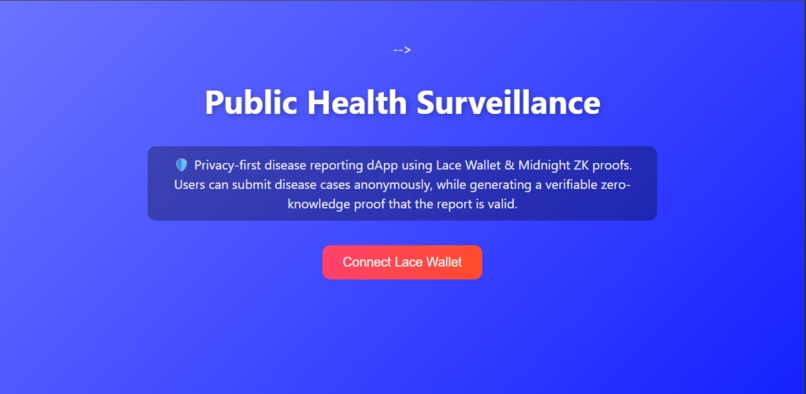
Home page

Inspiration
We wanted to explore how blockchain and zero-knowledge proofs could enable private, secure, and verifiable public health reporting. The goal was to let individuals share disease cases without exposing sensitive information, addressing privacy concerns in real-world health tracking.
What it does
Users can submit disease cases through a web interface. Each submission is verified via simulated ZK proofs, ensuring the data is valid without revealing identity or location. Wallet integration via Lace ensures secure authentication.
How we built it
- Frontend: HTML, CSS, and JavaScript, integrating Lace Wallet for secure authentication.
- Backend: Node.js Express server storing submissions and generating simulated ZK proofs.
- Proofs: Proof server simulates Midnight ZK proofs.
- Privacy: Location is anonymized; disease data is verified using ZK proofs.
Challenges we ran into
- Integrating Lace Wallet with the frontend correctly.
- Simulating ZK proofs while keeping the workflow simple for a hackathon demo.
- Ensuring form submissions didn’t refresh the page unexpectedly.
Accomplishments that we're proud of
- Fully functional dApp demo with wallet integration.
- Submissions verified through simulated zero-knowledge proofs.
- Frontend feedback and status updates that reflect proof verification.
What we learned
- How to integrate blockchain wallets into web apps.
- Practical usage of zero-knowledge proofs for privacy-preserving data.
- How to structure a hackathon-ready dApp with frontend, backend, and proof server.
What's next for Public Health Surveillance
- Connect to a real Midnight proof server for actual ZK proofs.
- Deploy a Compact smart contract for live submissions on a testnet.
- Improve UI/UX and add analytics for aggregated, anonymous disease trends.
Built With
- apis
- css
- express.js
- html
- javascript
- json
- midnight
- node.js
- npm


Log in or sign up for Devpost to join the conversation.