We are a team of two researchers in cognitive psychology and we have issues with managing our finances. At the intersection of Psychology and Finance we see an opportunity to introduce our project Psy-Fi !
Inspiration
“You can’t trust your instincts,” says financial psychologists. Recent surveys show that nearly 70% of Americans acknowledge their emotions have influenced their spending decisions (LendingTree, 2022). Whether driven by stress or exhilaration, many of us have experienced impulsive purchases under the sway of fluctuating moods.
Is there a reliable way to measure, predict, and manage emotional spending?
What it does
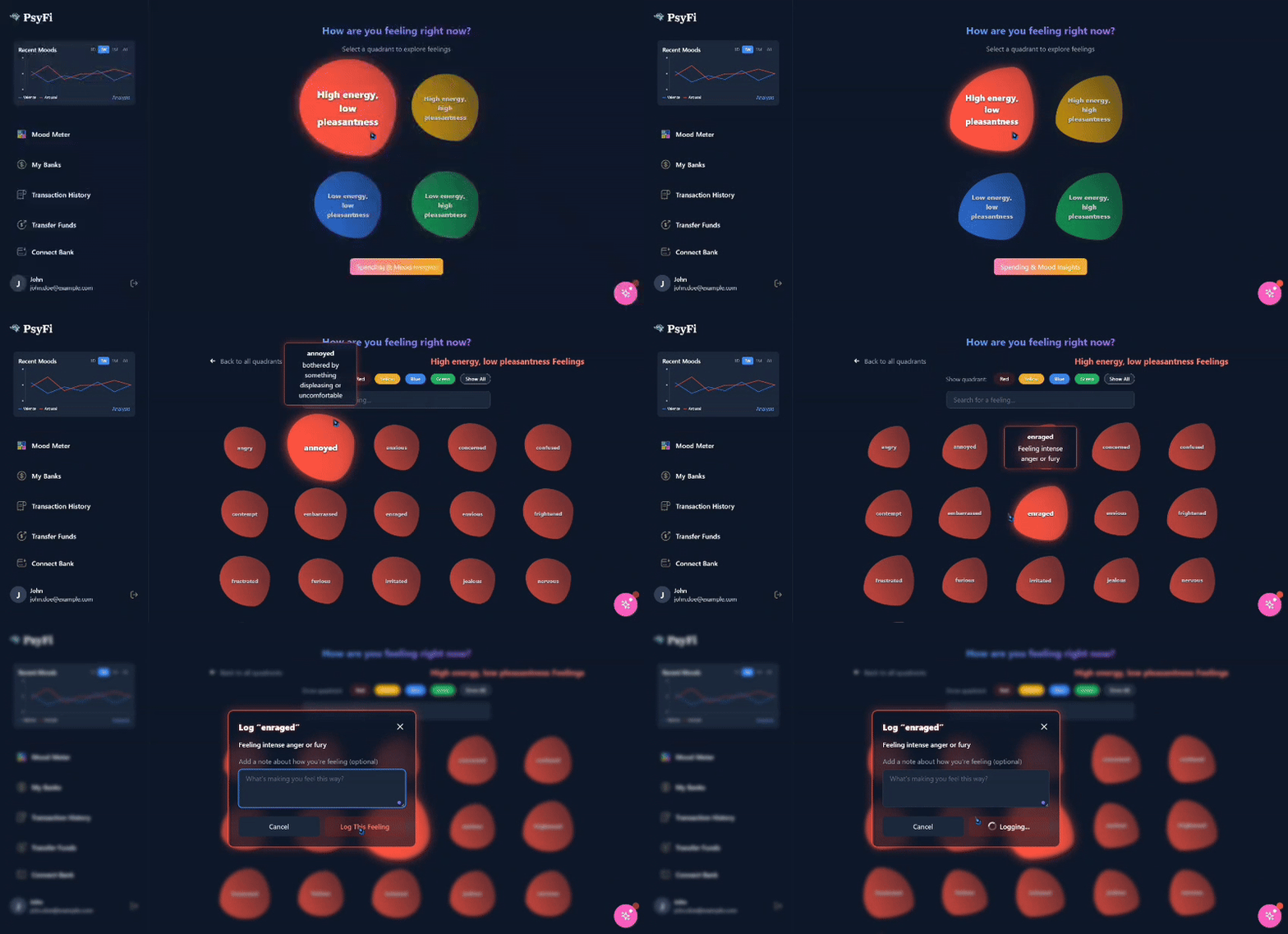
Psy-Fi enables users to gain behavioral awareness and receive tailored financial suggestions from personal AI assistants. The app’s goal is to prevent emotional spending while promoting mindful financial decisions. It contain following core features:
- Mood Diary: Users track their mood using a Mood Meter (developed by Yale’s HOPE Lab) to accurately identify, regulate, and take responsibility for their emotional states.
- Valence-Arousal Plot: Inspired by Dr. Saif Mohammad’s work (Mohammad, 2018), moods are quantified by breaking them down into valence (positivity/negativity) and arousal (intensity).
- Mood-Spend Analysis: Directly reads purchasing history from credit cards, correlating spending patterns with valence and arousal shifts.
- AI Assistant: Penny: Upon each new emotion entry, Penny identifies trends, flags potential risky purchasing moments, and offers proactive alerts or suggestions.
How we built it
- Leveraged an existing banking repo which uses Next.js as the core framework for rapid web development.
- Deployed a simple server with Python’s FastAPI to host an endpoint integrating the DeepSeek API for AI assistant features.
- Plaid API(in Sandbox mode) for integrating bank accounts, getting financial data.
- Dwolla for payment transfers
- Sentry to handle code breaks
- Employed Appwrite for database hosting.
- Building Visualizations with Chart.js library
Challenges we ran into
- The existing repo, while a time-saver initially, turned out to be front-end heavy, causing performance bottlenecks as the codebase grew. It is also very complex and we spend a lot time to figure out how its different components communicating.
- Building an intuitive UI to visualize complex emotional and financial metrics side by side was more challenging than expected.
Accomplishments that we're proud of
- Developed a highly visual, user-friendly interface to display emotional data and spending analytics clearly.
- Achieved a cross-disciplinary integration of psychology and fintech, bridging the gap between mood tracking and personal finance management.
What we learned
- We found it really meaningful to combine theoretical research with practical web app implementation creates a powerful synergy that can help people make more mindful financial decisions and make a better life.
- We had challenges in understanding the security concerns as we are interacting with customer's financially sensitive data, we learnt ways to manage both financial data and authentication data, figure out what can be done when things break, understanding server-side rendering and making our integrations work, making the user interface and experience clean and think of different ways to design the mood-meter for web and plot visualizations. We worked together and learnt debugging and understanding the documentation that helped us move further when stuck.
What's next for Psy-Fi: Mindful Money, Emotionally Informed
- Build browser extensions to alert our users when making online purchases.
- Wearables Integration: Incorporate real-time biometric feedback (e.g., heart rate variability) to anticipate emotional spikes.
- Enhanced AI Insights: Expand Penny’s predictive capabilities to offer longitudinal tracking of user mood and spending patterns as we get real-time user data.
- Community Benchmarking: Broaden Social Comparison features, offering more granular demographic insights and spending alerts.
- Partnering with financial institutions to get rewards for our users.
- Optimize Performance: Refine the underlying code architecture for speed and scalability.
- Confound Reduction: Develop advanced categorization to separate fixed, cyclical expenses (e.g., rent) from emotion-driven purchases, ensuring that predictive analytics remain accurate.

Log in or sign up for Devpost to join the conversation.