-
-
-
On Me - See it on you
Inspiration
OnMe started with something very familiar in our house: my wife loves clothes.
She'll go to the mall, find something she likes, try it on, look at herself from every angle, decide it isn't quite right, return it to the rack... and then move on to the next one. 😄
Online shopping makes the problem even harder. She can see a beautiful dress on a model, but the question is always the same:
"But how would this actually look on me?"
That got me thinking: why should she have to travel to a mall and physically try on ten different outfits just to answer that one question?
With today's generative AI, couldn't we make it as simple as taking a photo?
That became OnMe.
The idea is deliberately simple: upload a photo of yourself, upload a photo of something you'd like to wear, and see it on you.
Hopefully, that means a few fewer trips to the fitting room. 😄
What it does
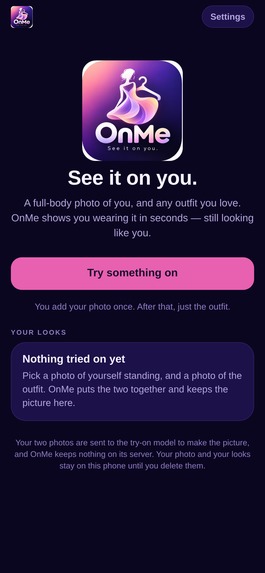
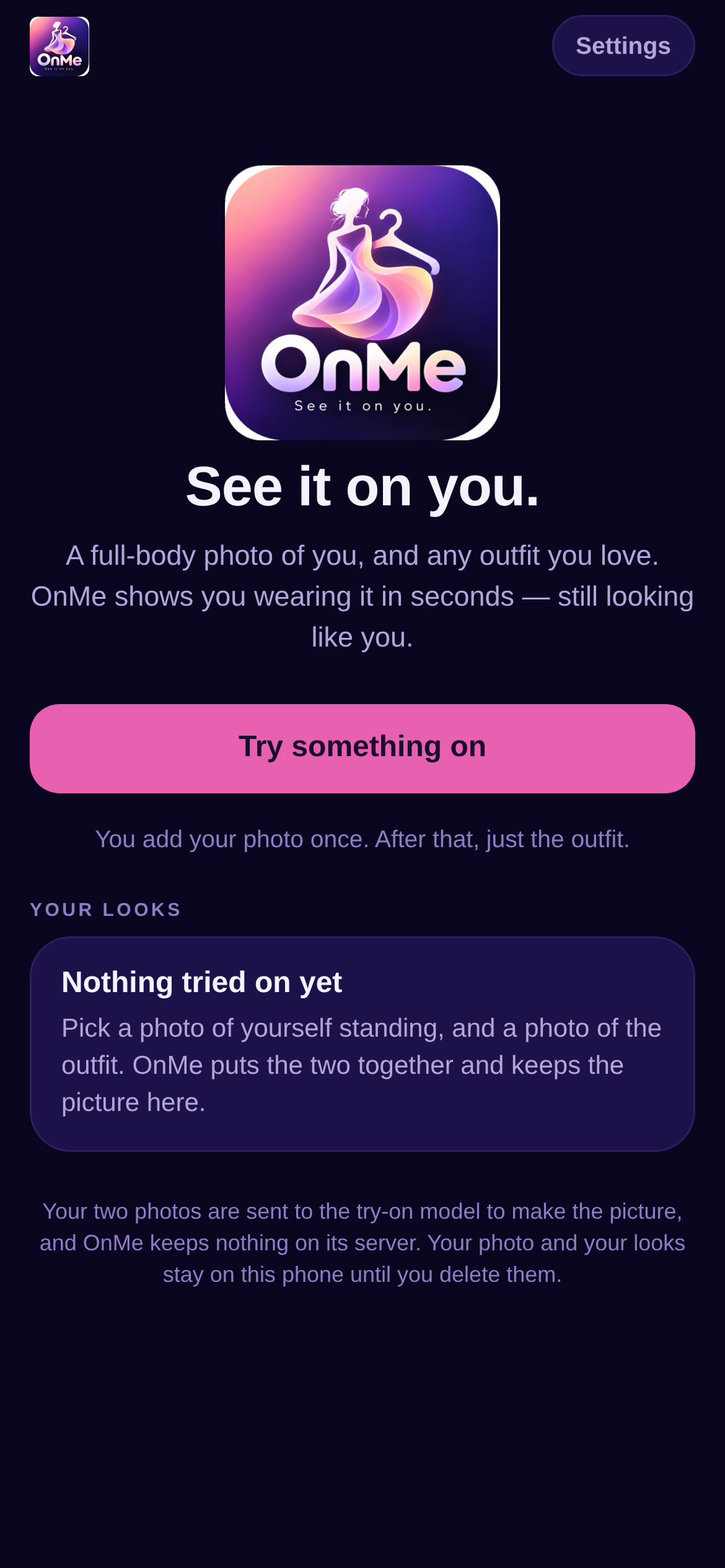
OnMe is an AI-powered virtual try-on app with an intentionally simple interface.
You give it just two images:
- A full-body photo of yourself
- A photo of an outfit you want to try
The outfit could be something you saw in an online store, on social media, in a screenshot, or simply a photo of clothing you liked.
OnMe uses AI to generate a realistic visualization of you wearing that outfit.
The goal isn't to create a different or "improved" version of you. OnMe aims to preserve your identity, face, hair, skin tone, natural body proportions, and overall appearance while transferring the clothing from the reference image.
No prompts.
No body sliders.
No complicated configuration.
Just:
You + an outfit → See it on you.
How we built it
We designed OnMe around an image-to-image generative AI workflow rather than a traditional text-prompt experience.
The system receives two visual inputs:
- the person image
- the outfit reference
The AI pipeline then has to understand both independently and generate a new image that combines them.
For the person, we want to preserve:
- identity and facial appearance
- hair
- skin tone
- natural body proportions
- pose and overall appearance
For the outfit, we want to preserve:
- color
- silhouette
- neckline
- sleeves
- length
- patterns
- fabric appearance
- important design details
The difficult AI work happens behind the scenes.
For the user, we deliberately reduced the experience to:
Upload yourself → Upload the outfit → Try it on → See the result.
We believe the interface should almost disappear. The result is what matters.
Challenges we ran into
The biggest challenge is that virtual try-on is much harder than simply generating an attractive AI image.
A generated picture can look impressive while still being completely wrong.
The AI might subtly change someone's face, make their body thinner or taller, alter the shape of the garment, change its color, lose a pattern, modify the neckline, or invent details that weren't present in the original outfit.
That means we're solving for two kinds of fidelity at the same time:
Person fidelity — does the result still genuinely look like the same person?
Garment fidelity — does it still genuinely look like the outfit they selected?
Getting one right while losing the other isn't enough.
Another challenge was actually simplicity.
It's tempting to keep adding AI controls: prompts, body settings, styles, poses, sliders, editing tools, and dozens of options.
We kept asking ourselves:
Does the user actually need this?
If not, we removed it.
OnMe should be understandable within seconds of opening it.
Accomplishments that we're proud of
We're proud that OnMe turns a sophisticated generative-AI problem into an interaction almost anyone can understand.
You don't need to know how to write an AI prompt.
You don't need fashion terminology.
You don't need to enter dozens of measurements.
You don't need to configure a generation model.
You simply show OnMe yourself and what you want to wear.
We're also proud of one important principle behind the product:
The AI shouldn't change you just to make the result look good.
The goal isn't to make you thinner, taller, younger, or turn you into an AI fashion model.
The goal is much simpler:
"Show me how this would look on me."
What we learned
One of our biggest lessons was that the quality of virtual try-on isn't just about photorealism.
Preservation matters.
If the image looks incredibly realistic but changes the person's face, it has failed.
If it preserves the person perfectly but changes the outfit, it has also failed.
The best result is one where the technology almost disappears and your immediate reaction is:
"That's me wearing that."
We also learned something broader about building AI products.
Powerful AI doesn't necessarily need a powerful-looking interface.
Sometimes the best AI experience is the one where the user barely has to interact with the AI at all.
Give it what it needs and let it do the complicated work.
What's next for OnMe
A single AI-generated image is only the beginning.
Our next goal is to make OnMe feel less like looking at a photo and more like standing in front of a virtual fitting-room mirror.
We want to explore:
- 360° View — turn around and see how the outfit looks from the front, side, and back.
- Zoom & Detail — inspect fabric, patterns, stitching, neckline, sleeves, and other garment details up close.
- Multiple Poses — see the same outfit while standing, walking, sitting, or turning.
- More Clothing Categories — dresses, shirts, jackets, suits, sarees, trousers, skirts, traditional clothing, and more.
- Better Fit Fidelity — preserve your real body proportions while showing how different cuts and silhouettes may look.
- Outfit History — quickly compare things you've already tried.
- Try Another Color — when a garment comes in multiple colors, visualize different options without changing the design.
- Instant Try-On from Anywhere — see an outfit online, share or upload the image to OnMe, and immediately see it on yourself.
Longer term, we imagine opening OnMe and having your own AI fitting room.
Upload yourself once. Then whenever you find something you like:
Add outfit → Try it on → Rotate → Zoom → Compare → Decide.
No trip to the fitting room required just to find out whether you like the look.
Our vision is simple:
If you can see it, you should be able to see it on you.
OnMe — See it on you.
Built With
- android
- audio-processing
- conversation-memory
- eas-build
- expo.io
- generative-ai
- llm
- node.js
- react-native
- revenuecat
- revenuecat-paywalls
- revenuecat-subscriptions
- sales-productivity
- speech-to-text
- typescript


Log in or sign up for Devpost to join the conversation.