-
-
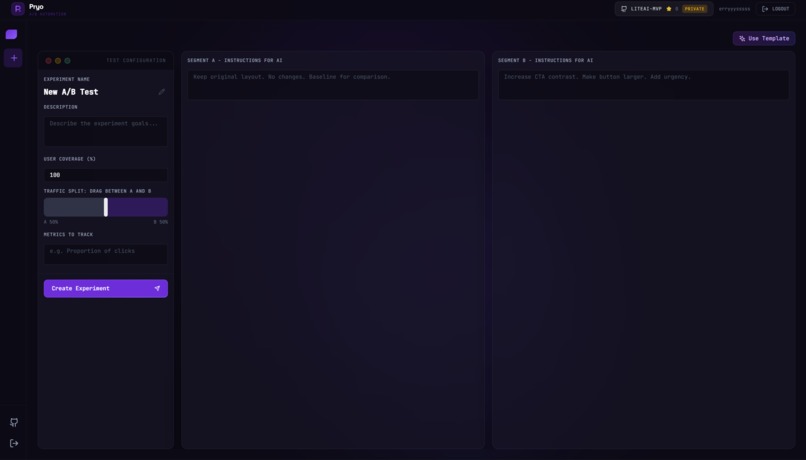
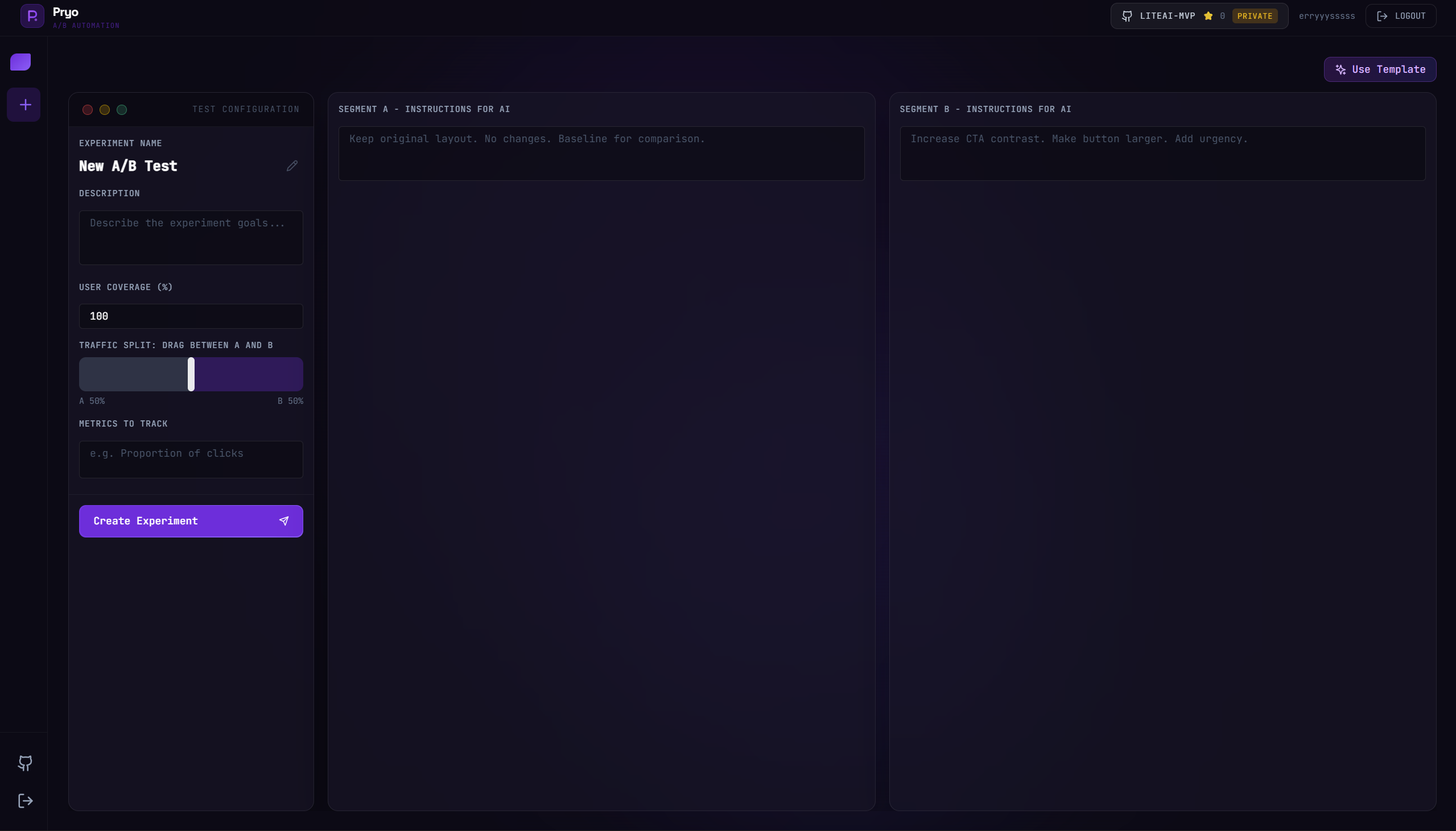
Our dashboard, where to define experiments to launch
Inspiration
From the team experience in startup building and user/market validation, we understood that the only, big step for growing a project that is not automatized regards the loop Build MVP, Collect Feedbacks, Improve the Idea. Pryo born from this need.
What it does
Pryo connects to a customer service repository and using agents is able to define experiments and metrics, collect data, analyze information, provide insights and build other experiments upon the results. In particular:
- user connects his/her service repo and fills out some starting questions about the first experiment to run.
- agents start from the "form", analyze the repo and provide code for creating defined segmentations for A/B tests. A Pull request is sent to the repo and the A/B test start running.
- Once service's customers trigger the tracked event, the event is sento to our database using structured webhooks.
- Once triggered by the user or at the end of the experiment, an agent will analyze those collected data and provide insights to show in Pryo dashboard. Insight will include oservations, plots, and a "winner" segment based on the metric performance
- Insights are used to propose new experiments to build upon the winner segment. The loops restarts.
How we built it
Frontend: React & TypeScript for flexibility Backend: Python for LLM integration Models/Agents: From text/questions/initial form we used OpenAI-4o-mini. For code execution and PR we used Claude 4.6 Sonnet.
Huge planning at the beginning, then focus one on frontend, one on backend, one on agent integration. Last member focused on video, pitch and presentation
Challenges we ran into
Using agents required structured prompts. Those structure should come from other LLM working on the integration. We almost broke everything at 4am but managed to restore the code ;)
Accomplishments that we're proud of
Once PR actually were sent by the agent and seen on github!
What we learned
the better the structure, the better the code execution.
What's next for Pryo
Better management of infrastructure and resources. Add fallback instruction if something goes wrong (e.g. run out of API credits). optimize code for more efficent data ingestion and analysis. fine tune agent for better insights
Built With
- claude
- docker
- github
- openai
- python
- railway
- typescript

Log in or sign up for Devpost to join the conversation.