Inspiration
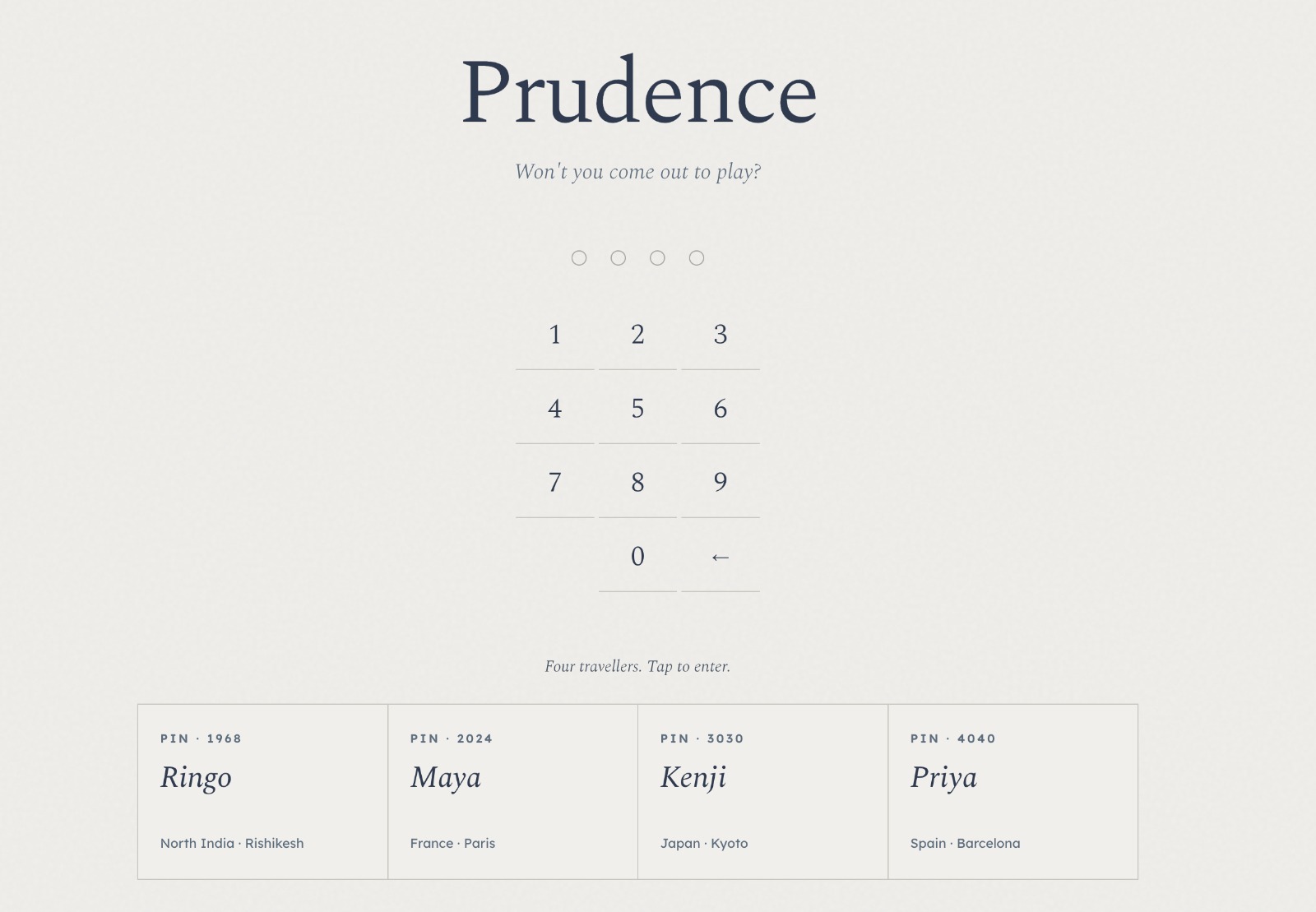
In 1968, Ringo Starr went to Rishikesh with the Beatles for a spiritual retreat. He was allergic to garlic and onions — the foundation of northern Indian cuisine. His solution was a suitcase of Heinz baked beans. He lasted ten days. Sixty years later, 220 million people with food allergies still don't have anything better. We built Prudence because nobody should have to choose between eating blind and not eating at all.
What it does
Prudence is a personal dietary threat intelligence system. You tell it your allergens, medical conditions, and severity once. When you arrive somewhere, it briefs you on what's hiding in the local cuisine before you sit down — cross-contamination risks, hidden ingredients staff don't think to mention, emergency infrastructure nearby. When you're ready to eat, you speak the menu, type a dish name, or point your camera — Prudence runs each dish against your profile using a structured cuisine-allergen knowledge graph with cross-reactivity traversal and severity-weighted risk scoring. It tells you what's safe, what to ask about, and what to avoid, with the specific reasons why. Then it gives you the words — medically precise phrase cards in the local language at the right severity level, with audio playback, so you can communicate your needs to a server who doesn't speak your language.
How we built it Prudence does not tell you what to eat. It tells you what to ask about. It does not replace medical advice — it replaces the moment of panic when you're sitting in a restaurant in a country where you don't speak the language, holding a menu you can't read, knowing that a mistake could kill you.
The interface is modeled on intelligence briefings, not health apps. You get a threat landscape, not a calorie count. Cross-contamination vectors, not nutrition facts.
Challenges we ran into
Getting Cactus running on-device was a fight — Python version dependencies, CMake installation, microphone permissions on macOS, and Parakeet being English-only when we needed multilingual transcription. We switched to Whisper through Cactus, which worked, but with latency trade-offs. Building a voice pipeline that gracefully degrades between on-device Cactus, browser Web Speech API, and pre-recorded audio fallback — without the user noticing the switch — was harder than any single integration.
The knowledge base was deceptively time-consuming. It's not a recipe database — it's threat intelligence. Knowing that palak paneer contains spinach and cheese is trivial. Knowing that restaurants silently add cashew paste for creaminess, that ghee is dairy and staff don't realize it, that shared tandoor oil means cross-contamination even in an allergen-free dish — that required deep regional food knowledge, not API calls.
Balancing the UI between "calming enough for someone who's stressed about their allergy" and "urgent enough to communicate real danger" was a constant tension.
Accomplishments that we're proud of
The cross-reactivity graph traversal is real computer science, not prompt engineering. When you say you're allergic to shrimp, the system automatically traces through immunological cross-reactivity pathways and flags crab, lobster, and shellfish — without you knowing those connections exist. That's BFS on a weighted graph with multiplicative probability and configurable thresholds. It's the kind of algorithm that makes this genuinely not a wrapper.
The Priya demo profile — egg and fish allergies, plus CKD, plus histamine intolerance — catches things no existing tool catches. Idlis are allergen-safe but flagged for histamine because the batter is fermented for 12 hours. Rajma has no egg or fish, but kidney beans are high-potassium, flagged by CKD. That intersection of allergen safety and medical risk is something we haven't seen anywhere else.
The emergency bypass design — encrypting the health profile but deliberately leaving crisis phrases and hospital information unencrypted so a bystander can help during anaphylaxis. Security that gets out of the way when someone's life is at stake.
What we learned
The hardest part of building a food safety tool isn't the AI — it's the domain knowledge. No foundation model reliably knows that Thai green curry paste contains shrimp paste even in vegetarian versions, or that Japanese soy sauce is brewed with wheat, or that ghee is classified as dairy but kitchen staff across India will tell you it isn't. That knowledge has to be curated by humans who understand how food is actually prepared in real kitchens, not scraped from the internet.
We also learned that the "wrapper vs. product" question isn't about whether you use a foundation model: rather, it's about whether removing the model breaks your product. Remove Claude from Prudence and the knowledge graph, the risk scoring, the cross-reactivity traversal, the phrase cards, and the encryption all still work. Claude adds capability at the edges. The core is ours.
What's next for Prudence Expanding the knowledge base — southern Indian, Korean, Mexican, and Middle Eastern cuisines. Each new cuisine requires real culinary research, not generation. Deepening the Cactus on-device integration with Gemma for a full offline voice-to-risk-assessment pipeline with intelligent cloud handoff only for unknown dishes. Building a feedback loop where users confirm or correct dish assessments, improving accuracy per cuisine over time. And exploring partnerships with travel health organizations and allergy advocacy groups to validate the knowledge base with clinicians.
Built With
- cactus
- claudeapi
- elevenlabs
- express.js
- node.js
- ocr
- react18
- vanillacss
- webspeech
- whisper


Log in or sign up for Devpost to join the conversation.