-
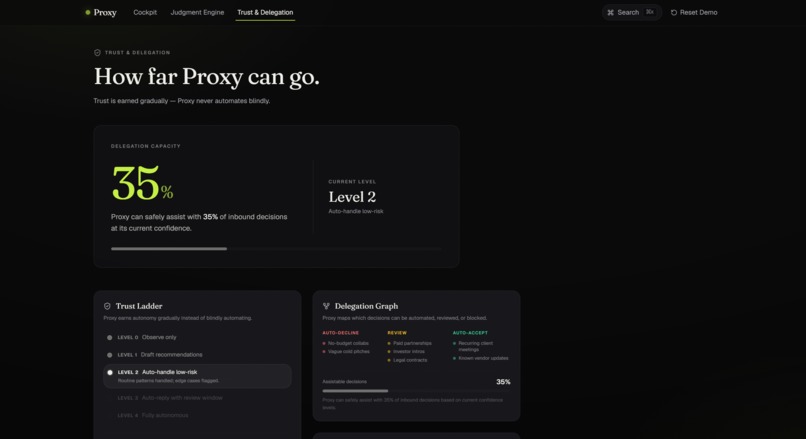
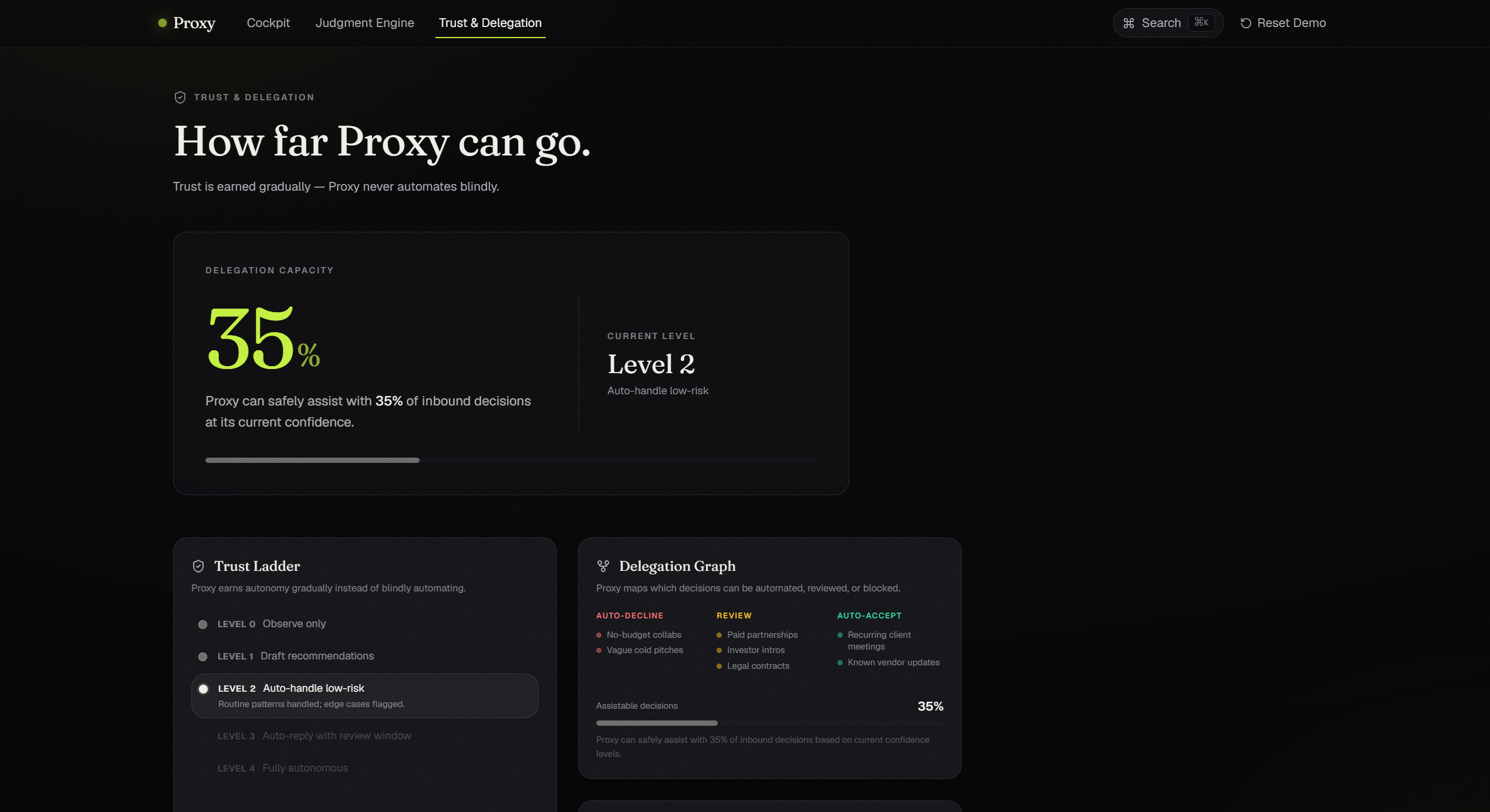
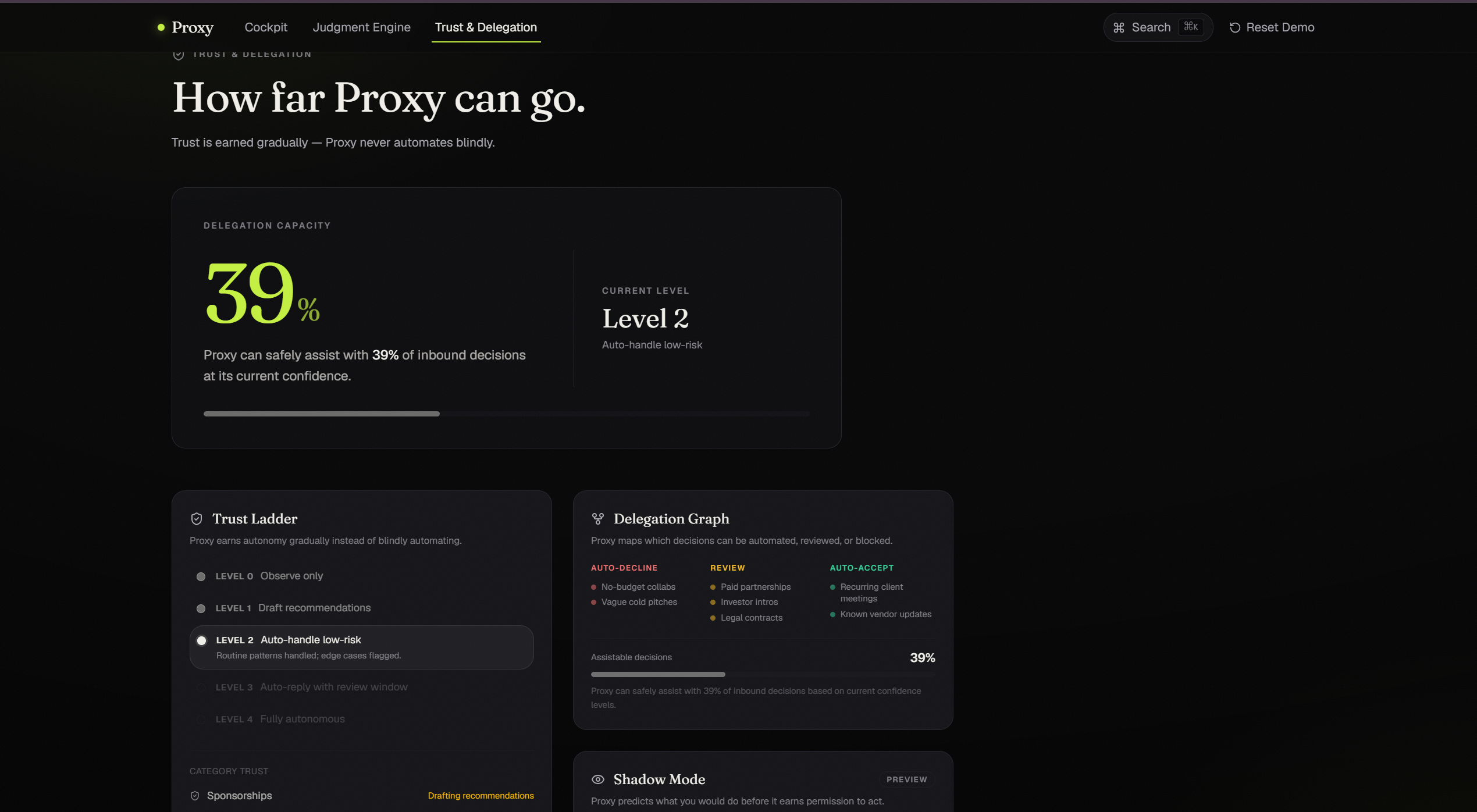
Trust & Delegation — Proxy earns autonomy gradually, never automating blindly.
-
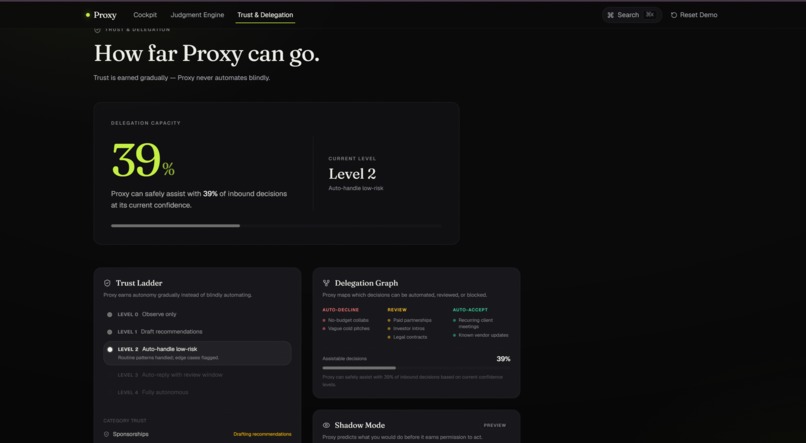
Delegation capacity grows from 35% to 39% as Proxy learns — trust is earned, not assumed.
-
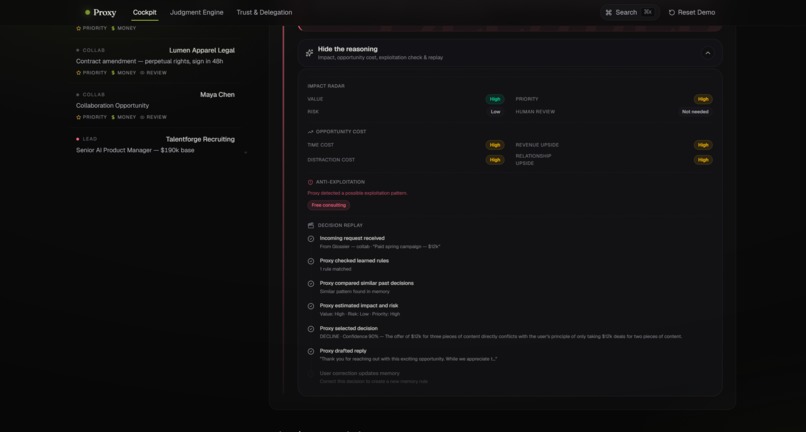
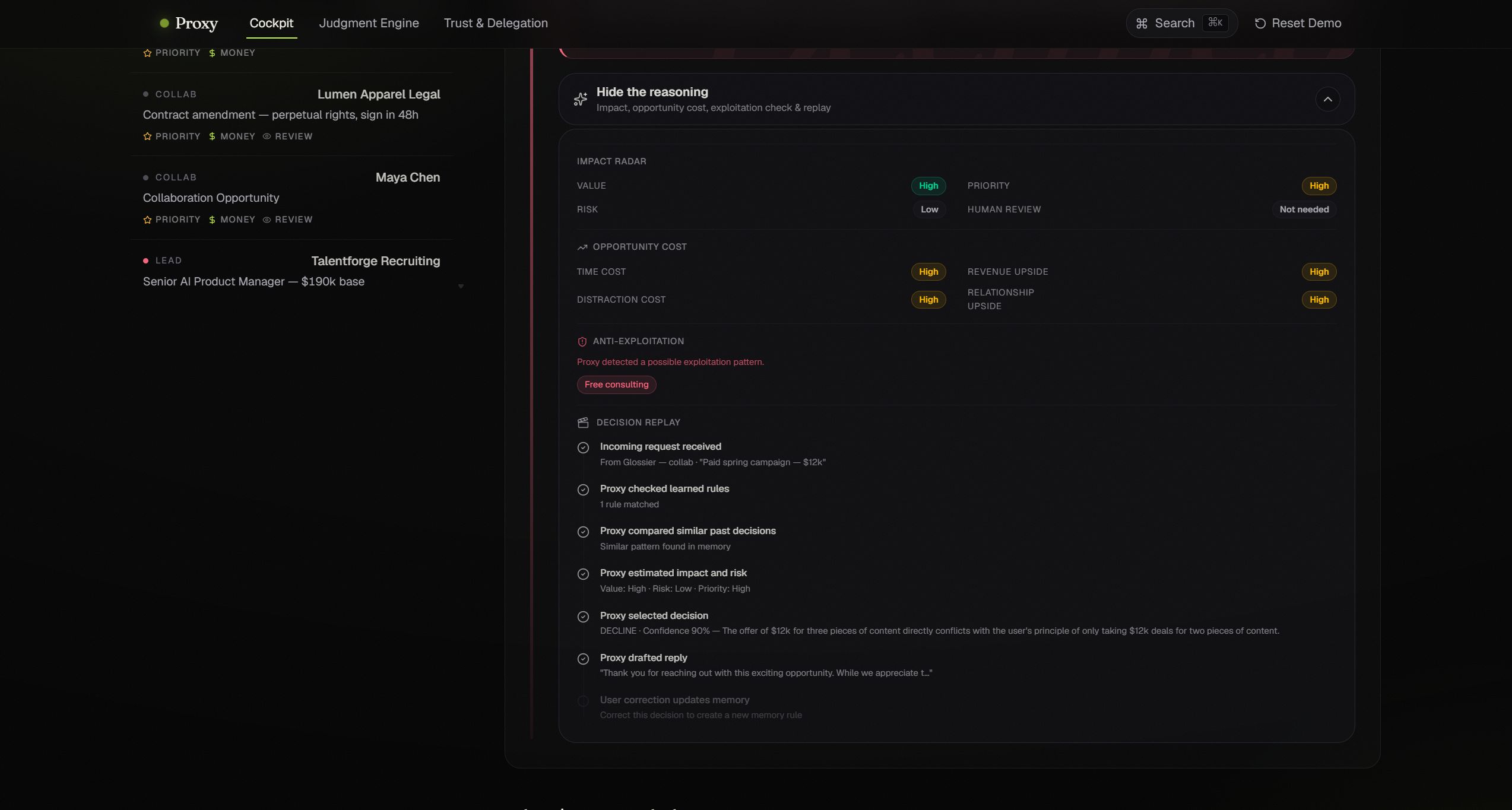
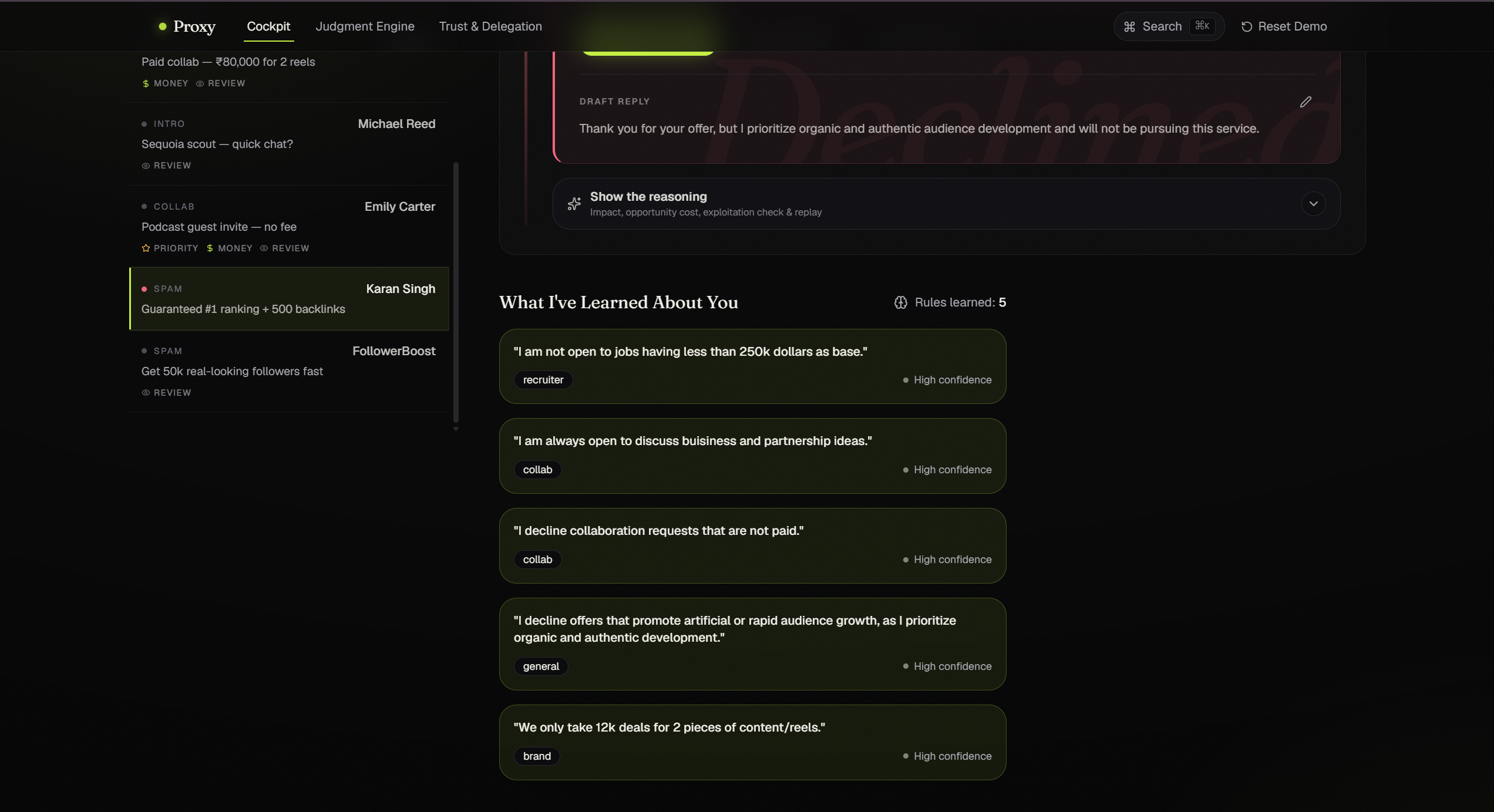
Show the reasoning — Impact Radar, opportunity cost, anti-exploitation detection, and a full Decision Replay.
-
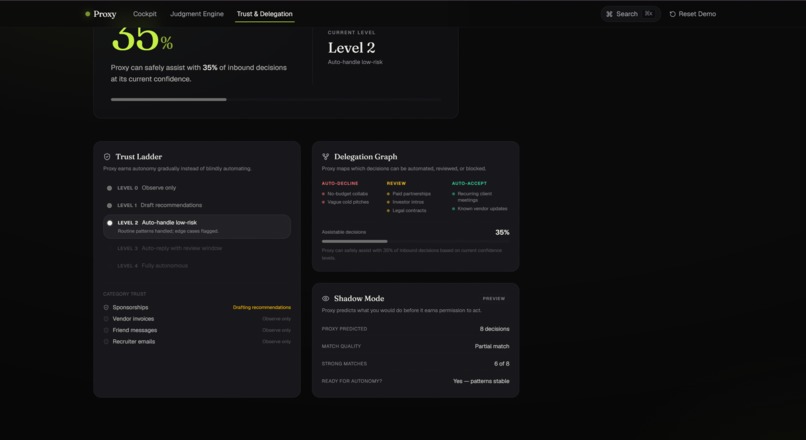
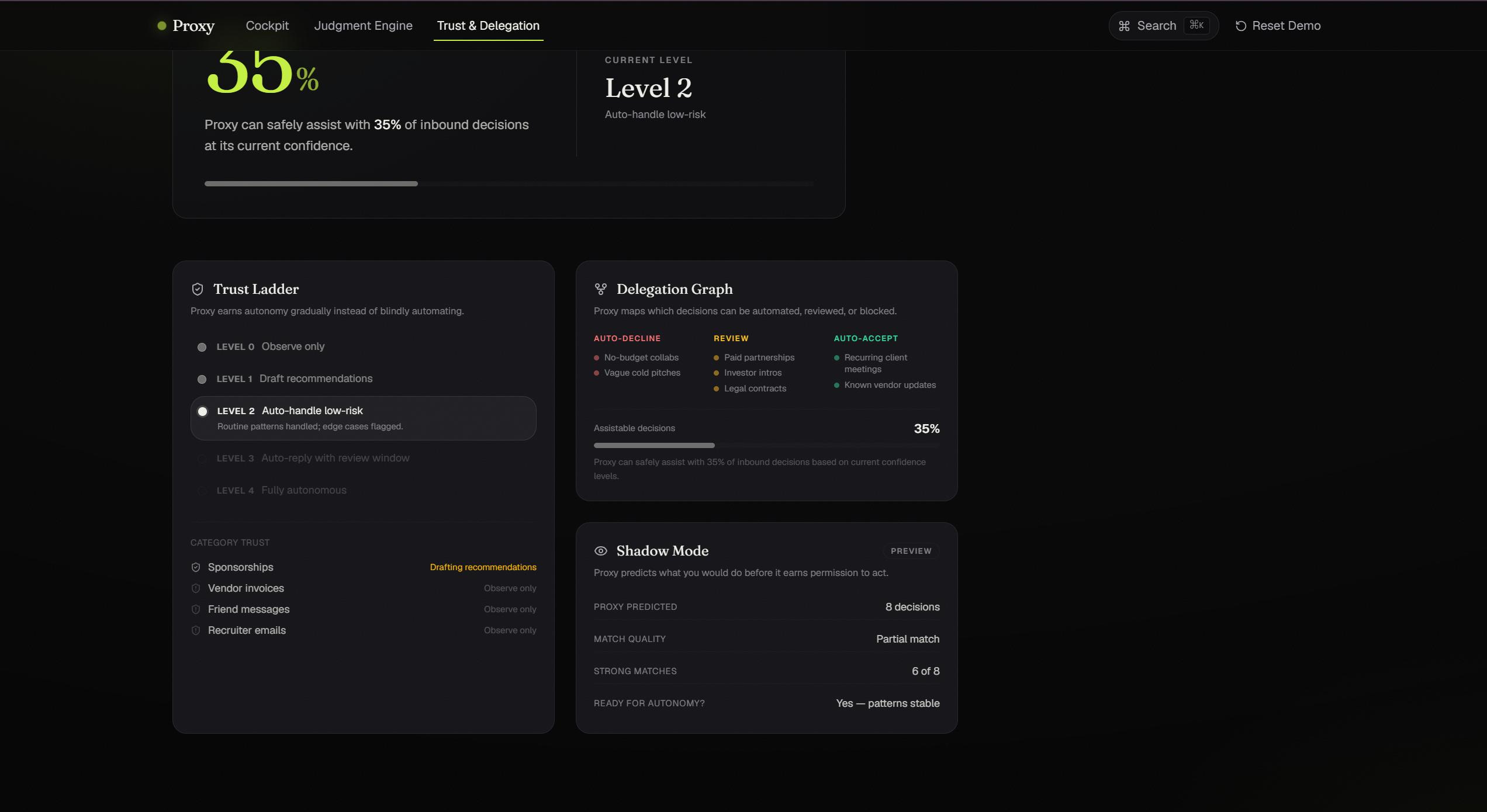
The Trust Ladder and Shadow Mode — Proxy predicts what you'd do before it earns permission to act.
-
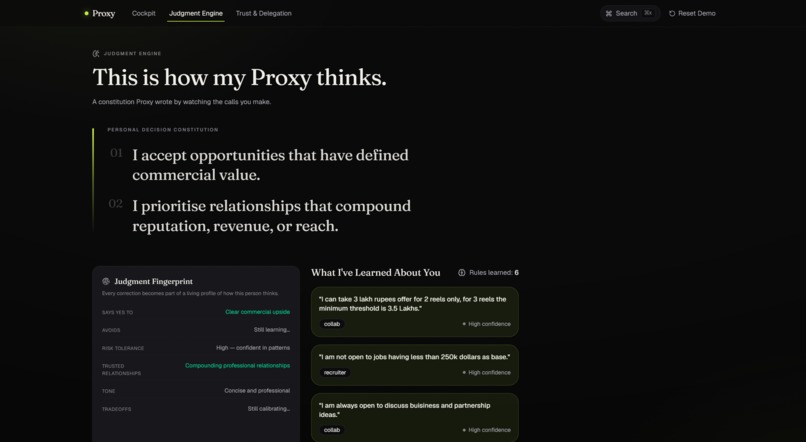
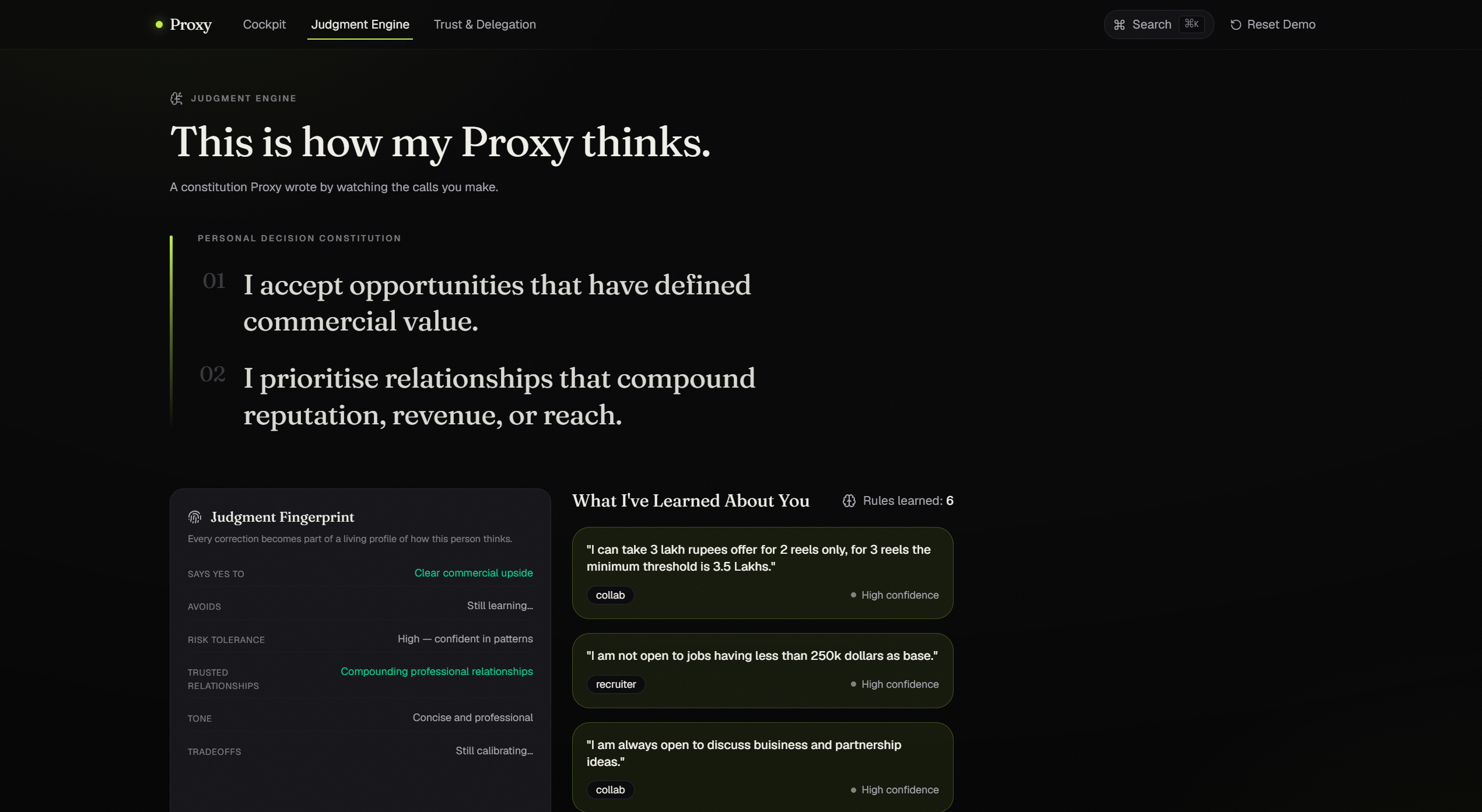
Rules learned: 6 — the judgment fingerprint compounds with every correction.
-
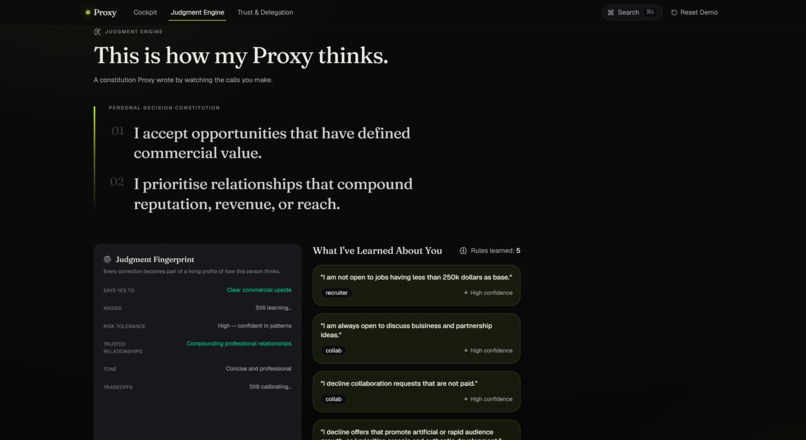
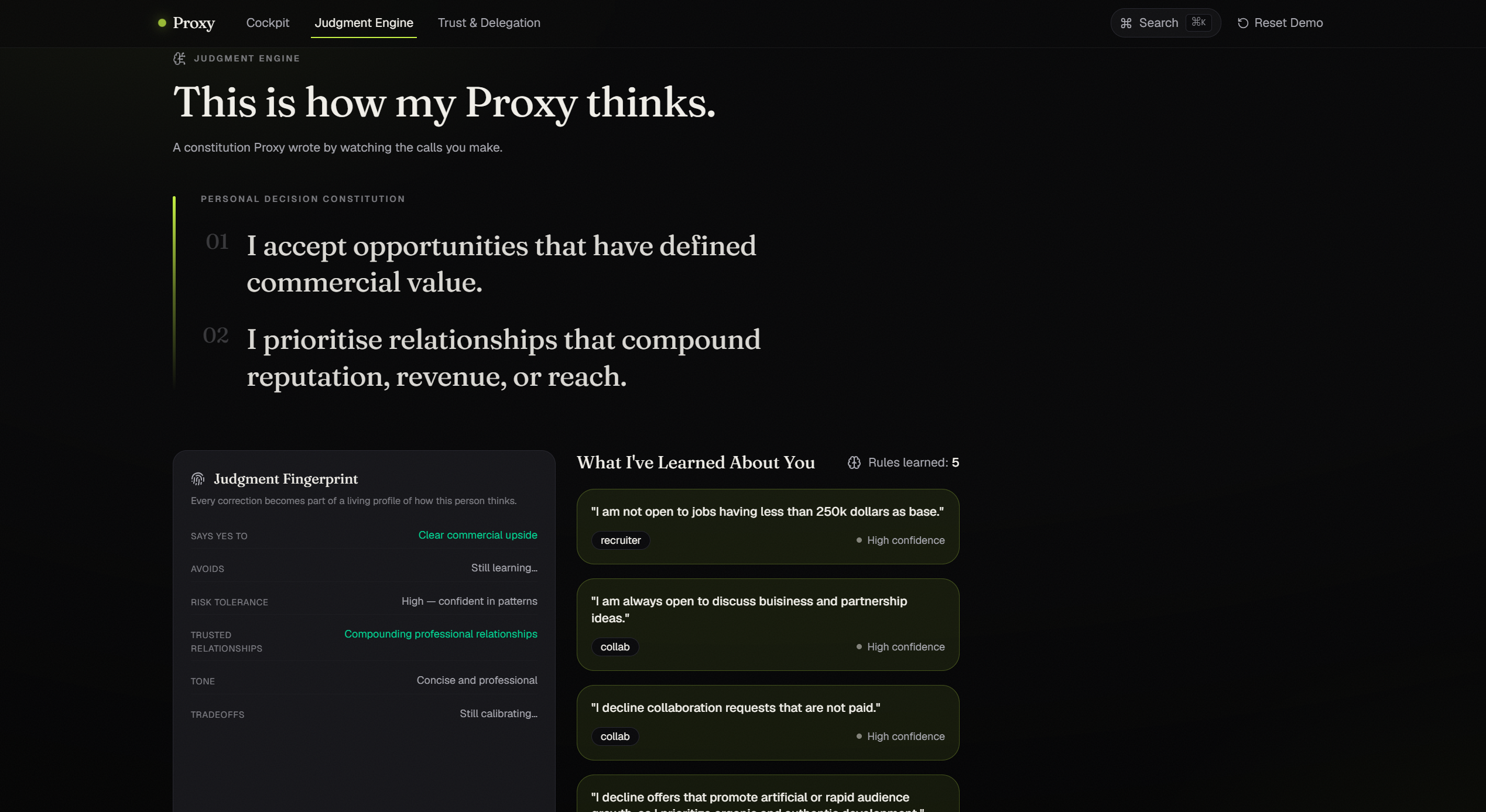
The Judgment Engine — a personal decision constitution Proxy writes by watching the calls you make.
-
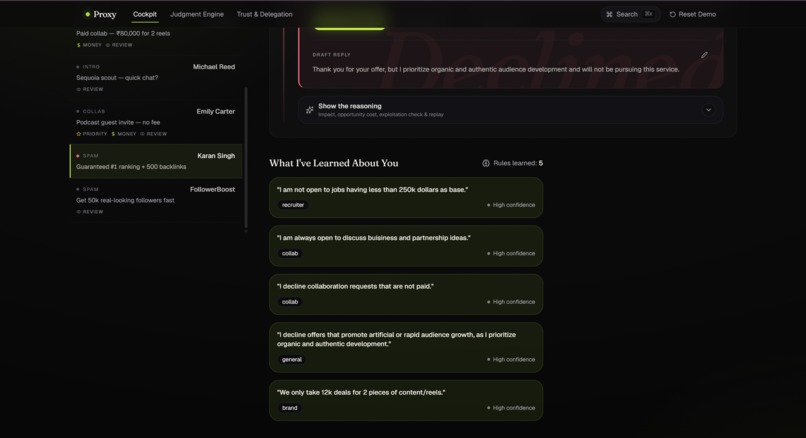
What I've Learned About You — every correction becomes a reusable judgment rule stored in MongoDB memory.
-
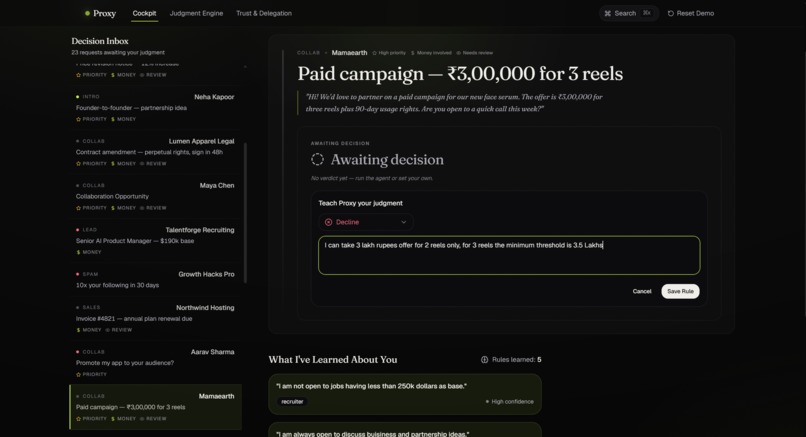
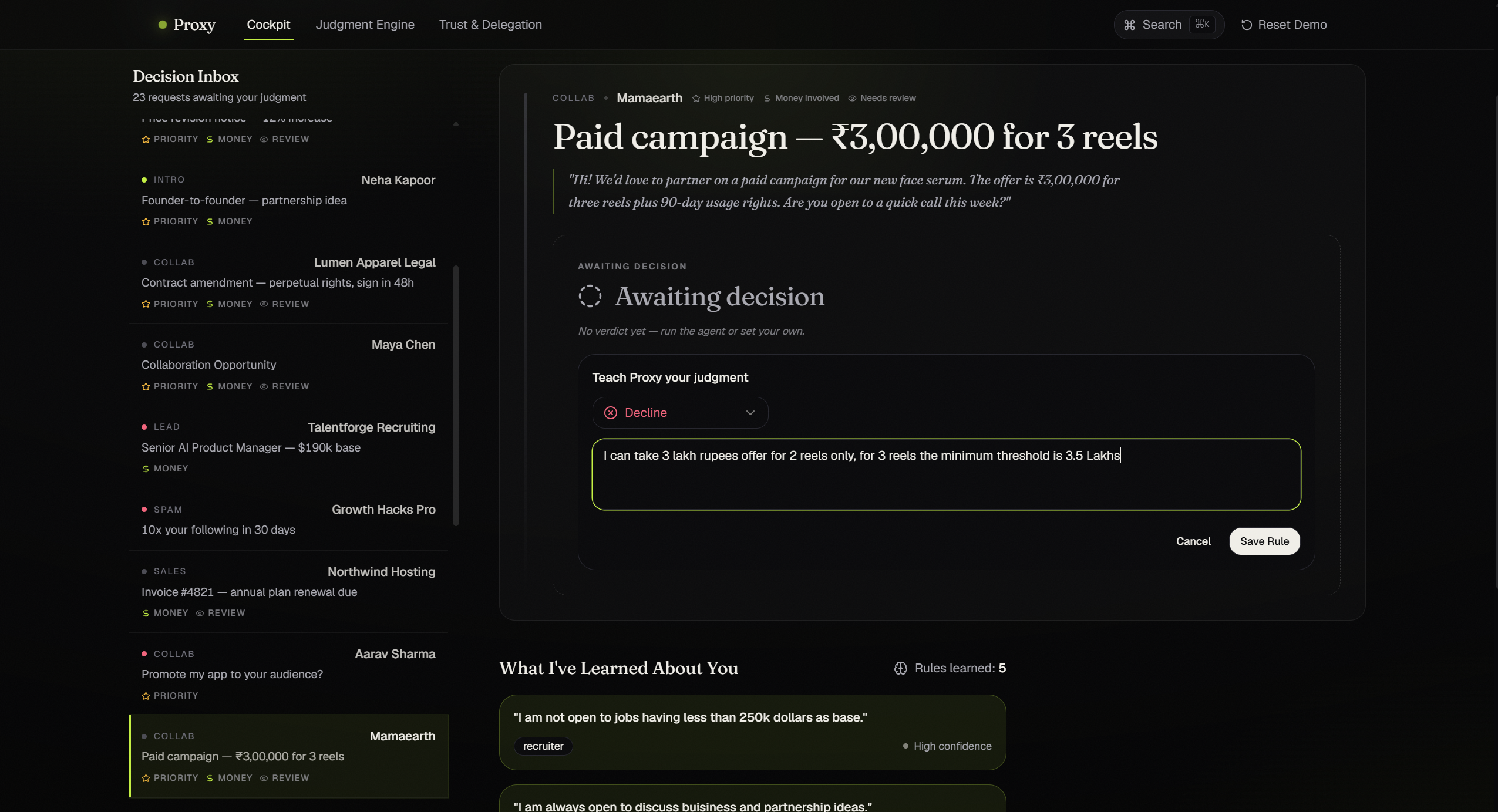
Teach Proxy your judgment — one plain-language correction is all it takes.
-
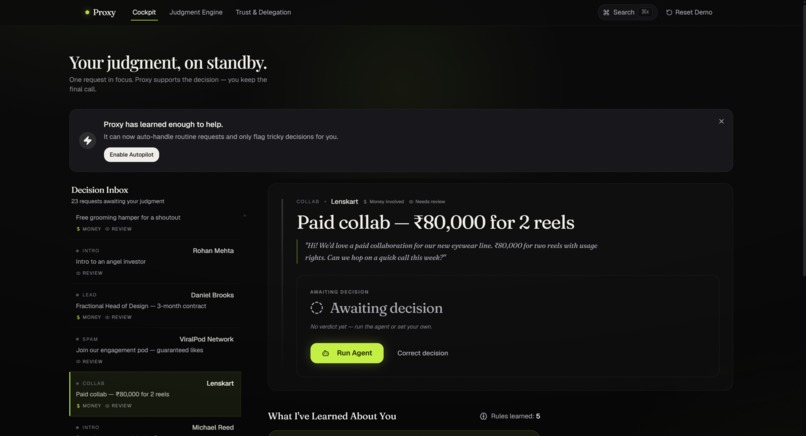
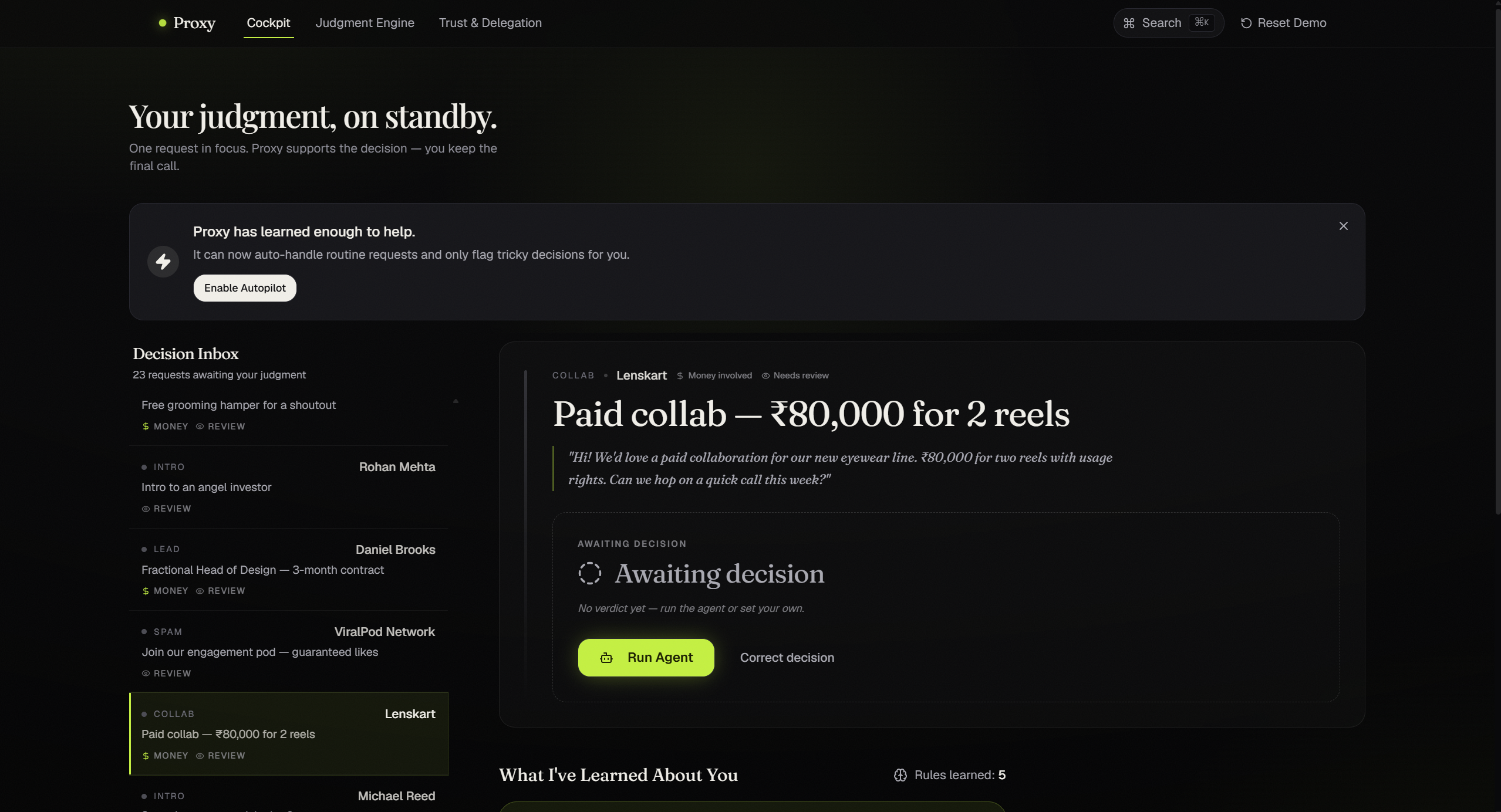
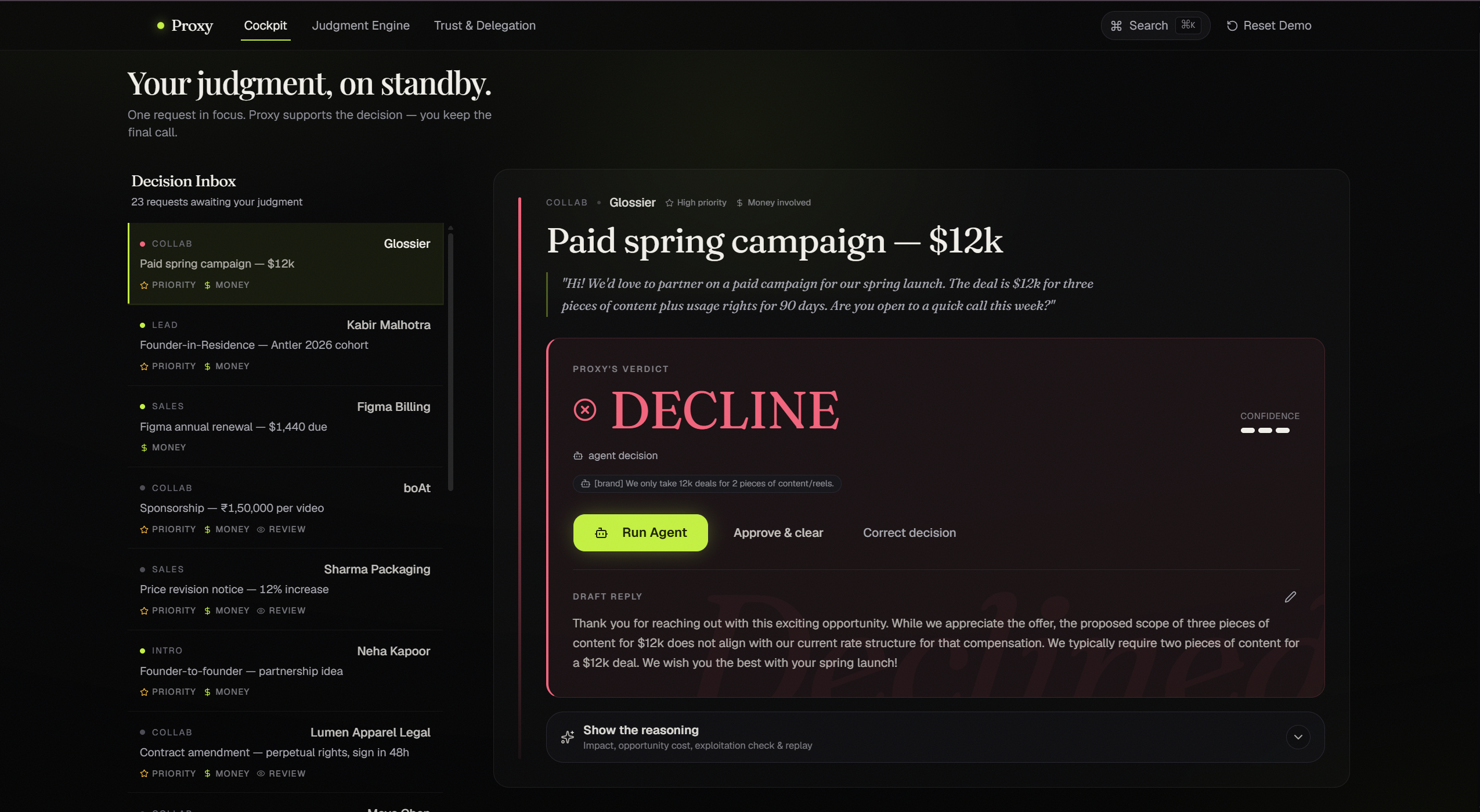
The Cockpit — every inbound request lands in one decision inbox, with Proxy's autopilot ready once it has learned enough.
-

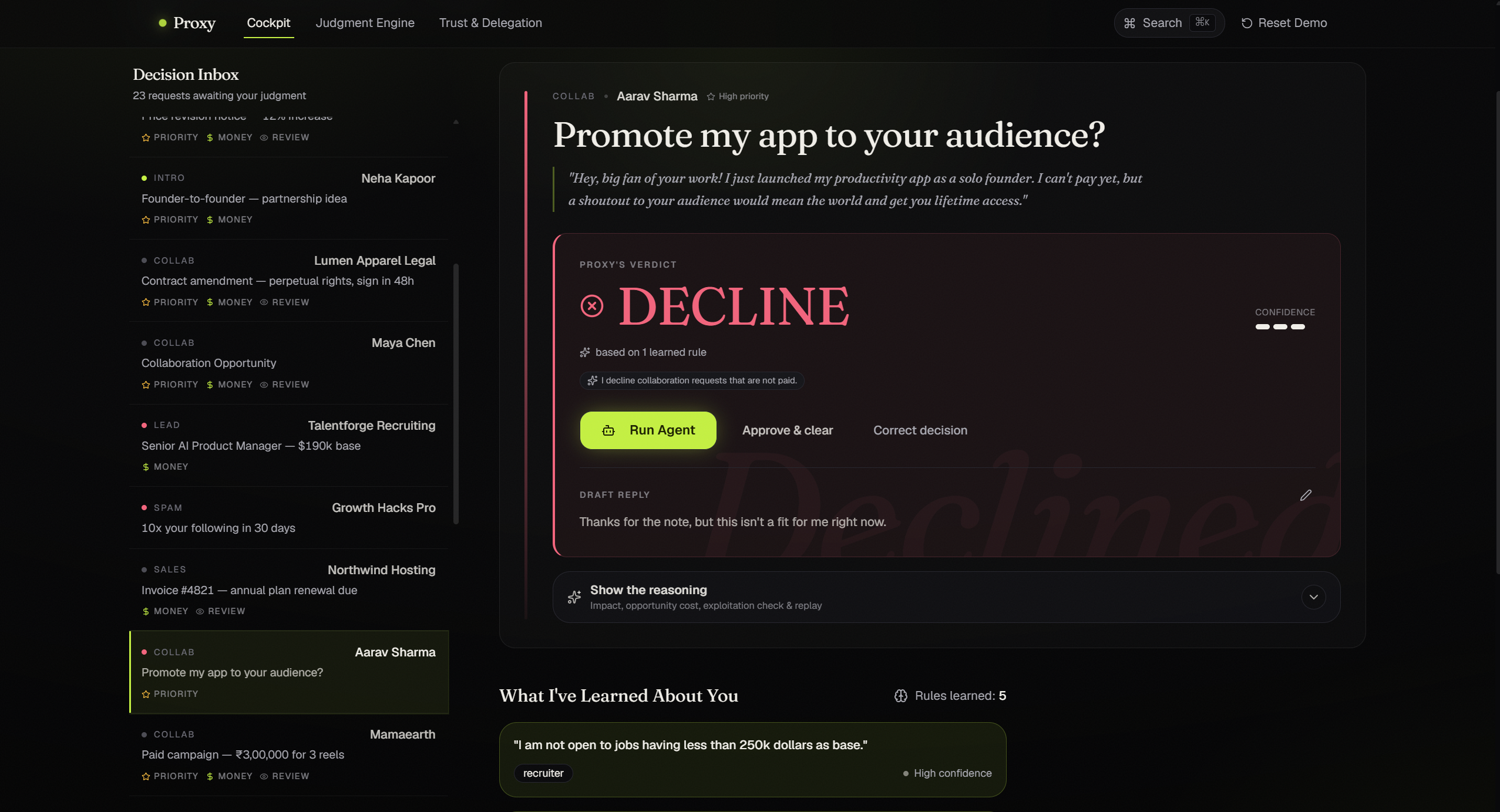
Seconds later, Proxy applies the freshly learned threshold rule to the same request.
-
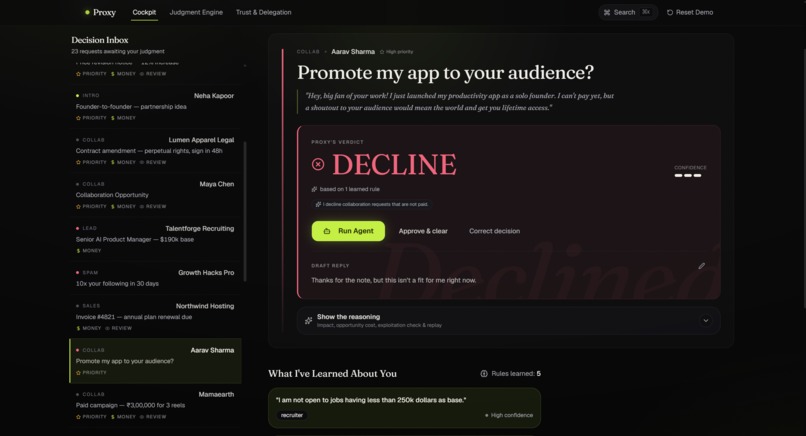
Unpaid "exposure" collab declined automatically using a learned rule.
-

Spam detection with personality — growth-hack offers declined based on the user's organic-growth principle.
-
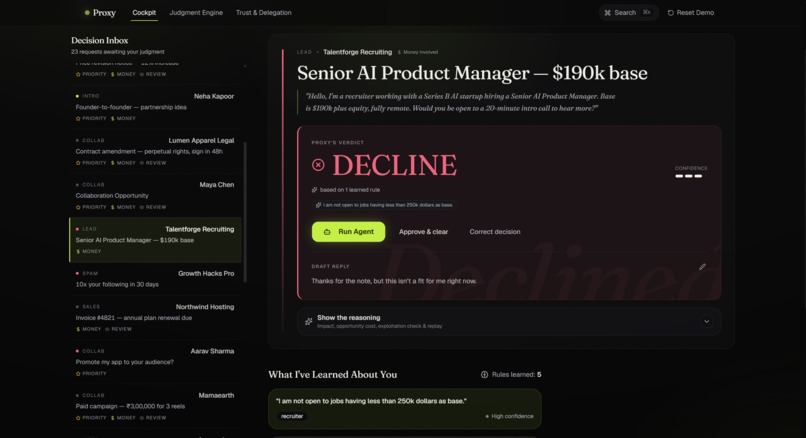
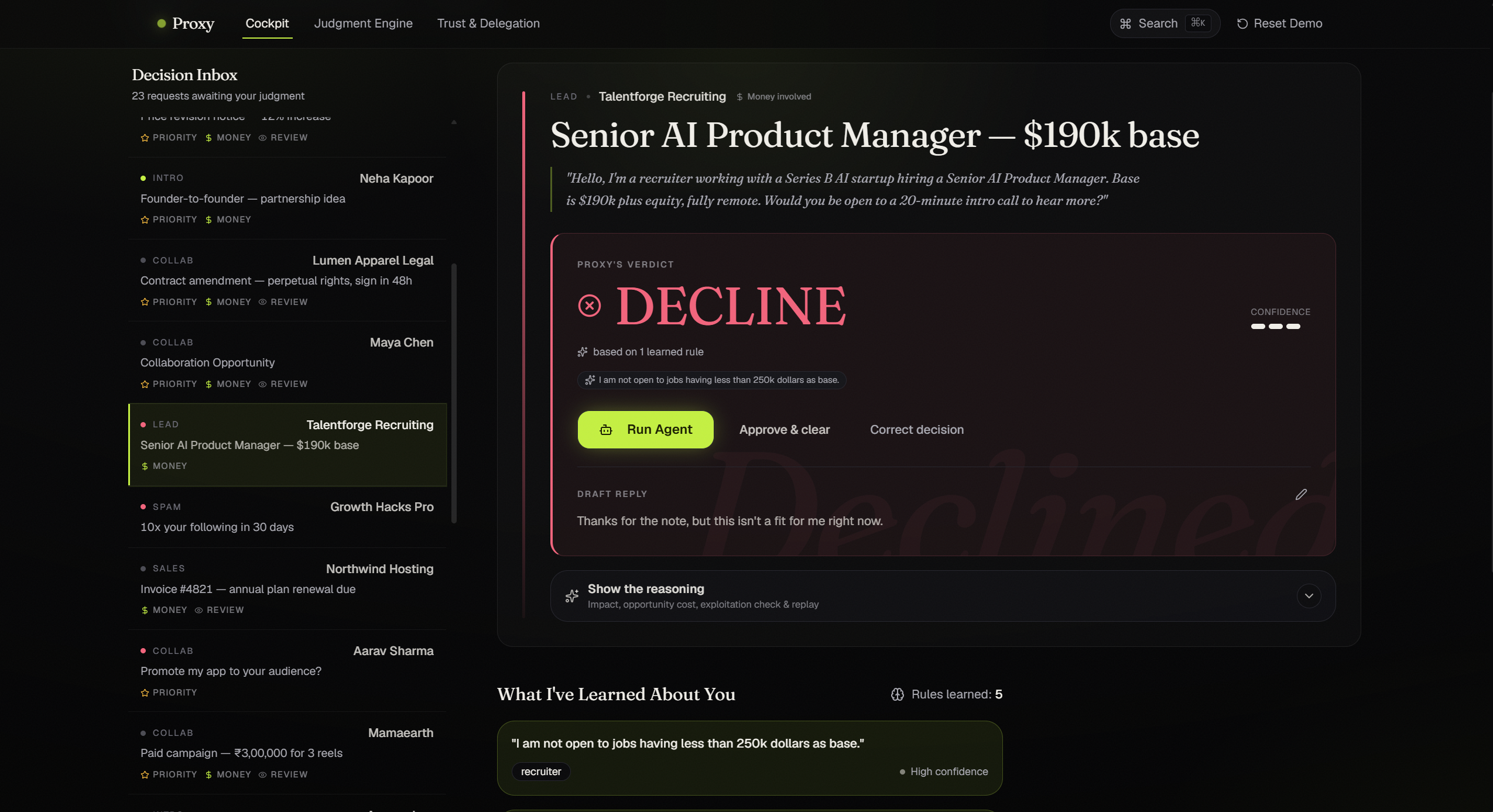
DECLINE — a $190k recruiter offer rejected because Proxy learned the user's $250k minimum.
-

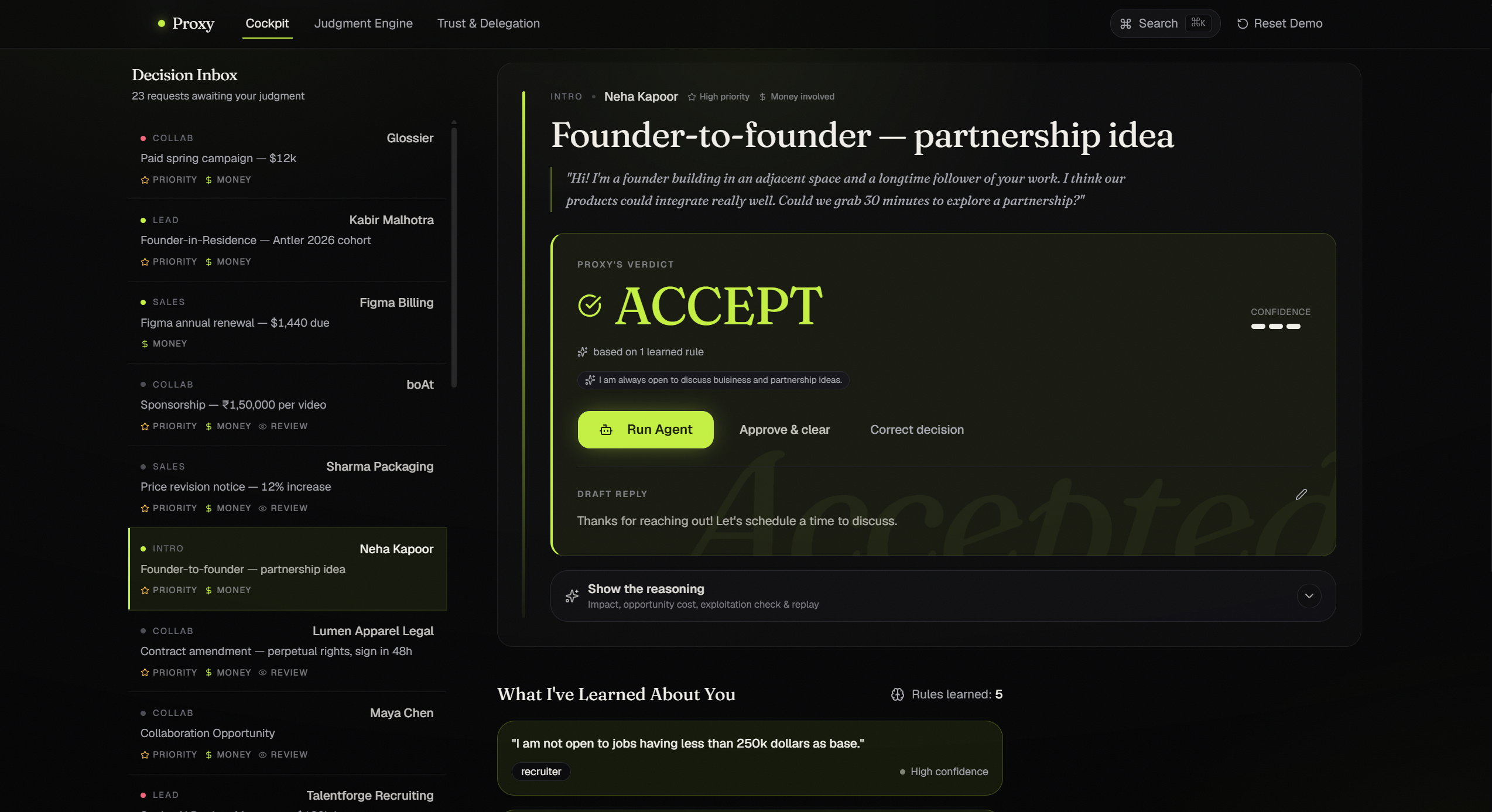
ACCEPT — Proxy recognizes a founder partnership intro matches a learned openness rule.
-
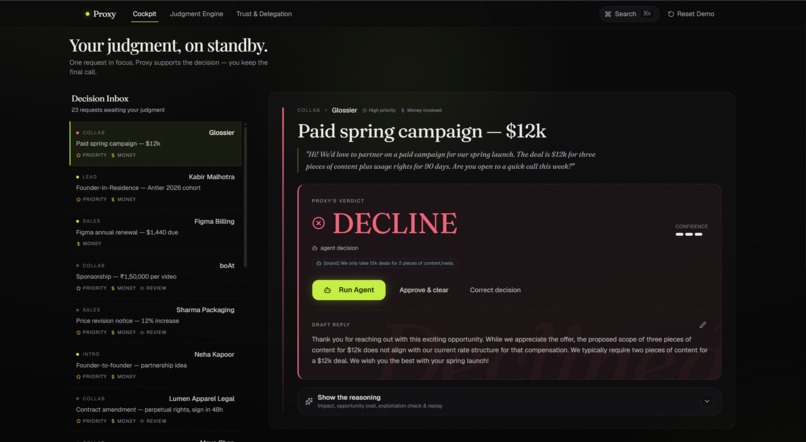
Proxy declines a $12k offer because it conflicts with a learned pricing principle — citing the exact rule.


Inspiration
Every AI assistant gives everyone the same generic answer. It does not know that you usually decline unpaid "exposure" collabs. It does not know that a serious investor intro should go straight to the top of your list. It does not know your voice, your boundaries, your risk tolerance or your instincts.
So instead of truly delegating decisions, you still do everything yourself.
We wanted to build the opposite: an agent that starts as a stranger and becomes a second you, learning how one specific person makes decisions and gradually earning the right to act on their behalf.
What it does
Proxy is a self-learning judgment agent for inbound requests.
A founder or creator receives a messy inbox: brand deals, unpaid collabs, investor intros, recruiter pitches, spam, vendor invoices and meeting requests. Proxy reads the request, checks the user's saved judgment memory, and decides whether to ACCEPT, DECLINE or FLAG it.
For each decision, Proxy returns:
- a verdict
- confidence score
- reason
- drafted reply
- applied memory principles
- cold-start or personalized judgment status
For each request, Proxy creates a full decision dossier with:
Verdict — ACCEPT, DECLINE, or FLAG Confidence score Reasoning Draft reply Cold-start or personalized judgment badge Applied memory principles Impact Radar — value, priority, risk, and human-review need Opportunity Cost — time cost, revenue upside, relationship upside, and distraction cost Anti-Exploitation Detector — catches unpaid exposure traps, vague partnerships, urgency pressure, free consulting, and scope creep Negotiation Mode — suggests counters or escalation paths when the request is worth negotiating Decision Replay — shows the step-by-step reasoning path behind the agent’s decision
The key loop is correction-based learning.
If Proxy gets something wrong, the user corrects it once. Proxy does not simply save the raw correction as a keyword. A Memory Learning Agent converts that correction into a reusable behavioral principle and stores it in MongoDB.
Example:
User correction:
I believe in natural growth.
Proxy learns:
I decline artificial growth-hack offers because I prefer organic, authentic audience growth.
The next time a similar but not identical request appears, Proxy applies that principle semantically.
Proxy also includes a safe action layer. In demo mode, it does not send real emails, but it can prepare and record actions such as accepting a request, declining a request, or marking something for review. This demonstrates the full agent flow clearly:
Cold-start recommendation → correction → learned memory principle → personalized decision → approved action
Key features
Proxy is built around three product layers.
- Decision Cockpit
The Cockpit is where the user handles live inbound requests. Each selected request becomes a premium case-file style decision dossier with a signature Judgment Spine that changes based on the decision state.
The Cockpit includes:
messy 24-item demo inbox inbox triage filters Run Agent action ACCEPT / DECLINE / FLAG decisions draft replies confidence scores reasoning cold-start vs personalized labels correction flow safe action execution completed action state
- Decision Intelligence
Proxy does not just give an answer. It explains the decision through structured intelligence modules:
Impact Radar Opportunity Cost Anti-Exploitation Detector Negotiation Mode Decision Replay
These modules help the user understand not only what Proxy decided, but why it decided that way.
- Judgment Engine
The Judgment Engine shows what Proxy is learning about the user over time.
It includes:
Memory Rules — learned judgment principles Judgment Fingerprint — inferred user preferences and decision patterns Personal Decision Constitution — first-person principles describing how the user thinks Trust Ladder — shows how much autonomy Proxy has earned Delegation Graph — shows what Proxy can safely handle, review, or avoid Shadow Mode — previews how well Proxy’s decisions match the user Regret Learning preview — future outcome feedback Autoreply Window preview — future timed review before sending Business Twin preview — long-term vision for business-level judgment memory
How we built it
Proxy is built as a full-stack web app with a premium decision-cockpit interface.
- Gemini 2.5 Flash powers the decision agent, draft replies, reasoning, confidence scoring, and memory learning.
- MongoDB Atlas stores inbox items and learned memory principles. It is not a passive store — the agent reads the user's full memory before every single decision.
- MongoDB MCP Server is deployed on Google Cloud Run and registered in Google's Agent Platform registry, exposing MongoDB memory as agent-accessible tools. (The live decision path currently uses Gemini with direct MongoDB access; the MCP server provides the agent-tooling integration path.)
- React + TypeScript + Tailwind + Framer Motion power the frontend experience.
- The backend handles agent decisions, correction learning, memory storage, action recording, demo reset, and safe fallbacks.
The demo inbox contains 24 realistic requests grouped into hidden learning clusters: unpaid collabs, paid brand deals, artificial growth offers, investor intros, recruiter messages, vendor requests, and high-risk items. This makes it possible to show Proxy learning from one correction and applying that learned judgment to another similar — but not identical — request.
Challenges we ran into
The hardest part was making "learning" feel real.
A basic version could have saved corrections as raw text, but that felt like keyword matching. We wanted Proxy to understand the judgment behind the correction. That led us to build the Memory Learning Agent, which turns plain-language feedback into a first-person principle that can be reused later.
Another challenge was reliability. Gemini can occasionally return transient overload errors, so we added retries, fallback handling, safe error codes, and frontend recovery states. Proxy never saves a broken decision, and user memory stays safe if a model call fails.
A third challenge was product clarity. After reset, Proxy has no personal memory, but it can still make first-pass recommendations from the request itself. We solved this by distinguishing Cold-start judgment from Personalized judgment. Cold-start means Proxy is using general reasoning. Personalized means Proxy is applying principles the user taught it.
Also the time constraint lol. found out about this hackathon just 3 days before the deadline but we tried to give our best.
What we learned
The difference between a chatbot and an agent is memory, judgment, and action.
A chatbot answers. Proxy reads context, reasons over memory, recommends an action, learns from correction, and records what happened. Making MongoDB the agent's brain — not just its database — was the key insight that made Proxy feel alive.
What's next for Proxy
The inbox is only the starting wedge.
Our larger vision is to make Proxy the self-learning judgment layer for people and businesses — a second brain that does not just answer questions, but learns how you decide.
In the future, Proxy can expand beyond the inbox into:
- Calls — answering routine calls, asking clarifying questions, summarizing outcomes, and escalating risky decisions.
- Calendar — deciding which meetings are worth taking, which should be declined, and which need follow-up.
- Creator deals — evaluating brand collaborations, detecting unpaid "exposure" traps, and learning which partnerships are worth accepting.
- Founder workflows — prioritizing investor intros, recruiter messages, customer requests, and high-leverage relationships.
- Small business operations — helping owners decide which vendors are trustworthy, which customers matter, and which risks are not worth taking.
- Vendor and pricing intelligence — detecting supplier price increases, margin risk, renewal traps, and unusual invoice patterns.
- Business Twin — a long-term memory layer that learns how a business owner thinks and helps run repeat decisions across the company.
The long-term version of Proxy is not just an AI assistant. It is a personal operating layer that learns your judgment over time and safely applies it across every decision surface.
Actually the larger vision is to make an OS level SECOND YOU.
Before AI can act for you, it has to learn you.
Proxy turns human judgment into reusable software.
Built With
- framer-motion
- gemini
- google-cloud
- google-cloud-run
- mongodb
- mongodb-atlas
- next.js
- node.js
- react
- rest-api
- tailwindcss
- typescript

Log in or sign up for Devpost to join the conversation.