-
-
-
ProximEATy
1. The problem our project solves:
The food supplier-customer relationship is facing an existential crisis. COVID-19 has impacted direct access to food; introduced a new regulatory paradigm; and created a consequential disconnection between consumers and producers. Moreover, it has amplified the existing technological divide and has revealed the fragility of the food supply-chain, mostly with small producers.
2. The solution we bring to the table:
We believe that by implementing an adaptive framework to address the asymmetry gap in business as usual practices, we can facilitate the flow and consumption of goods between small suppliers and consumers, and enable the exchange of information among players on a global scale.
Our solution guarantees the resilience of local food economies and their responsiveness to crises and shortages, by introducing a novel adaptive framework that ensures the well-being of individuals, sustainable flow of goods and timely access to relevant information on production.
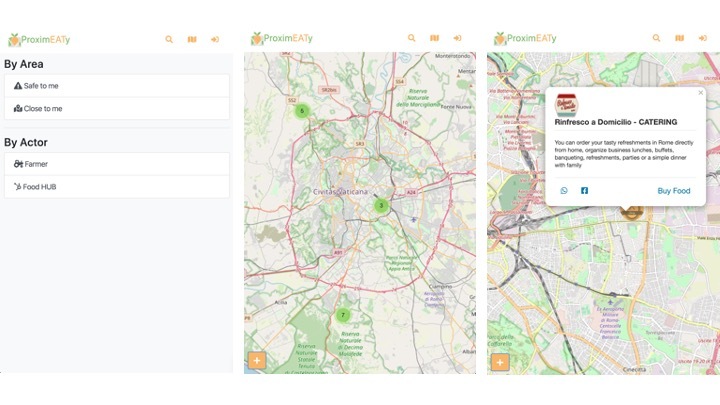
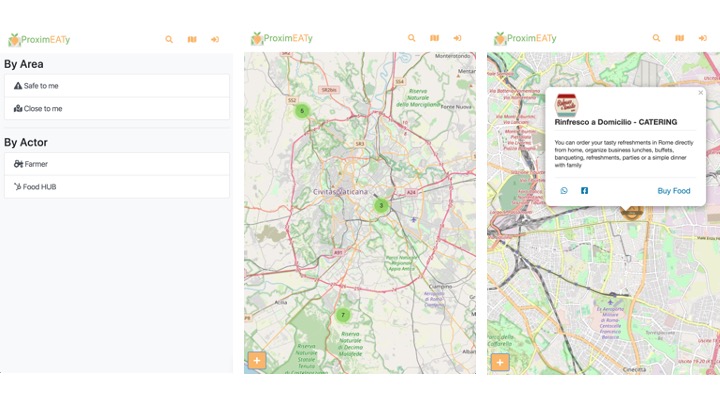
Introducing ProximEATy. An interactive map-based solution that helps users locate and purchase food products based on availability and proximity.
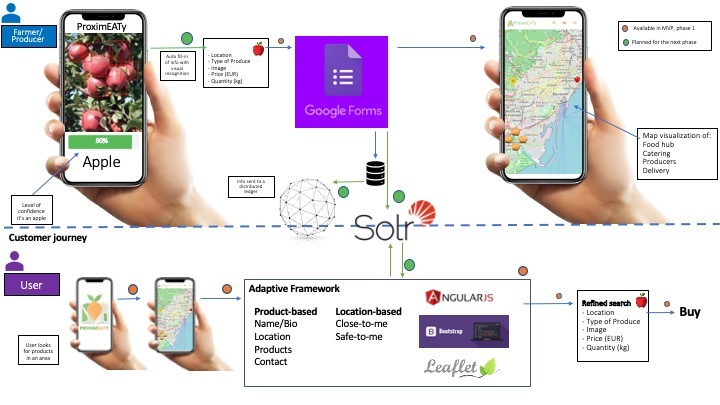
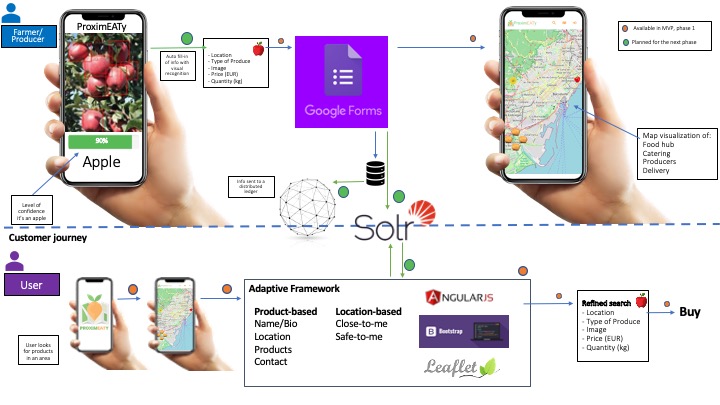
The phase 1, our MVP, focuses on assisting the producer to ingest structured data into the system (e.g. location, Type of Produce, Image, Price, Quantity), and makes them available via an interactive map accessible by the user. Based on localization, the users can search for products in an area, by leveraging on an adaptive search, and proceed to purchase. The main advantage is that the user can visualize points that are “close to me” and/or “safe to me”, to ensure social distancing and regulation-compliance are maintained.
For phase 2, we envision an AI-based visual recognition feature that automatically identifies objects (e.g. fruits) and provides the farmer with a more complete set of information to be inserted, which will go afterwards to GoogleForms, connected with a shared ledger (Blockchain) system. This is then included and transmitted to the adaptive framework of the system via Solar. The result is a refined search based on live data.
3. What we have done during the weekend:
- Formed a multi-disciplinary pan-European team
- Literary review, market research, needs assessment, SWOT analysis
- Community Consultation with core users (small-medium producers/farmers)
- Explored different scenarios in a discovery phase
- Design thinking solution session
- Identified personas and technologies
- Connected to mentors and validated the idea
- Built a prototype and supporting material
4. The solution’s impact to the crisis:
COVID-19 has pushed the European Food Industry to a tipping point. Panic is setting in as distribution channels are buckling under the pressure of the pandemic. Farmer’s Markets across the European Union are in limbo, wholesale orders from restaurants are at a standstill, and farmer’s simply can’t keep up with the demands of digitalizing their business. So, we asked ourselves how might we mitigate the impact of COVID-19 on pan-European food security?
Here’s what we discovered:
Europe’s small-to-medium size local producers have essential produce but need help connecting to distribution channels. Meanwhile consumers are struggling to access local produce due to self-isolation, social distancing and the closure of public gatherings, including farmer’s markets.
ProximEATy was created to open a new direct sales channel connecting local producers with local consumers to shorten the food supply chain and ensure sustainable food security/support the resilience of local food economies.
Our solution creates economic opportunities for local food producers and increases consumer access to local food.
The technology is adaptive to meet the needs of the users in different scenarios based on data filters (i.e. COVID-19: direct access to local foods filtered by proximity to infected areas. Post-COVID-19: a open-source tool to support farmer’s markets and pop-up food hubs).
Benefits:
- Support resilience of local food economies
- Unlocking the economic potential of local food systems
- Opens up a direct sales channel between local producers and local consumers
- Redesigning the way consumers are connected to their local producers
- Possibility of skipping several steps of the food chain (reduce costs of food and improve the quality)
- Improved location-based distribution
- Empowers local producers and consumers to find each other
- Quick and agile implementation and scalability
- User-friendly for all
- Proximity-based identification of local food sources
- Boundless and swift scalability of the technology
- Easy to implement in multiple environments (rural, urban, suburban etc.)
- Bridge knowledge gap between small producers and consumers to increase exchange and market options
- Provide valuable information on food (type, characteristics, foot print)
5. The necessities in order to continue the project:
a.) Technical Development b.) Activation of Community Onboarding c.) Core Team Recruitment (Community Leader, Project Manager, Partnership Lead) d.) Pilot Implementation in Italy, Spain, Germany, France e.) Communication Campaign & Launch
6. The value of our solution(s) after the crisis:
- Creates new economic opportunities and jobs
- Directly addressing issues of food security by providing access to local food
- Strengthens local food systems through reliable direct access to producers
- Diversification of food choice
- Supporting the long-term financial sustainability of local producers
- Increased consumer awareness and accessibility to their local producers
- Continuous cultivation of the producer-consumer relationship
- A strong network of engaged producers across Europe
- Modular to adapt according to user needs
Built With
- blockchain
- delivery.com
- disruptive
- distributed-architecture
- food
- food-security-data
- frameworks-(angular/java)
- logistic
- micro-service(api-driven)
- tech


Log in or sign up for Devpost to join the conversation.