-
-
SimForge - grounded AI
-
SimForge - Screenshot
Inspiration
First I built Provexar, an AI-powered mock oral exam, to prepare for my Private Pilot checkride. Then my flight instructor encouraged me to turn it into a product.
While working on it, I realized that the idea can be applied to almost any domain. If you rate passive studying, flashcards and mock exam, mock exam will be on top.
This is how was born SimForge.
What it does
SimForge transforms documents and media into source-grounded interactive simulations that teach, test, and verify applied understanding.
Users upload their own reference materials. SimForge interprets their structure and identifies:
- Competencies
- Critical rules
- Procedures
- Evidence requirements
- Source authority
- Knowledge gaps
It then proposes a simulation model for human approval.
After approval, SimForge generates an interactive scenario in which the learner must inspect evidence, make decisions, communicate, recover from mistakes, and complete the situation safely.
SimForge does more than produce a chatbot conversation. It records learner’s actions and actually evaluates student knowledge and understanding.
How we built it
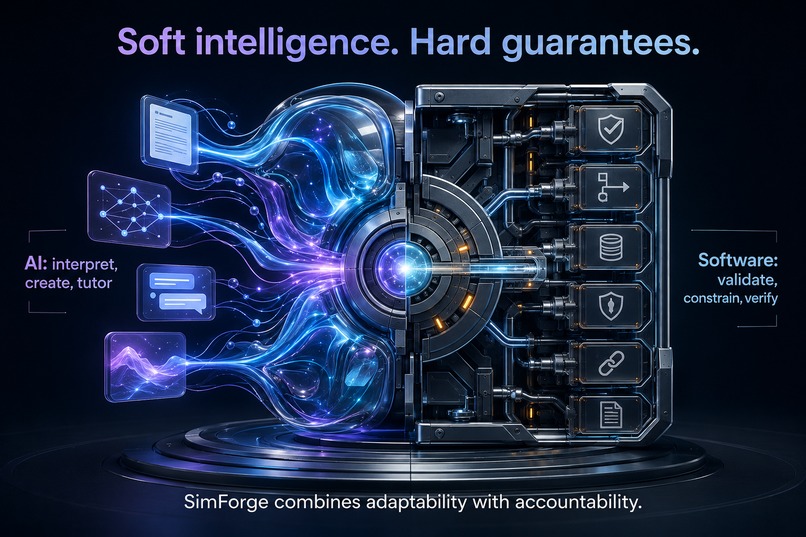
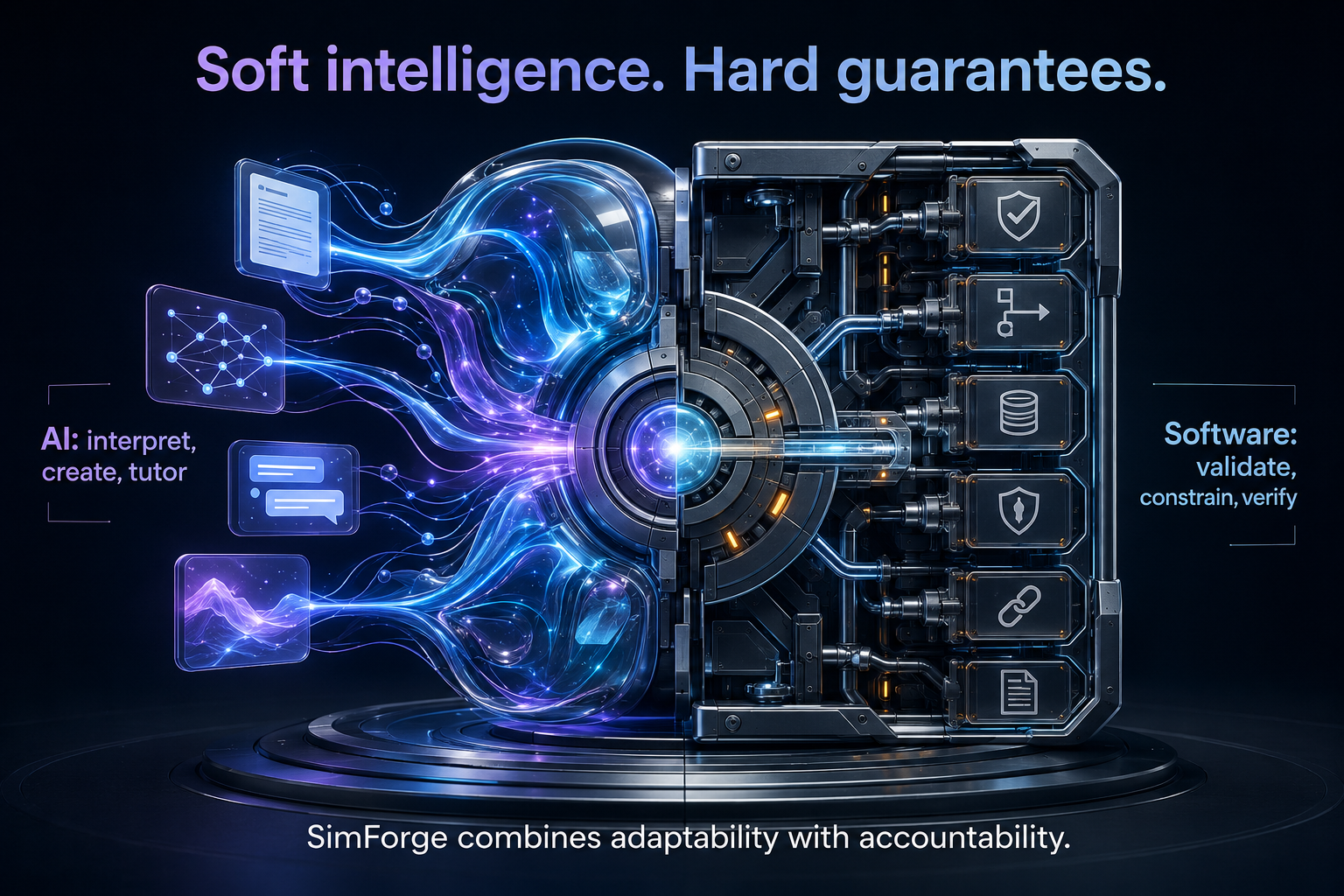
I built SimForge as a combination of generative AI and deterministic software.
GPT-5.6 Sol interprets the uploaded materials and produces a structured knowledge model containing competencies, rules, procedures, source authority, ambiguities, and disclosed assumptions. A human reviews and approves that model before simulation generation begins.
GPT-5.6 then generates a semantic scenario blueprint. A deterministic compiler validates and converts that blueprint into an executable simulation specification. The generic runtime handles:
- Scenario state
- Learner actions
- Evidence
- Consequences
- Safety constraints
- Recovery paths
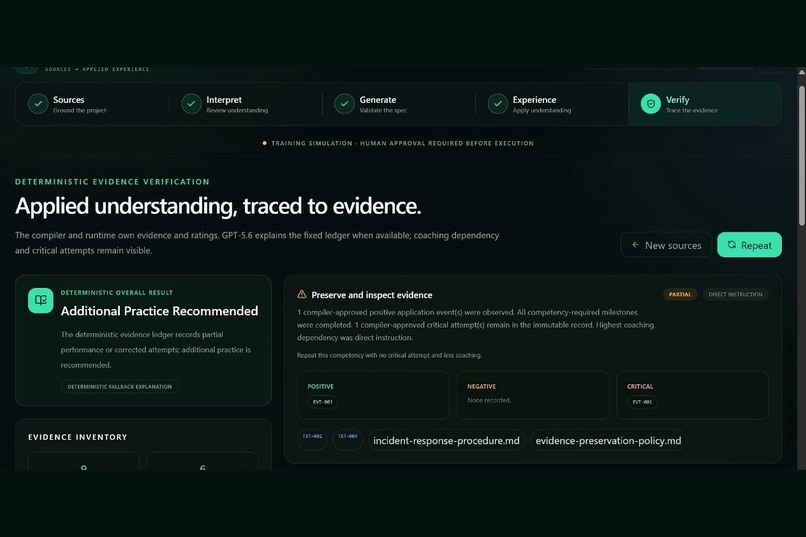
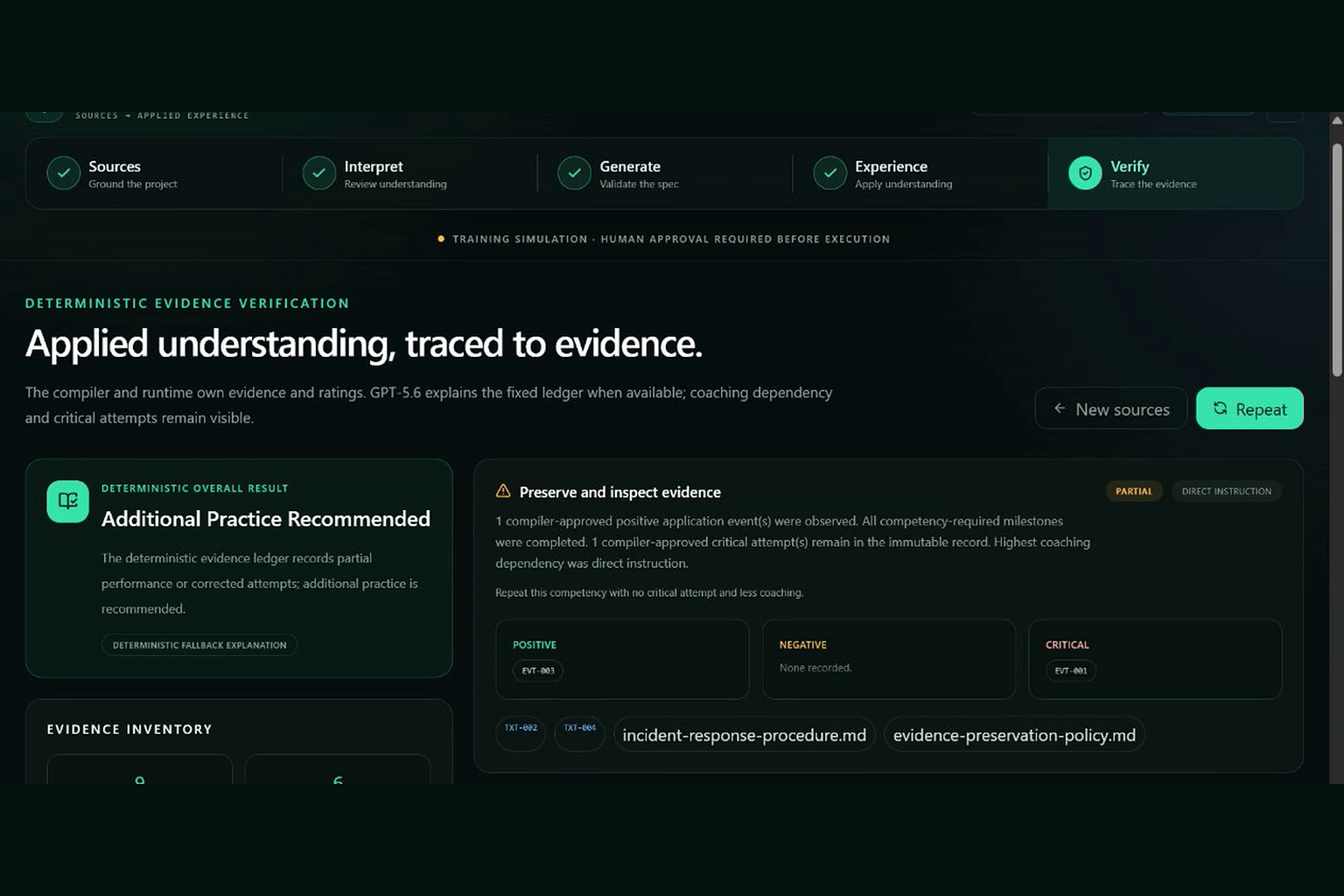
During the simulation, every meaningful event is recorded. The evidence ledger and competency ratings are calculated deterministically.
GPT-5.6 may explain the results in natural language, but it cannot change them. If its explanation makes a claim that is not supported by the evidence, SimForge rejects it and uses a validated deterministic explanation instead.
The prototype uses:
- Next.js
- TypeScript
- Zod
- OpenAI Responses API with Structured Outputs
- OpenAI Files
- Temporary vector stores and file search
- Realtime transcription
- Text-to-speech
Challenges we ran into
The hardest challenge was grounding generated simulations in the uploaded sources without allowing the model to invent procedures, thresholds, or assessment criteria.
A simulation can look convincing while still being subtly wrong. To address this, we added:
- Source references
- Semantic validation
- Explicit human approval boundaries
- Disclosed assumptions
- Deterministic compilation before launch
Assessment created another challenge. LLM can produce an evaluation that is not fully supported by what the learner actually did. So evidence collection and rating separated from narrative explanation.
During live validation, GPT-5.6 generated several unsupported claims about independent performance. SimForge rejected those claims, preserved the deterministic ratings, and returned a safe fallback explanation. That failure became one of the strongest demonstrations that the architecture working correctly.
I also needed resumable checkpoints because interpreting substantial source packages can take several minutes. When a generated blueprint failed validation, SimForge preserved the approved knowledge model, applied a bounded correction, and resumed generation without repeating the expensive ingestion and interpretation stages.
Finally, I had to protect the system from instructions embedded inside uploaded documents. SimForge treats uploaded content as reference material—not executable instructions. Prompt-injection probe confirmed that hostile document directives were not promoted into system policy.
Accomplishments that we're proud of
I proved that SimForge is not tied to one handcrafted scenario or one industry. The same runtime supports simulations across unrelated domains, including:
- Cybersecurity incident response
- Workplace conflicts of interest
- Chemical-spill response
- Software deployment failure
I successfully ran an unseen source package through the complete live pipeline:
- Ingestion
- Interpretation
- Human approval
- Blueprint generation
- Deterministic compilation
- Simulation
- Evidence collection
- Assessment
- Tutoring
I also tested source-change sensitivity. When a rollback threshold in the source material changed from 8% to 11%, that change propagated through interpretation, generation, validation, and compilation using a fresh, isolated source store.
Most importantly, SimForge retains unsafe attempts instead of erasing them after a learner recovers. The final assessment can show what happened, how the learner responded, what coaching was required, and which source supports each conclusion.
What we learned
I now think of a reliable AI system as a cyborg: a combination of hard mechanical parts and soft living organs.
The soft parts are where AI is strongest:
- Interpreting unfamiliar materials
- Finding relationships
- Creating realistic situations
- Adapting tutoring
- Explaining complex ideas naturally
The hard parts are where the system must remain exact:
- Validation
- Permissions
- Safety rules
- State transitions
- Evidence retention
- Scoring
- Provenance
- Auditability
The breakthrough was not simply using a more capable model. It was learning which responsibilities should belong to the model and which must remain deterministic.
AI provides adaptability and intelligence. Conventional software provides boundaries and accountability.
What's next for SimForge
The next step is to expand support for additional document and media formats and make source interpretation faster and more collaborative.
I want subject-matter experts to review, edit, version, and approve generated knowledge models and scenario blueprints before publishing simulations to learners.
I also plan to add:
- Reusable organizational policies
- Simulation libraries
- Team analytics
- Accessibility improvements
- Richer voice-based interaction
- Collaborative review and approval workflows
For controlled live deployments, I will add authentication, durable usage quotas, concurrency controls, monitoring, audit logs, and administrative kill switches.
As very long term goal I'm thinking of embedding the core components into standalone products or product blocks. The material interpreter will help me in my job in Control Systems engineering.
Built With
- edge-middleware
- file-search
- gpt-5.6
- openai-api
- prompt-caching
- realtime-api
- responses-api
- speech-to-text
- text-to-speech
- vector-stores
- vercel


Log in or sign up for Devpost to join the conversation.