Inspiration
Over the past year, we have all laid personal witness to the havoc that tariffs can wreak. The trend of attacks on free trade and its effects on Canadian businesses, particularly small businesses, inspired this project.
What it does
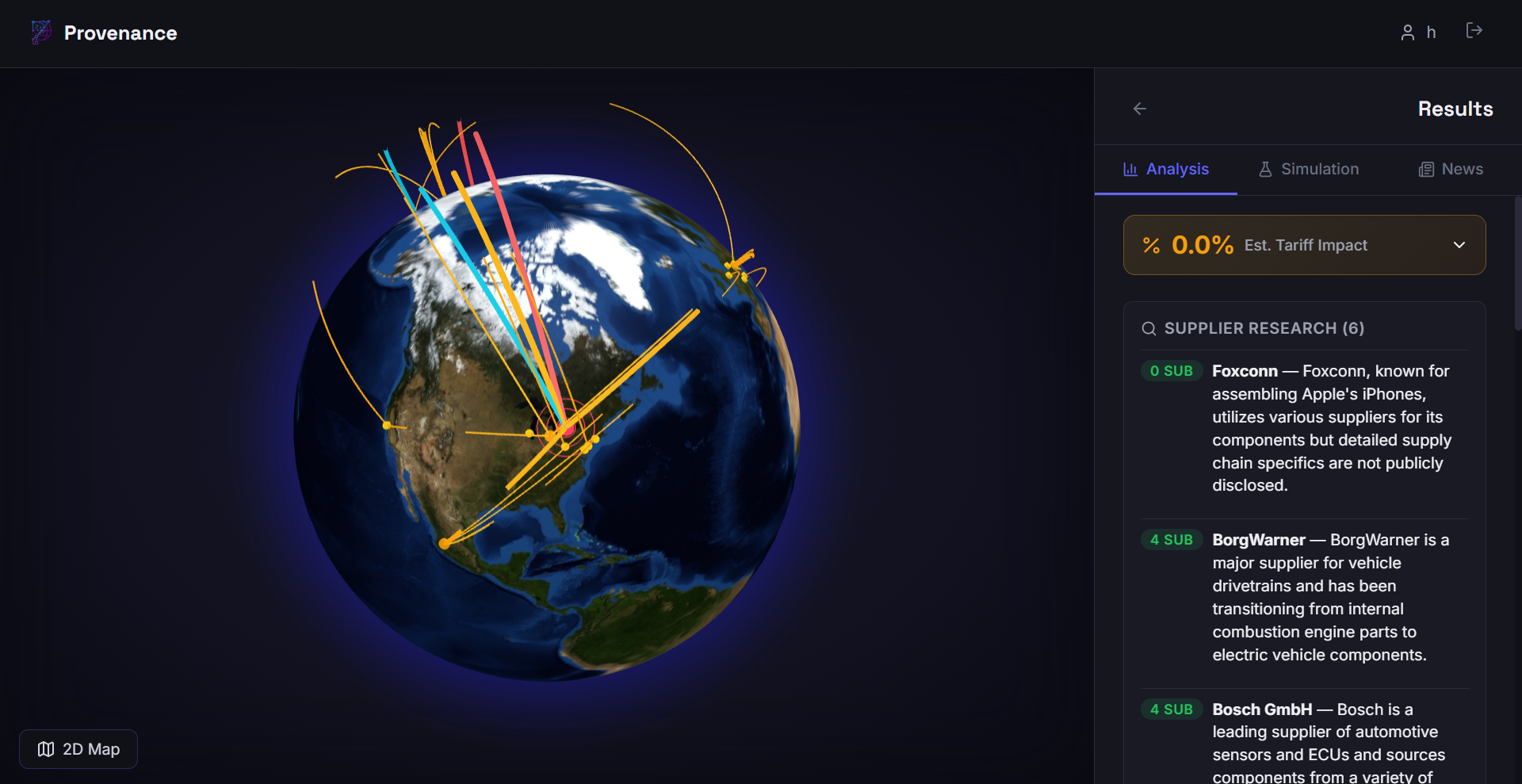
Paste your supply chain in plain language and watch it render on an interactive 3D globe. Every supplier becomes a node, colour-coded by tariff exposure. Every edge carries a dollar value, and for the first time, you can see exactly where your business is exposed and what it's costing you.
Under the hood, Backboard's multi-agent pipeline maps your inputs to standardized tariff classifications, cross-references live Canadian tariff schedules, and calculates your net cost impact down to the line item. When a node is flagged high-risk, Provenance finds you alternatives, pulling from a growing cache of Canadian and CUSMA-compliant suppliers that gets smarter with every business that uses the platform.
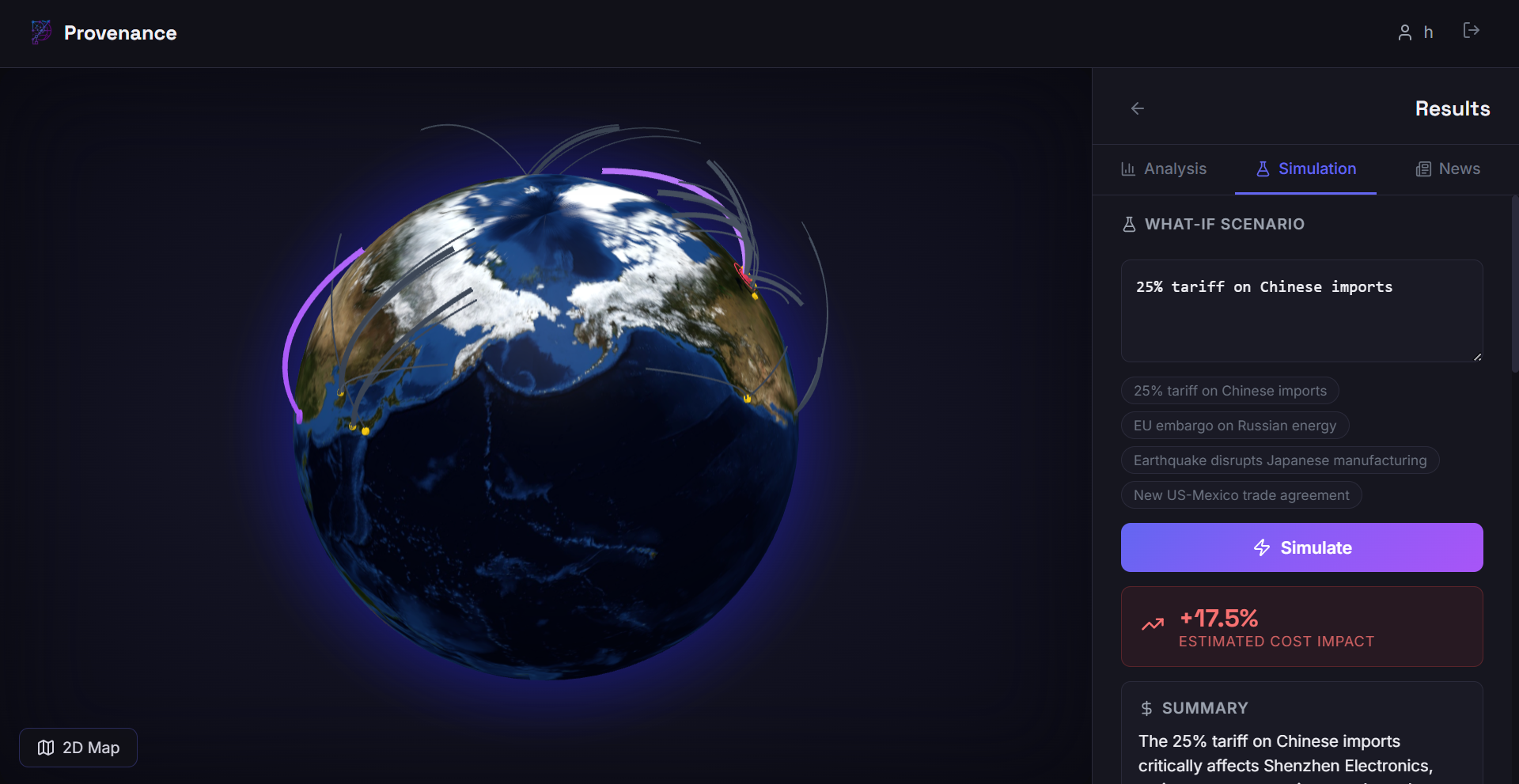
But static analysis isn't enough in an environment where policy changes weekly. Provenance's scenario simulator lets you model what-if situations before they happen: dial up a tariff escalation, simulate a supplier going dark, visualize any scenario you can imagine, or pick from a curated list of common trade disruptions. Supply chains respond in real time: costs recalculate, risk scores shift, and you receive tailored recommendations on how to avoid, mitigate, or position around the event.
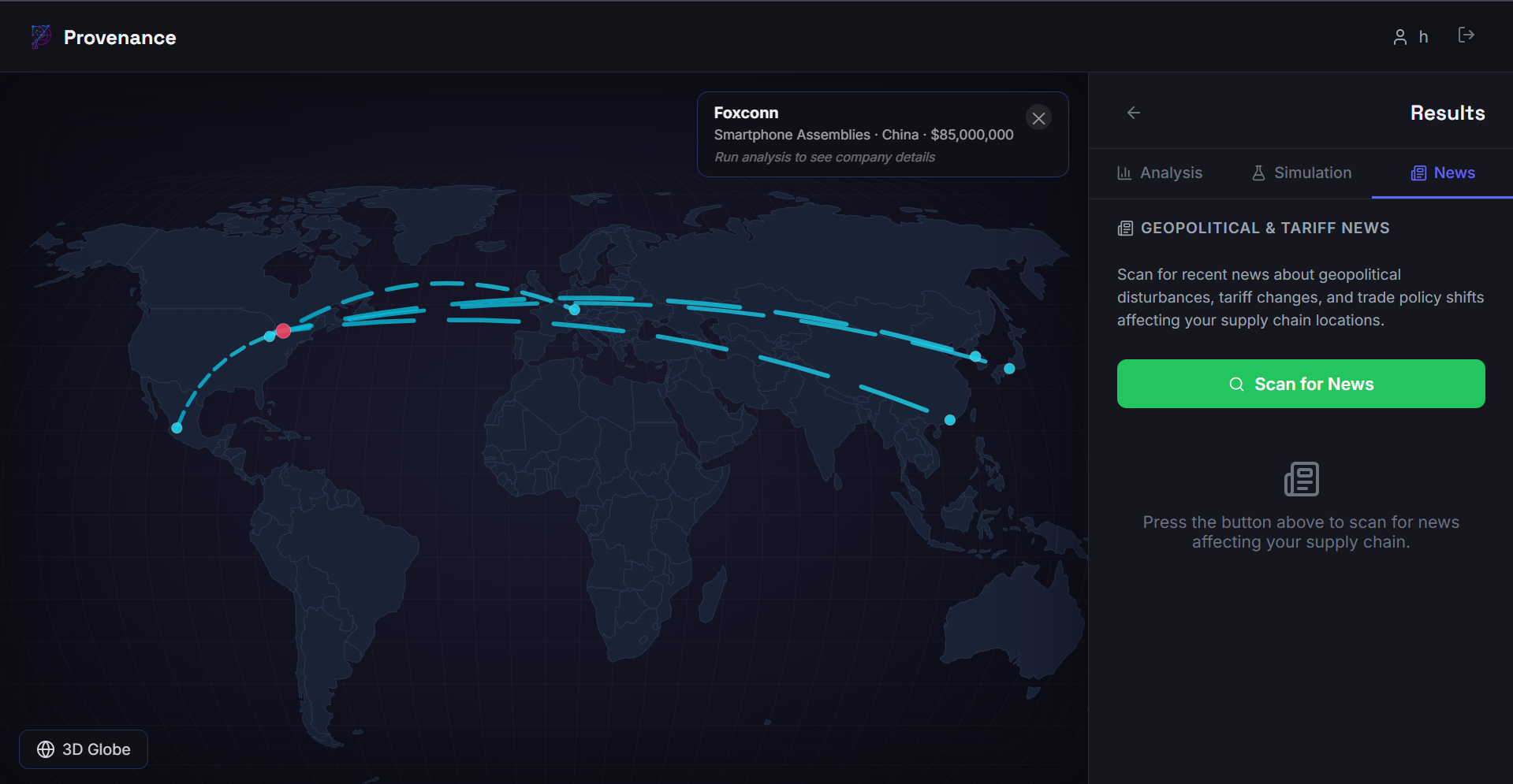
A built-in news intelligence layer continuously monitors for developments relevant to your specific supply chain. Stories about your commodities, your supplier regions, and your tariff codes are used to update supply chain health the moment they're published.
How we built it
React/Typescript front end Python FastAPI backend Backboard models for complex reasoning/analysis tasks (we asked claude which models to use for which agent and unsurprisingly it picked a claude model for each one of them)
Challenges we ran into
One of our biggest challenges was handling large and messy supply chain inputs. Backboard’s SDK could become unstable with more complex payloads, which led to API errors and forced us to rethink how we chunked and processed information.
Another challenge was the tariff data itself. Trade classification is not clean or intuitive, and mapping real-world products to the correct tariff categories was much harder than we expected. A lot of the difficulty was figuring out how to make ambiguous product descriptions usable for downstream analysis.
We also had to balance technical depth with usability. It is easy to build a pipeline that produces numbers, but much harder to present supply chain risk in a way that feels clear and useful to a non-technical business user.
Accomplishments that we're proud of
- turning plain-language supply chain descriptions into a structured global network
- connecting tariff reasoning to a visual interface in a way that is easy to understand
- building scenario simulation instead of stopping at static analysis
- creating a foundation for supplier recommendations, not just risk reporting
What we learned
Agents are very powerful, as long as you clearly explain the role and its scope. Also, building around ambuiguity is very hard, but setting clear boundaries on what the agent is allowed/not allowed to do is important.
What's next for Provenance
Next, we want to make Provenance more robust and more useful for real businesses. Our main priorities are:
- support for larger and more complex bills of materials
- better product-to-tariff classification accuracy
- stronger supplier recommendation coverage
- more realistic disruption modeling
- live integrations with procurement, ERP, or spreadsheet workflows Basically, we want to create a more seamless experience for our clients.
Built With
- backboard
- fastapi
- python
- react
- sqlite
- typescript

Log in or sign up for Devpost to join the conversation.