-
-
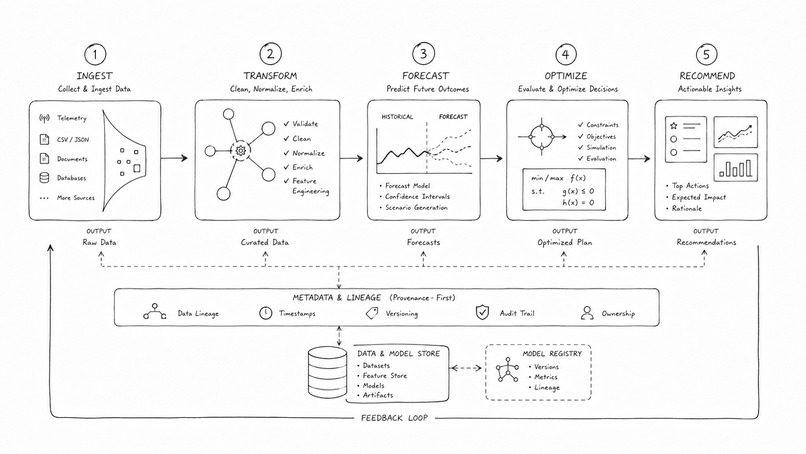
Data pipeline system architecture diagram
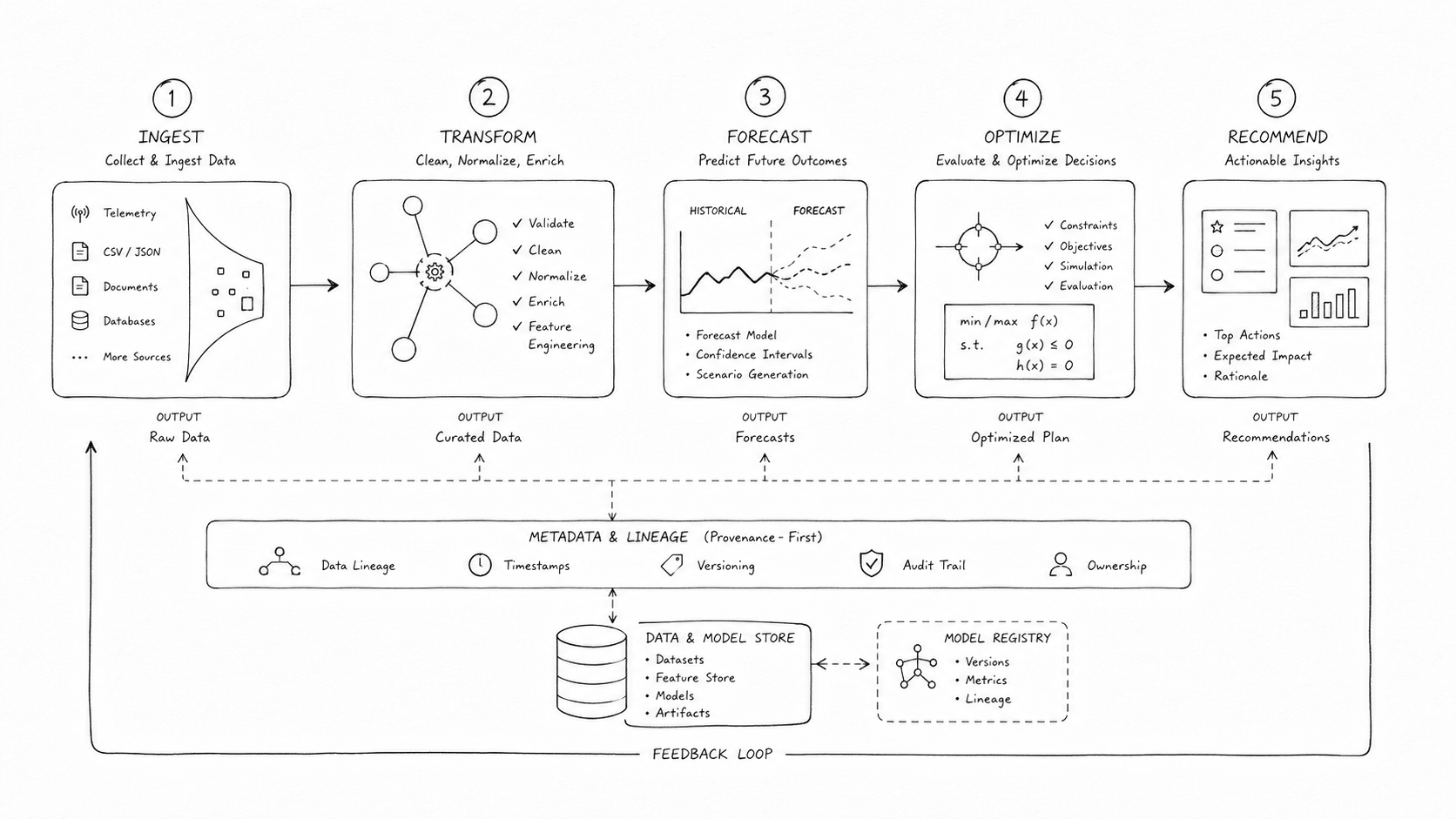
Forecast Engine
The Grove Forecast Engine treats provenance as part of computation rather than metadata added afterward.
Inspiration
The breakthrough of early aircraft was not just propulsion, but the three-axis control system, allowing pilots to adapt to unpredictable wind shear in real-time. Transformative tech amplifies potential, where modern AI serves as a powered engine for R&D. In this collaborative ecosystem, intelligent co-pilots handle continuous forecasting and micro-adjustments, while the human scientist acts as the mission controller in the decision and the delivery layers, including building skills and steering the overall flight path.
AI systems can produce increasingly accurate predictions, but the computational lineage behind those inferences is often lost. Data is transformed through multiple stages, including ingestion, preprocessing, feature extraction, inference, and optimization. Much of this computational lineage is either discarded or scattered across logs. As a result, reproducing an AI decision becomes difficult even for its own developers.
The insight that formed the forecast engine's different approach began with a question:
What if provenance were treated as part of computation itself, rather than a reactive metadata afterthought?
Instead of viewing lineage as an auditing feature, the forecast engine models provenance as a first-class component of the computational pipeline. Every transformation contributes to a traceable execution graph, allowing forecasts to be inspected, reproduced, and verified.
The technical idea behind the build
A provenance-first forecasting engine that transforms heterogeneous datasets into traceable predictions:
The system ingests structured and semi-structured data, constructs an internal lineage graph describing how information flows through the engine, performs forecasting over the resulting state, and records every computational transition in an append-only ledger. Rather than producing a prediction as an isolated output, the forecast engine produces a prediction together with its computational history.
Conceptually, the execution flow is:
APIs & Visualization
     ↑
Decision Ledger
     ↑
Forecast Engine
     ↑
Provenance Graph
     ↑
Ingestion
     ↑
Data Sources
Each stage contributes to an inspectable execution history that can be queried independently from the prediction itself.
Implementation
The project follows a modular architecture designed around separation-of-concerns principles.
- Engine Core performs deterministic computation, forecasting, optimization, and lineage construction.
- Ingestion normalizes heterogeneous data into a common representation.
- Forecaster generates predictions from the evolving state.
- Ledger records immutable execution transitions.
- Gateway APIs expose forecasts, provenance, and lineage for external applications.
- User Interface visualizes forecasts and computational relationships.
The system isolates provenance, forecasting, and persistence into independent modules. This architectural design remains fully extensible while preserving deterministic execution boundaries.
Challenges
The largest challenge was architectural rather than algorithmic. Most AI systems optimize for producing predictions. The Grove Forecast Engine instead optimizes for preserving the reasoning pathway that produced those predictions. This required designing provenance capture as an integral part of execution rather than a logging layer added afterward.
Another challenge was balancing flexibility with reproducibility. Supporting heterogeneous datasets while maintaining deterministic lineage required carefully separating domain logic, execution state, and persistence into distinct modules.
Finally, reducing a broad research vision into a focused prototype required deliberately narrowing the scope. Several core ideas remain for future work. These include optimization pipelines, digital twins, simulations, and richer graph analytics. The current implementation concentrates on demonstrating the core principle: provenance-aware forecasting.
Tradeoffs
Building The Grove Forecast Engine reinforced an important observation: Reproducibility is not solely an attribute of machine learning models; it is a property of the entire computational pipeline.
Treating provenance as a first-class citizen changes how we validate, inspect, and extend AI systems. Instead of asking only "What prediction was made?" Our system enables developers and researchers to ask:
- Which data contributed to this prediction?
- Which transformations occurred?
- Which intermediate states were produced?
- Can the computation be reproduced?
These questions become part of the system's design rather than post hoc investigations.
Roadmap
The Grove Forecast Engine is intended as the foundation for provenance-aware AI systems where forecasting, optimization, and decision support share a common computational lineage. Future work includes richer graph analytics, streaming telemetry, digital twin integration, uncertainty propagation, and larger-scale optimization. The long-term vision is an execution engine where every prediction remains explainable, reproducible, and computationally traceable from input to output.

Log in or sign up for Devpost to join the conversation.