-
-
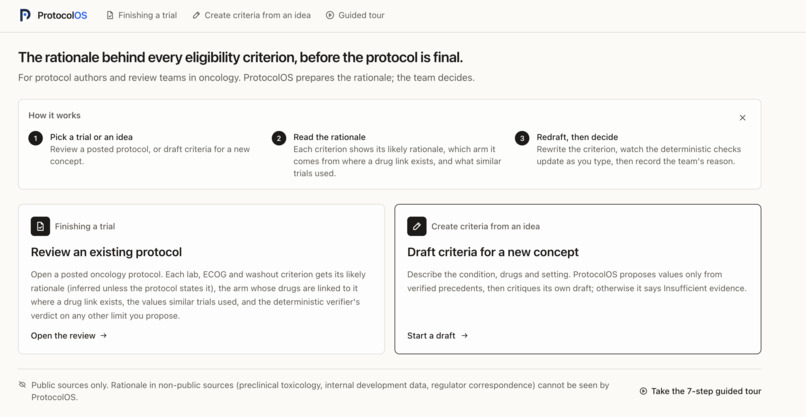
One platform to review and draft clinical trials
-
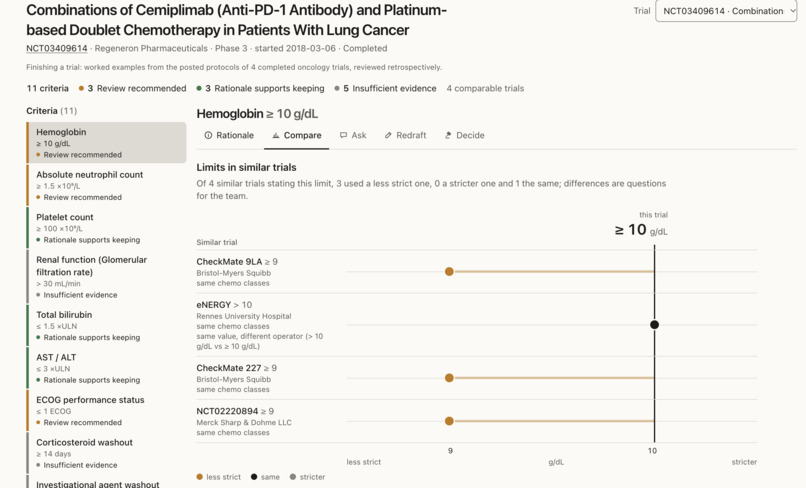
Compare eligibility rules across trials
-
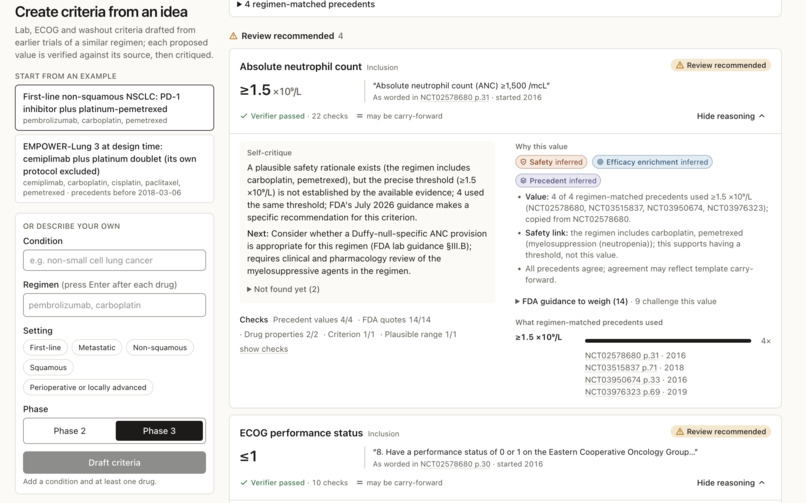
Draft new criteria from verified evidence
-
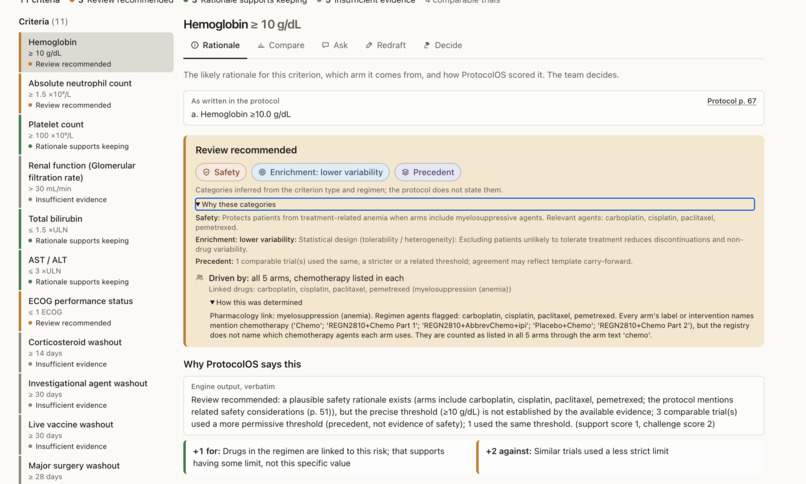
Explain the evidence behind each rule
-
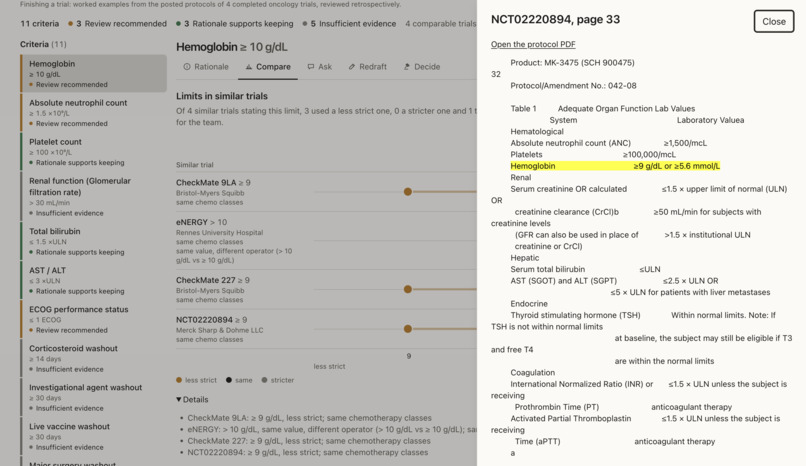
Trace every claim to its source
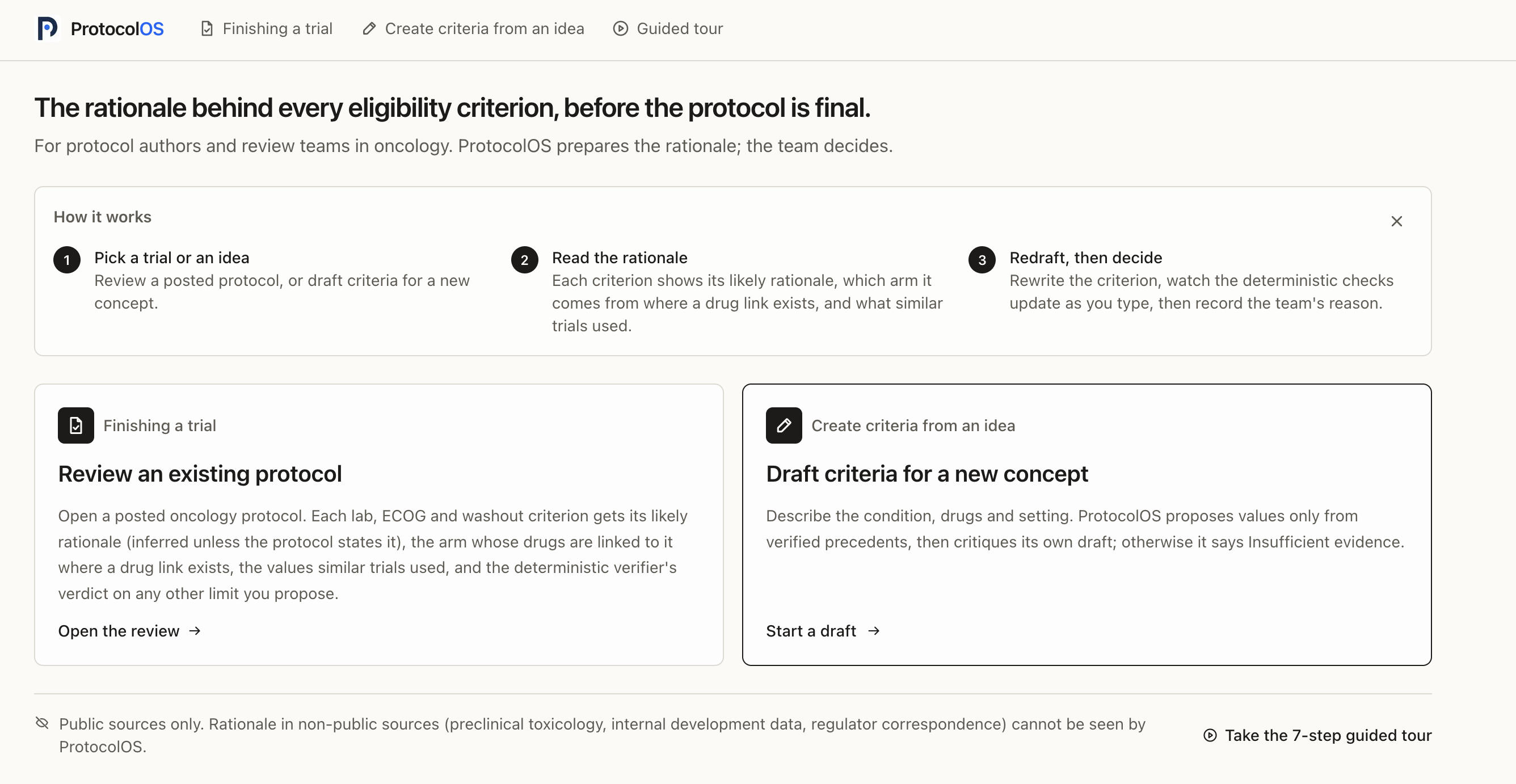
Inspiration
Clinical trials determine which new treatments can reach patients. Before a trial begins, pharmaceutical companies must decide who can participate and who cannot. Those rules protect patients and help produce reliable scientific results, but poorly justified restrictions can also exclude people from potentially beneficial experimental treatments or make recruitment more difficult. Relaxing necessary safety requirements, on the other hand, can put participants at risk.
Getting eligibility decisions wrong can have consequences for both patient safety and access to research. Delayed trials also mean delayed answers for patients waiting for new options.
In a study of 1,197 oncology trials, approximately 19% failed to enroll enough patients. Separately, a 2016 Tufts CSDD study reported a median $535,000 in direct implementation costs for a substantial Phase III protocol amendment across amendment types. Neither statistic measures the impact of our software, but both show why trial design deserves careful attention.
We asked: What if every eligibility decision came with its evidence, rationale, and unanswered questions before a protocol was finalized?
That's why we built ProtocolOS — Every exclusion deserves evidence.
What it does
ProtocolOS helps pharmaceutical companies review, verify, and draft clinical trial eligibility requirements while keeping medical experts responsible for the decisions.
Review an existing trial
ProtocolOS reads published oncology trial protocols and extracts rules such as blood-count thresholds, performance-status requirements, and washout periods. For each rule, it:
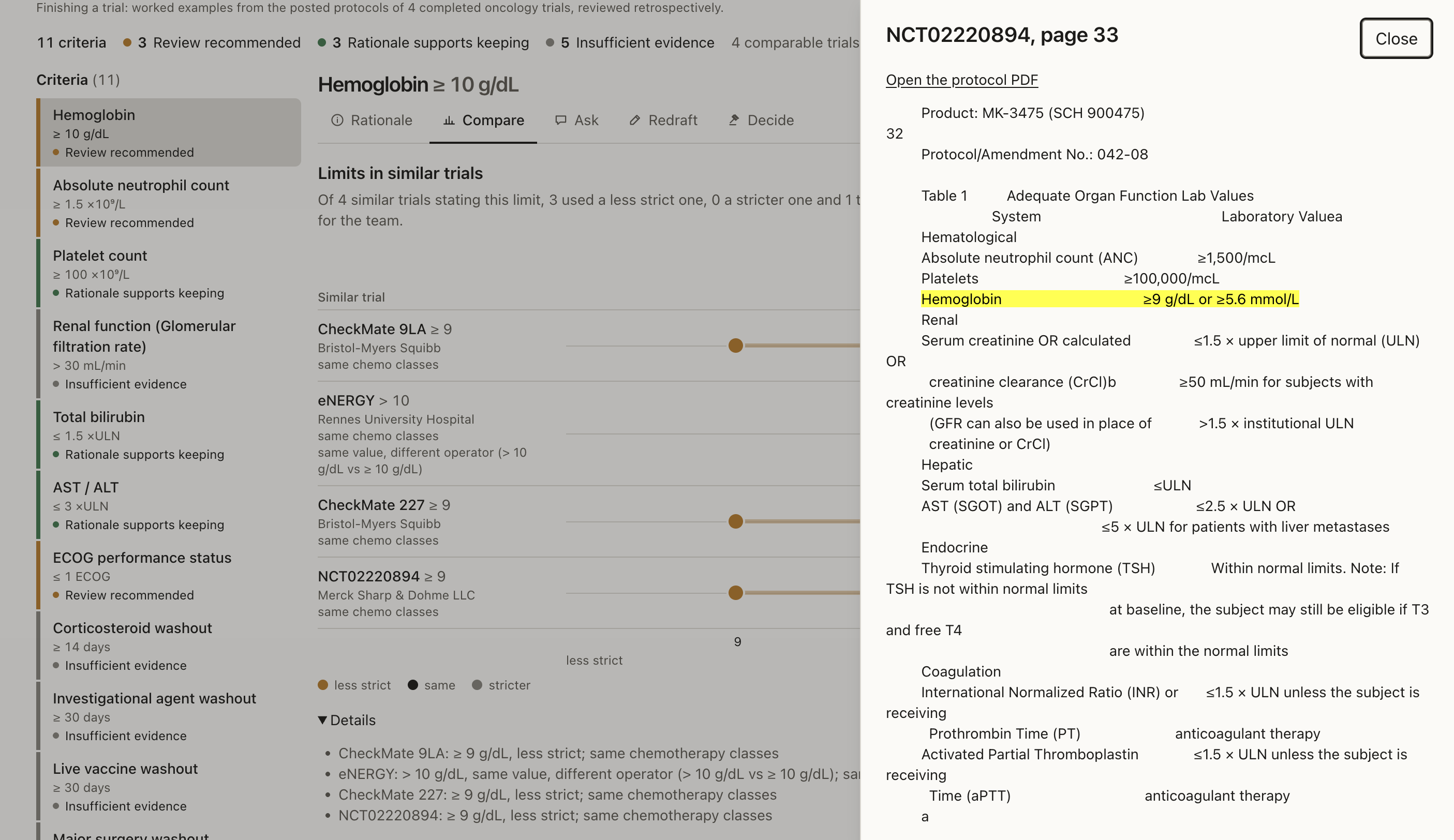
- Links the requirement to its source protocol.
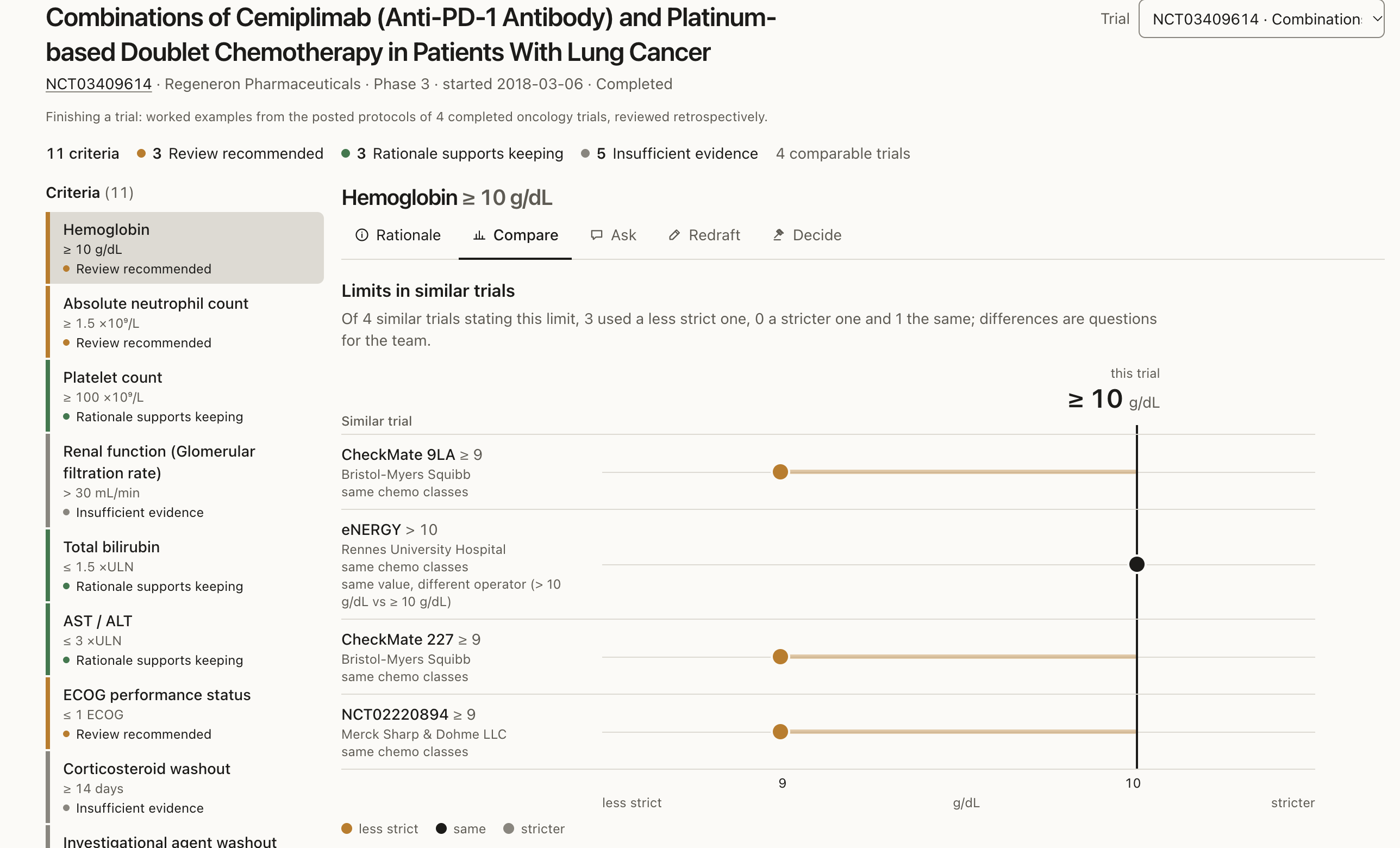
- Compares it with earlier trials involving relevant treatments.
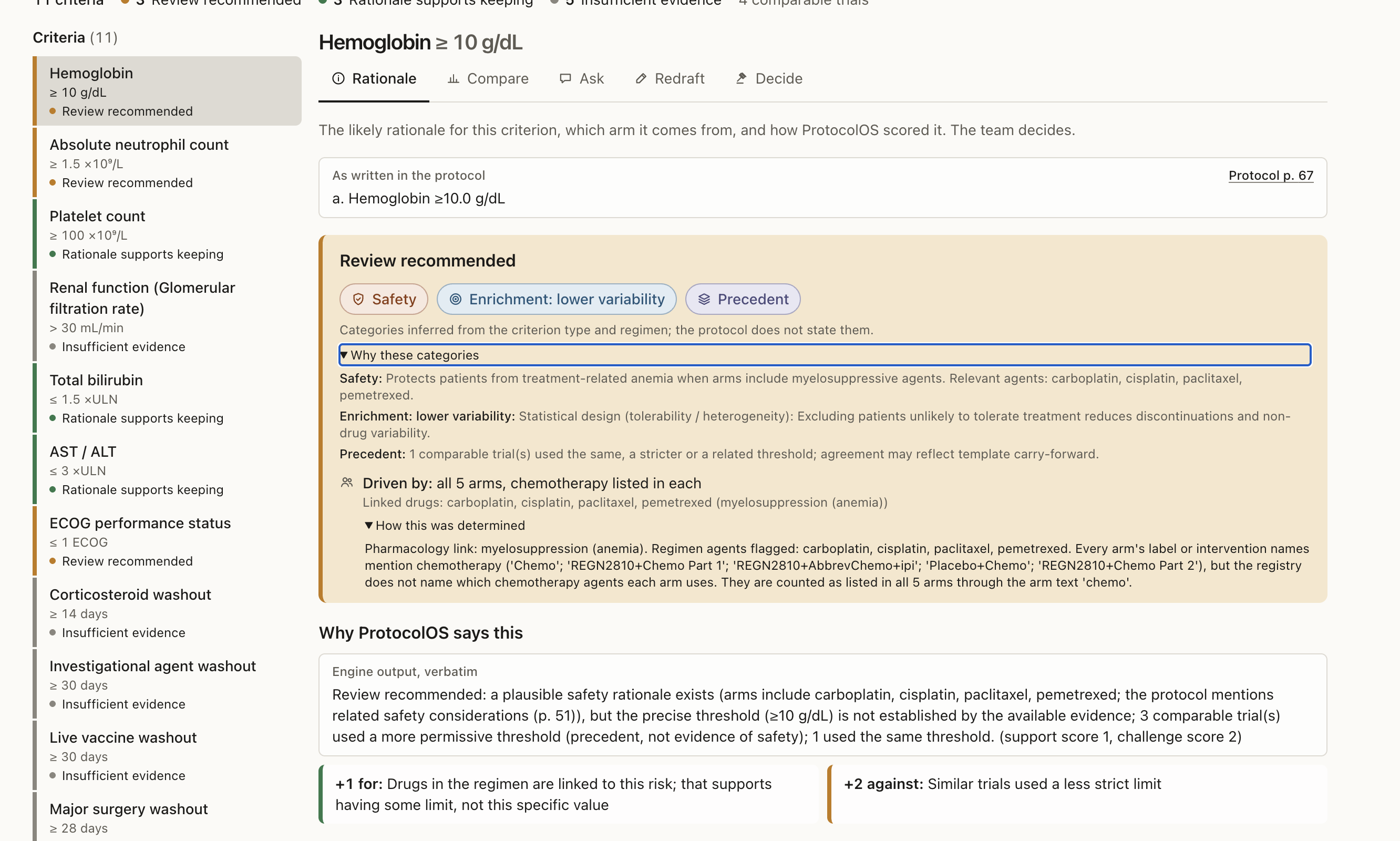
- Examines possible safety and scientific rationales, including the drugs used across treatment arms.
- Shows evidence supporting or questioning the restriction and flags unresolved questions for review.
- Checks numerical claims, quotes, trial references, and certain treatment-related reasoning errors.
- Lets a reviewer record a decision and export a review packet.
For example, Regeneron's EMPOWER-Lung 3 protocol requires hemoglobin ≥10 g/dL, while five of six earlier lung-cancer trials we examined used ≥9 g/dL. That difference does not establish that 9 is safe in EMPOWER-Lung 3: its treatment arms include chemotherapy with potential anemia risk. ProtocolOS frames the precise threshold as a medical review question, not as proof the trial was wrong.
Draft criteria for a new trial idea
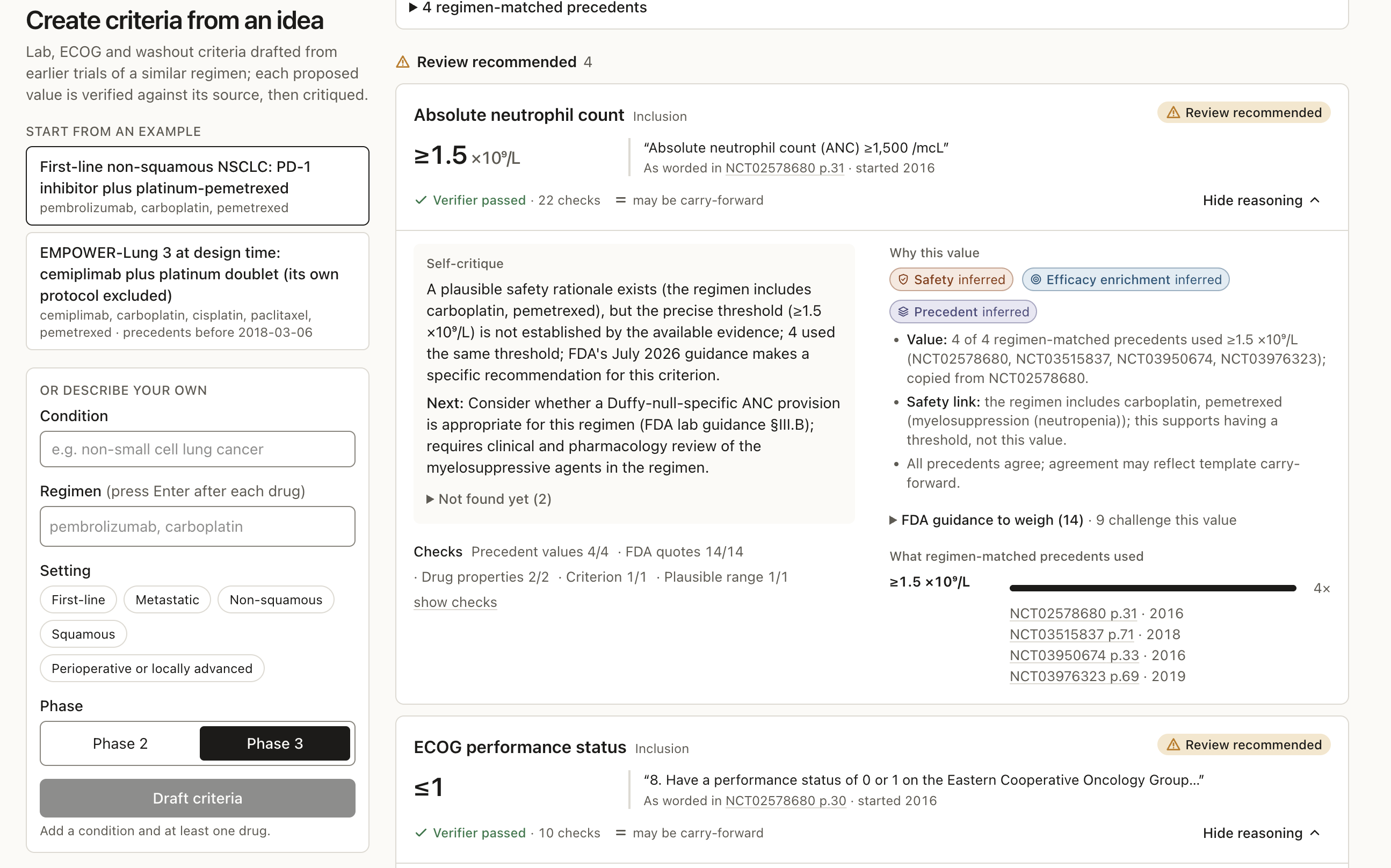
Starting with a disease, treatment regimen, trial phase, and setting, ProtocolOS uses verified earlier trial protocols to propose laboratory, performance-status, and washout requirements. It links drafted values to their precedents, performs a rule-based self-review, and reports insufficient evidence when it cannot support a proposal.
The core workflow is evidence-grounded and deterministic; ProtocolOS does not automatically decide what is safe or approve a clinical protocol.
How we built it
We built ProtocolOS at HackHarvard 2026 as a deployed web application with a shared engine for reviewing and drafting eligibility criteria.
- Python + FastAPI: protocol extraction, trial comparison, clinical-rationale analysis, deterministic verification, drafting, and exports.
- Next.js + React + TypeScript: interactive protocol review, evidence inspection, reviewer decisions, and drafting interface.
- ClinicalTrials.gov and published protocol PDFs: trial information and primary-source eligibility requirements.
- Curated treatment information and FDA guidance: context for evaluating reasons behind requirements, with dates and source limitations kept visible.
- Chalk: live trial registry features and hosted verifier evaluations; optional model-assisted investigation is separate from the deterministic core.
- Vercel + Railway: publicly accessible frontend and backend.
Our verification approach separates what a source states, what the software infers, and what a clinician decides. Drafted criteria are traced to their original protocol evidence rather than being generated as unsupported medical recommendations.
Challenges we ran into
A lower threshold is not automatically a better threshold. Earlier trials may use different therapies, doses, patient populations, or safety safeguards. We had to look beyond comparisons of numbers and account for treatment-related risks across trial arms.
Important eligibility details can be buried in long PDF protocols. Registry summaries often do not contain exact laboratory cutoffs, so we built extraction and source-tracing workflows around the original documents.
An argument can sound convincing and still be wrong. For instance, focusing on an immunotherapy alone may overlook chemotherapy in the other treatment arms. We developed deterministic checks for cited facts and recognizable reasoning contradictions.
Drafting requires restraint. When the available precedent does not justify a specific value, the system should show that limitation instead of guessing. We made insufficient evidence an explicit outcome and kept human review central.
Accomplishments that we're proud of
ProtocolOS is a working, deployed application with both review and drafting workflows, not just a slide deck or mockup.
In developer-run engineering evaluations, we achieved:
- 122/128 annotated eligibility requirements extracted correctly from 19 real oncology protocols.
- 24/24 deliberately faulty test arguments rejected by our deterministic verifier, with 0/10 valid test arguments falsely rejected in that test set.
- 39/39 expected verdicts in a hosted Chalk evaluation, with zero task errors.
- 22/31 drafted threshold values matching the values in the original protocols in a small four-trial historical back-test; the drafting workflow did not propose values without verified precedent in that test.
We also tested deliberately stricter eligibility rules: 22/24 were escalated in one evaluation, although 11 had already been flagged before modification. In the more restrictive historical-comparator setup used by the application, 16/24 were escalated. We report these distinctions because the numbers are not a clean measure of newly discovered errors.
These are engineering tests, not clinical validation. We have not shown improved enrollment, better outcomes, prevented amendments, or measured cost savings.
What we learned
The biggest lesson: finding a difference between two trials is not the same as establishing a clinical mistake. Patient safety, study interpretability, and treatment-specific risks all matter.
We also learned that trustworthy software for clinical teams must show its work. Every numerical claim and comparison should be traceable to its source, inferred explanations should be clearly identified, and the final decision must remain with qualified people.
Finally, reviewing and drafting are closely connected problems. A new criterion should have a defensible origin, and an existing criterion should be reviewable against that same evidence.
What's next for ProtocolOS
Our next step is a pilot with clinical development and protocol-review teams to evaluate whether ProtocolOS makes reviews faster and more useful without sacrificing rigor. That means testing with clinicians, checking performance on sponsor-relevant documents, and measuring review time and decision quality.
We also want to integrate the workflow into sponsors' existing protocol-authoring and review systems, expand beyond the current lab, performance-status, and washout criteria, and eventually support evidence-backed review across a broader clinical protocol.
Any future claims about avoided amendments, savings, recruitment, or clinical outcomes would need to be measured in real-world evaluations.
Our vision: as trial drafting becomes faster, every important decision should become easier to examine and defend.
Every exclusion deserves evidence.
Try ProtocolOS · Explore the source code View Our Pitch Deck (PDF)
Built With
- chalk
- clinicaltrials.gov
- css
- docker
- fastapi
- html
- javascript
- next.js
- python
- railway
- react
- typescript
- vercel

Log in or sign up for Devpost to join the conversation.