-
-
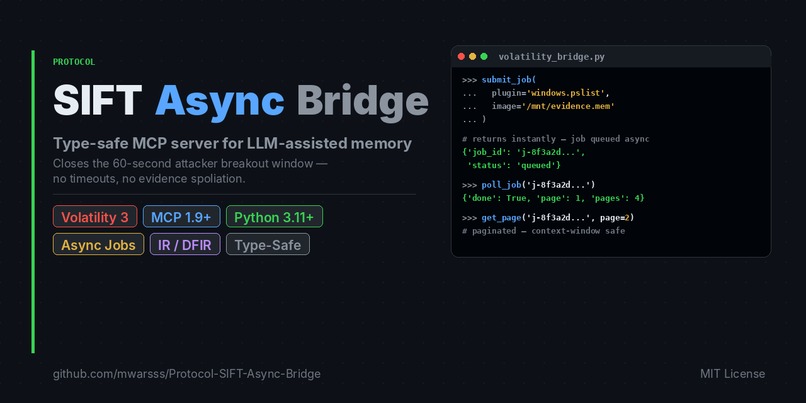
Media_preview
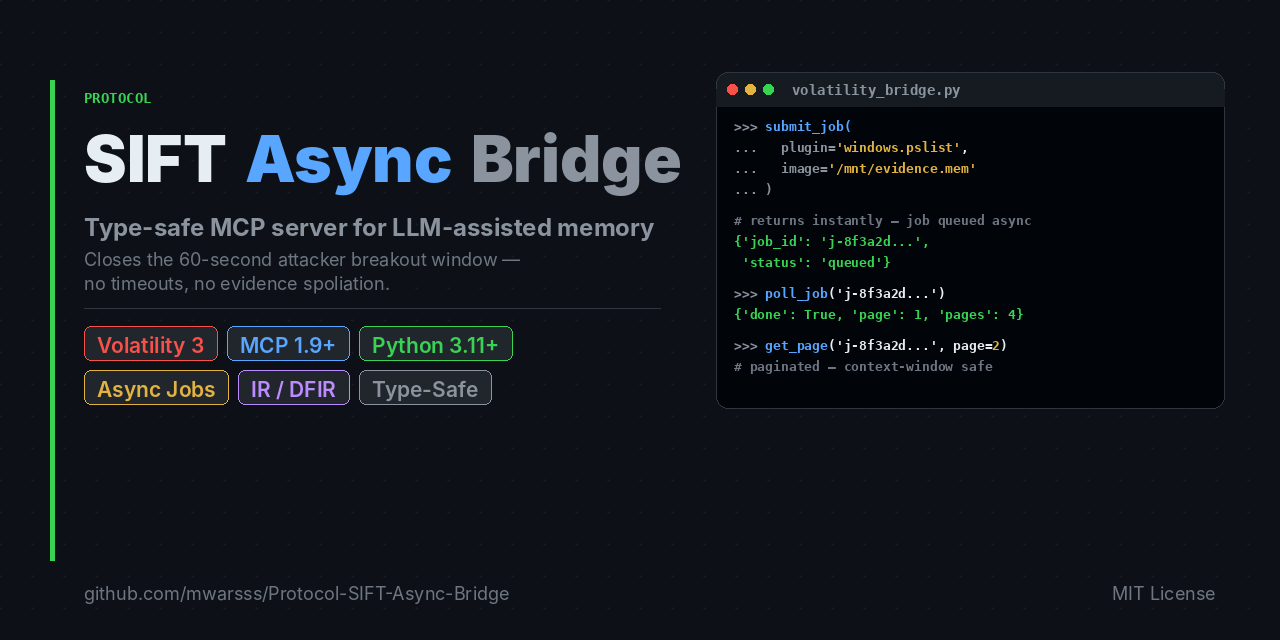
The Story of VOLBREACH: An Async, Forensic-Safe MCP Protocol Wrapper
Inspiration
In November 2025, Anthropic's security team dropped a threat intelligence report on GTG-1002 — a state-sponsored threat group utilizing autonomous AI agents to execute reconnaissance, exploit targets, and achieve full domain control at request rates that are physically impossible for human operators. Adversaries now move at machine speed, clocking breakout times ranging from 60 seconds to 8 minutes.
Meanwhile, human incident responders are left manually digging through complex command-line flags on their workstations.
The SANS SIFT Workstation provides an elite arsenal of over 200 forensic tools, but connecting an AI directly to a raw shell creates a catastrophic bottleneck. Standard LLM client-tool connections feature a strict execution timeout barrier of 4 minutes, while a comprehensive Volatility 3 memory scan or an MFT filesystem timeline on a production image routinely takes anywhere from 10 to 45 minutes. When traditional, naive AI wrappers hit this threshold, they drop connections, experience context window degradation, or worse , hallucinate and mutate raw evidence files, violating chain-of-custody.
We were inspired to close this operational gap by building VOLBREACH: a forensic-safe execution protocol that enables autonomous AI investigation while enforcing evidence immutability, asynchronous long-running task orchestration, and token-aware result pagination.
.##What It Does
VOLBREACH (Protocol-SIFT-Async-Bridge) is a Custom MCP Server that gives any MCP-compatible LLM client (Claude Desktop, Claude Code, MCP Inspector) safe, type-safe access to Volatility 3 memory forensics on the SANS SIFT Workstation.
An analyst points the server at a memory image; the LLM agent can then:
- Launch Volatility 3 plugins (pslist, pstree, cmdline, malfind, netscan, dlllist, etc.) as non-blocking background jobs and poll for completion — eliminating the 4-minute MCP tool-call timeout on scans that take 10-45 minutes.
- Page through large plugin outputs (1,000-50,000+ lines) via disk-backed, gzip-compressed pagination, keeping the LLM's context window small without losing data.
- Be structurally blocked from prematurely concluding an investigation: the generate_incident_report tool returns PROTOCOL_ERROR if any truncated job hasn't been fully paged, forcing exhaustive review before a report is generated.
End-to-end, this lets an LLM agent run a full incident triage against a real memory image — e.g., the CyberDefenders "Reveal" case — and produce a REPORT_READY incident report (phishing decoy → hidden PowerShell → WebDAV/rundll32 payload → process injection → live C2) without ever risking a write to the original evidence file, because no write or shell-exec tool exists in the server's tool surface.
How We Built It
  We engineered a custom, type-safe Python Model Context Protocol (MCP) Server
  running natively on the SANS SIFT Workstation using the FastMCP framework.
  Instead of exposing generic, hazardous shell execution commands, we built an
  abstraction layer with structured, type-safe tool definitions.

  The runtime implements six core security and optimization paradigms:

  1. Asynchronous Non-Blocking Workers — launch_volatility_plugin schedules the
  command on a ThreadPoolExecutor and immediately returns a UUID job ID in under
  5ms. The agent polls check_job_status independently, completely neutralizing
  LLM connection timeouts.
  2. Gzip Disk Slicing — Completed plugin outputs are stripped of layout noise
  and streamed to disk as compressed files (raw_output.txt.gz) inside an
  isolated, server-controlled workspace.
  3. Token-Aware Pagination — Raw output is hard-capped at MAX_OUTPUT_LINES
  (default 120) to protect the LLM's context window. read_job_output_page pages
  the full output on demand.
  4. The Premature-Conclusion Protocol Gate — generate_incident_report returns
  PROTOCOL_ERROR if any complete job has truncated=True and hasn't been fully
  paged. The agent is structurally forced to exhaustively review evidence before
  forming conclusions.
  5. Process Group Terminations — os.setsid + os.killpg(SIGKILL) on timeout
  ensures zero orphaned Volatility subprocesses.
  6. Perimeter Hardening — A pre-flight disk-exhaustion gate
  (shutil.disk_usage(), 5GB floor) and an evidence-stream isolation wrapper
  (<untrusted_evidence_stream> + security notice) neutralize prompt injection
  embedded in memory artifacts.
Challenges We Faced
The road to a fully verified, 51/51 passing test suite was riddled with major engineering hurdles:
The Subprocess Popen Lifecycle Trap :Shifting from standard synchronous execution to non-blocking background process tracking completely broke our verification suite. When we switched to using Process Group IDs to clean up orphaned workers, we had to refactor 19 distinct subprocess patch sites across our unit tests to gracefully mock the complex two-call
.communicate()sequence triggered duringTimeoutExpiredexceptions.In-RAM Bloat vs. Disk Race Conditions :Our initial prototype cached raw strings in an in-memory dictionary. When we moved this to compressed disk files to prevent OOM errors, we introduced potential thread race conditions during simultaneous reads, writes, and worker sweeps. We mitigated this by wrapping all shared state operations inside robust synchronization locks.
The Lazy Agent Dilemma :Early testing revealed that the AI model would read page one of a process list, spot a minor indicator, and immediately halt the investigation to save its context footprint, completely missing deeper hidden threat indicators. Designing the protocol gate to actively reject premature report compilation required careful server-side state tracking but successfully forced the model to think like a senior forensic investigator.
What We Learned
This development cycle completely reshaped our perspective on AI orchestration in high-stakes defensive environments:
Architecture Rules Over Prompts :You cannot patch critical security flaws or prevent data destruction by telling an LLM "please don't write to the disk" in a system prompt. True safety must be hardcoded at the protocol level.
Depth Outperforms Breadth :Building an incredibly deep, fault-tolerant, and resource-governed wrapper for a single foundational toolkit (like Volatility 3 memory forensics) provides infinitely more defensive value than shallow, fragile coverage over hundreds of unconstrained command utilities.
The Power of Standardized Interfaces : Model Context Protocol (MCP) is a massive force multiplier for the digital forensics and incident response (DFIR) community. By creating predictable standard streams (stdio), we can confidently give autonomous agents access to professional-grade tools without sacrificing evidence integrity or system stability.
What's Next for VOLBREACH
While our current release is a hardened, production-ready framework verified end-to-end against a real-world, 2.0 GB CyberDefenders memory snapshot (reveal.dmp), our engineering roadmap includes:
Cryptographic Hash Chaining :Implementing append-only logs where every frame of the 45-frame JSON-RPC trace is cryptographically bound to the previous event, creating a totally tamper-evident chain of custody.
Automated Cross-Source Correlation : Teaching the agent to map extracted memory injection offsets directly against physical disk Master File Table (MFT) timelines using an integrated plaso/log2timeline server hook.
Dynamic Resource Leveling : Using Linux cgroups to dynamically throttle the CPU allocation of non-essential forensic workers when the SIFT host system faces high computational pressure.
Try It Out / Links
- GitHub repo: https://github.com/mwarsss/Protocol-SIFT-Async-Bridge
- Demo video: https://youtu.be/zaiSCVtHg7M
- Evidence source (CyberDefenders "Reveal" lab): https://cyberdefenders.org/blueteam-ctf-challenges/reveal/
- Audit trail: docs/sample_trace.jsonl + docs/three_claim_trace.md
Built With
- anyio-(v4.13.0)
- fastmcp-(v3.4.2)
- gzip
- linux-(sans-sift-workstation)
- model-context-protocol-(mcp)
- pydantic-(v2.13.4)
- pytest-(v9.0.3)
- pytest-asyncio
- python-3.12.3
- rich-(v15.0.0)
- shutil
- volatility-3-framework

Log in or sign up for Devpost to join the conversation.