About the project
What inspired us As viruses like SARS-CoV-2 and HIV mutate, their physical 3D shape changes. If the "drug binding pocket" of a virus mutates too much, frontline therapeutics and vaccines physically bounce off, leading to widespread drug resistance. Traditionally, doctors and researchers struggle to quickly "see" and measure these microscopic 3D changes. We wanted to bridge the gap between complex computational biology and clinical action by creating a rapid, easy-to-use "Command Center" for structural mutation tracking.
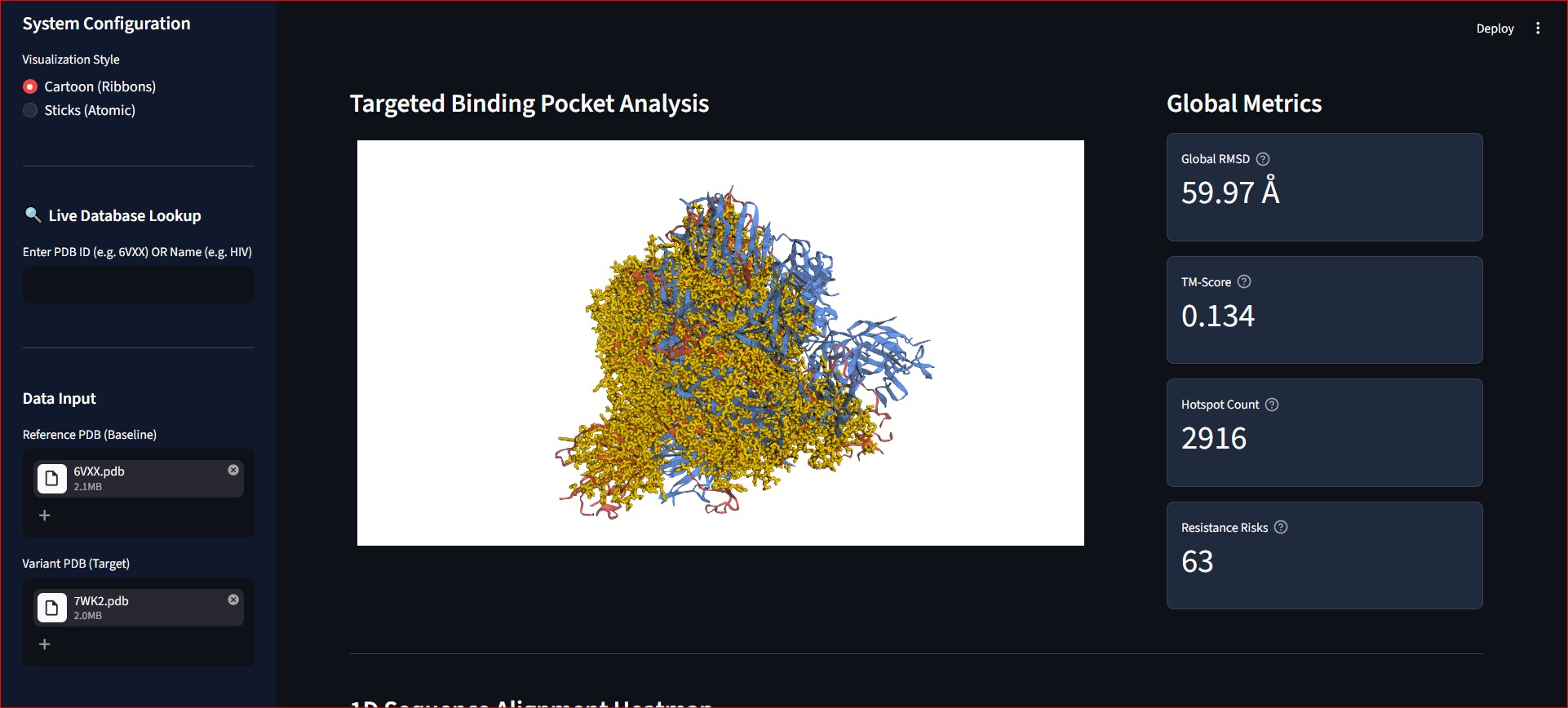
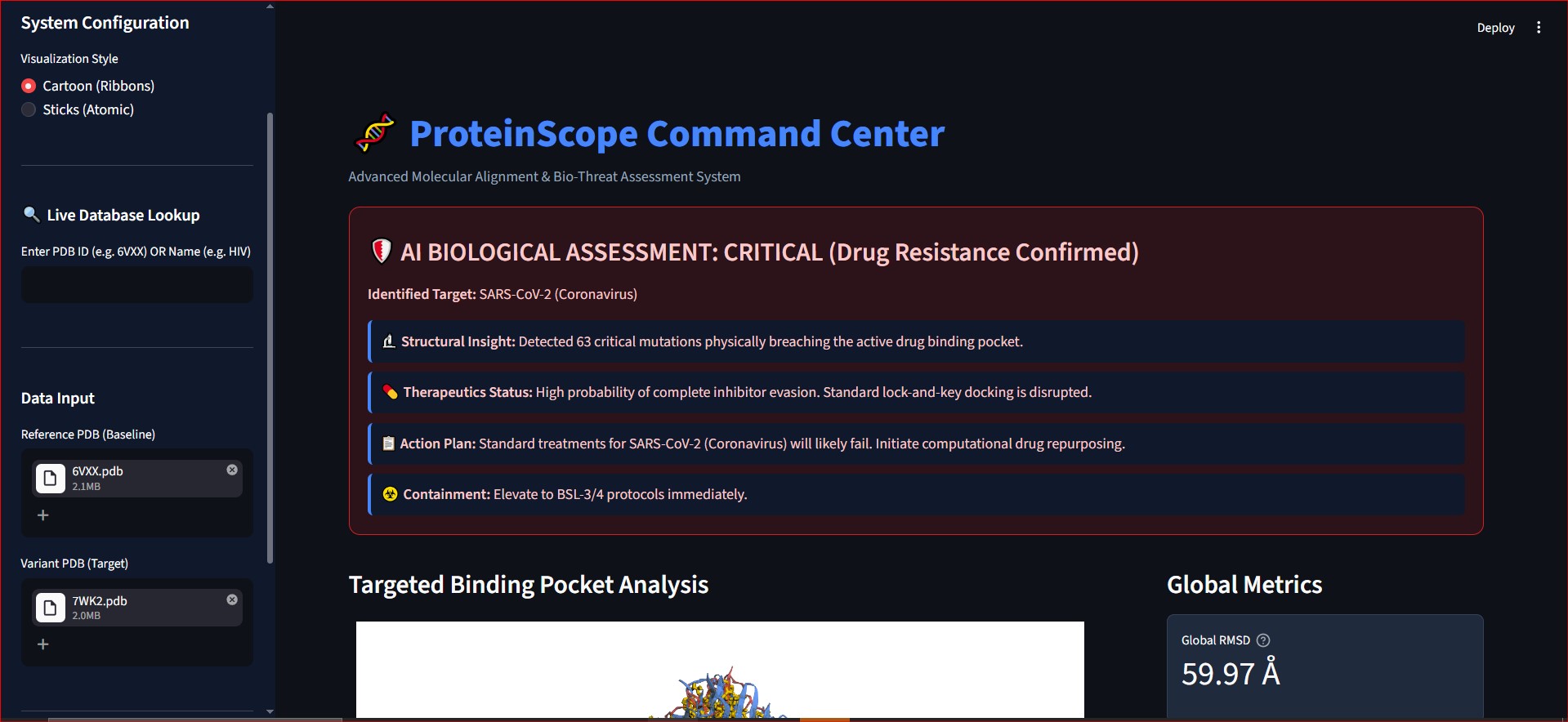
What it does ProteinScope is an advanced AI biological assessment dashboard. It allows a researcher to input two PDB (Protein Data Bank) codes—a healthy baseline and a mutated variant. The system:
- Aligns the proteins in 3D space using rigid-body transformations.
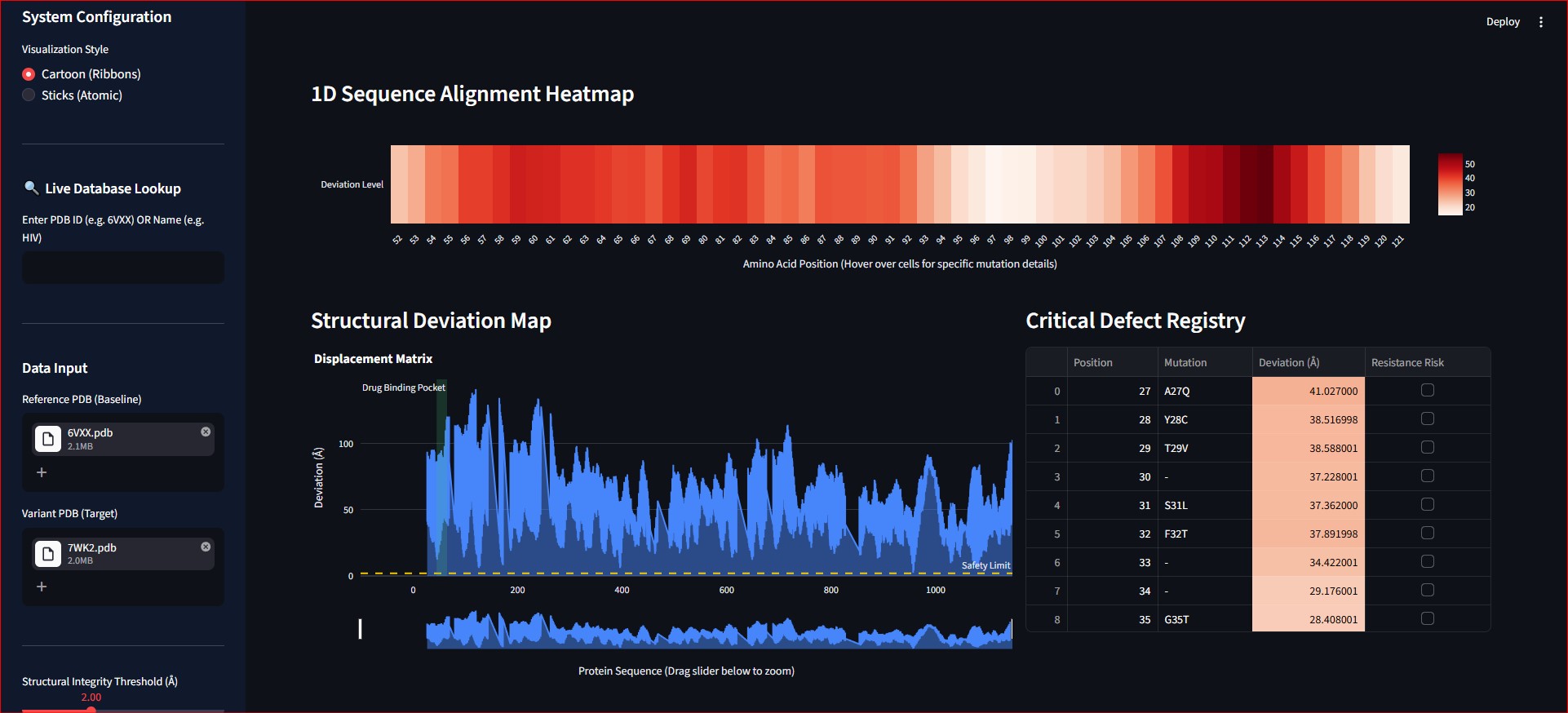
- Calculates the exact atomic drift (in Ångströms) of every single amino acid.
- Scans the critical drug-binding pocket for structural breaches.
- Predicts whether standard therapeutics will fail using a trained Random Forest classifier, outputting a clear, actionable containment protocol (STABLE, HIGH, or CRITICAL).
How we built it
We separated the application into a high-performance mathematical core and an interactive frontend.
The Frontend: Built entirely in Streamlit to create a responsive, dark-mode medical dashboard. We integrated py3Dmol to render the complex 3D protein ribbons directly in the browser.
The Math Engine: We used NumPy and Pandas to power the geometry calculations. To align the proteins, we implemented the Kabsch algorithm, which minimizes the Root Mean Square Deviation
The AI Model: We trained a Random Forest classifier (scikit-learn) on structural data to evaluate the TM-Score, global RMSD, and targeted pocket anomalies to output a deterministic clinical diagnosis.
Challenges we ran into
API Versioning: During development, the RCSB Protein Data Bank updated their API from v1 to v2. Our live-lookup feature suddenly crashed with Status 400 errors because the pagination parameters changed. We had to quickly debug the network requests and rewrite our API fetching logic on the fly.
Biological "Noise": Proteins naturally flex and "breathe," meaning even two healthy scans will have tiny atomic differences. Initially, our AI was flagging everything as a dangerous mutation. We solved this by engineering a dynamic Structural Integrity Threshold slider, allowing researchers to tune the sensitivity and filter out harmless background noise.
Accomplishments that we're proud of We successfully took incredibly dense structural bioinformatics which usually requires command-line tools and a PhD to understand and turned it into a sleek, visual, web-based UI. Features like the 1D Sequence Alignment Heatmap and the Critical Defect Registry make it possible to spot a drug-resistant mutation in seconds rather than hours.
What we learned We learned a massive amount about structural biology, specifically how metrics like the TM-Score and RMSD are used to mathematically prove protein fold conservation. We also leveled up our skills in Streamlit state management, API error handling, and bridging Python machine learning models with front-end visualizations.
What's next for ProteinScope Currently, the system is tuned for viral pathogens. Next, we want to expand the AI's training data to include Oncology. By applying this exact same 3D math engine to human DNA proteins, ProteinScope could be used to detect the specific structural deformations that cause genetic cancers, helping doctors design highly targeted immunotherapies.
Built with
pythonstreamlitscikit-learnnumpypandaspy3dmolrcsb-api
"Try it out" links GitHub Repository: https://github.com/ullash-naik/ProteinScope
Built With
- numpy
- pandas
- py3dmol
- python
- scikit-learn
- streamlit
