Inspiration:
Wildlife is often injured or endangered without anyone knowing how to help. We were inspired by the idea that everyday people with smartphones could become first responders for animals. By combining AI with community action, we wanted to make wildlife rescue faster, smarter, and more accessible.
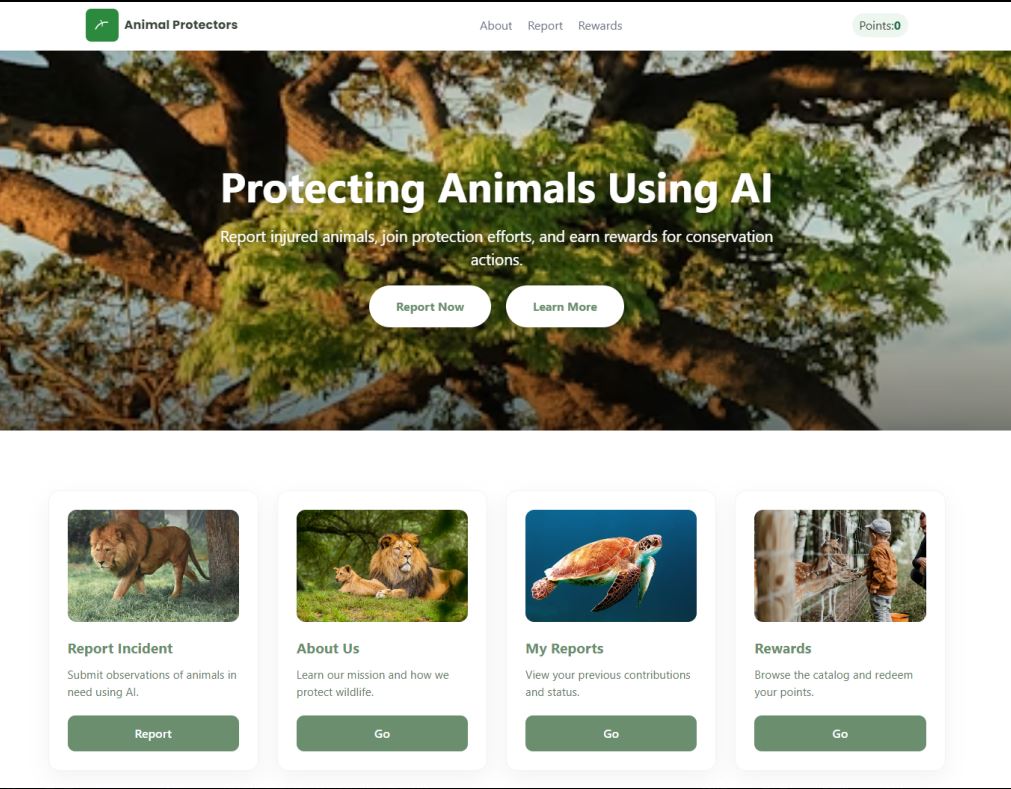
Imagine a world where every citizen can be a guardian of wildlife, simply by using their smartphone. That's the vision behind Animal Protectors.
Our platform empowers everyday people to report animal sightings, contributing vital data to conservation efforts. Here's how it works:
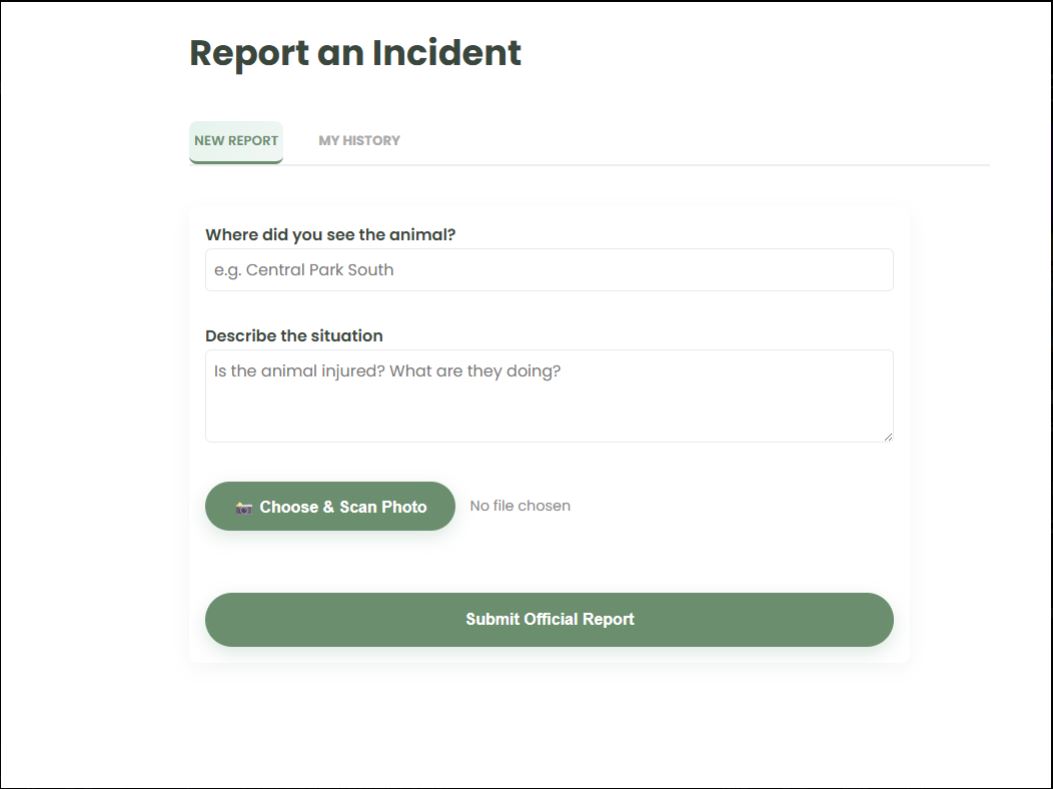
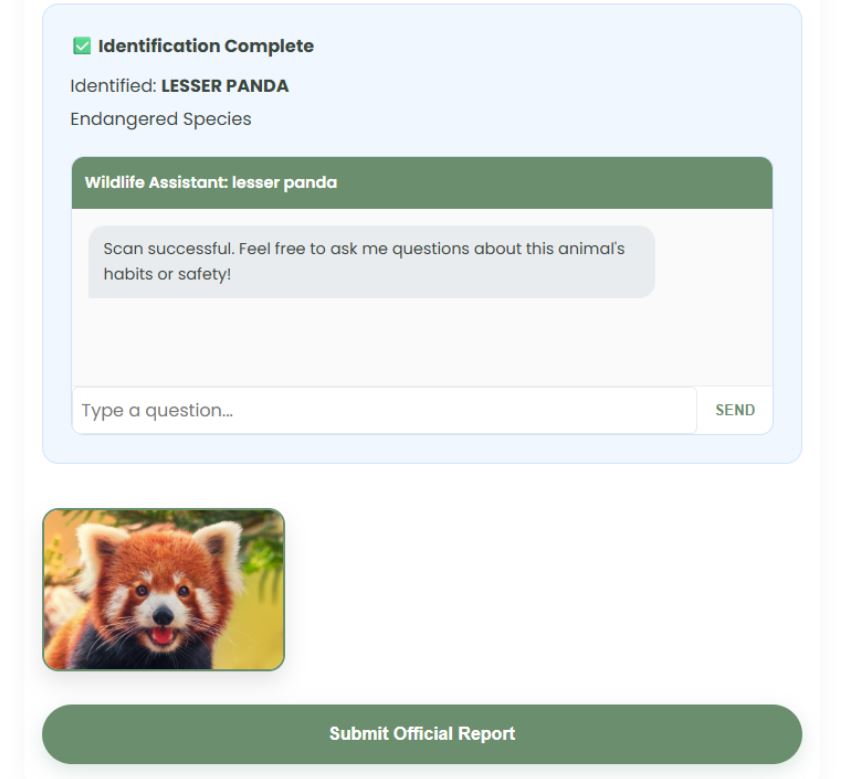
Users simply snap a photo of an animal. Our integrated AI, powered by ml5.js, instantly identifies the species right on their device. From there, an intelligent chat agent provides immediate facts about the animal, like its diet or behavior, turning every report into a learning opportunity.
The collected reports, including location and species, are then stored and tracked. To make conservation engaging, we've built a reward system: users earn points, especially for reporting endangered species, visible on their personalized 'My History' page.
Animal Protectors transforms passive observation into active participation, making conservation accessible, educational, and rewarding for everyone.
What it does:
Animal Protectors is an AI-powered wildlife rescue platform. When someone spots an injured or endangered animal, they take a photo through our platform. Our AI analyzes the image to identify the species and assess the severity of the situation. If intervention is needed, the system alerts and dispatches the nearest trained rescue team. We also give the user points depending on the severity of the case (Endangered / Common).
How we built it:
-A computer vision model for species identification -A backend intelligence system to process images and risk scores -Node.js (server.js) for report processing and data management.
- Persistence: Local Storage for instant points tracking and user history. -A simple, user-friendly frontend for photo uploads.
Challenges we ran into:
Model Accuracy and "Out-of-Distribution" Data The Challenge: ml5.js (Mobile Net) is trained on a specific set of images. If a user uploads a blurry photo, an obscure subspecies, or a non-animal object, the AI might give a "confident" but incorrect guess (e.g., mistaking a park bench for a rhino).
The Solution: We implement a confidence threshold. If the AI is less than 60% sure, the system should prompt the user for a better photo rather than awarding points automatically.
Validation & Spoofing (Anti-Cheating) The Challenge: In a reward-based system, users might try to "game" the app by uploading photos of animals from their computer screen or old National Geographic photos to farm points.
The Solution: Future iterations would use Metadata Validation. By checking the photo’s EXIF data (GPS coordinates and timestamp), we can ensure the photo was actually taken in real-time at the reported location.
Edge Case Diversity The Challenge: Many animals look vastly different depending on their age (cub vs. adult) or the lighting (nighttime vs. daytime).
The Solution: Moving toward Transfer Learning. We can "fine-tune" the base MobileNet model with a custom dataset of local wildlife specific to your region to increase regional accuracy.
Accomplishments that we're proud of:
-Successfully building an end-to-end prototype in limited time -Creating a real-time AI image analysis pipeline -Designing a scalable concept with strong social impact -Combining technology, conservation, and community engagement -Delivering a solution with clear real-world potential
What we learned:
-AI can be a powerful tool for environmental protection -Data quality is critical in computer vision applications -Real-world impact requires more than just good technology -Community-driven platforms can significantly amplify conservation efforts
What's next for Protecting Animals with AI | Animal Protectors: -Improving model accuracy with larger wildlife datasets -Partnering with other wildlife rescue organizations and NGOs -Building a live dispatch integration system -Launching a pilot program in a local park or city -Adding features like wildlife heat maps and conservation analytics -Our long-term vision is to build a global, AI-powered wildlife protection network driven by communities.

Log in or sign up for Devpost to join the conversation.