-
-

sign in page
-
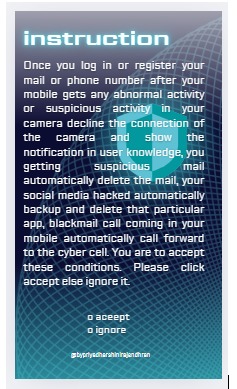
terms and condition page
-
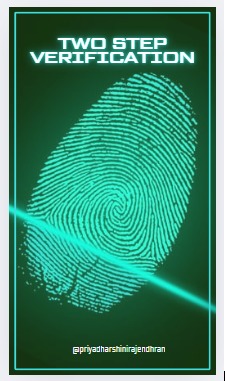
bio matric authentication

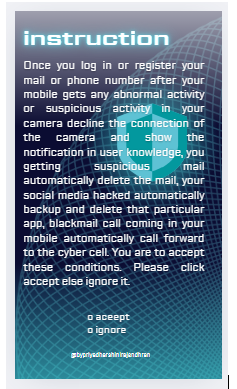
PROTECTING THE MOBILE FOR CYBERATTACK DESCRIPTION: Protect the mobile from a cyber attack like WhatsApp, Instagram, Facebook hacks, mail spoofing, camera phone access, and personal data hacking, my app protects those attacks. My solution is WhatsApp, Instagram, and Facebook hacking data automatically backup and delete, mail spoofing acts automatically delete the inbox mail, camera access automatically declines the connection, spam calls, and mail coming automatically forward the call and mail to cybercrime Overview Introduction This project aims to develop an advanced mobile security application that uses AI and Machine Learning (ML) technologies to protect mobile devices from various cyber threats. These threats include hacking attempts, blackmail calls, suspicious emails, and unauthorized camera access. The app’s goal is to automatically detect and prevent these cyber attacks in real time, securing sensitive data and privacy. Key Features Automatic Protection for Hacked Apps: ⦁ Problem: Popular mobile apps such as WhatsApp, Instagram, and Facebook are common targets for cybercriminals. When these apps are hacked, sensitive data can be exposed. ⦁ Solution: The app will automatically detect any breach, update sensitive data to prevent further theft, and delete the compromised app to eliminate any risk. Blackmail Call Prevention: ⦁ Problem: Cybercriminals use blackmail calls to threaten users and demand personal or financial information. ⦁ Solution: The app will automatically identify suspicious or blackmail-related calls and forward them to the cyber cell for investigation. Spam and Suspicious Email Detection: ⦁ Problem: Phishing emails and spam are common ways for cybercriminals to steal information. ⦁ Solution: The app will use AI and ML algorithms to automatically detect suspicious emails and delete them from the inbox to prevent any potential harm. Camera Access Security: ⦁ Problem: Unauthorized access to a phone’s camera can violate a user’s privacy. ⦁ Solution: The app will automatically decline any unauthorized requests to access the phone’s camera, ensuring privacy protection. Technology Stack AI & Machine Learning (ML): ⦁ Anomaly Detection: Machine learning models will be used to detect abnormal behaviors in app activities, phone usage, and incoming calls. ⦁ Natural Language Processing (NLP): For email filtering, NLP models will help detect suspicious or phishing content within emails. ⦁ Pattern Recognition: ML algorithms will also be trained to recognize patterns in calls to flag potential blackmail or fraudulent activity. Free and Paid Resources: ⦁ Some AI/ML tools and technologies (such as TensorFlow, Scikit-learn, and OpenCV) are free and open-source, while some datasets required for training the models may incur a cost. ⦁ The use of free resources will help minimize development costs, but acquiring high-quality datasets may require a budget.
Inspiration
My app has the potential to offer holistic security for users' personal data, social media accounts, and devices, filling a gap in the market for proactive mobile security. By combining features like real-time threat detection, automatic data backup and deletion, spam and fraud call blocking, and unauthorized camera access prevention, I will create a comprehensive solution that helps protect users from various cyber threats. By integrating machine learning algorithms to detect phishing emails, using AI-based spam call databases, and offering encrypted cloud backups, my app could be a much-needed security tool for those looking to secure their mobile experience from potential threats
What it does
- Real-time monitoring and protection for WhatsApp, Instagram, and Facebook against unauthorized access and hacks.
- Automatic data backup and deletion for social media accounts in case of suspicious activity.
- Spoofed email detection and automatic forwarding of phishing emails to cybercrime authorities.
- Camera access control by denying unauthorized camera requests.
- Spam call and email detection, with automatic forwarding to cybercrime authorities.
My app is an all-in-one security solution that automatically protects users from a range of cyber threats, including social media account hacks, email spoofing, unauthorized camera access, and spam calls/emails. The app not only prevents these threats but also takes proactive steps like backing up data, forwarding suspicious activity to authorities, and denying unauthorized access in real-time. By doing so, it significantly reduces the risk of data theft and privacy violations for its users.
How we built it
- Frontend (Mobile App Interface): 1.1 Languages/Frameworks: 1.1.1. React Native or Flutter: For cross-platform mobile development (iOS and Android) to ensure the app is accessible to a wide audience. 1.1.2. Swift for iOS and Kotlin for Android if you prefer building the app natively for better performance. 1.1.3. UI/UX Design: Use Figma or Sketch to design user-friendly and secure interfaces. Ensure that the app is easy to navigate, with a clear and intuitive flow for users to monitor and manage security features.
- Backend (Data Processing & Cloud Integration): 2.2 Server-Side Development: Node.js or Python with frameworks like Express or Django can handle backend operations such as data processing, monitoring social media activity, and triggering alerts when a security breach is detected. Use a microservices architecture for scalability and ease of maintenance, especially when dealing with multiple data sources (social media platforms, emails, calls).
- Cloud Storage: 3.1. AWS (Amazon Web Services), Google Cloud, or Microsoft Azure for secure cloud storage where users' data is backed up when a threat is detected. This ensures data is safely stored in case of a hack. Integrate serverless technologies like AWS Lambda to manage tasks like data backup and forwarding to cybercrime authorities automatically without needing continuous server infrastructure.
- Database: 4.1 Use NoSQL databases like MongoDB or Firebase to store user data, app settings, and logs securely.
- Security Technologies: 5.1 End-to-End Encryption: Use SSL/TLS encryption for all communications between the mobile app and backend servers to prevent data interception. 5.2 Encryption Algorithms: Implement AES or RSA encryption for storing and transmitting sensitive data (social media backups, email content). 5.3 Real-Time Threat Detection: Use machine learning for real-time detection of phishing and spoofing attempts. Libraries like TensorFlow or Scikit-learn can be used to train detection models based on data patterns. 5.64 Multifactor Authentication (MFA): Enable MFA for user authentication in the app, adding an extra layer of security.
- APIs & Integration: 6.1 Social Media APIs: Integrate with social media APIs for WhatsApp, Instagram, and Facebook for monitoring and detecting suspicious activity. You can use these APIs to detect login anomalies or unauthorized access attempts. 6.2 Phone Number Database APIs: Services like Truecaller API to identify spam calls and report them. Email Authentication APIs: Use DMARC, SPF, and DKIM protocols to verify and filter out spoofed emails. 6.3 Cybercrime Reporting: Integrate your app with government or private cybercrime reporting systems for automatic forwarding of suspicious calls, emails, and activities.
Building this app requires a combination of machine learning, real-time monitoring, cloud storage, and automated response mechanisms to protect users from cyber attacks. By integrating APIs, leveraging security technologies, and creating a seamless user interface, My app can automatically detect and respond to security threats, keeping users' personal data safe and secure across social media, emails, calls, and even physical device access.
Challenges we ran into
The key challenges i am likely to face when building and maintaining your cybersecurity protection app include handling real-time monitoring, ensuring privacy and data protection, dealing with false positives and evolving threats, and maintaining a seamless user experience. Legal compliance, ethical considerations, and scalability also add complexity. Overcoming these challenges will require continuous development, keeping up with evolving cyber threats, and optimizing both performance and user satisfaction.
Accomplishments that we're proud of
My app has made tremendous strides in providing comprehensive, automated cybersecurity that protects users from a wide variety of cyber threats like social media hacks, mail spoofing, unauthorized camera access, and spam calls/emails. By offering a holistic solution, the app not only safeguards individual users but also contributes to combating digital crime through proactive reporting and cybercrime cell engagement. With its real-time protection, automated actions, and user empowerment, My app has set a new standard in mobile security, providing peace of mind to users and promoting safer digital experiences.
What we learned
The development of cybersecurity app provided valuable insights into the complexities of mobile security. The lessons learned highlight the importance of real-time protection, user privacy, automation, and collaborating with authorities. Additionally, offering customization and minimizing false positives ensures a user-friendly experience, while continuous adaptation and resource management keep the app efficient and effective in combating evolving threats. These lessons will help improve the app’s effectiveness and ensure it remains a valuable tool in protecting users from cyberattacks.
What's next for Protect the mobile for cyber attacks
The future of mobile security involves a holistic, adaptive approach that incorporates AI, real-time threat detection, user empowerment, collaboration with authorities, and constant updates to counter evolving threats. By implementing these innovations, my app will not only provide more robust protection against cyber attacks but will also remain at the forefront of cybersecurity in an ever-changing digital landscape.
Built With
- apigee
- auto0
- celery
- cloudflare
- couchbase
- django
- fireeye
- googlecloudspanner
- kivy
- kongapigateway
- lookoutmobilesecurity
- nose2
- okta
- pandas
- prisma
- pyqt
- pytest
- python
- pytorch
- scikit-learn
- scrapy
- sentinelone
- symantec
- tensorflow
- tkinter
- unittest
- zimperium

Log in or sign up for Devpost to join the conversation.