Prosperity Empire
Inspiration
Our team has always been interested in both strategy games and economics, and we noticed that there were very few games that truly combined the two in an educational and interactive way. Many idle and civilization games are entertaining, but they often focus only on progression and numbers without teaching players anything meaningful about how real economies function. At the same time, we were fascinated by topics like investing, markets, macroeconomics, quantitative finance, and global trade. We wanted to create a project that could merge those interests into something both engaging and educational.
Games such as Civilization, Cookie Clicker, and Adventure Capitalist inspired the progression systems and long-term scaling mechanics, while real-world economic concepts inspired the educational side of the project. We wanted players to experience the growth of an economy firsthand: starting with basic labour and agriculture, transitioning into industrialization and trade, and eventually developing into a global financial superpower. Another major inspiration was the idea that games can be powerful learning tools when education is integrated naturally into gameplay rather than separated into lessons or tutorials.
Our goal from the beginning was to design a game where players could learn concepts such as inflation, supply and demand, diversification, central banking, fiscal policy, and technological innovation simply by interacting with the systems around them.
What it does
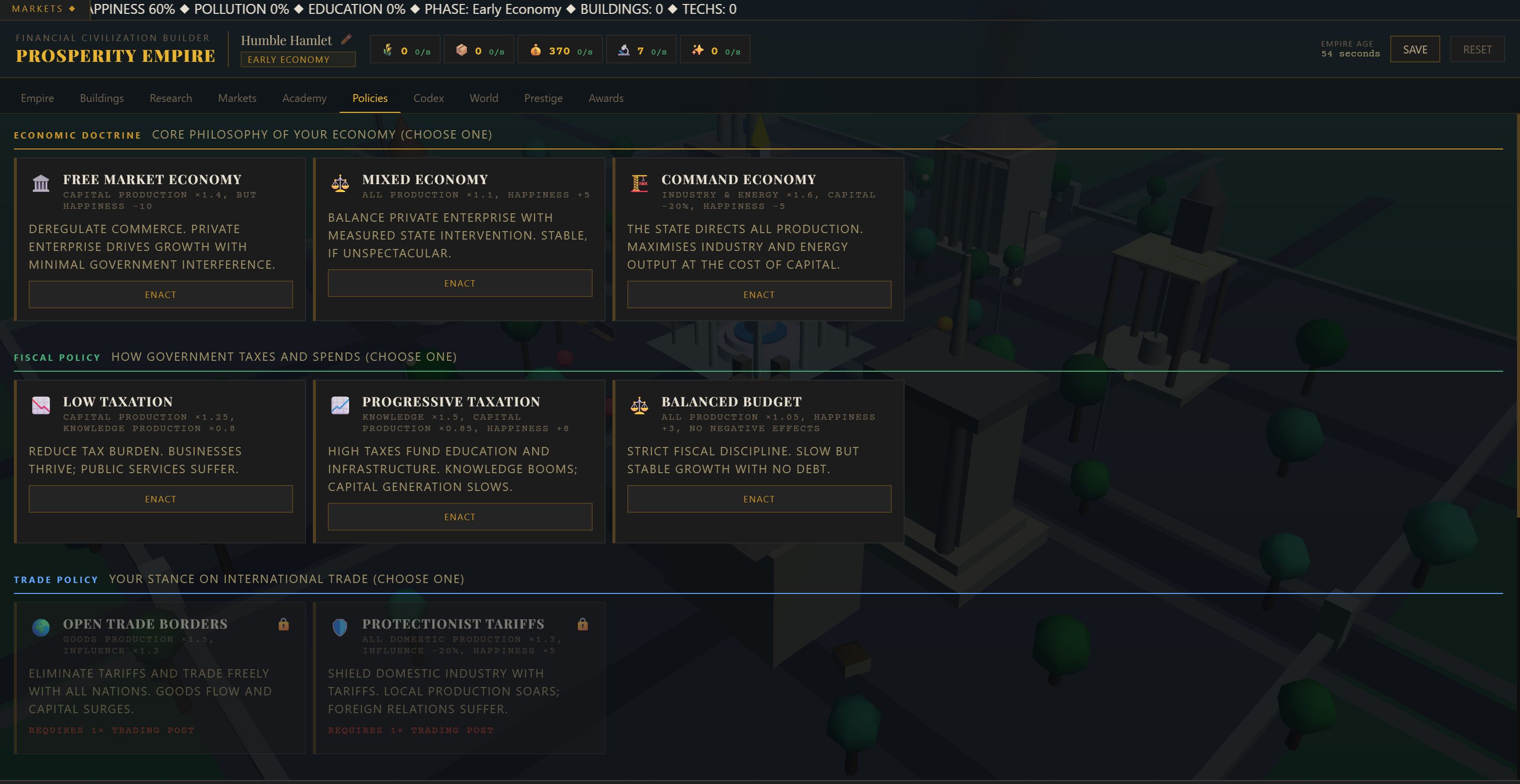
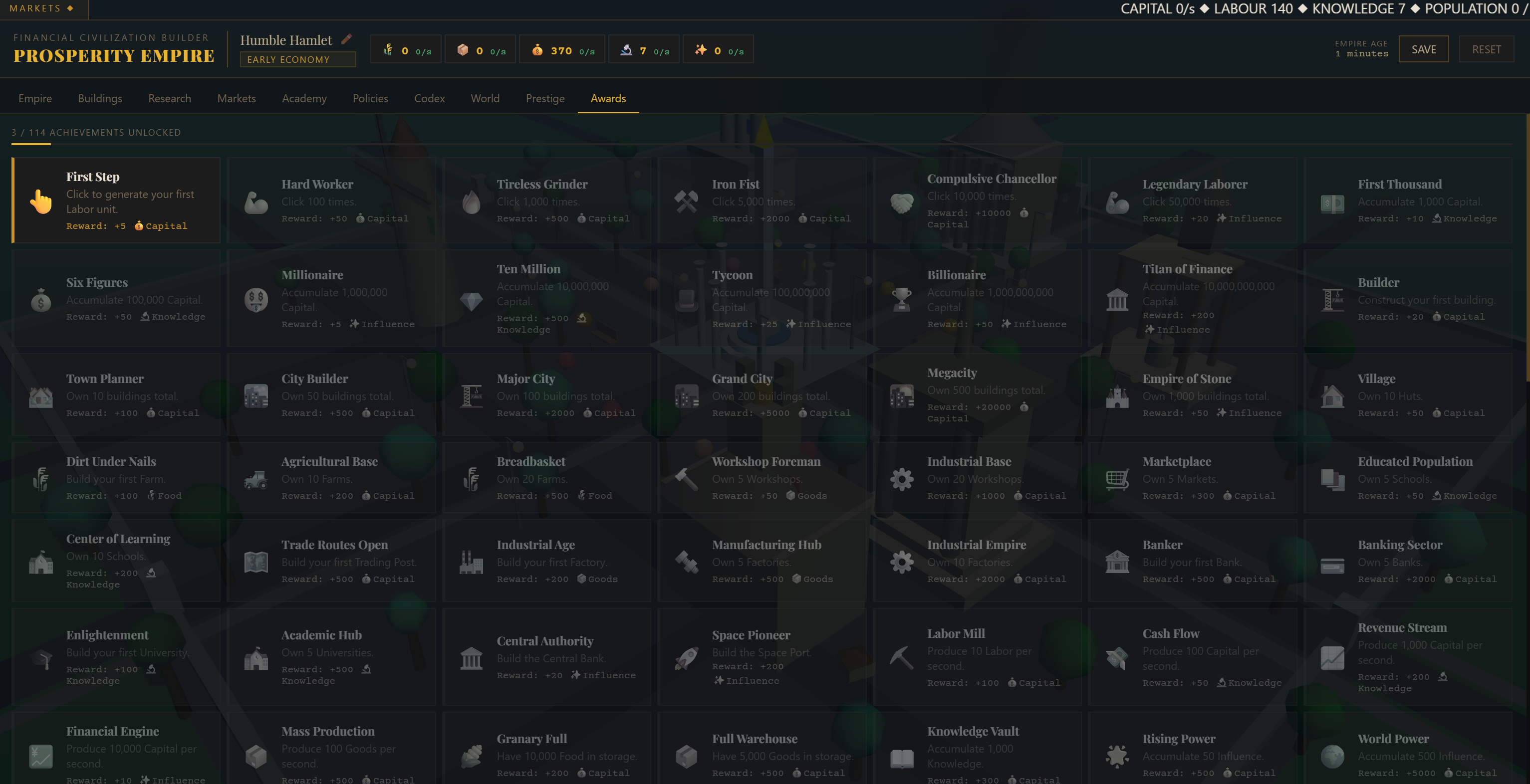
Prosperity Empire is a browser-based financial civilization idle game where players build an empire from a handful of Labour into a technologically advanced and economically dominant civilization. Players generate resources, construct buildings, manage population growth, unlock technologies, enact government policies, respond to world events, and trade in simulated financial markets.
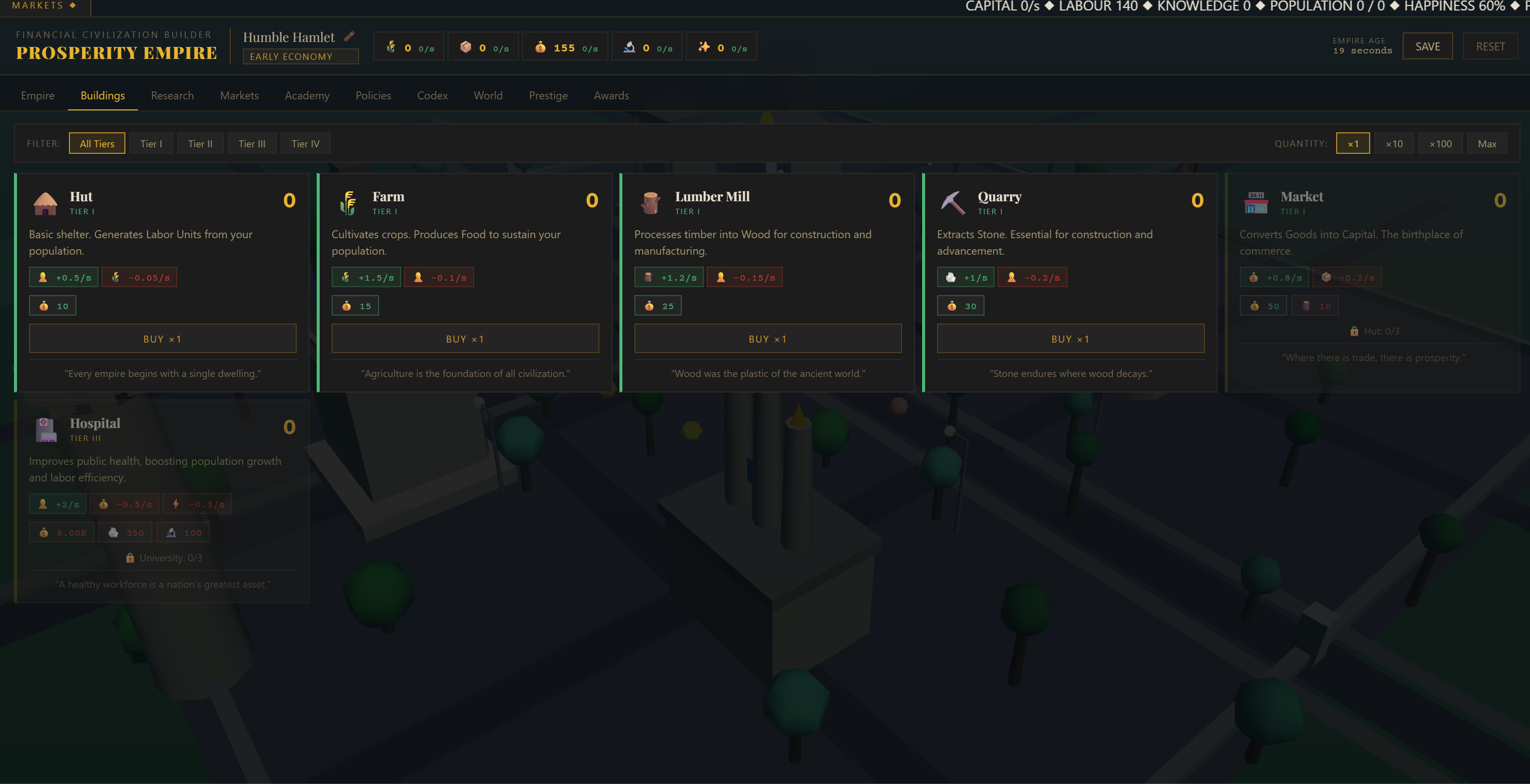
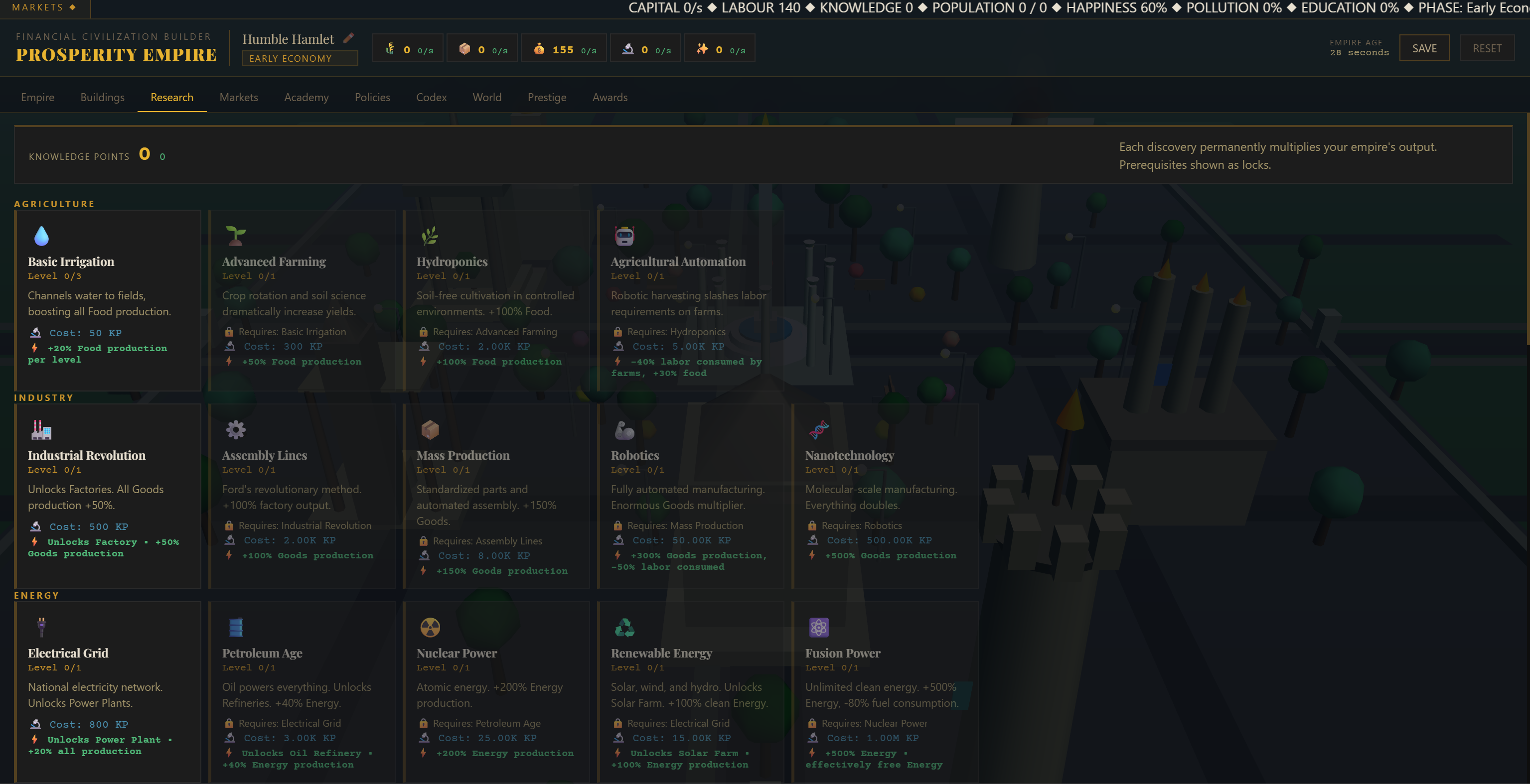
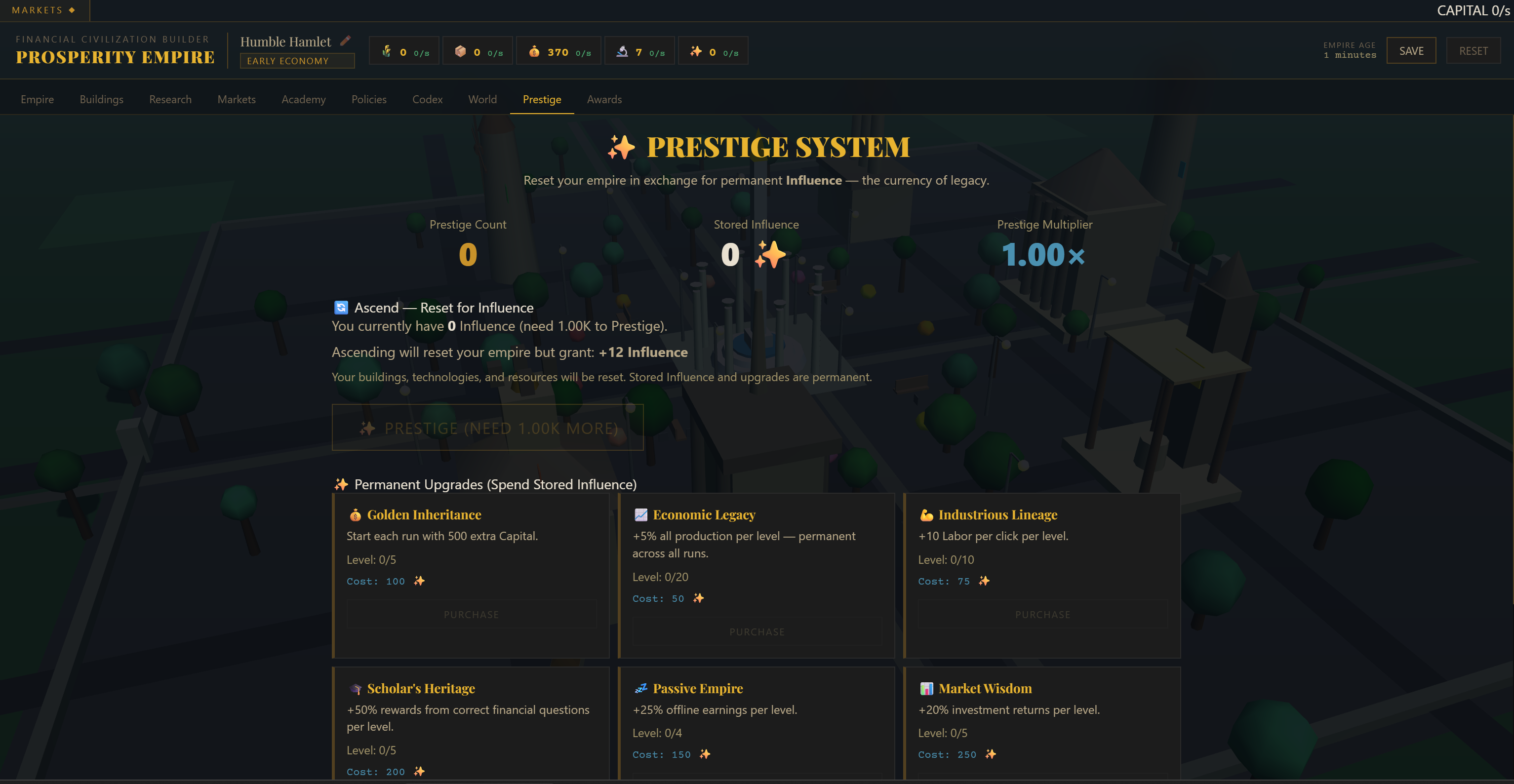
The game contains multiple interconnected systems designed to mirror real-world economic structures. Buildings passively generate resources, populations consume food and provide labour, technologies unlock production multipliers and new industries, and policies shape the direction of the player’s economy. As players progress, the game evolves from a primitive agricultural society into an advanced globalized financial empire with stock exchanges, investment firms, renewable energy systems, and digital economies.
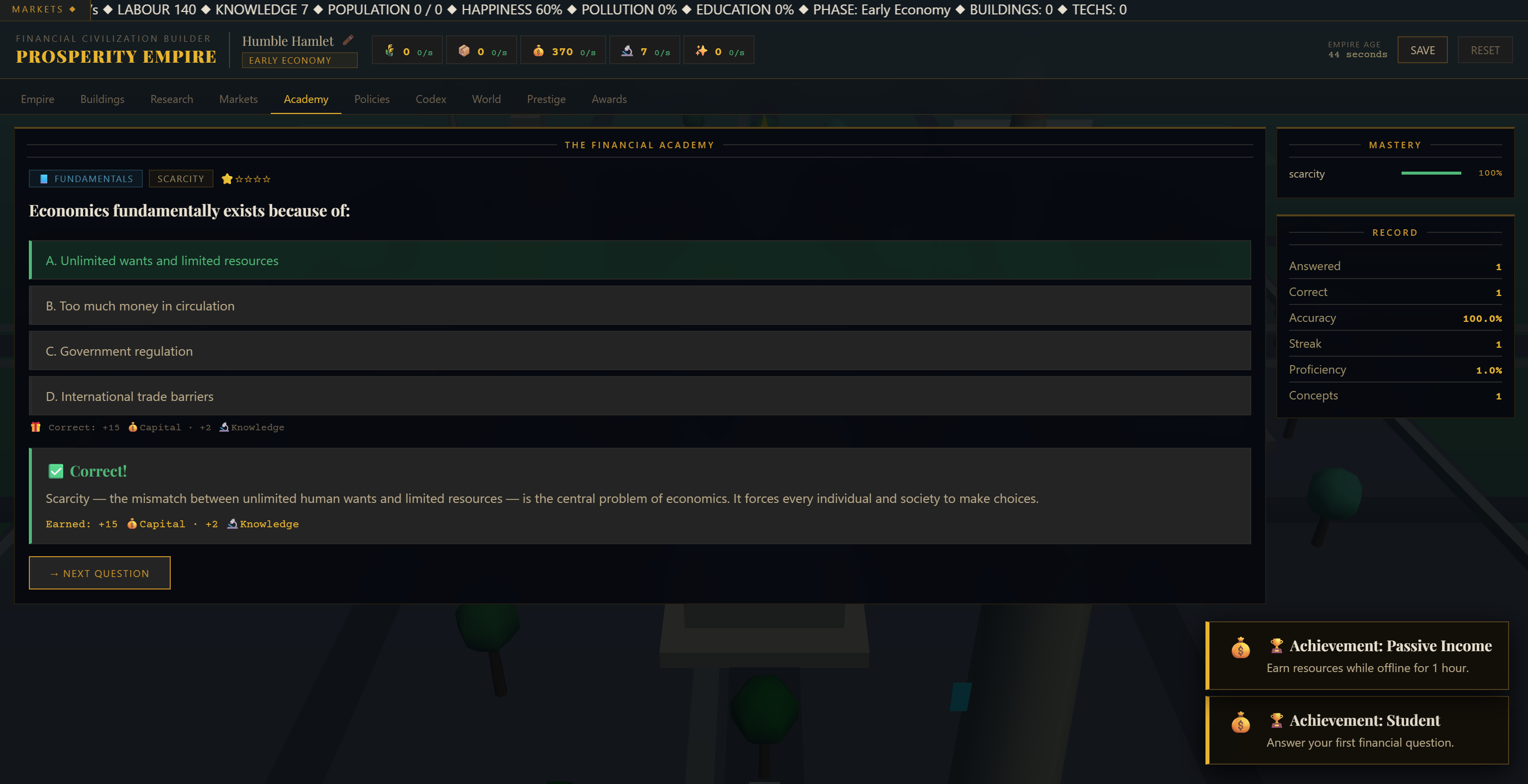
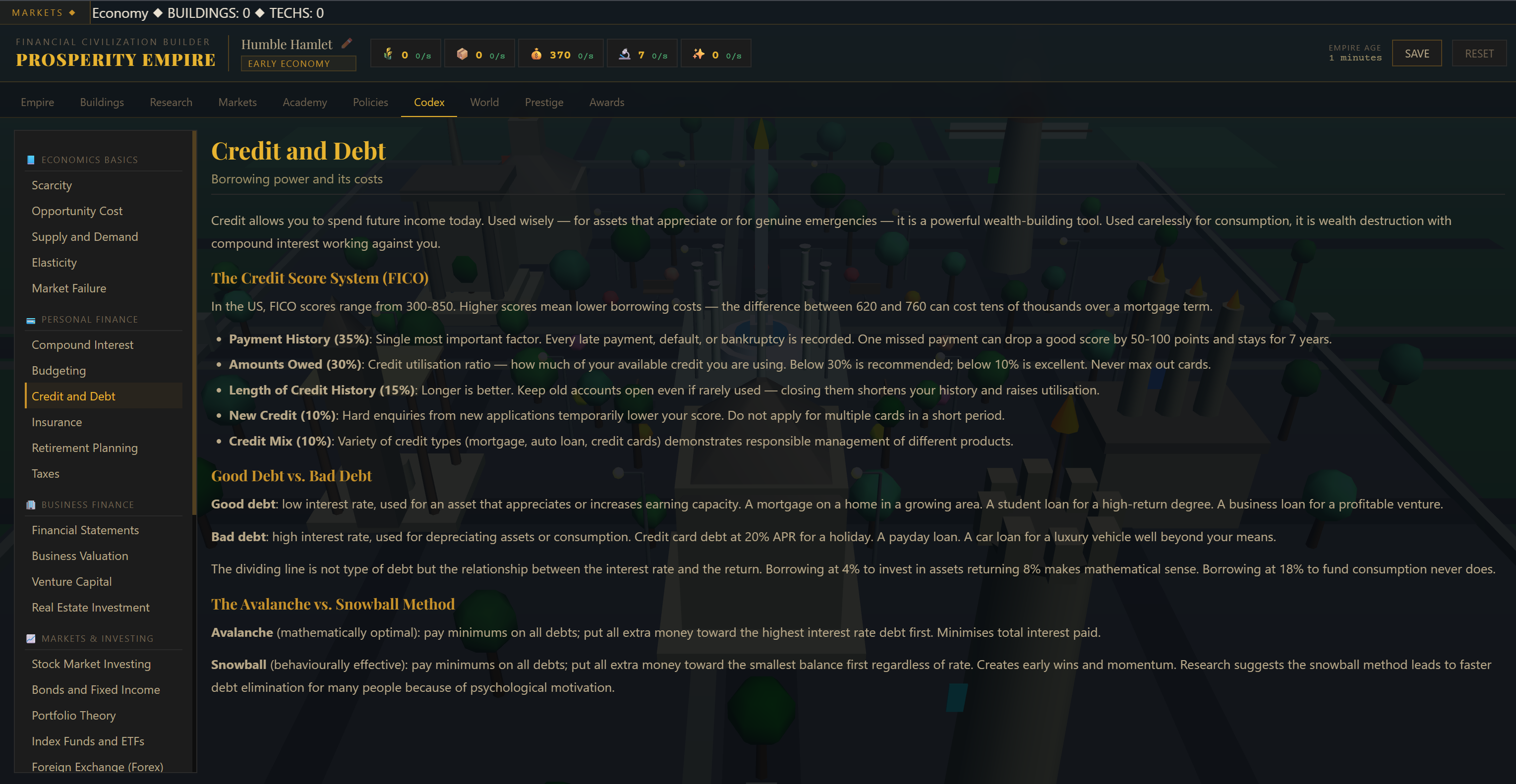
One of the most unique features of the project is its educational component. The Academy system contains hundreds of finance and economics questions that reward players for learning concepts correctly. The Codex acts as a financial encyclopedia with articles covering economics, investing, macroeconomics, and quantitative finance topics. The Markets system simulates stocks, bonds, commodities, and forex with changing prices, volatility, and risk levels, helping players understand concepts such as diversification and market cycles through gameplay itself.
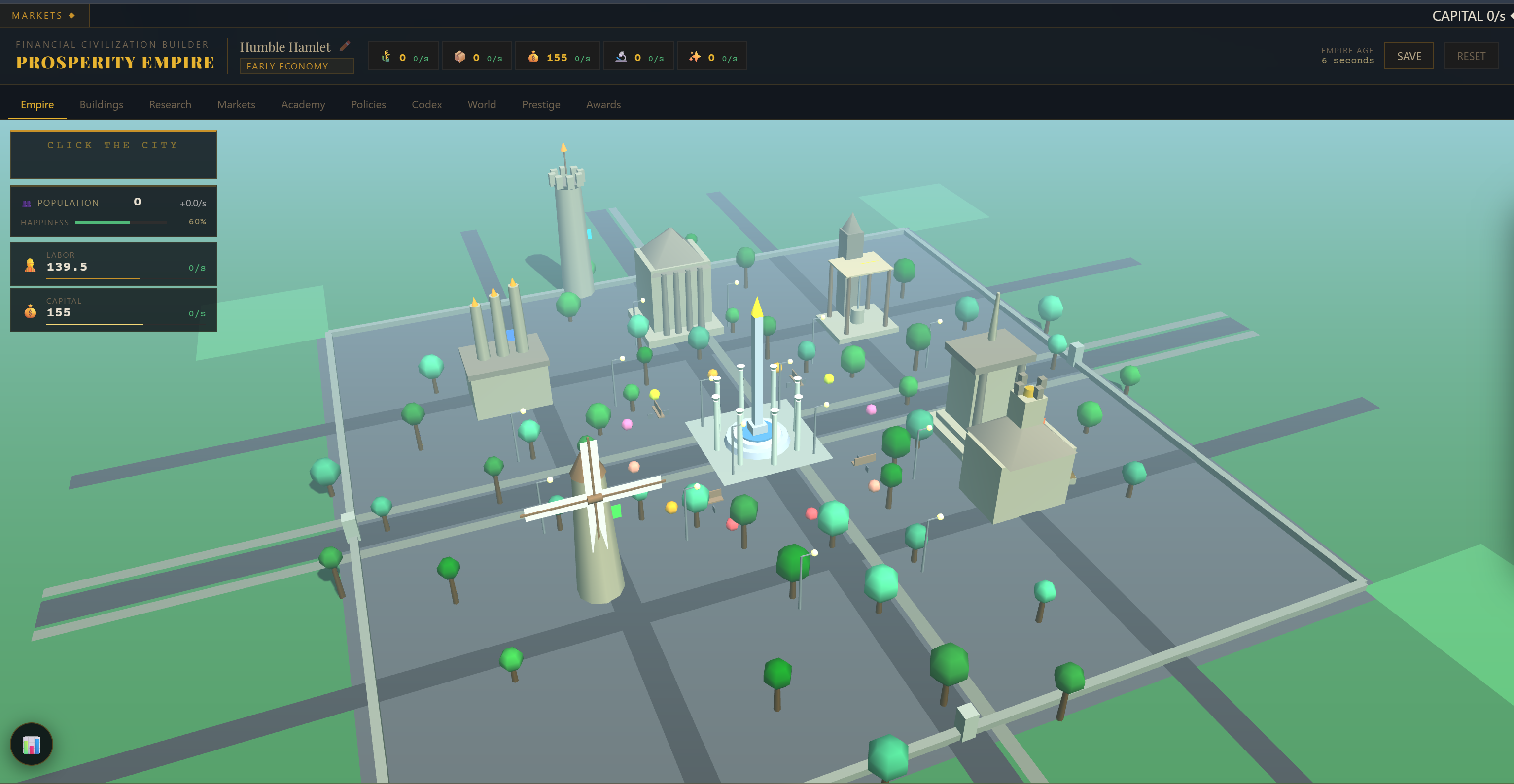
The game also includes a fully interactive 3D city built with Three.js. The city visually evolves as the civilization progresses through different eras, featuring dynamic architecture, atmospheric effects, animated citizens, event-based particle systems, and multiple economic zones representing different sectors of the economy.
How We Built It
We built Prosperity Empire entirely using HTML, CSS, and vanilla JavaScript without relying on frameworks or game engines. From the beginning, we wanted to challenge ourselves by creating a large-scale project from scratch while keeping the game lightweight and browser accessible.
To make the project manageable, we divided the game into modular systems and engines. Separate systems handled production calculations, building management, population growth, research progression, policy effects, prestige scaling, market simulation, event spawning, educational content, achievements, and save functionality. Structuring the game this way allowed us to continuously expand the project without rewriting major systems each time we added a new mechanic.
One of the largest technical challenges was designing the simulated financial markets. We implemented fluctuating stock prices, volatility systems, commodity cycles, forex rates, and investment mechanics that respond dynamically over time. We also created a large educational database consisting of hundreds of Academy questions and extensive encyclopedia articles related to economics and finance.
On the visual side, we used Three.js to render a fully interactive 3D city in real time. We designed different economic zones, animated environmental effects, evolving landmarks, pedestrians, cloud systems, and dynamic camera movement. The city visually changes depending on the player’s current economic era, making progression feel more immersive and rewarding.
We also implemented autosaving using localStorage, responsive UI systems, particle effects tied to global events, achievement tracking systems, and balancing formulas for production scaling, prestige progression, and resource management.
Challenges We Ran Into
One of the biggest challenges we faced was balancing complexity with accessibility. We wanted the game to feel deep enough to simulate meaningful economic systems while still remaining understandable and enjoyable for new players. Many mechanics, such as inflation, production scaling, market volatility, population growth, and policy balancing, required extensive tuning and testing.
Performance optimization was another major challenge. Since the game constantly updates dozens of systems simultaneously — including passive resource generation, population simulation, financial markets, event timers, AI calculations, and the live 3D city — optimization became critical. We had to carefully organize update loops, reduce unnecessary calculations, and improve rendering efficiency to keep the game running smoothly.
Balancing progression was also difficult because every system was interconnected. Small changes to resource generation or technology bonuses could dramatically affect the pacing of the entire game. Creating meaningful progression without making the game too slow or too fast required many rounds of iteration and testing.
Another challenge was designing the educational systems in a way that felt integrated rather than forced. We wanted players to genuinely enjoy learning economics and finance concepts instead of feeling like they were reading textbook material. Creating hundreds of accurate and engaging questions and encyclopedia entries required extensive research and refinement.
Accomplishments That We're Proud Of
One accomplishment we are especially proud of is the overall scale and depth of the project. Prosperity Empire evolved far beyond a simple idle game and became a fully interconnected economic simulation with dozens of systems influencing one another simultaneously. Seeing buildings, policies, markets, education, population, and events all interact cohesively was incredibly rewarding.
We are also proud of creating a project that combines entertainment with meaningful education. Instead of separating gameplay and learning, we designed mechanics that naturally teach players concepts such as monetary policy, investing, economic cycles, diversification, and quantitative reasoning through direct interaction.
Another accomplishment we are proud of is the fully interactive 3D city. Watching the civilization visually evolve from primitive settlements into futuristic financial districts made the progression feel immersive and alive. The addition of animated events, dynamic weather effects, and evolving architecture helped transform the game into a much more engaging experience.
We are also proud of the technical complexity of the project, including the large-scale modular architecture, simulated financial systems, educational databases, prestige mechanics, and extensive achievement systems. Building all of this entirely from front-end technologies without external frameworks taught us a tremendous amount about software design and engineering.
What We Learned
Through this project, we learned a significant amount about large-scale software architecture, game design, balancing systems, optimization, and user experience design. Building interconnected systems taught us the importance of modular programming and scalable code organization. We also improved our understanding of JavaScript, rendering pipelines, state management, and simulation-based programming.
The project also deepened our understanding of economics and finance. Researching concepts such as inflation, central banking, market cycles, quantitative finance, portfolio theory, and international trade helped us better understand how complex and interconnected real-world economies truly are.
Perhaps most importantly, we learned how difficult it is to transform a large vision into a polished and functional product. The project required constant iteration, debugging, redesigning, and collaboration. We learned the value of persistence, long-term planning, and incremental improvement while working on a large technical project over time.
What's Next for Prosperity Empire
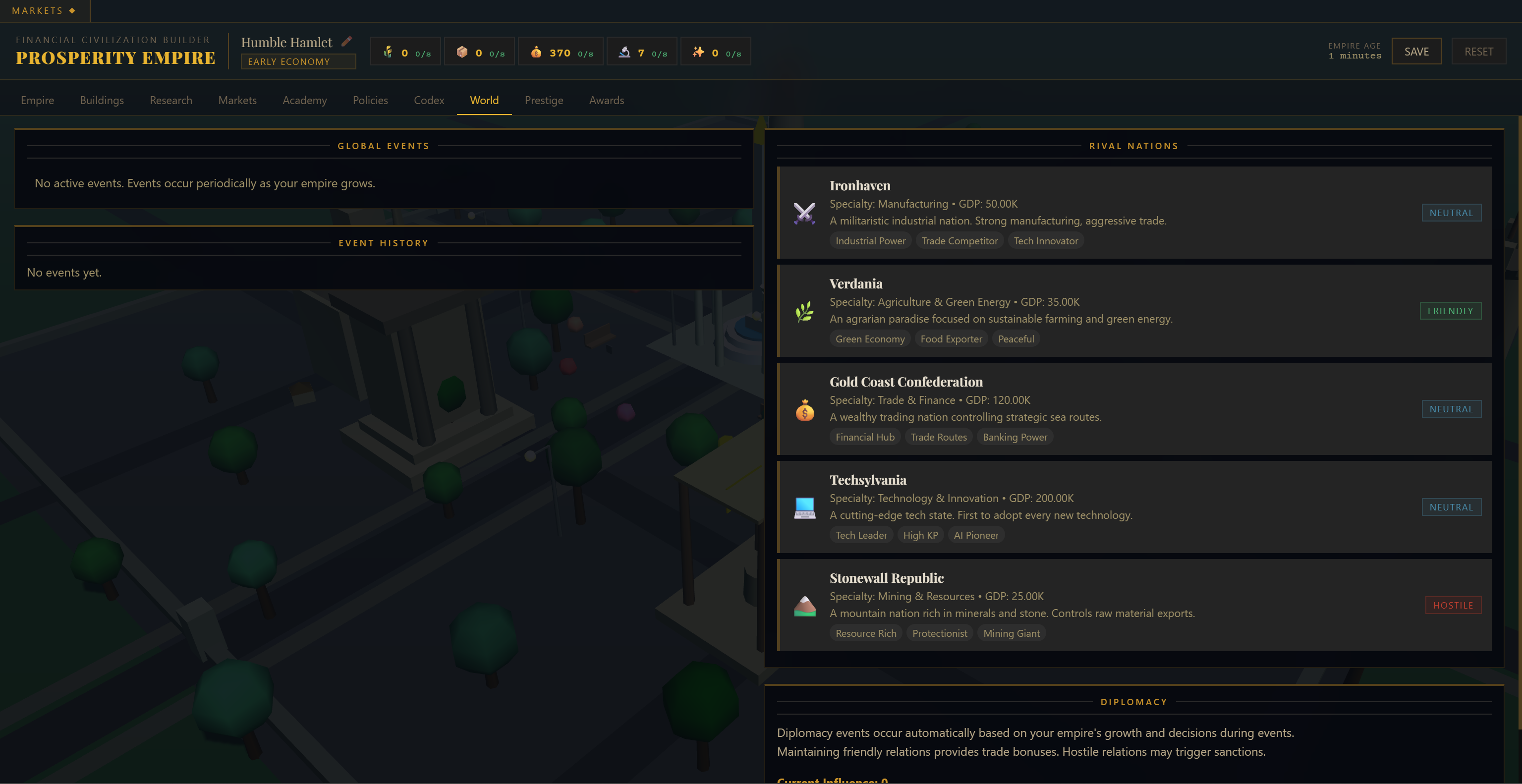
In the future, we want to expand Prosperity Empire into an even more advanced economic and financial simulation. One major goal is adding multiplayer functionality, allowing players to trade, compete, and interact with each other in shared economic systems. We also want to introduce more advanced AI-controlled rival nations with dynamic diplomacy, trade negotiations, and economic competition.
On the financial side, we plan to implement deeper quantitative finance systems such as derivatives, options trading, algorithmic investing, hedge funds, and more advanced market simulations. We are also interested in creating dynamic economic graphs and visualizations to help players better understand trends and economic indicators in real time.
We additionally hope to expand the educational systems with adaptive learning, personalized question difficulty, and interactive tutorials that respond to player performance. On the technical side, we plan to improve optimization, expand mobile support, and potentially migrate parts of the game to a backend-supported architecture with online saves, cloud syncing, and global leaderboards.
Built With
- batchfile
- css
- html
- javascript
- three.js


Log in or sign up for Devpost to join the conversation.