-
-
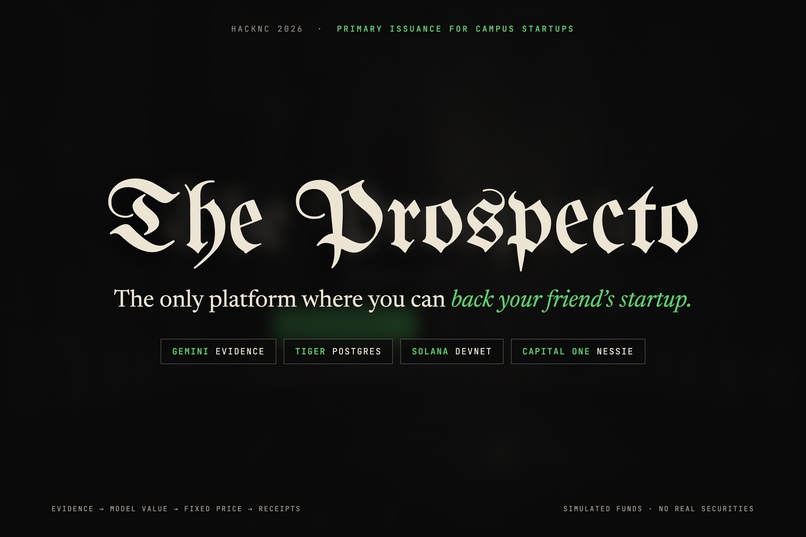
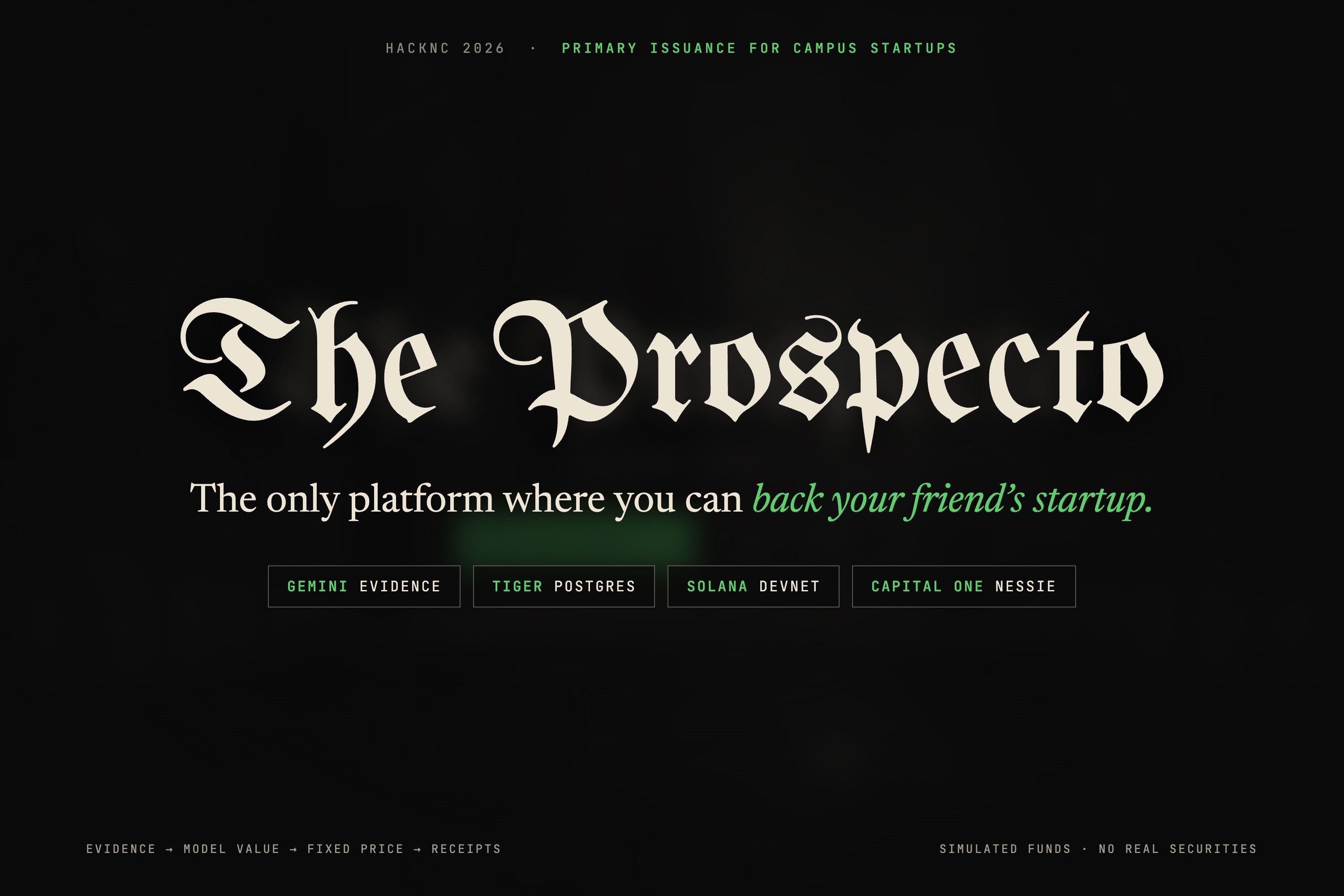
Title card: "The only platform where you can back your friend's startup," with the four sponsor tools
-
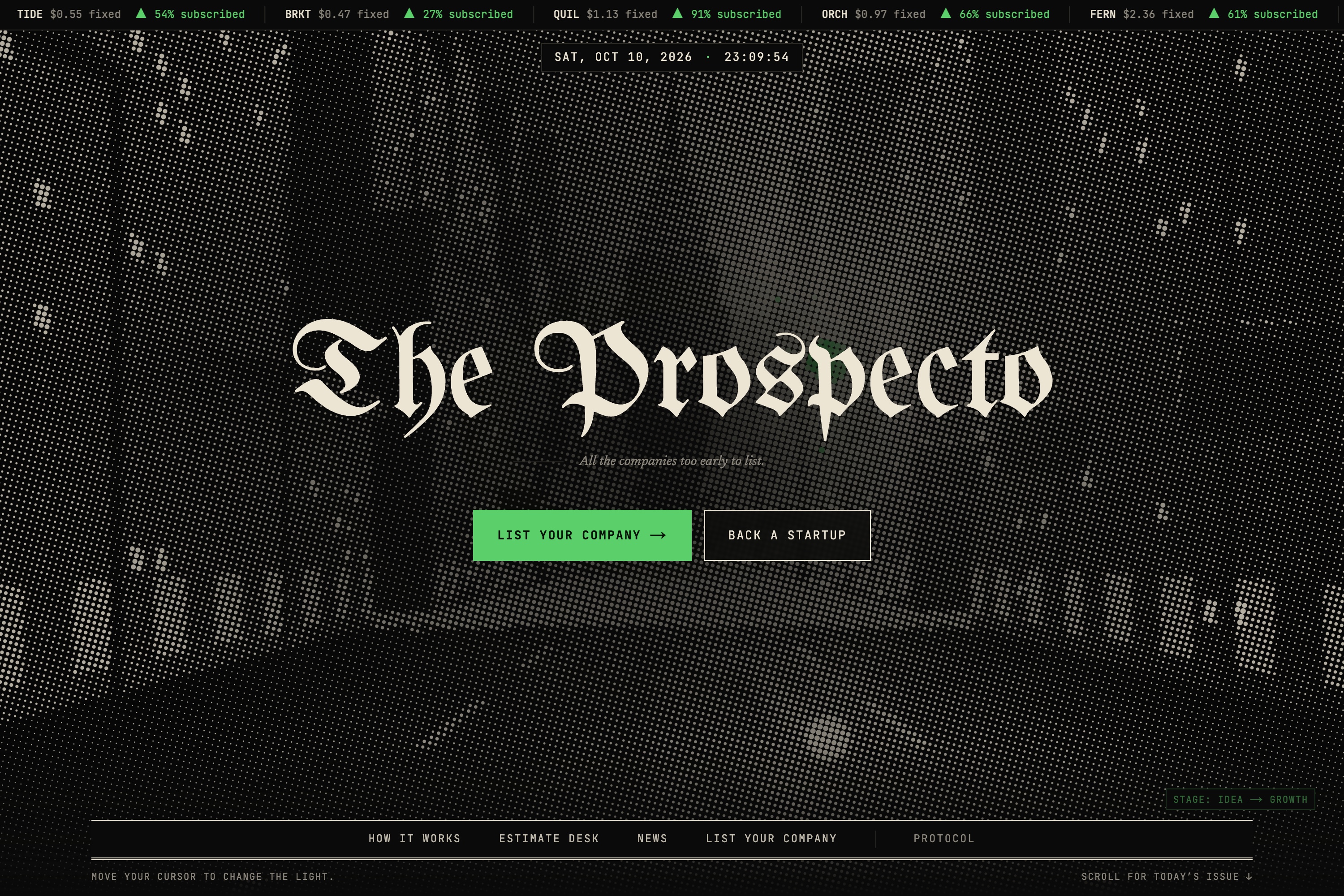
The live halftone front page
-
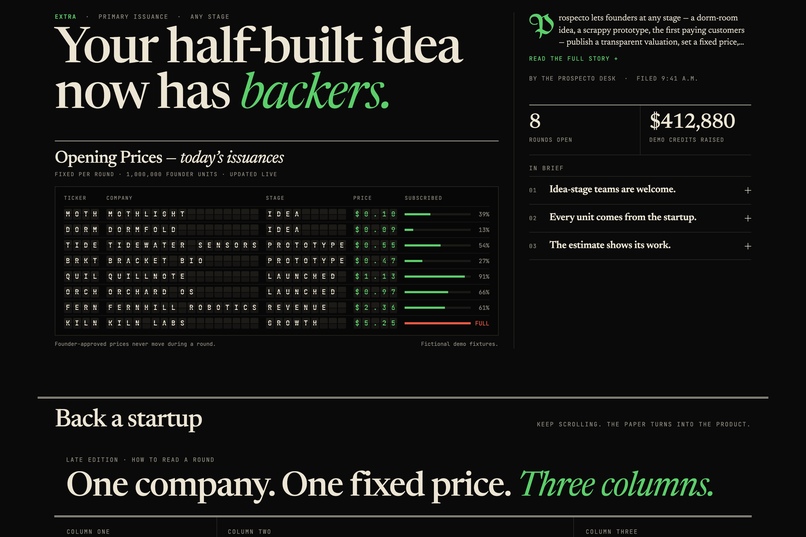
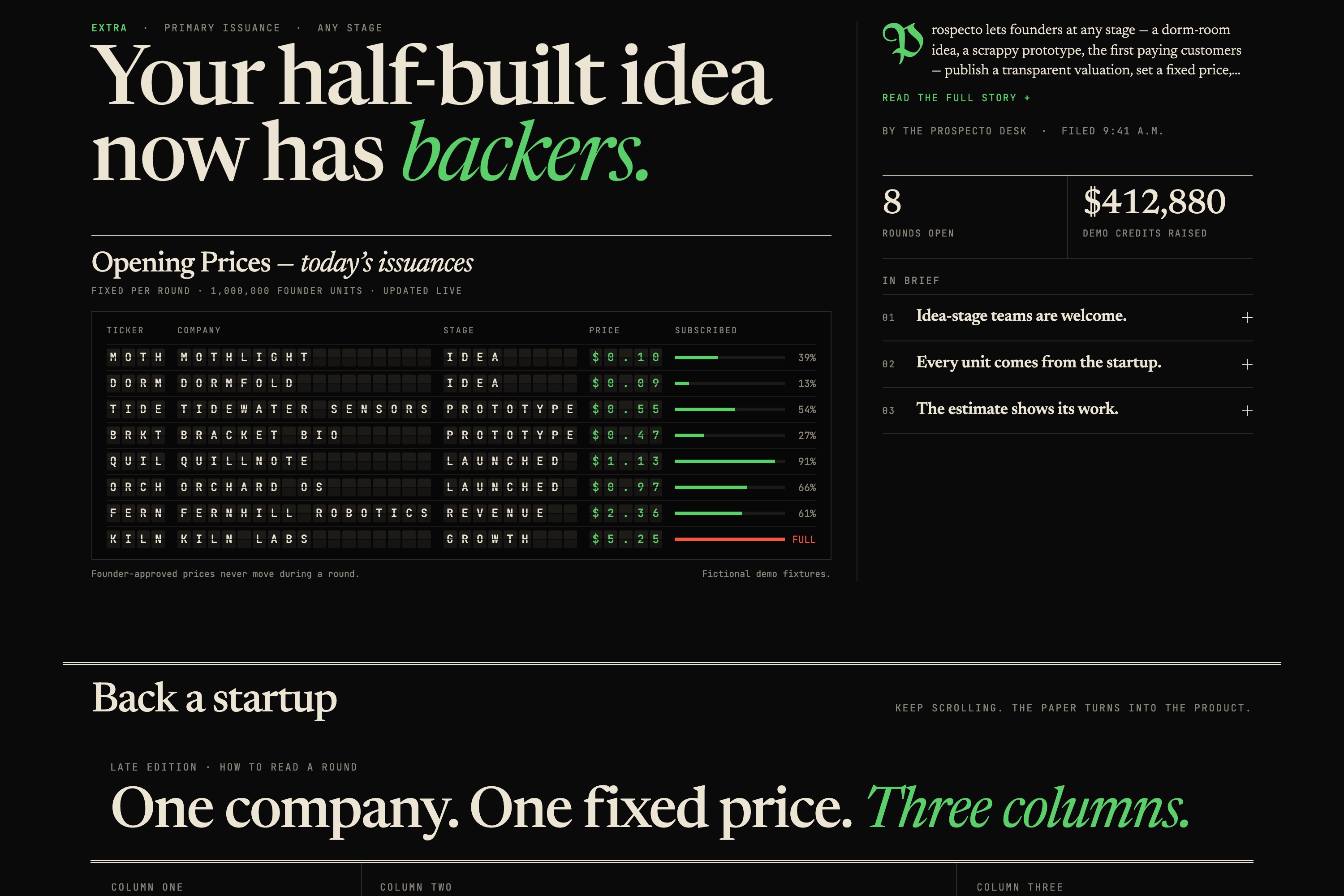
The price board, plus "Your half-built ideas now have backers"
-
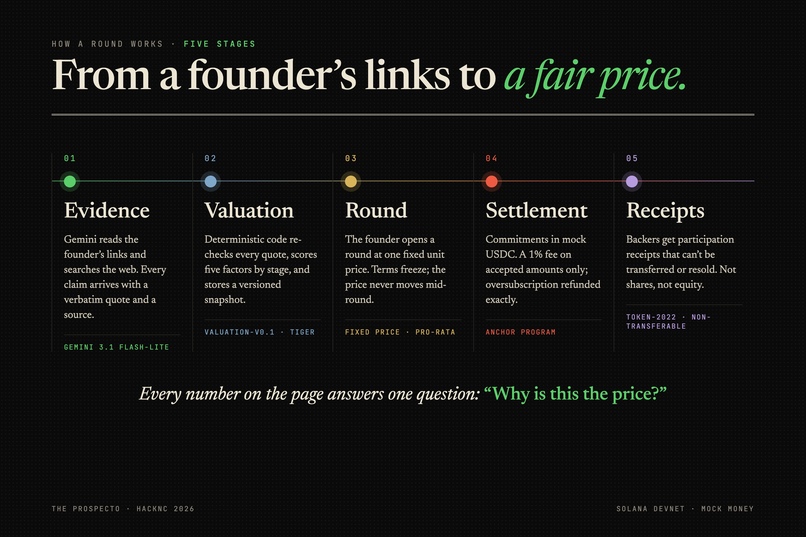
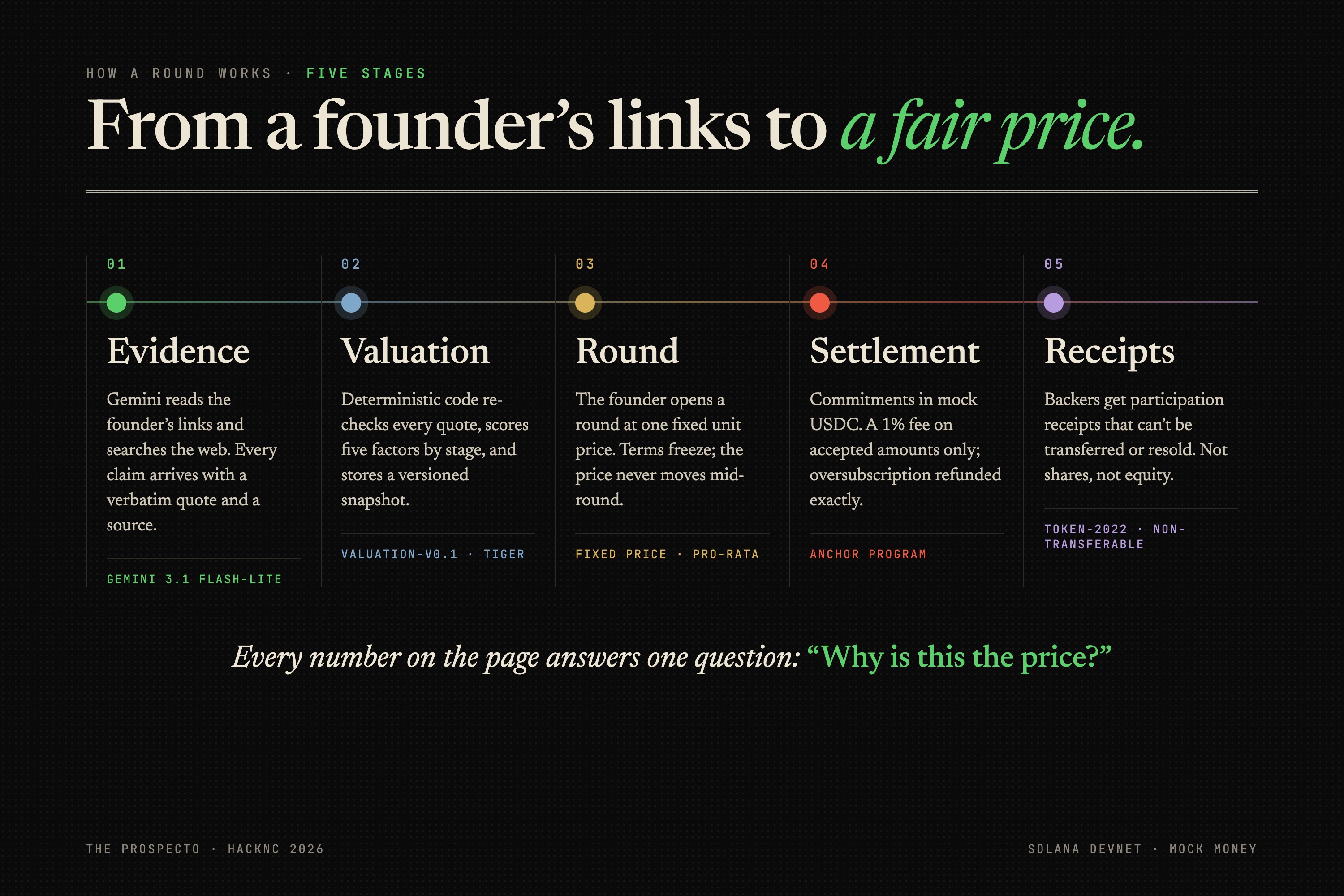
Card: five stages, from evidence to receipts
-
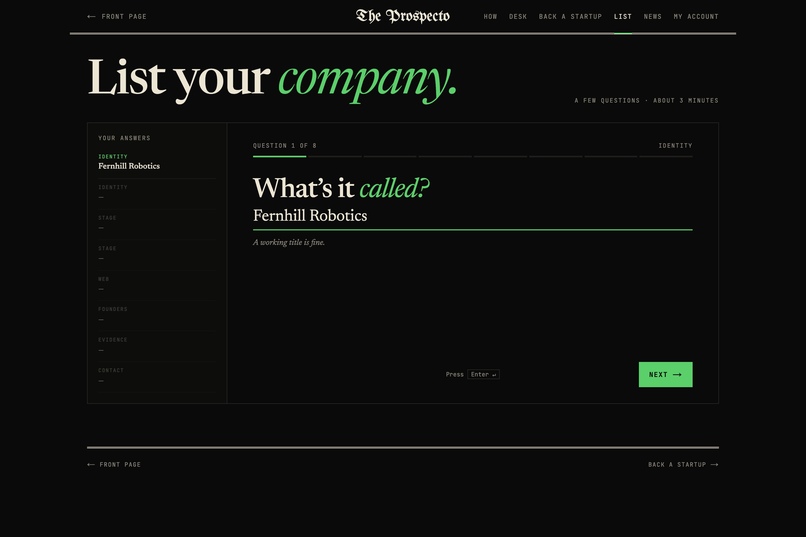
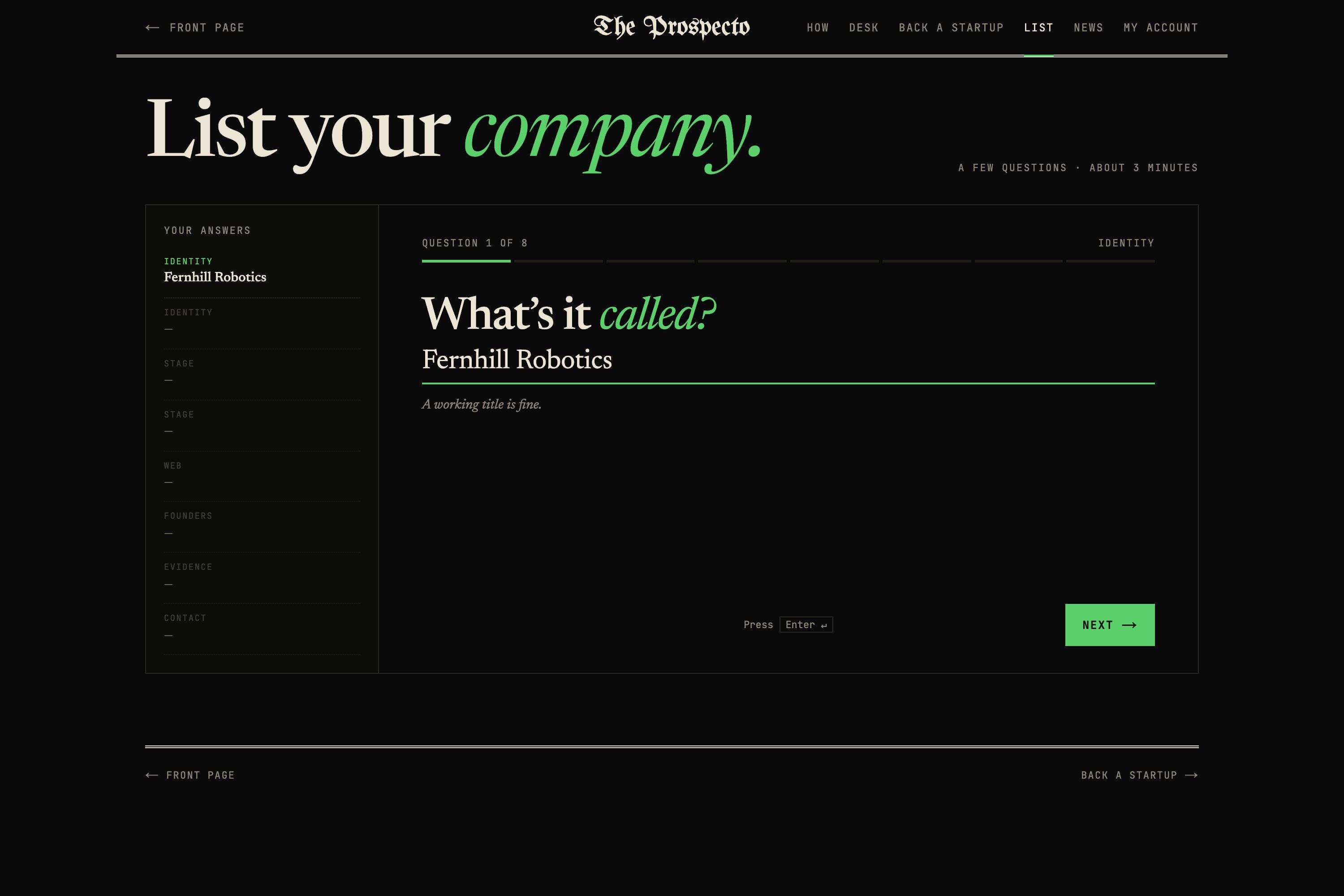
founder interview, first question
-
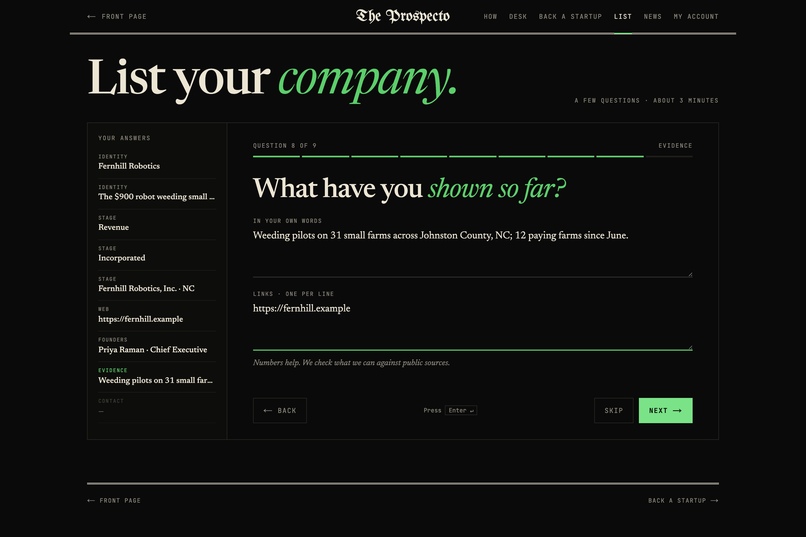
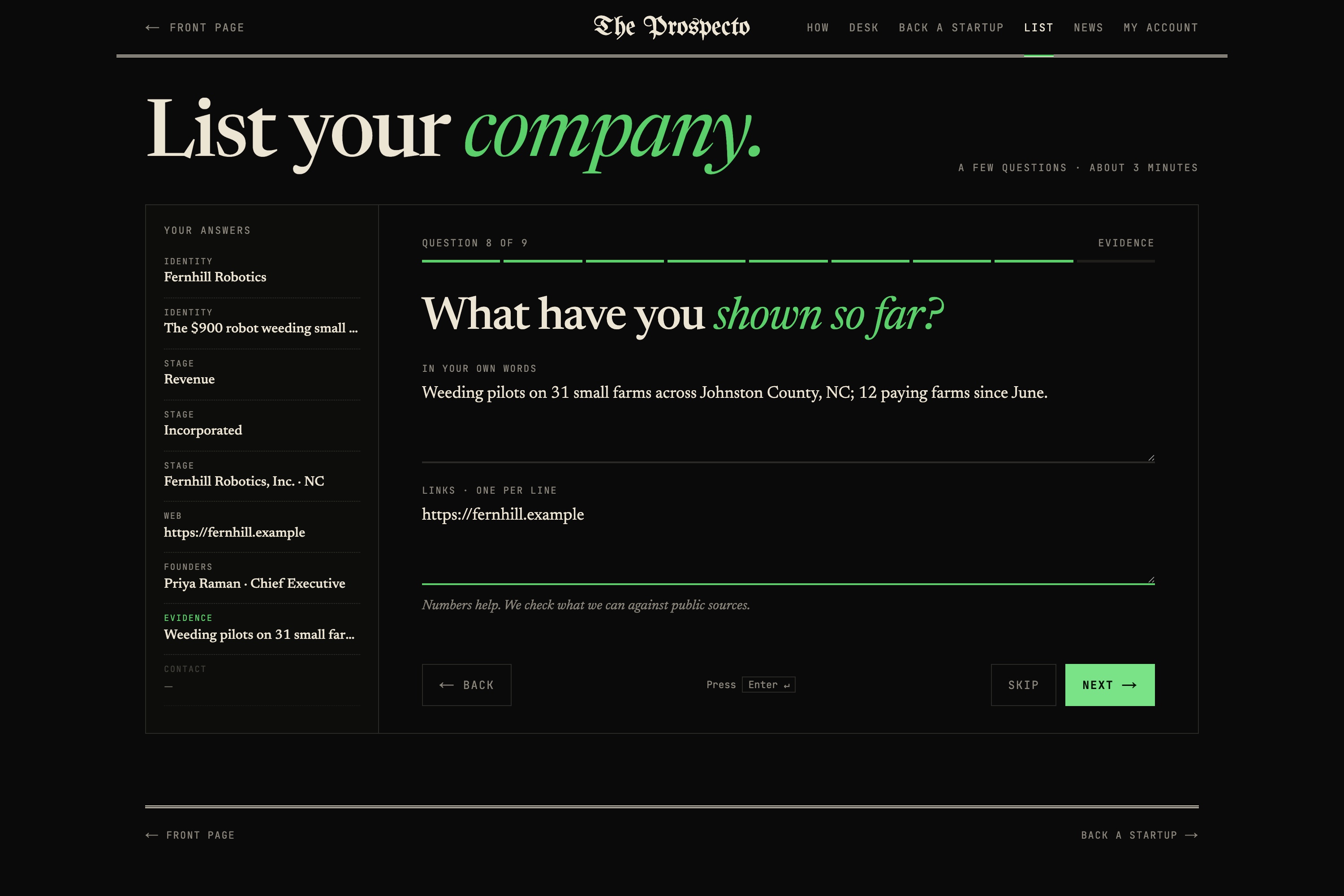
Interview at questions, with the answers filled in on the side
-
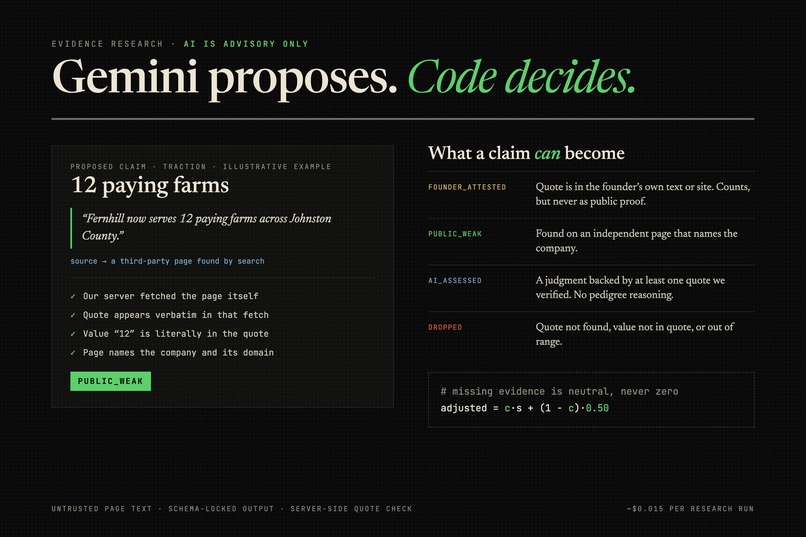
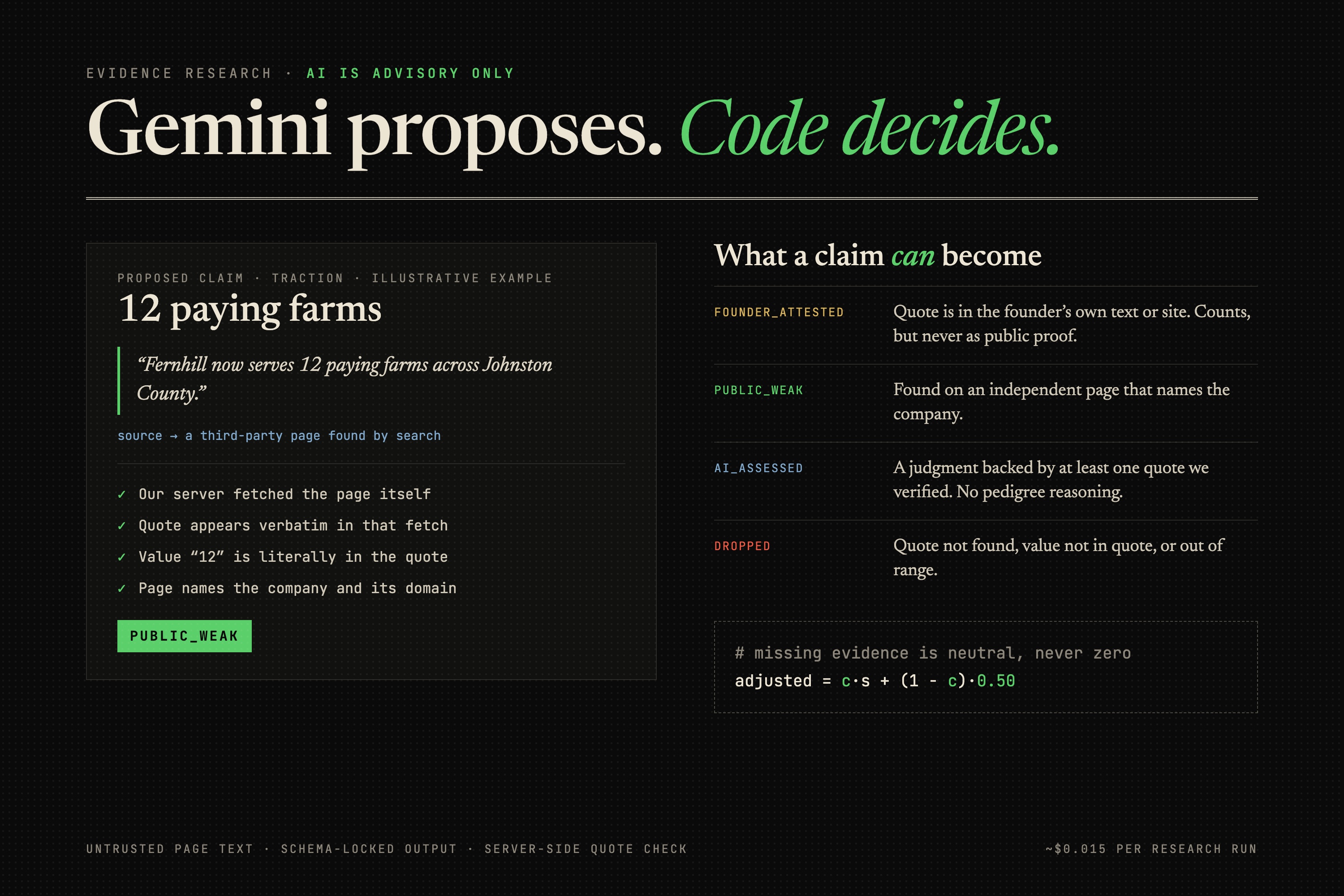
Card: how a gemini-claimed get checked, and what each label means
-
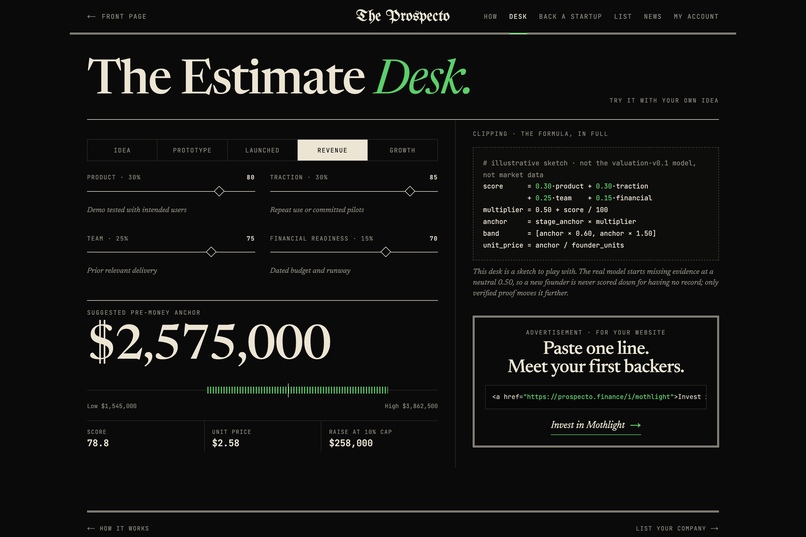
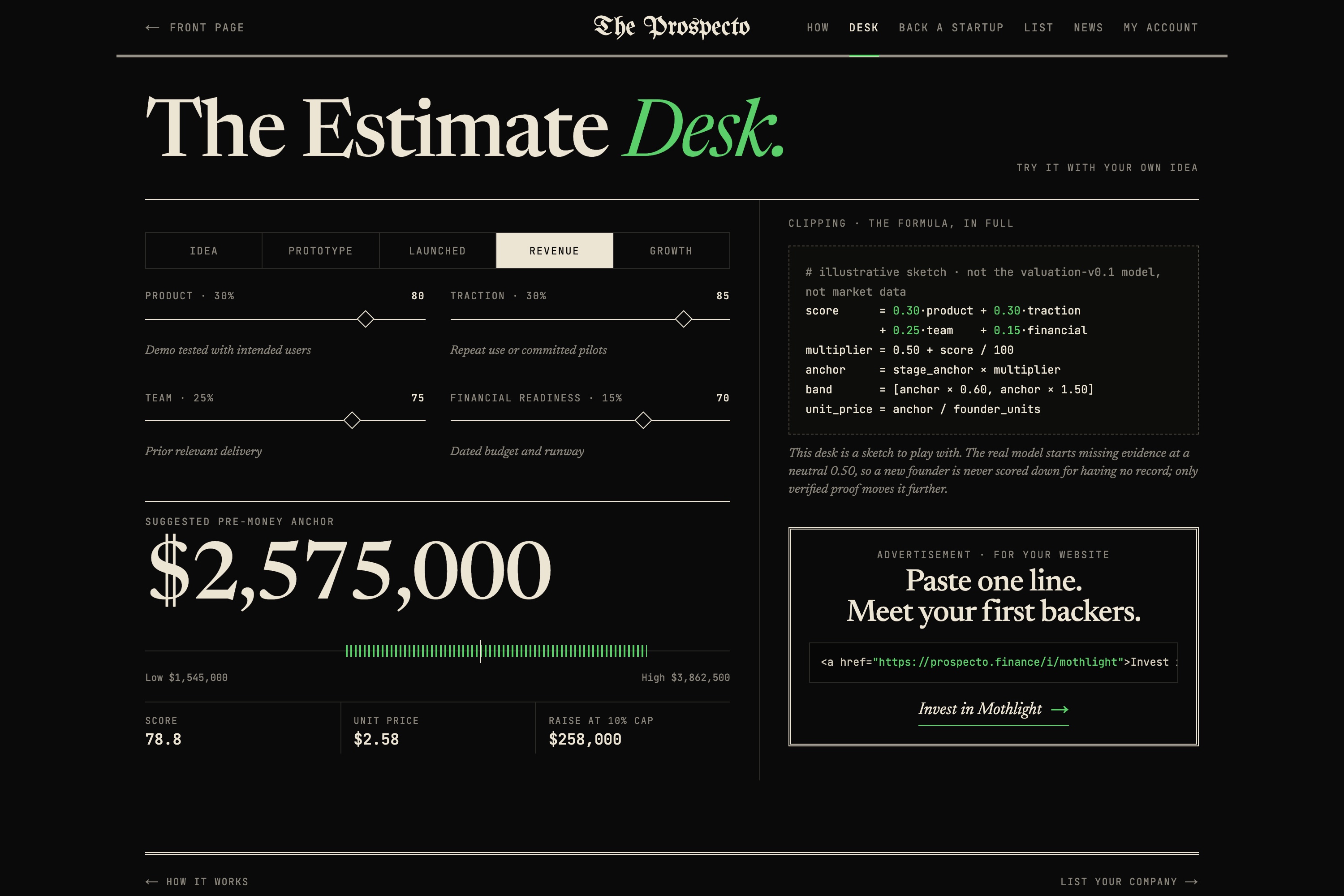
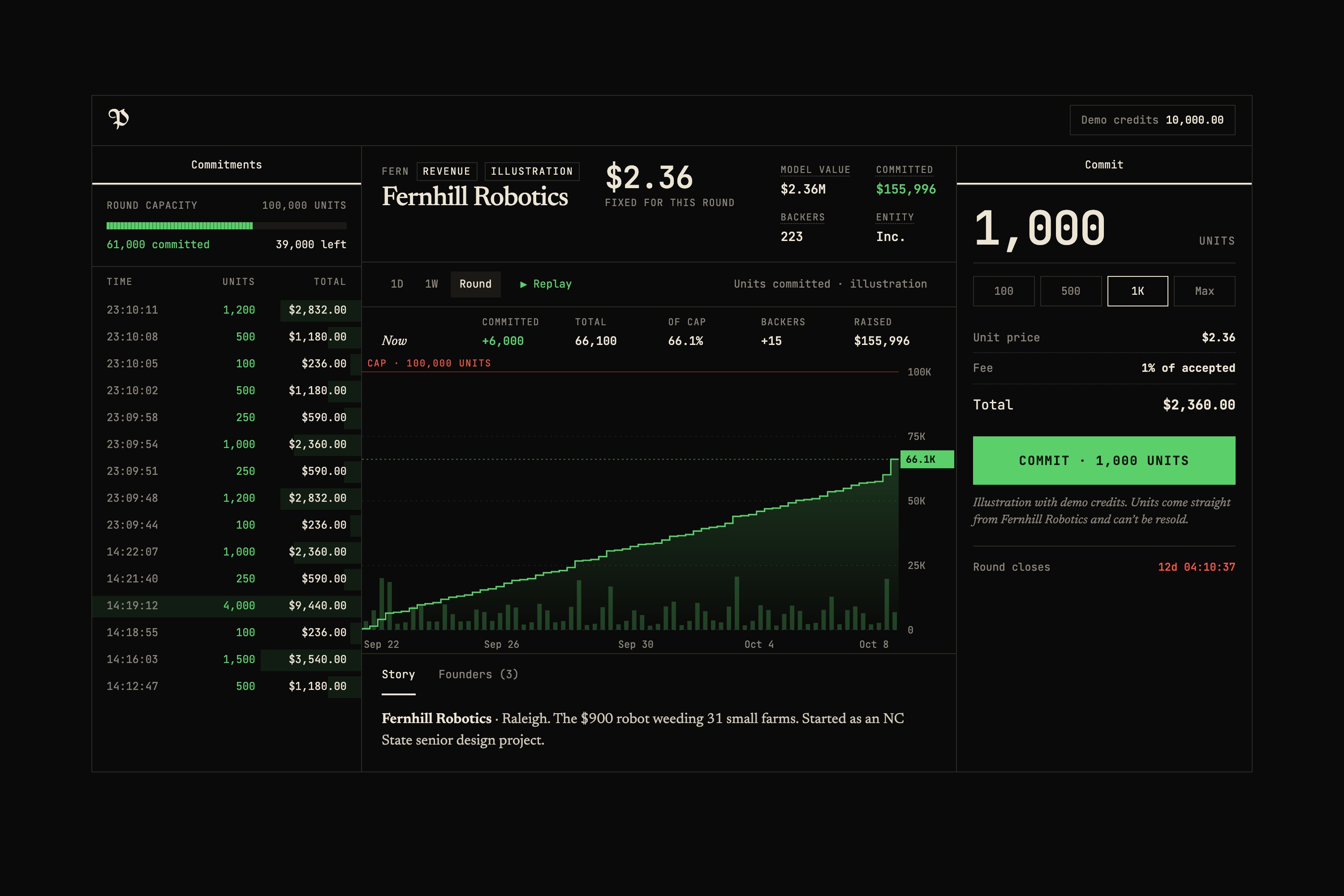
Estimate Desk set to the revenue stage
-
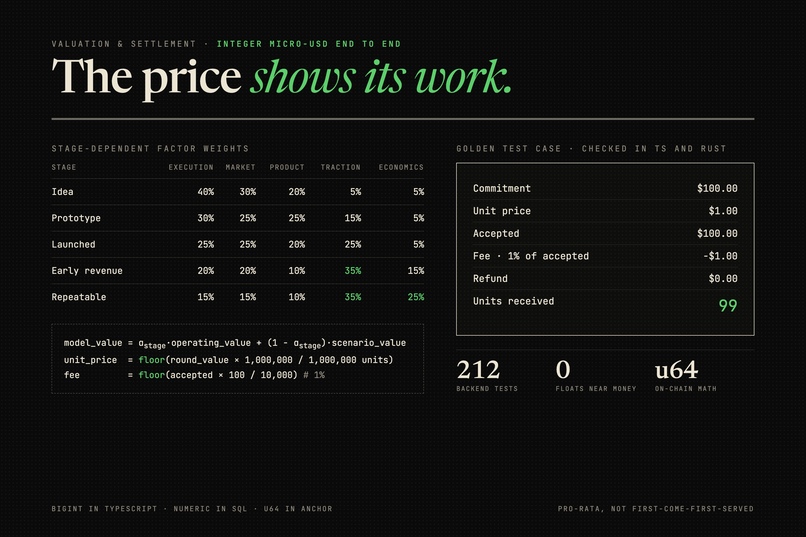
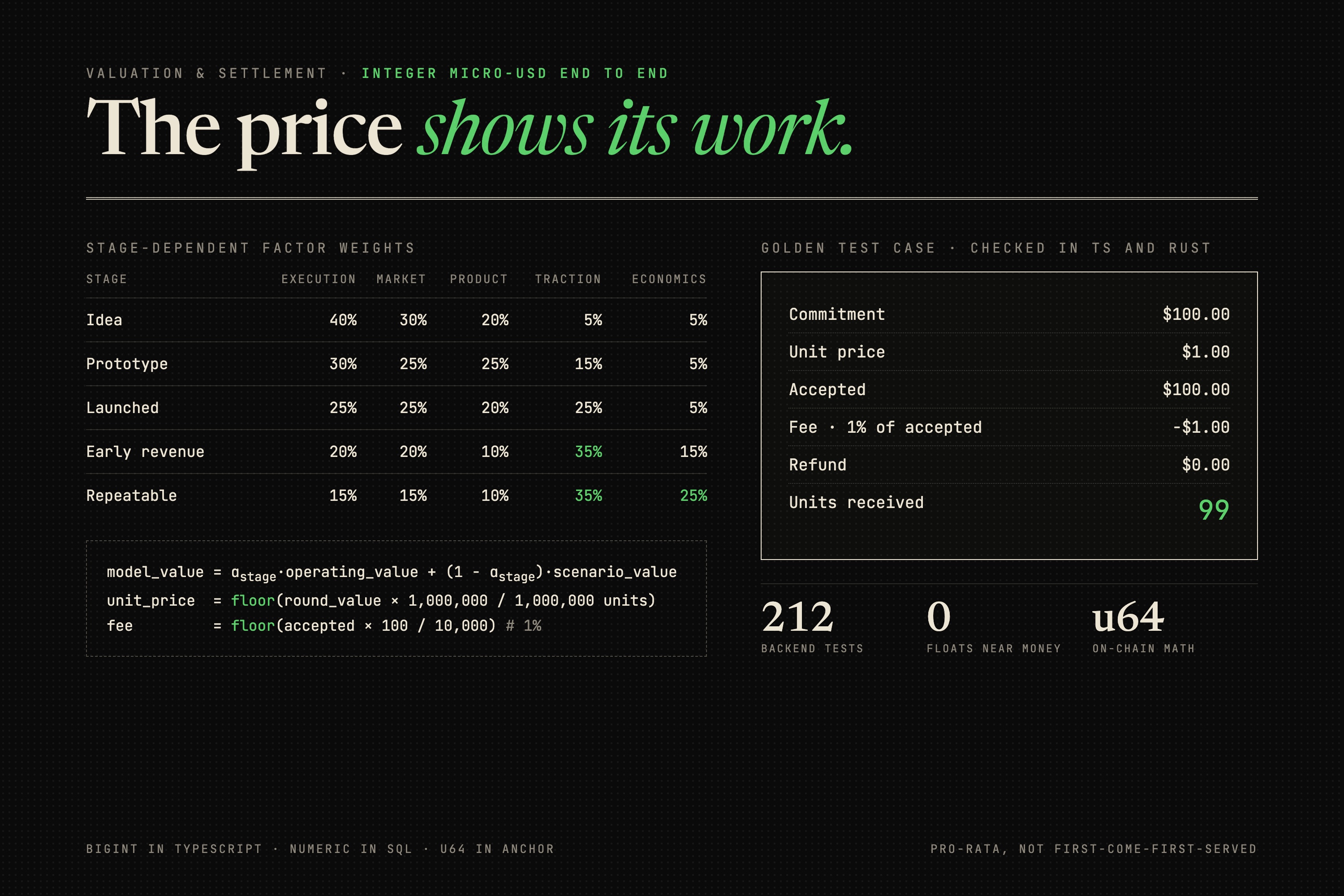
Card: stage weights, the formulas, and the test
-
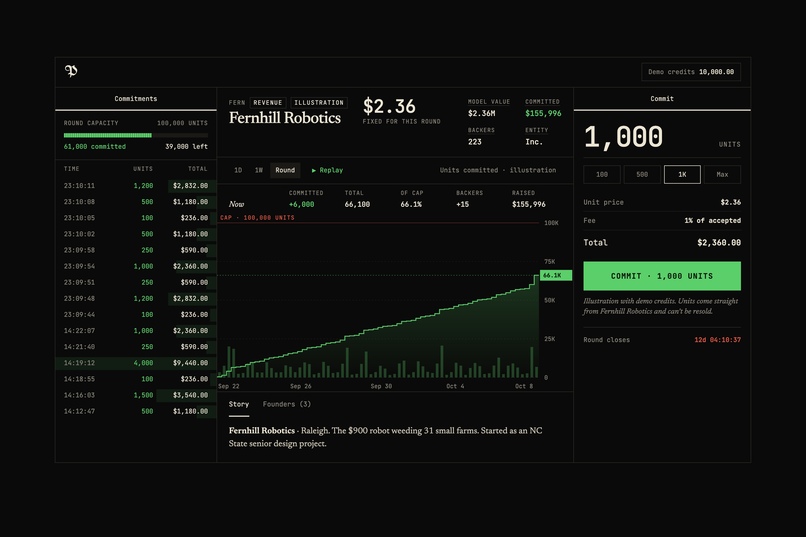
chart and quote panel
-
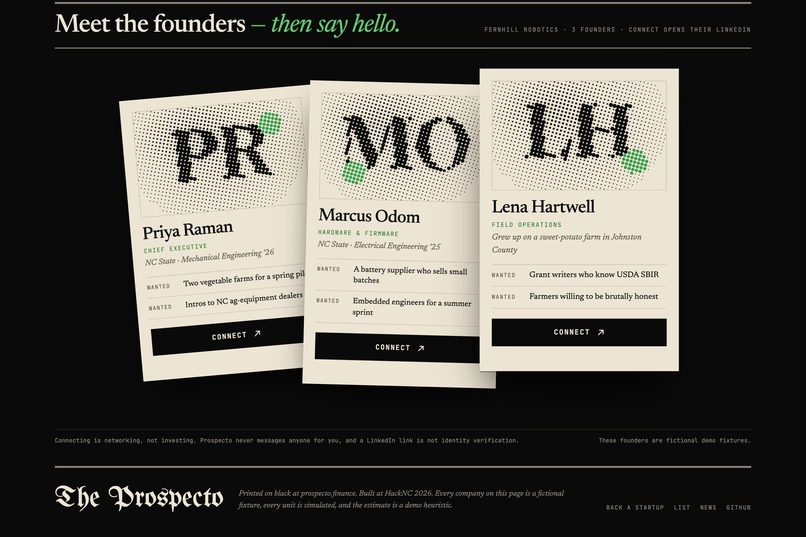
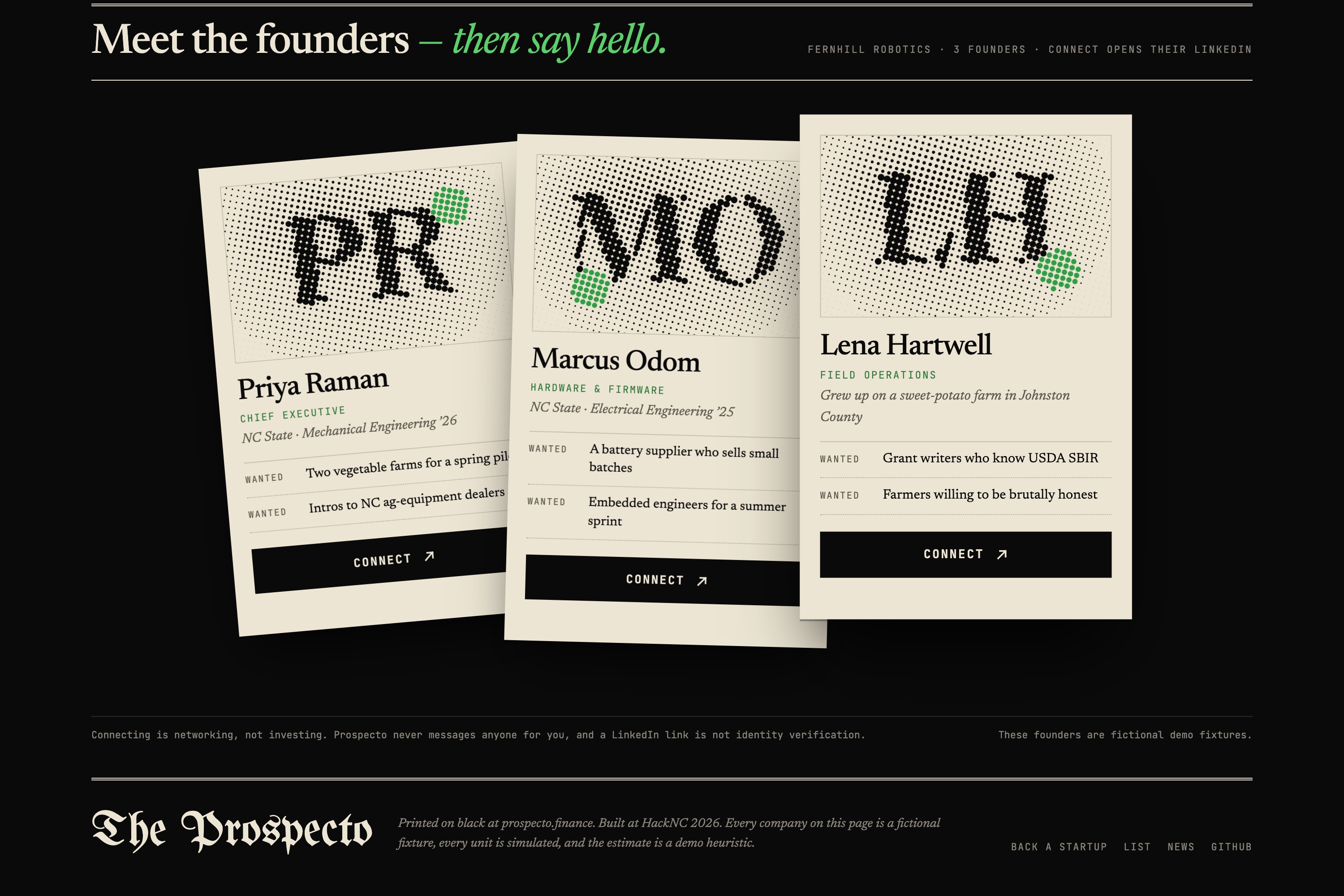
The tilted founder cards
-
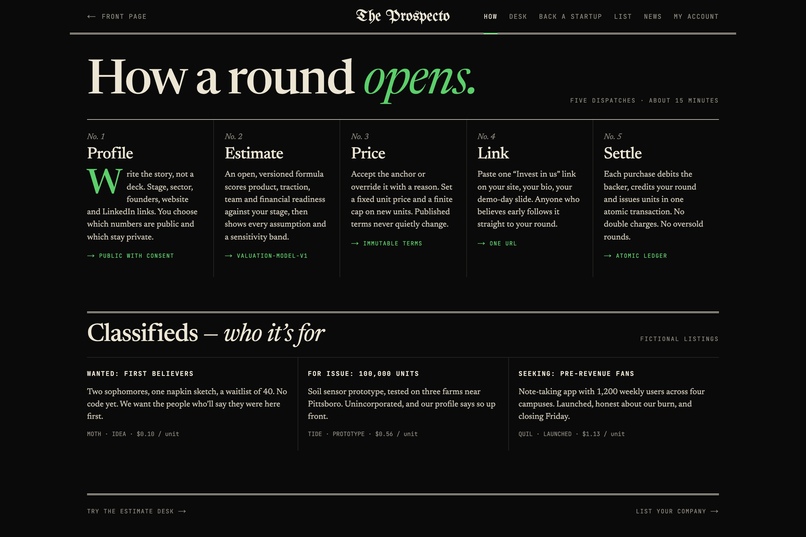
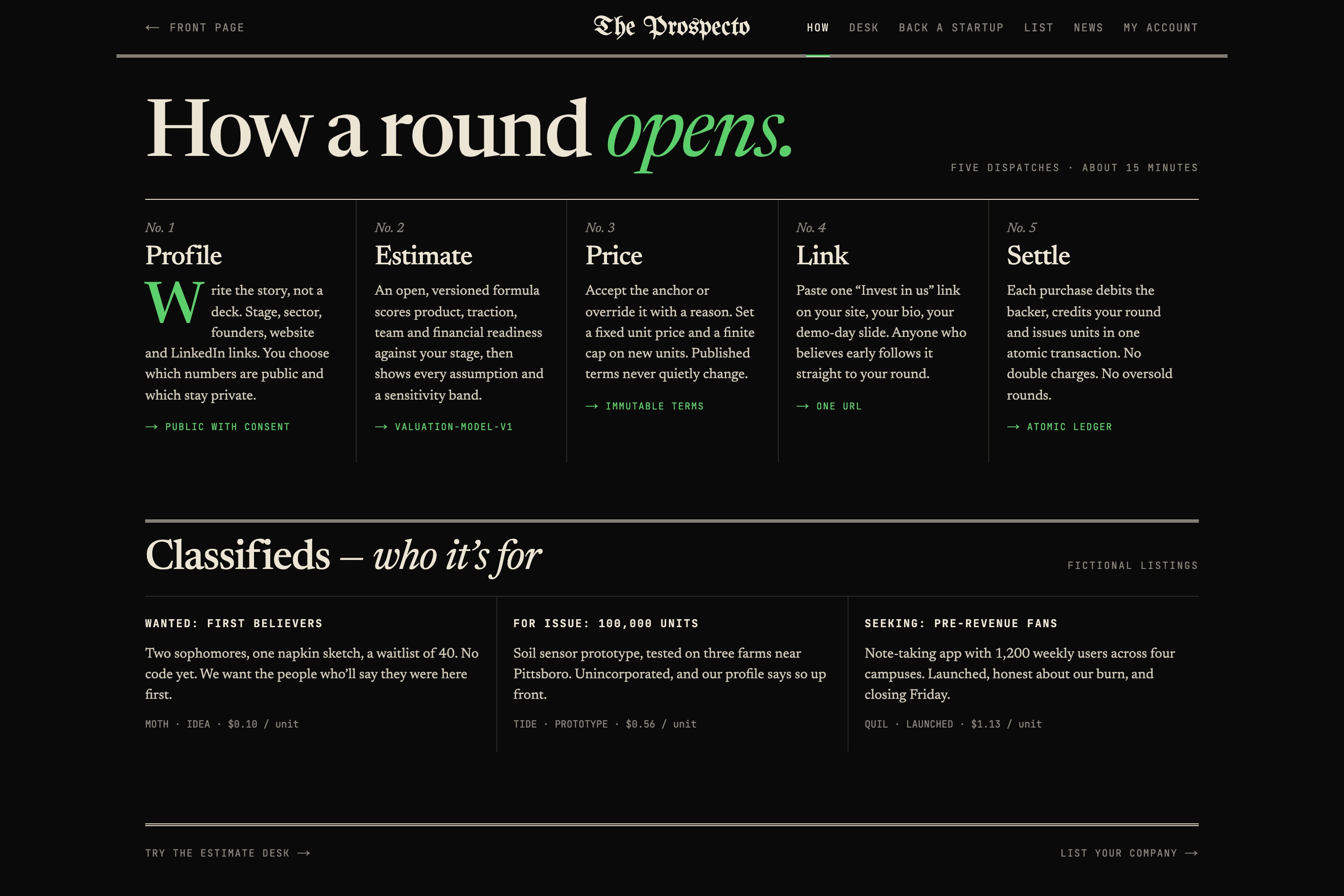
The /how page
-
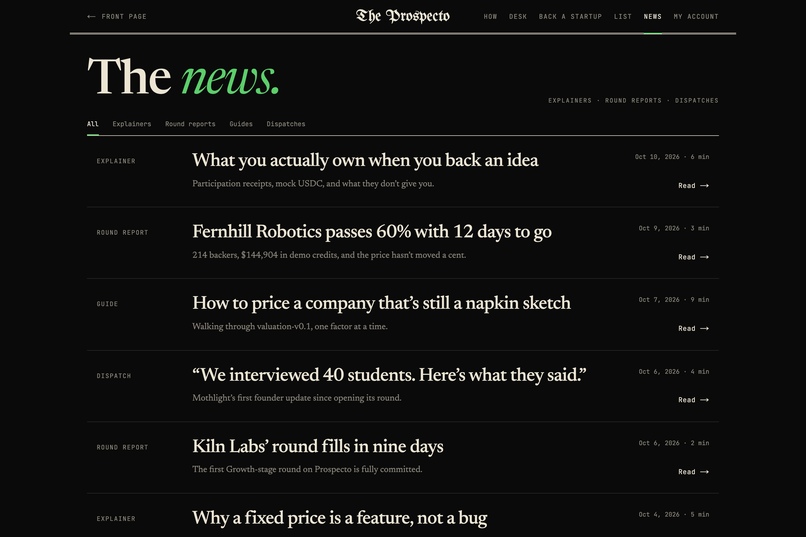
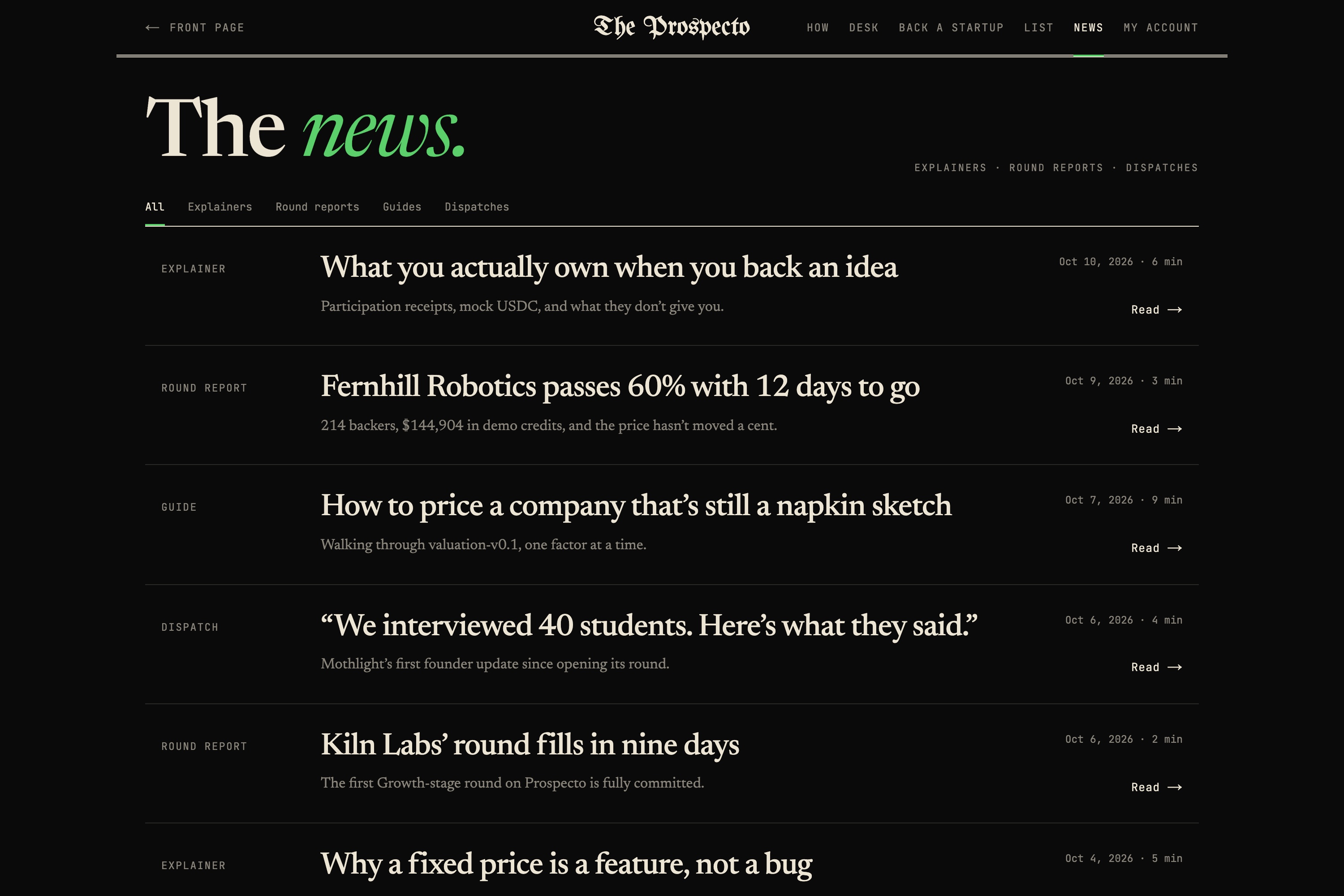
News page
-
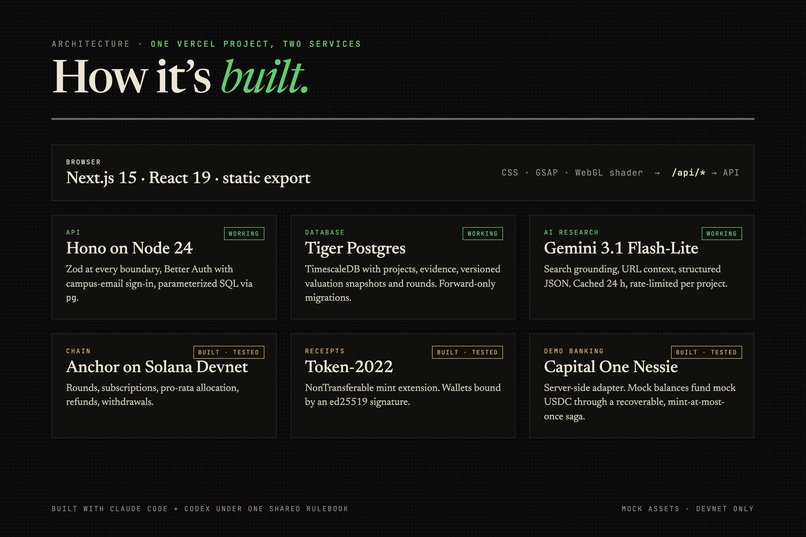
Card: the tech stack, with honest status labels
-
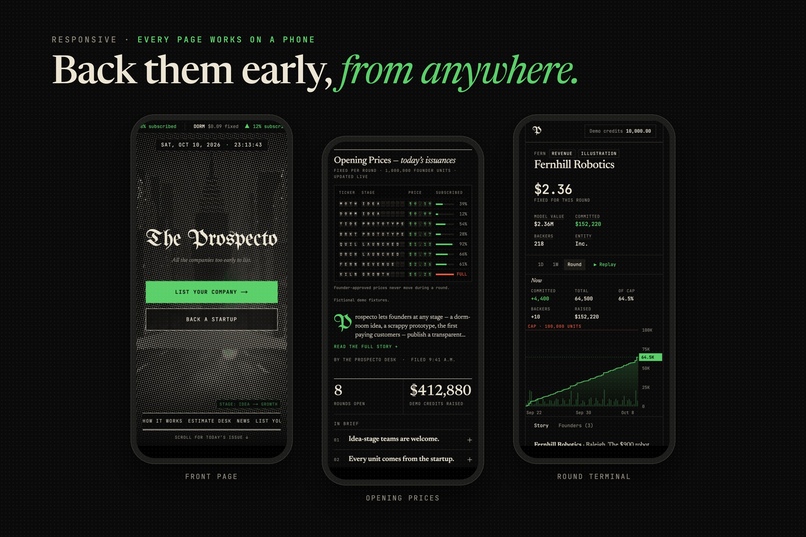
Cards with three phone screenshots
Inspiration
Student founders start with prototypes, GitHub repos, early users, or signed pilots, not clean financial statements. Those signals matter, but they are hard to price. VCs usually enter later, while regulated crowdfunding is too heavy for most campus projects.
This affects a large group. In the 2023 GUESSS survey of 226,718 students across 57 countries, 25.7% were actively trying to start a business.
Prospecto explores what a financial market for those companies could look like if prices began with evidence.
What it does
Prospecto turns an early-stage company into an evidence-backed listing with two connected layers.
First, founders submit a pitch, website, GitHub repo, and traction data. Gemini extracts claims with quotes and sources. Prospecto fetches those sources independently and rejects unsupported claims.
Deterministic code then scores execution, market, product, traction, and economics. The weights change by stage. Execution and market make up 70% of an idea-stage score; traction and economics make up 60% at repeatable revenue. Every valuation stores its evidence, inputs, formulas, and model version.
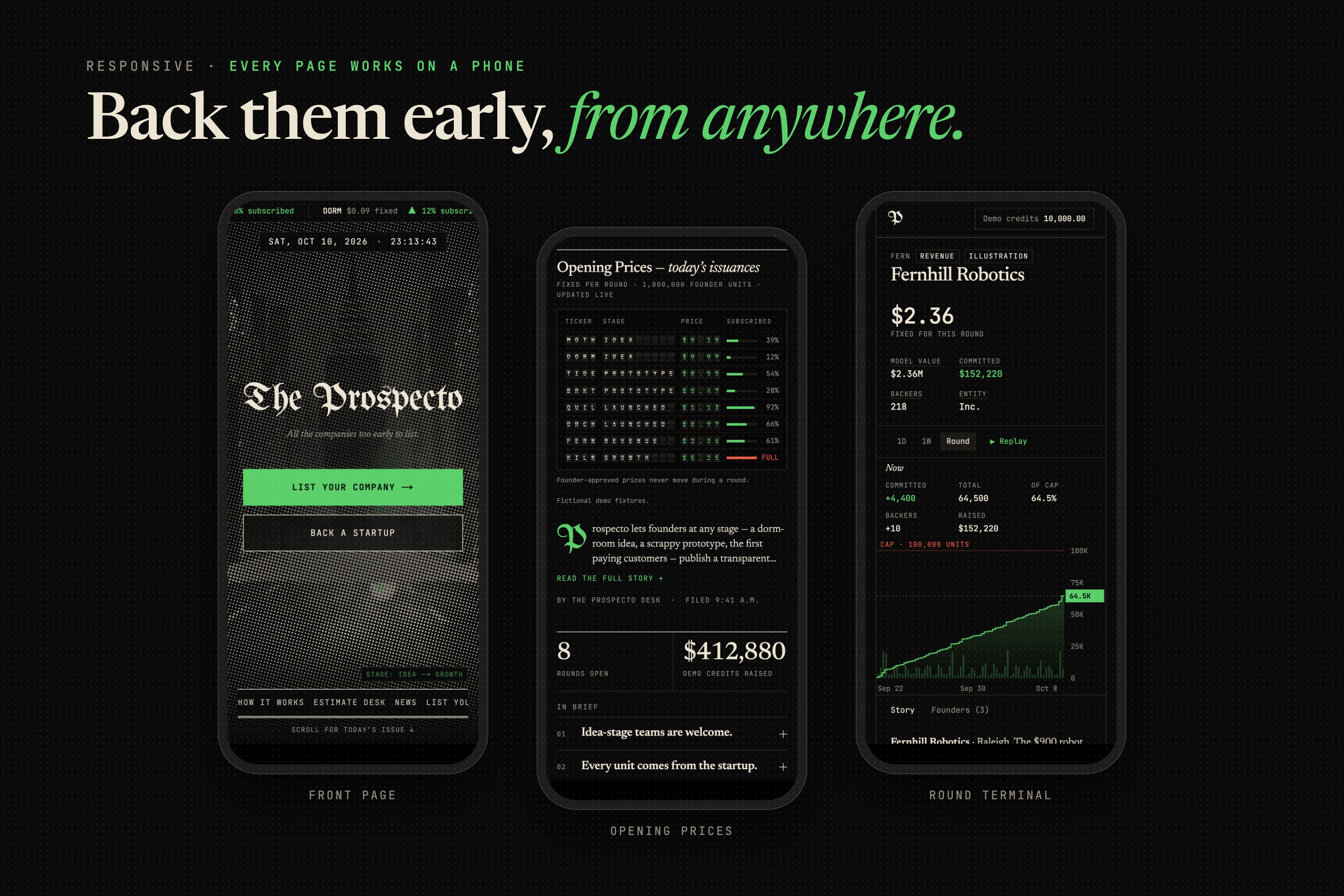
That model price anchors a simulated market. Each company gets a ticker, live quote, 24-hour chart, and buy/sell ticket. Users start with 10,000 play credits, trade fractional simulated units, and track their portfolio and P&L.
Prices follow a deterministic, mean-reverting path around the model value. The chart contains 288 five-minute observations and refreshes every two seconds. Orders fill at the displayed quote and stay in the browser. They do not move real money or tokens.
Prospecto also models primary issuance on Solana. A founder opens a fixed-price round with a funding target, unit supply, subscription cap, closing time, and hashes of the valuation model and evidence.
Participants commit mock USDC to a round vault. At closing, oversubscribed rounds allocate funds pro rata. Prospecto deducts a disclosed 1% fee, refunds the excess, and mints the final allocation as Token-2022 participation receipts.
The receipts are non-transferable. They record who participated, how many units they received, and the round that produced them. They are not equity and carry no redemption or cash-flow rights.
Why tokenize it?
The Solana program enforces the financing rules instead of trusting the interface. It checks the round window, supply, payment, allocation, fee, refund, and minting state. Replaying settlement cannot mint the same receipt twice.
Non-transferability is deliberate. The token records primary-market participation without creating an unrestricted secondary asset. The live buy-and-sell market remains a separate simulation until a regulated version can connect trading to a legally valid financial instrument.
How we built it
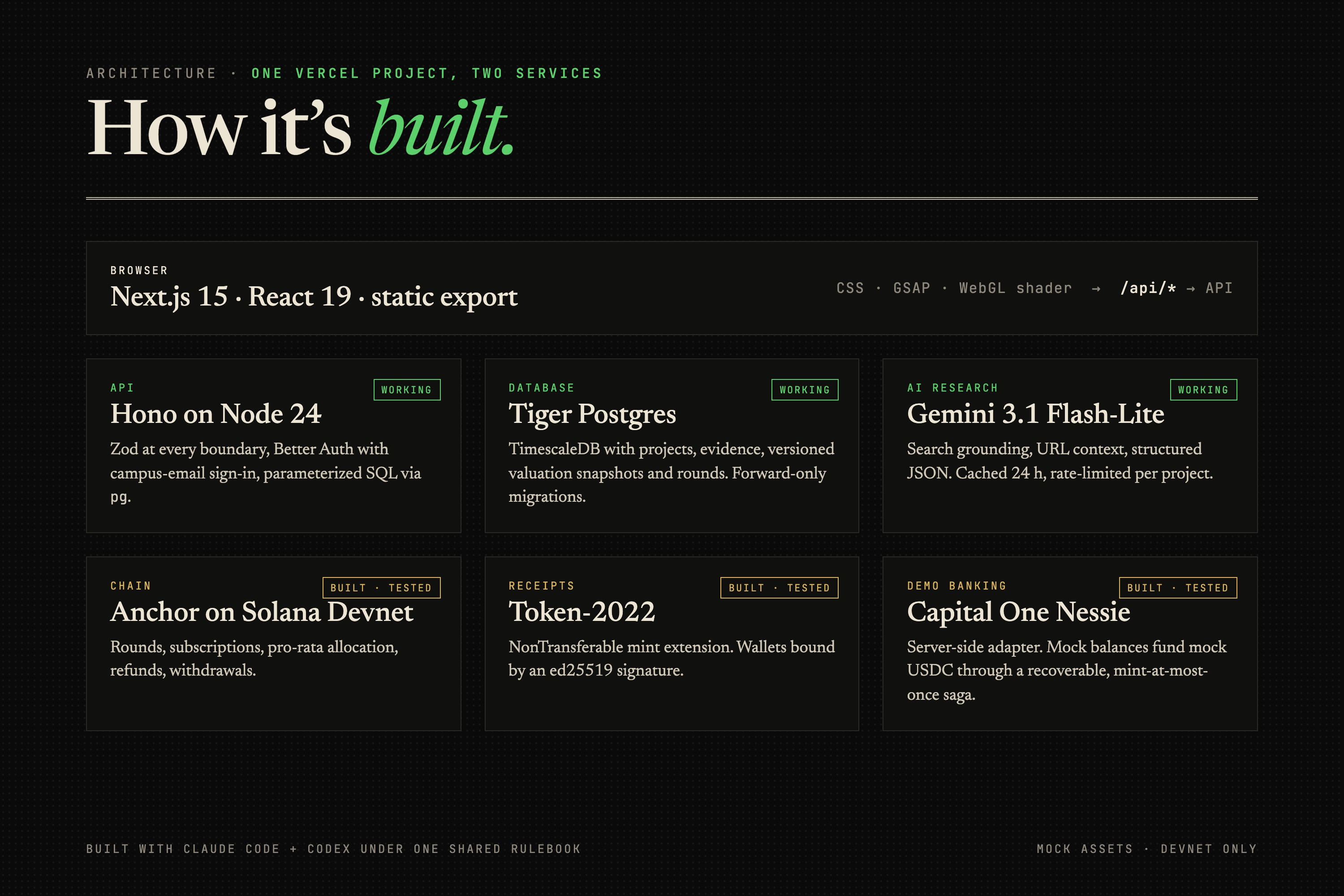
The frontend uses Next.js 15, React 19, TypeScript, GSAP, hand-written CSS, and a custom WebGL shader.
The simulated market is a pure TypeScript engine. A ticker, model price, and timestamp always produce the same path. A browser-local ledger stores cash, positions, cost basis, P&L, and up to 200 fills.
A Hono API on Node 24 handles research, valuation, authentication, rounds, and transaction preparation. Zod validates every boundary.
Tiger Cloud PostgreSQL stores projects, evidence, valuations, rounds, and chain events. TimescaleDB hypertables and continuous aggregates produce valuation and funding histories.
Gemini 3.1 Flash-Lite researches founder materials in two passes: founder sources, then public corroboration. Results are cached for 24 hours and cost about $0.015 per complete run. Gemini extracts evidence; deterministic code sets every score and price.
Our Anchor program implements project creation, subscriptions, pro-rata allocation, refunds, fee splitting, and non-transferable Token-2022 receipts.
Capital One Nessie supplies simulated bank accounts. Funding is handled as a recoverable workflow across Nessie, Tiger, and Solana, with idempotency protection against duplicate transfers or minting.
Money remains integer micro-USD across TypeScript, PostgreSQL, and Rust. At a $1 unit price, a $100 accepted commitment produces exactly 99 units after the 1% fee.
Challenges we ran into
Separating value, price, and ownership
The valuation estimates company fundamentals. The market price simulates investor attention. The receipt records primary issuance. Keeping those three concepts separate prevented a moving chart from silently changing a founder’s valuation or legal claims.
Verifying AI output
Gemini could return a plausible claim whose source did not contain the quoted evidence. We built a verifier that downloads each page and confirms the quotation before the claim affects valuation.
Coordinating three systems
Nessie, Tiger, and Solana cannot share one transaction. We persist a funding intent before making a mock bank transfer. If the chain step fails, Prospecto retries that step without repeating the bank write.
Exact settlement
TypeScript, PostgreSQL, and Rust had to agree on rounding, fees, oversubscription, dust, and u64 limits. Shared golden fixtures keep the implementations aligned. The repository reports 229 passing backend tests, plus Rust and compiled-program coverage.
Accomplishments we are proud of
- Every valuation traces back to evidence and a versioned formula.
- Every company receives an interactive market and portfolio experience.
- Oversubscription allocates proportionally instead of rewarding speed.
- Token-2022 enforces non-transferability at the asset level.
- Settlement can be retried without duplicating receipts or refunds.
- The interface presents financial infrastructure without looking like developer tooling.
What we learned
Early-stage valuation works better as an auditable argument than a mysterious score. Gemini helps read messy evidence, but it should not control money.
We also learned that tokenization needs a mechanical purpose. Encoding supply, allocation, fees, refunds, and transfer restrictions is more useful than simply placing a token on-chain.
What’s next
First, we will complete the Devnet path from Nessie wallet funding through final Token-2022 receipts.
Next, we want to replace displayed-price fills with a true reserve-backed bonding curve. Purchases would add reserves and raise the marginal price. Sales would return units, release reserves, and lower it. Users would see price impact, average execution price, slippage, and reserve depth before trading.
A multi-campus pilot would let us calibrate valuations against milestone completion, later fundraising, and company survival.
Long term, Prospecto could give young companies a continuous capital history from first prototype through institutional funding. A real-money version would require regulated issuance, identity checks, disclosures, custody, investor limits, and a legally enforceable relationship between each company and its financial instrument.
Built With
- claude-code
- codex
- css3
- gemini
- javascript
- nextjs
- react
- solana
- tiger-data
- typescript
- vercel


Log in or sign up for Devpost to join the conversation.