-
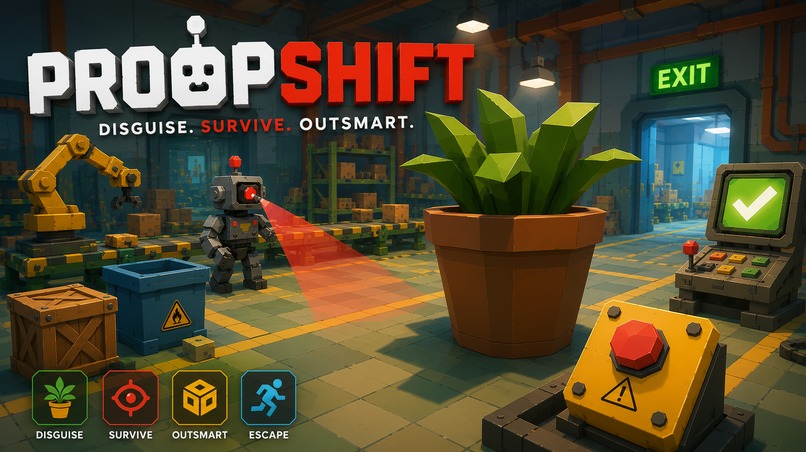
Cover Image
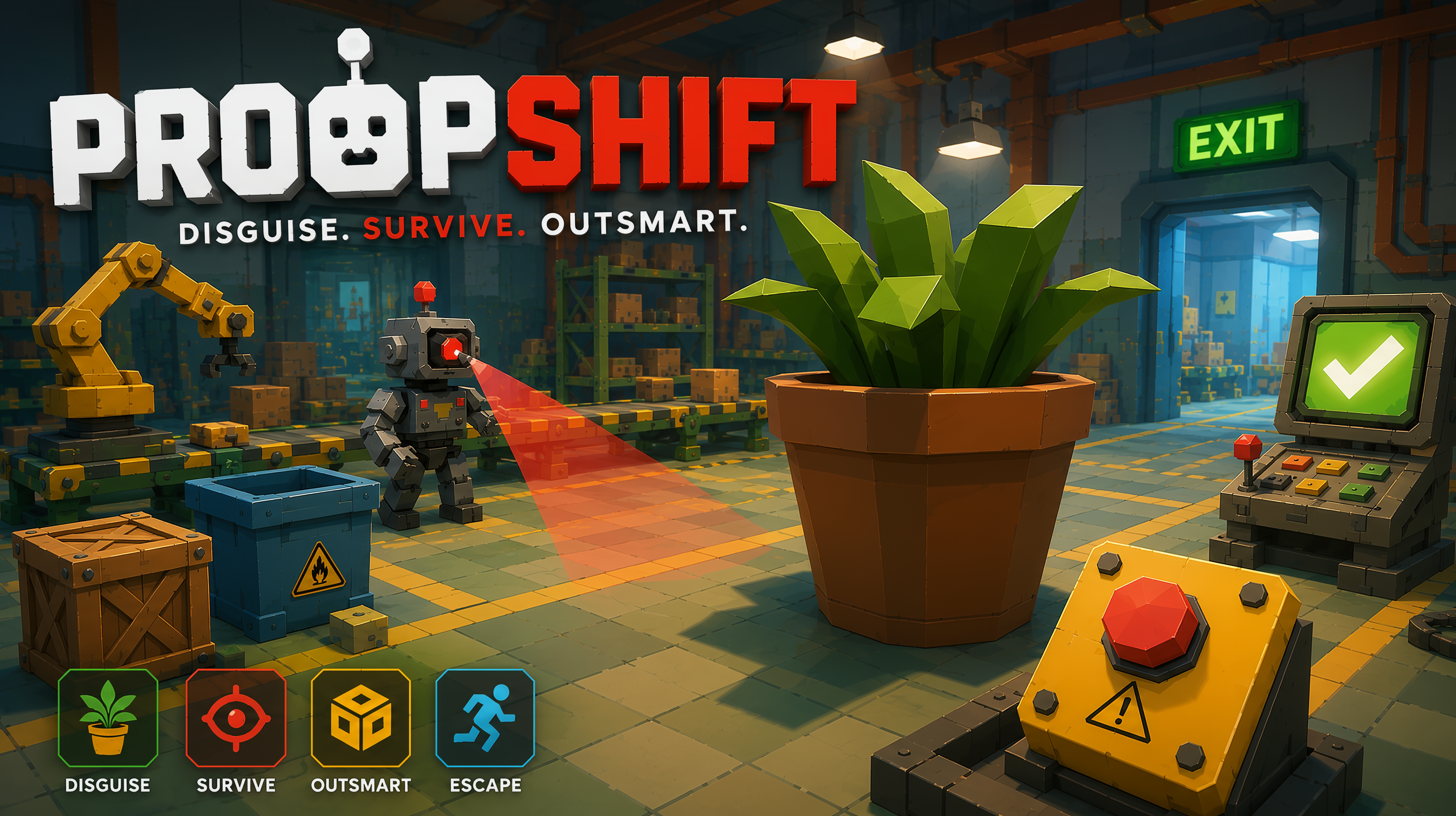
About The Project - PropShift
Inspiration
The idea came from two games colliding in my head. Among Us proved that social deception works on mobile, but it's turn-based and talk-heavy. Fall Guys proved that chaotic multiplayer survival works; but it's purely physical, no cognitive load. I wanted the space between them: a real-time survival game where the threat isn't other players voting you out, it's your own reading speed.
The NOT System was the first mechanic I designed. I kept thinking about Simon Says, how the simplest rule inversion ("Simon didn't say") creates instant panic in a room full of adults. What if that panic happened every 30 seconds, with drones hunting anyone who got it wrong? That single question shaped everything else.
The toy factory setting came later. I needed a world where "turning into an object to hide" made narrative sense. Sentient toys in a factory, surrounded by shelves, crates, rubber ducks gave prop-shifting a reason to exist beyond gameplay.
What it does
PropShift is an 8-player social survival game set in a retro-futuristic toy factory. Players control sentient toy figures trying to outlast each other while evading factory Sweeper Drones.
Every 30 seconds, the factory announces a Survival Protocol, a rule all players must follow. White text means obey. Red text means do the opposite. That's the NOT System: a one-second reading challenge that separates survivors from targets. Miss the color, follow the wrong instruction, and drones lock onto you.
Between protocols, players gather materials, craft survival tools, and shift into props to break drone line-of-sight. Each material has a weakness tied to specific protocol types, transforming into a wooden table during a Heat Protocol means double damage if caught.
Sessions are 10 minutes long. Eliminate everyone and take the full reward solo. Survive to the timer with others and split it. Every rival is simultaneously a threat and a potential shield.
How we built it
Documentation-first, same as the other projects. The GDD was written to implementation-ready depth before any prototype work, every system described precisely enough that a developer could build it without asking what happens when...?
The design process had three critical phases:
- Protocol rhythm design — locking the 30-second heartbeat. Every protocol cycle needed to contain a full decision arc: alarm → read → react → survive. If any cycle felt empty, the timing was wrong.
- NOT System calibration — the red/white text distinction had to be instantly readable but still create half-second hesitation. Too subtle and nobody notices; too obvious and there's no panic. The current solution: same font, same size, color is the only differentiator.
- Material-weakness matrix — mapping Wood/Metal/Plastic vulnerabilities to protocol categories (Heat, Electric) so that prop-shifting isn't just "hide behind anything" but "hide behind the right thing."
Challenges we ran into
Making the NOT System fair. The core tension: red text must be noticeable enough that failure feels like the player's mistake, not the game's trick. Early versions used subtle color shifts, and players felt cheated. Current version uses full saturated red vs clean white. Failures now feel like "I should have read more carefully," not "I couldn't see it."
Balancing 8-player elimination pacing. Too fast and half the lobby is spectating by minute three. Too slow and the final minutes lack tension. Solution: 3 lives per player, drone count escalating every 45–60 seconds, and a compliance window that shrinks as the session progresses. The last three minutes have zero grace period, protocol appears, enforcement is instant.
Prop-shifting depth vs simplicity. Early designs had 20+ props with individual stats, which was overwhelming. We cut it to two categories: small props (2 materials, instant shift, low HP) and large props (4 materials, 1–2 second shift, high HP). Two categories, clear trade-off, no menu browsing mid-panic.
The shared-victory problem. If multiple survivors split the reward equally, why would anyone take risks? The answer is the solo-win bonus: eliminate everyone and you get the full payout. This creates a constant social calculation, cooperate to survive, or betray to monopolize. The game never tells you which to do; the pressure does.
Accomplishments that we're proud of
The NOT System as a zero-tutorial skill expression mechanic. No learning curve, no combo memorization. Can you read fast and act on what you read? That's the entire skill. First-time players understand it in one protocol. Veterans still panic on red text at minute eight.
The 30-second rhythm that makes every session feel dense without being exhausting. Ten minutes contains twenty protocol cycles. Each one is a micro-story: alarm, read, decide, survive or fail. No filler. No downtime.
Material weaknesses tied to active protocols. This single rule transforms prop-shifting from "hide behind anything" to "hide behind the right thing at the right time." It rewards players who track which protocol category is active, not just players with fast reflexes.
The elimination economy. Solo win = full reward. Shared survival = split reward. This one rule makes every other player simultaneously an ally (more survivors = more drone targets that aren't you) and an enemy (fewer survivors = bigger payout). No system forces betrayal. The math does.
What we learned
Simplicity scales better than complexity. The NOT System is one rule: red means opposite. That single rule generates more emergent gameplay — bluffs, misreads, panic chains, "I knew it was red but my hands moved anyway" stories — than any multi-layered deception system could.
Rhythm is more important than content. The specific protocol doesn't matter as much as the fact that a protocol arrives every 30 seconds. The heartbeat creates tension. The content just gives it shape. Weekly protocol rotation keeps the content fresh, but the rhythm is what makes the game feel alive.
Spectating is retention. Eliminated players who watch the final minutes almost always queue again immediately. The "I would have survived that" feeling is stronger than any reward screen. Building a good spectator experience wasn't in the original design, it emerged from playtesting and became a deliberate retention tool.
Fair failure is addictive. When a player misreads red text and gets caught, they don't blame the game. They blame themselves. That distinction, "my fault, not the game's fault" is what produces "one more round." Unfair failure creates quitting. Fair failure creates learning.
What's next for PropShift
Hunter Mode — asymmetric multiplayer where two players directly control Sweeper Drones instead of AI. Human intelligence behind the patrols transforms every hiding spot from "probably safe" to "maybe they know I'm here." Designed as a separate queue alongside standard AI sessions.
Expanded Crafting — second-tier craftable items unlocked through play: area denial tools, multi-drone disablers, short-range signal jammers. More options for veteran players without changing the core loop for newcomers.
New Factory Maps — additional environments with unique layouts, map-specific hazards, and exclusive prop rosters. Each map changes which props are available for shifting, creating strategic variety without touching the base mechanics.
Boss Shift Events — late-session escalation events that replace standard protocols in the final two minutes. Factory blackouts, conveyor belt activations, emergency lockdowns. Designed to spike tension at the exact moment the surviving player count is lowest.
Seasonal Factory Themes — cosmetic and environmental refreshes tied to real-world seasons or in-game factory events. New prop skins, themed daily quest pools, and limited-time leaderboard rewards.
Built With
- antigravity
- chatgpt
- claude
- cursor
- gemini
- midjourney
- topaz


Log in or sign up for Devpost to join the conversation.