



Inspiration
Creating Proprio, we wanted something that didn't exist yet. Something we needed ourselves.
Last year Junheng broke his wrist at the gym doing a workout at the gym. During his recovery, a question kept coming back up, “Why didn’t I see this coming?”. Maybe his body had been strained for weeks or months, and he couldn’t feel it. The tension, compensation patterns, and the subtle imbalances were all there, just no way to read it.
During our research and ideation, we found the problem was far bigger than one injury. Proprioception, the body’s sense of perceiving its own position, movement, and spatial orientation, keeps our bodies balanced, coordinated, and injury-free. We wanted a way to tap into this sense to allow you to record and learn from your movements.
60–80% of adults will experience back pain in their lifetime. 40-50% of competitive athletes will report overuse injuries in a single season. 1.3 billion people live with musculoskeletal disorders worldwide. Not because their bodies weren't sensing the problem. Because they had no way to see it.
This is where Proprio comes in.
What it does
Proprio gives you body observability through proprioception.
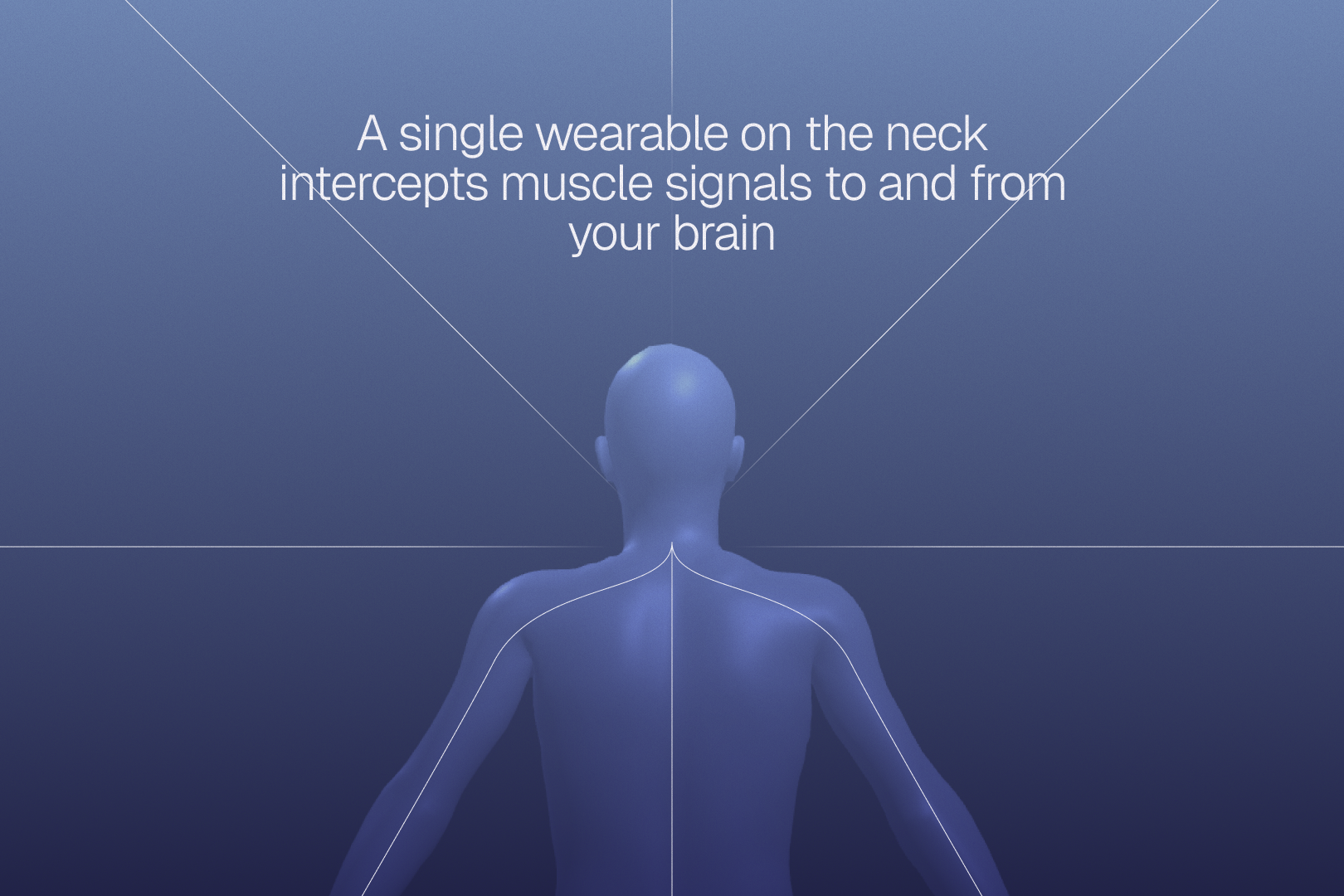
A single wearable device worn on the neck reads the body's muscle movement and tension data in real time. Paired with the Proprio app, it translates that stream of data into:
- 3D motion replay — visualize exactly how your body moved through any activity
- Muscle activation mapping — see which muscles are engaged, overloaded, or compensating
- Strain detection — track tension levels across muscle groups over time
- Intelligent alerts — receive warnings when the system detects patterns that could lead to injury
- Posture & lifestyle monitoring — understand how everyday habits are affecting your body
Proprio works for everyone from competitive athletes analyzing jump mechanics, to desk workers managing spinal load, to older adults tracking balance patterns over time. It doesn't diagnose. It makes visible what the body already senses.
How we built it
We approached Proprio as a full-stack design problem with a theoretical hardware device, a mobile app, and branding working as a unified system.
Design & Prototyping
We began by mapping the human experience at the center of the problem. Who carries pain they don't understand? Everyone. That universality shaped every design decision that followed. We wireframed the app around three core interactions: real-time monitoring, post-activity replay, and long-term trend analysis.
Visual Language
The interface uses a deep navy foundation with ocean blue as the primary interactive tone — fluid, alive, in constant motion — and red reserved exclusively for strain and critical alerts. Typography is precise and clean. Every visual element was chosen to serve one goal: make the invisible legible.
3D Visualization
Movement is spatial, and flat charts can't capture it honestly. We used the SMPL body model along with CMU Mocap data to visualize different movements for our prototypes.
Hardware Concept
The device sits at the neck which is the convergence point for signals traveling between the brain and body. The device will be designed to be unobtrusive enough to wear through any activity.
Challenges we ran into
Designing for universality
Proprio has to work for a 22-year-old athlete and a 70-year-old adult managing balance decline. We were debating whether to narrow down our scope to just one type of user but we felt that this app could truly be useful for many use-cases.
Communicating the hardware concept
A neck-worn device that reads whole-body movement is a technically ambitious claim. We had to find language that was honest about what the product does without losing the clarity of the core vision.
Balancing data depth with simplicity
The system captures a rich stream of movement data. The challenge was surfacing only what's actionable — without overwhelming users or creating anxiety around normal variation.
Accomplishments that we're proud of
We're proud that Proprio feels truly useful. During our ideation and design we’ve all been thinking how much we would actually like to use a product like this for our own health and athletic performance.
Specifically we’re proud of:
- A brand identity and visual system that reflects the product's purpose
- A 3D visualization model that makes movement data feel spatial and real
- A narrative that connects the science of proprioception with the experience of pain, injury, and recovery
What we learned
Building Proprio taught us that the most important design decisions aren't just visual. They're about trust. When you're working with something as personal as how a person's body moves, it’s important for us as designers to gain the trust of the user.
We also were challenged to use some new design tools including Claude Code + Remotion, Threejs rendering, and Capcut.
Thank you for reading!
We really put everything into this project this weekend and would love to hear what you think.
Sincerely,
Junheng, Isaac, and Kolbe
Built With
- capcut
- figma
- remotion
- smpl


Log in or sign up for Devpost to join the conversation.