Inspiration
Freelancers lose hours scanning projects, guessing what clients really need, and rewriting similar proposals. Mass auto-apply creates spam, underpricing, invented claims, and account risk. I wanted to build a safer assistant that improves the decision before it improves the wording.
What it does
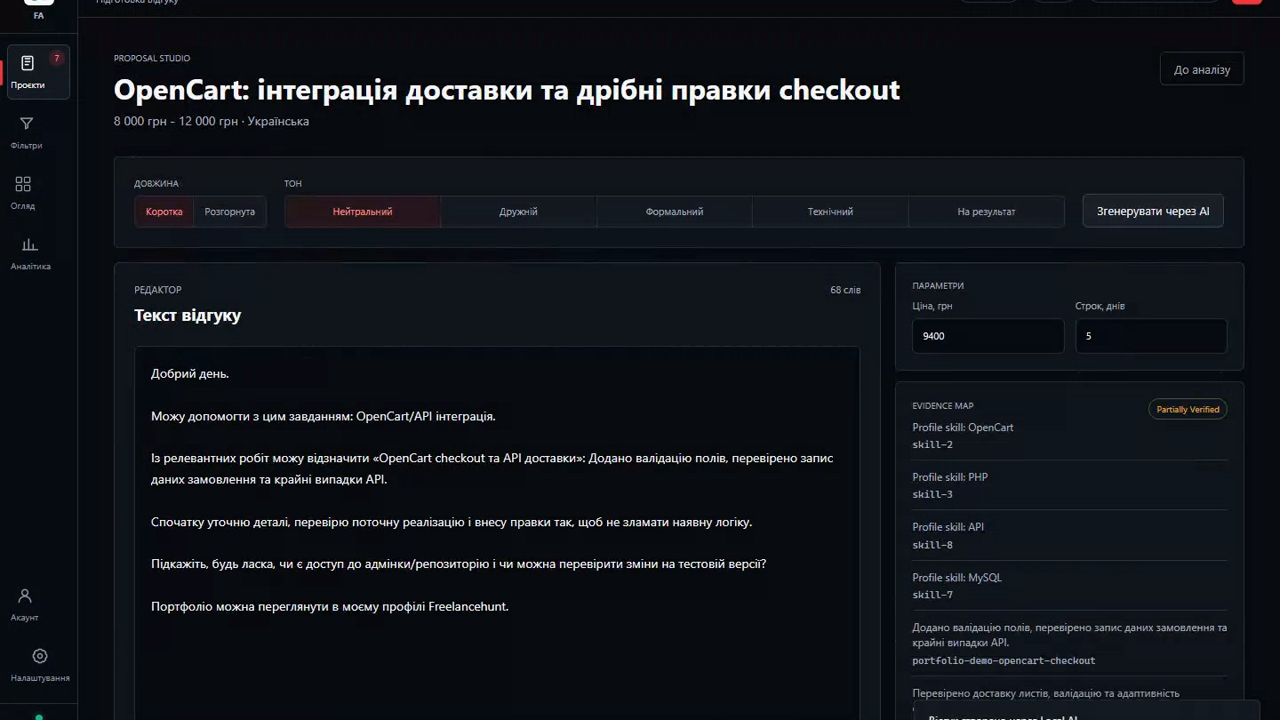
Proposal Copilot turns freelance projects into an explainable decision workspace. It filters projects, scores fit across visible factors, detects risks and unrealistic budgets, recommends Apply, Clarify, Save, or Skip, and generates an editable proposal in the client's language.
Every claim is linked to confirmed freelancer evidence. Unknown information is shown as uncertainty instead of being invented. External actions always require explicit human confirmation, with duplicate-submit protection and an audit history.
The demo includes three scenarios: a strong fit, a suspicious project that should be skipped, and a project that needs clarification.
How I built it
The product is a local-first Node.js web application with SQLite persistence. It includes a structured OpenAI Responses API integration with runtime validation, safe error handling, bounded retries, backend-only secrets, and GPT-5.6 model support.
For the public demo, I use an explicitly labelled deterministic Local AI mode. This makes the walkthrough reproducible without pretending that a paid API response is live. Codex was used for architecture, implementation, UX, security review, testing, documentation, and final regression fixes.
Challenges
The hardest part was preserving trust. AI must not invent portfolio evidence or hide uncertainty. Deterministic safety rules can override an optimistic recommendation, and live submissions remain blocked until the user reviews and confirms the proposal.
What I learned
The most useful AI behavior is sometimes refusal or a good question. Explainability must be part of the whole data model, not just an extra panel added after generation.
Accomplishments
- Explainable fit scoring with ten visible factors
- Risk detection and price recommendations
- Evidence-grounded proposal generation
- Client-language drafts with review and preview
- Human confirmation before external actions
- Duplicate-submit protection
- 50 automated tests and 28 visual checks passing
What's next
The next step is a small private beta with real freelancers, outcome tracking, more marketplace connectors, multi-user isolation, and a live GPT-5.6 evaluation when API billing is available.
Built With
- codex
- css
- freelancehunt
- gpt-5.6
- html
- javascript
- node.js
- openai-responses-api
- playwright
- sqlite


Log in or sign up for Devpost to join the conversation.