-
-
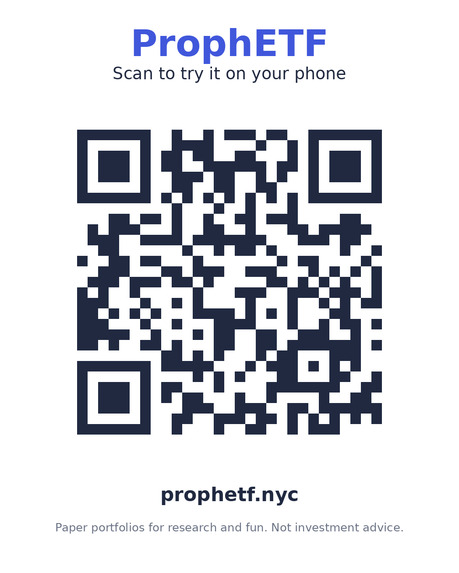
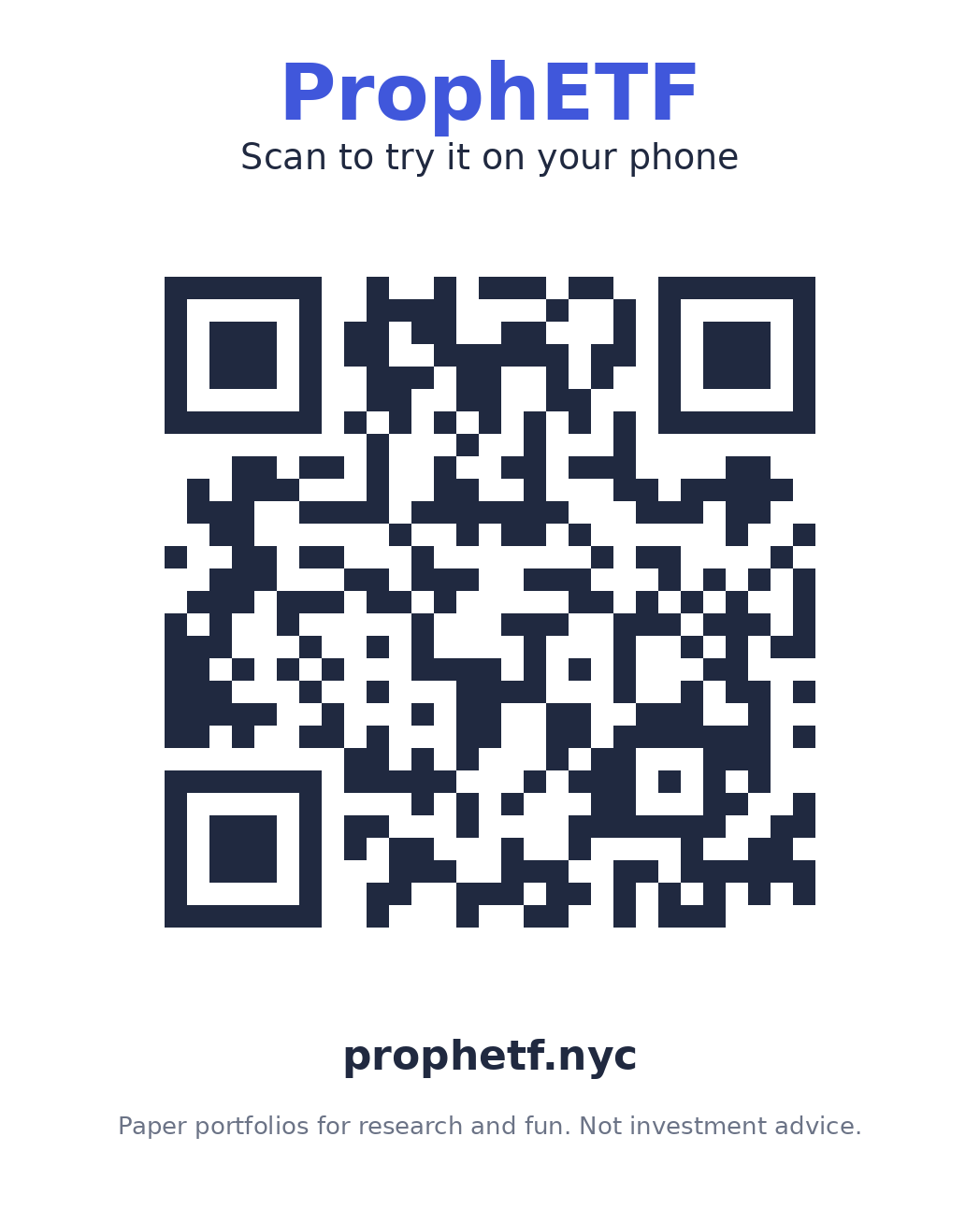
website QR code
Inspiration
Prediction markets like Polymarket put a live price on world events: a Taiwan crisis, a Fed rate cut, a Ukraine ceasefire. Stock investors talk about these events constantly, but almost nobody connects the two. We wanted a tool where you type an idea in plain English ("AI chips and Taiwan risk") and get a stock basket built around those event odds. Then we asked the question most AI finance demos skip: is the AI actually right?
What it does
Try it live at prophetf.nyc.
- Idea → basket. A Gemini agent turns your idea into 3 stocks from a 40-stock universe, using the live Polymarket odds for the events your idea touches.
- Asks when it doesn't understand. If an idea is unclear, too broad or outside what we cover ("car", "I don't know"), it stops and offers 2–3 clickable options instead of guessing.
- Weights from real odds. The basket's percentages tilt as the linked Polymarket odds move, and you can see which market moved each stock and what happens to the basket if each event does or doesn't happen.
- A panel of 5 AI agents (Growth, Value/risk, Macro & events, Skeptic, Fit checker) votes on every stock and on one forecast: "Will this basket beat the S&P 500 next week?"
- An honest track record. We replayed the panel on 8 past weeks using only the data available on each date and scored 80 decisions against the S&P 500. Result: the panel was right 50% of the time, no better than a coin flip, and the site says so next to every vote.
- Paper-trading Lab. Send your basket to the Lab, buy and sell with paper money, and drag an event's odds on a slider to see how your basket might react.
How we built it
- Google Gemini (Flash-Lite) powers the stock agent (function tools, session memory, structured output) and the 5-agent panel. Each task has a fallback chain of models with per-model budgets, so we stay inside the free tier.
- Tiger Data (TimescaleDB on PostgreSQL) stores Polymarket odds every minute in a hypertable with hourly continuous aggregates, plus daily stock closes, every panel decision and its outcome, the answer cache, agent memory and API budgets. The track record is scored in plain SQL.
- GoDaddy Registry gave us our home on the web: prophetf.nyc, a .nyc domain for a tool built around Wall Street's favourite question, connected to our Vercel deployment with HTTPS.
- Polymarket and Kalshi public data (read-only, no keys) for odds and odds history; Yahoo Finance daily closes for scoring.
- Next.js and TypeScript on Vercel for the website and API; cron-job.org calls our odds job every minute; GitHub Actions runs the tests on every pull request.
- Python (FastAPI) for the research and the weighting method, ported to TypeScript and checked against the Python reference on 88 requests.
- Claude Code helped us write and test most of the backend, the agent and the website.
Challenges we ran into
- Free-tier limits. Some Gemini models allow only 20 requests a day. We added model fallback chains, per-model budgets tracked in Tiger, and a cache that keeps an answer until the Polymarket odds behind it move 3 points. A new idea usually costs 2 calls; repeats cost none.
- Nonsense input. At first the agent had to return 3 stocks for anything, even "banana dance". We made it judge clarity first and ask instead of guessing.
- Hindsight in the replay. To grade the AI fairly, we only replayed weeks after the models' release dates, ran a leak check, and gave the agents only the odds and prices known on each date.
- Connecting four people's work (agent, weights, framework, Lab) into one live site in 36 hours, then moving it to our own .nyc domain on the last night without breaking the old link.
Accomplishments that we're proud of
- An AI that publishes its own scorecard, even when the score is a coin flip.
- Answers grounded in live market data: the server, not the AI, writes every odds number, so nothing is made up.
- A clarify flow that turns "I don't know" into a useful question.
- Everything runs on free tiers, with live numbers on the How it works page, at a real address judges can scan with a QR code: prophetf.nyc.
What we learned
- Hao's event study (61 large Polymarket odds moves on 58 dates, 2023–2026) found that linked stocks moved the predicted way on the same day 69% of the time (+59 basis points, p = 0.002 against random dates). But there was no reliable edge the next day or the next week. Prediction markets are a strong real-time read on event risk, not a crystal ball.
- Measuring an AI is more convincing than trusting it: our panel sounded confident, and the data showed it was guessing.
- Small engineering choices (caching, fallbacks, asking instead of guessing) matter more on a free tier than a bigger model.
What's next for ProphETF
- Keep scoring live decisions every week, so the track record grows and the ranges get tighter.
- Add more of the stock market (carmakers, airlines, retail) so fewer ideas need clarifying.
- Alerts when an event behind your basket suddenly moves.
- Use the track record to weight each agent's vote, and drop agents that never beat a coin flip.
Paper portfolios for research and fun. Not investment advice. Not affiliated with Polymarket or Kalshi.
Team: Lucas (backend, AI agent, panel, track record, website) · Hao (Polymarket research, weighting method, event risk) · Shaun (framework and paper-trading Lab) · Kieran (website design)
Built With
- claude-code
- cron-job.org
- css
- fastapi
- github
- google-gemini
- html
- javascript
- kalshi-api
- node.js
- pnpm
- polymarket-api
- postgresql
- python
- sql
- tailwind-css
- tiger-data
- timescaledb
- typescript
- vercel
- vitest
- yahoo-finance
- yfinance
- zod

Log in or sign up for Devpost to join the conversation.