-
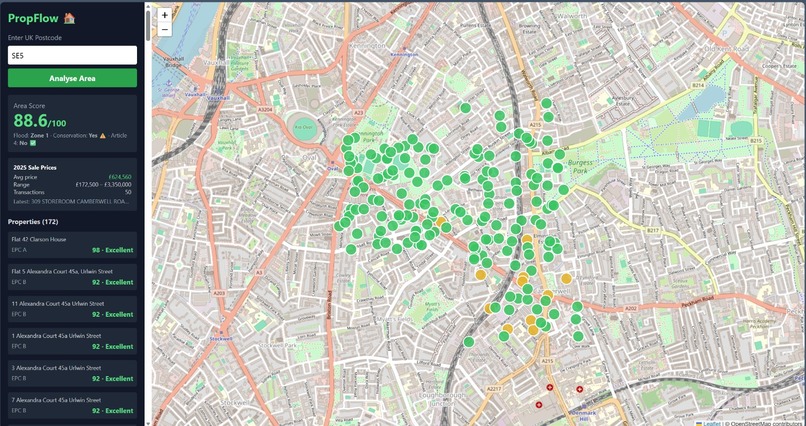
phase 4 (final)
-
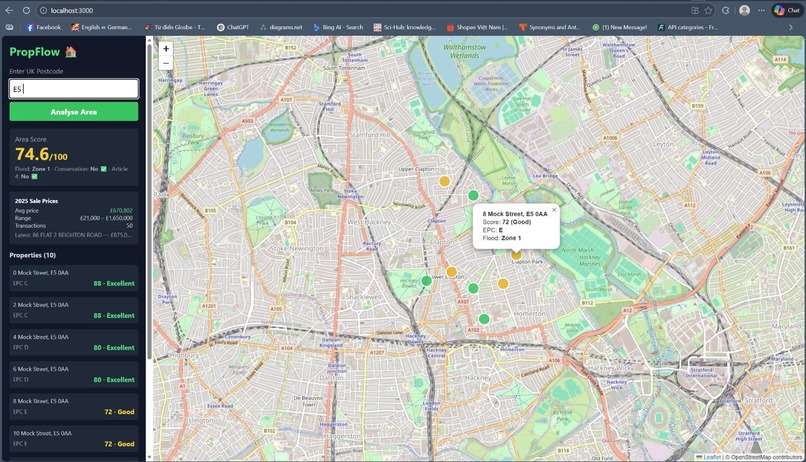
phase 3
-
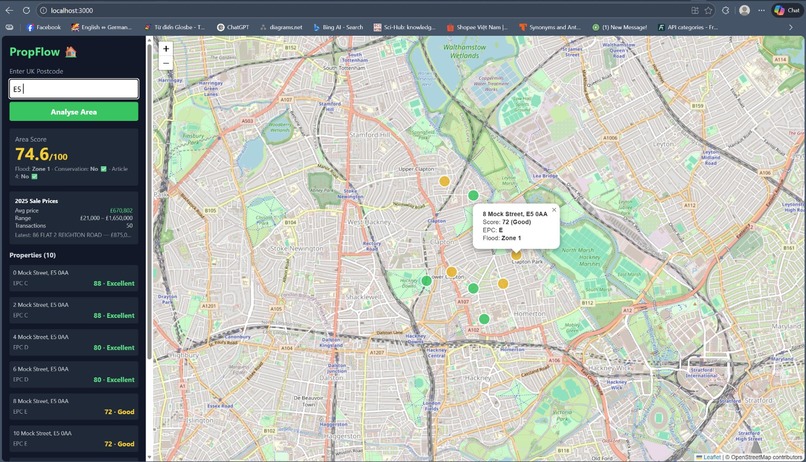
phase 2
-
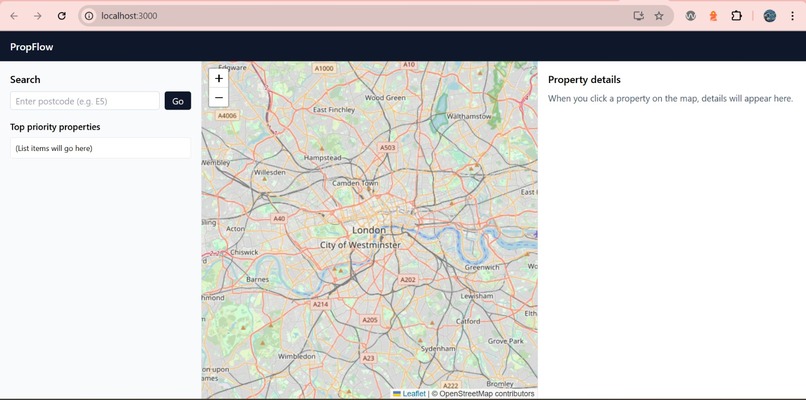
phase 1
Inspiration
Inspiration
The UK has a housing problem hiding in plain sight. 14 million homes sit below EPC Band C. A net zero target demands mass retrofit. And yet adoption is glacially slow.
We started asking why. The answer wasn't a lack of will or technology — it was a lack of actionable intelligence. The data exists: EPC ratings, flood risk, planning history, sale prices. But it's scattered across five government portals, incompatible in format, and impossible to act on without hiring a consultant.
We wanted to build the tool that makes that data speak. One postcode. One score. Instant clarity on where retrofit matters most — and why.
What it does
PropFlow is a three-layer retrofit intelligence platform:
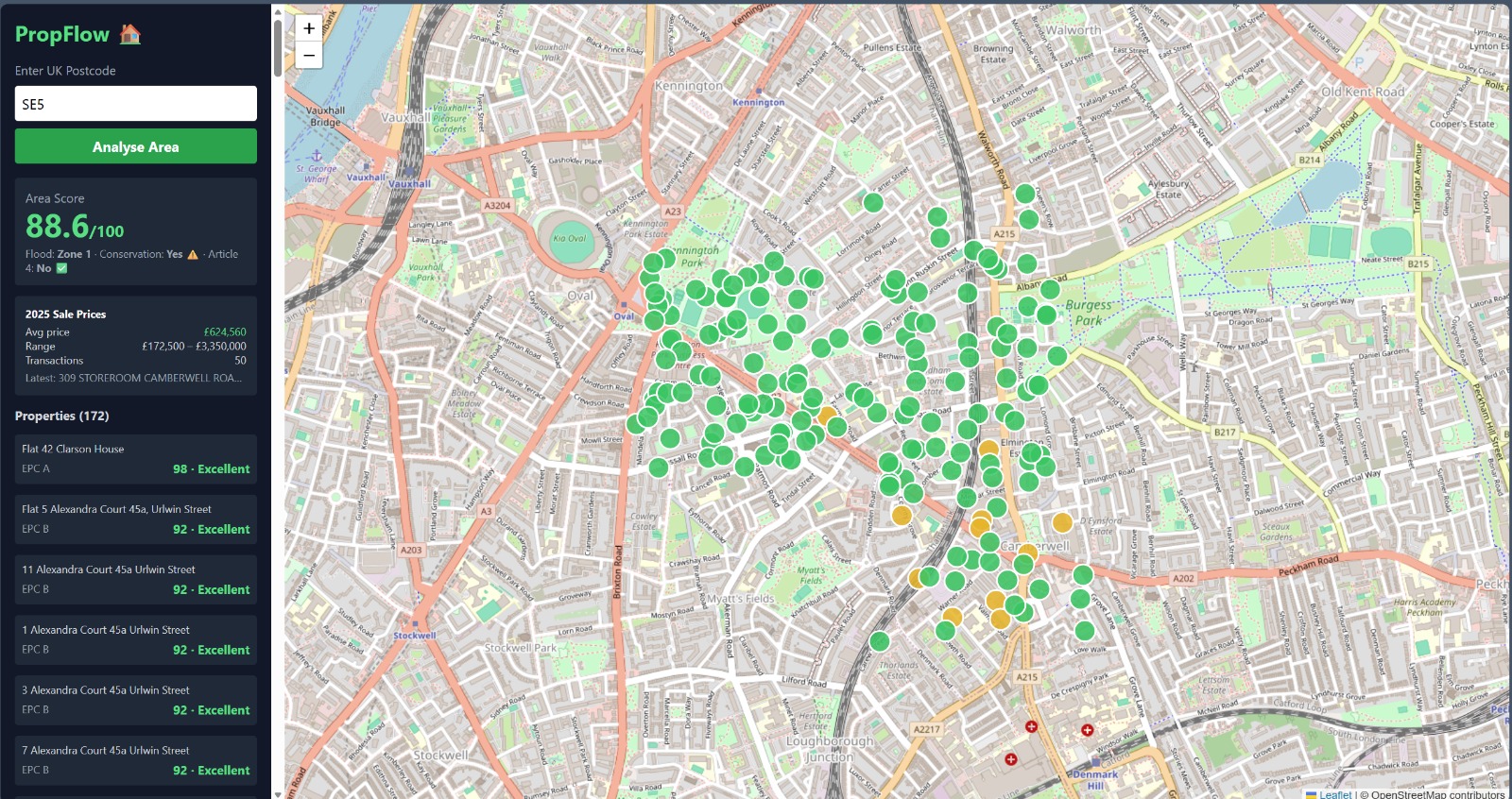
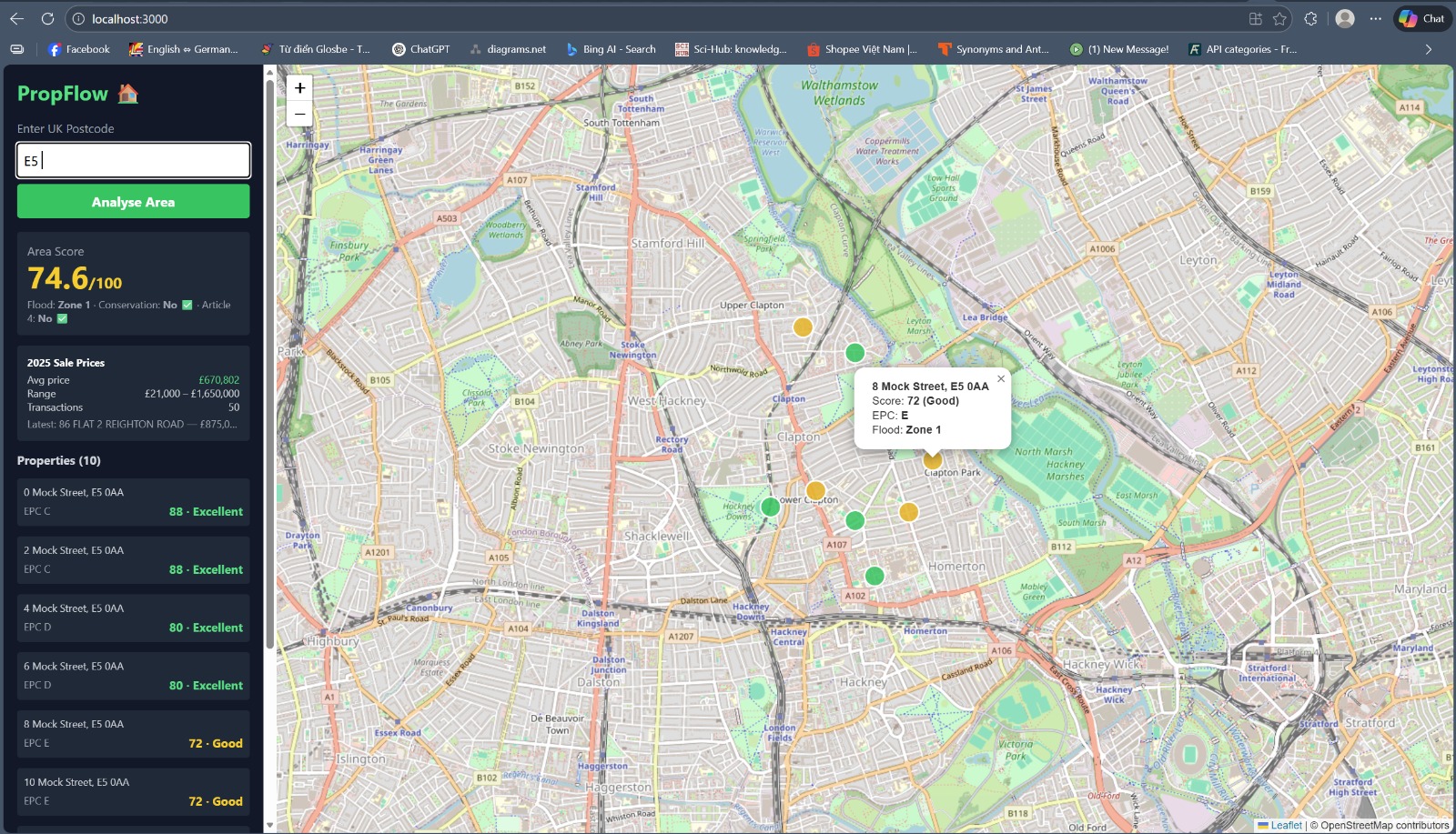
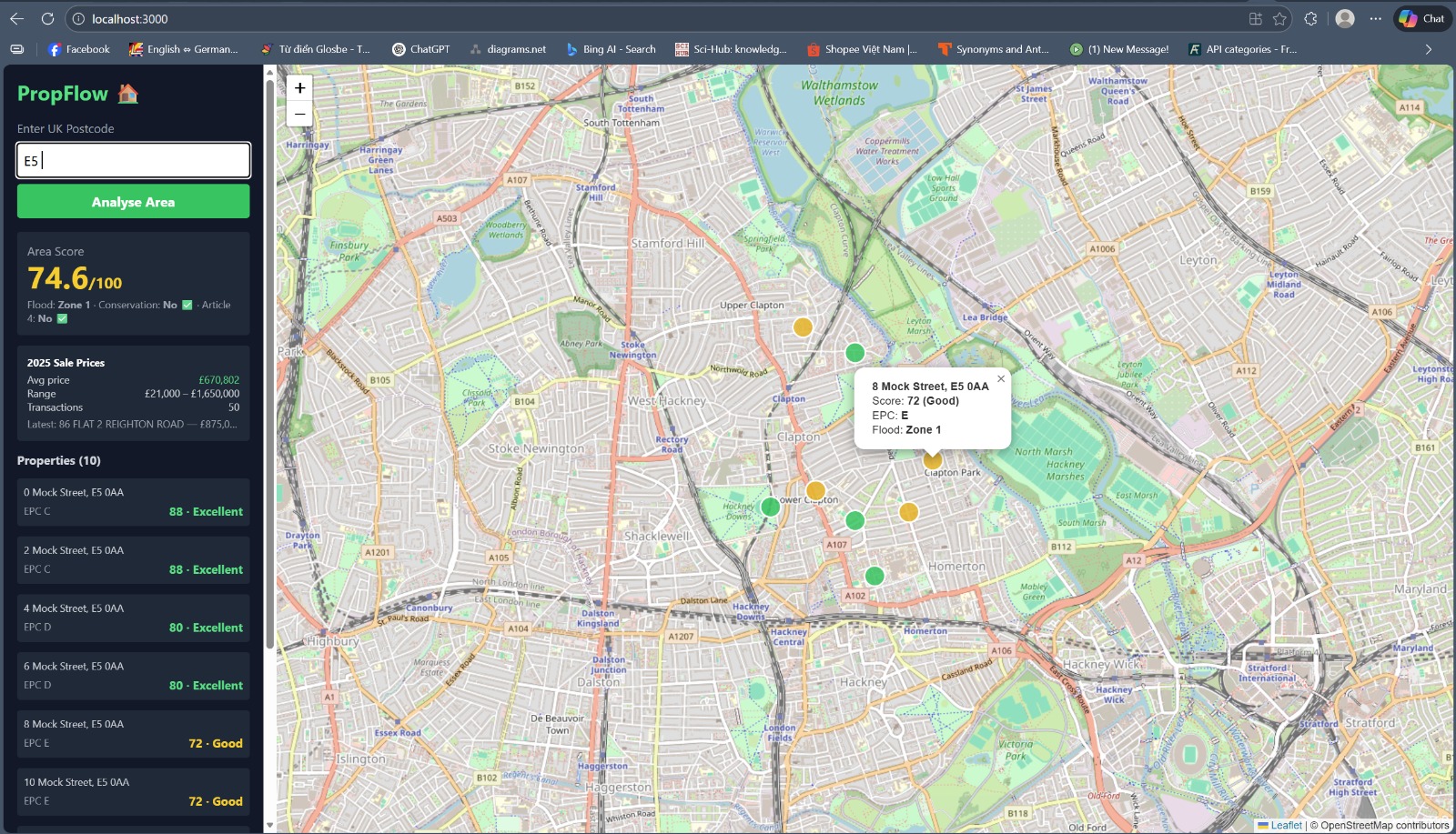
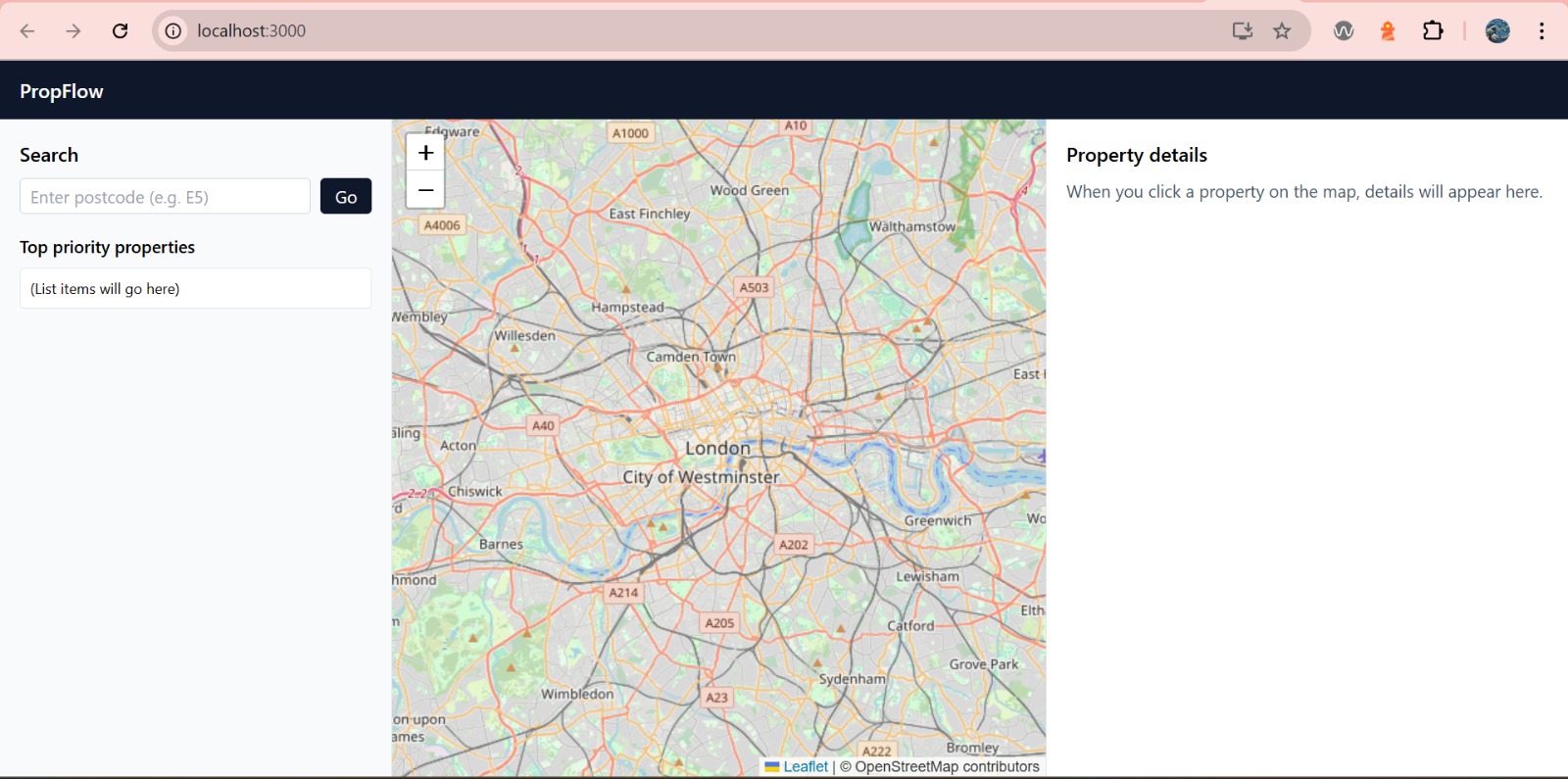
🔍 RetrofitIQ (built) — Enter any UK postcode and get an interactive map of real properties, each scored with a Retrofit Priority Score (RPS) built from live EPC ratings, flood risk zones, Land Registry sale prices, and planning constraints. Green = efficient. Red = act now.
📊 RetroROI (designed) — Property-level analysis engine. Quantifies estimated value uplift, annual energy bill savings, CO₂ reduction, and planning approval probability for any specific home.
📄 CarbonComply (designed) — Auto-generates a complete, blockchain-certified, planning-ready sustainability report. No consultant. No delay.
How we built it
PropFlow is a full-stack web application:
- Backend: FastAPI (Python) REST API
- Frontend: React.js with Leaflet.js for the interactive map
- Database: MongoDB for flexible storage of EPC, planning, and price data
- Data: Live calls to the MHCLG EPC Open Data API, HM Land Registry Price Paid dataset, and Environment Agency Flood Risk data
The Retrofit Priority Score is calculated as:
$$RPS = (0.35 \times E) + (0.25 \times F) + (0.20 \times P) + (0.20 \times H)$$
Where:
- $E$ = EPC inefficiency concentration (proportion of E/F/G rated properties)
- $F$ = Flood risk exposure (proportion in Flood Zone 2 or 3)
- $P$ = Price paid delta (deviation below area median — proxy for underinvestment)
- $H$ = Planning history friction (inverse of local authority approval rate)
RetroROI and CarbonComply are fully architecturally designed — RetroROI built around a machine learning model trained on Land Registry and EPC data, and CarbonComply using SHA-256 document hashing registered on an Ethereum-compatible blockchain for tamper-evident certification.
Challenges we ran into
EPC API inconsistency — Coverage gaps for non-residential and newly registered properties required a graceful mock fallback to keep the demo stable without surfacing false data
Scoring calibration — Getting the RPS weights to produce meaningful differentiation across diverse postcodes (inner-city new builds vs outer-London Victorian terraces) required real-world validation against known areas
22-hour scope discipline — We made the deliberate call to build one layer exceptionally well rather than three layers poorly. That decision was harder than it sounds under time pressure
Data heterogeneity — Joining EPC, flood risk, price paid, and planning data across inconsistent postcode formats and update frequencies required non-trivial normalisation logic
Accomplishments that we're proud of
A fully working, live prototype pulling real data from three government APIs simultaneously
Meaningful score differentiation across postcodes — the RPS correctly distinguishes Canary Wharf new builds (~88) from Leytonstone Victorian terraces (~62) without any manual tuning
Zero broken demos — the mock fallback means PropFlow never crashes, even on non-residential postcodes like Buckingham Palace (SW1A 1AA)
Designing a complete, coherent three-layer product vision end-to-end within the hackathon window
Building something that addresses a genuinely underserved real-world problem — not a toy dataset, real open government data throughout
What we learned
Open government data is powerful but messy — The UK's open data ecosystem is genuinely rich, but format inconsistencies and API reliability gaps mean defensive engineering is non-negotiable
Weighted scoring is harder than it looks — Building a composite score that is mathematically sound and intuitively meaningful to non-technical users requires careful calibration and real-world sanity checks
Scope discipline wins — Shipping one working, demo-ready layer beats three half-built ones every time
The problem is real — Working through the use cases during the build made us realise how genuinely underserved councils and housing associations are for data-driven retrofit tooling
What's next for PropFlow
Train RetroROI on the full Land Registry and EPC dataset for ML-grade value uplift and savings predictions
Build the first CarbonComply PDF reports with blockchain certification
Live Article 4 and Conservation Area boundary API integration
National rollout across all 333 UK local authorities
Open API for housing associations, estate agents, and mortgage lenders
Green mortgage eligibility scoring integrated with lender platforms
Built With
- ai
- blockchain
- claude
- css
- data
- environment-agency
- flask
- github
- google-gemini
- hm-land-registry
- html
- javascript
- leaflet.js
- libraries
- mhclg-epc-api
- ml
- mongodb
- npm
- open-government-licence
- platforms
- pydantic
- python
- react
- sources
- tools
- uvicorn
- vite


Log in or sign up for Devpost to join the conversation.