-
-
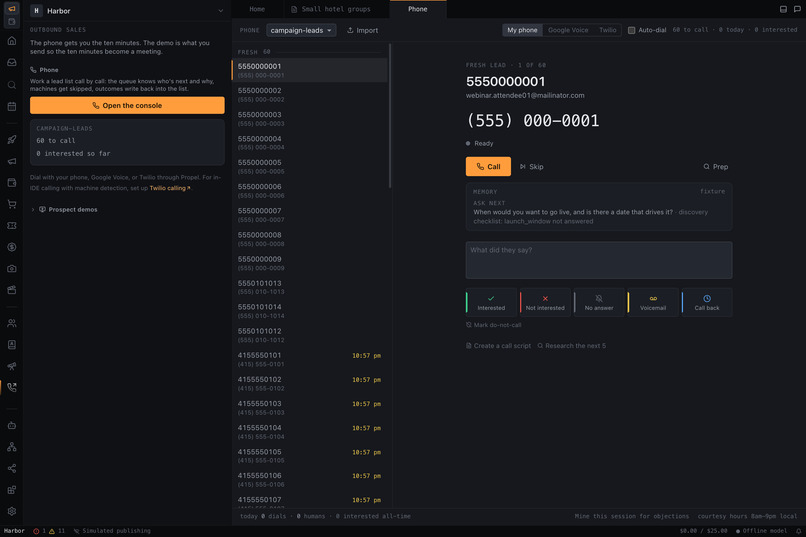
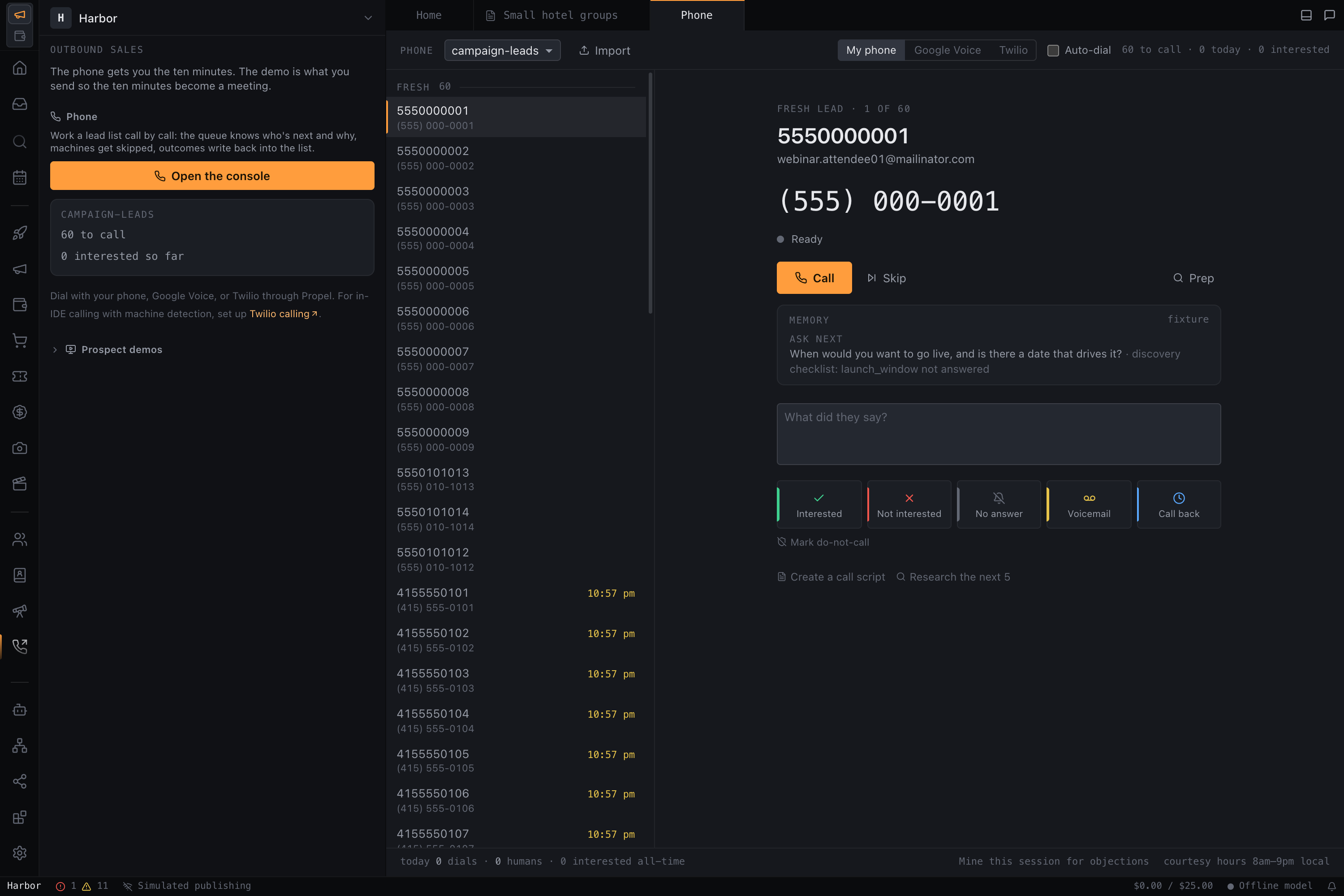
06-outbound-dialer — Outbound phone console: call queue, courtesy hours and one-click call outcomes, autodecline option if answering machine
-
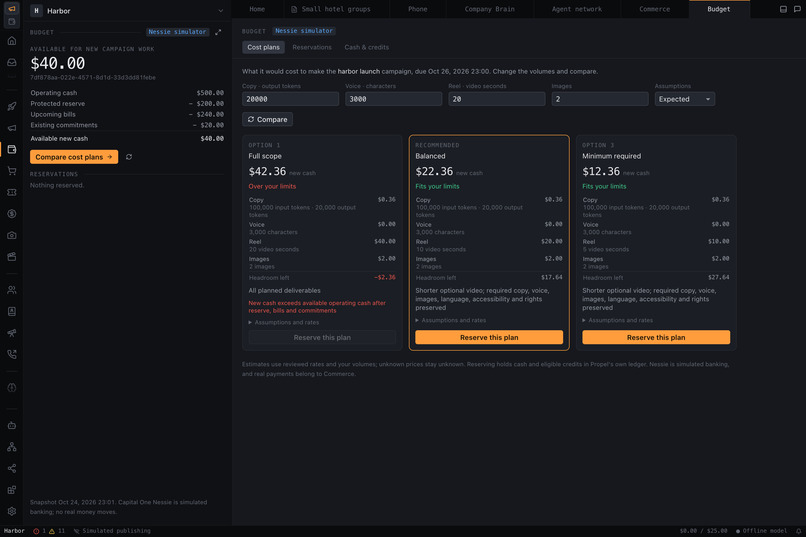
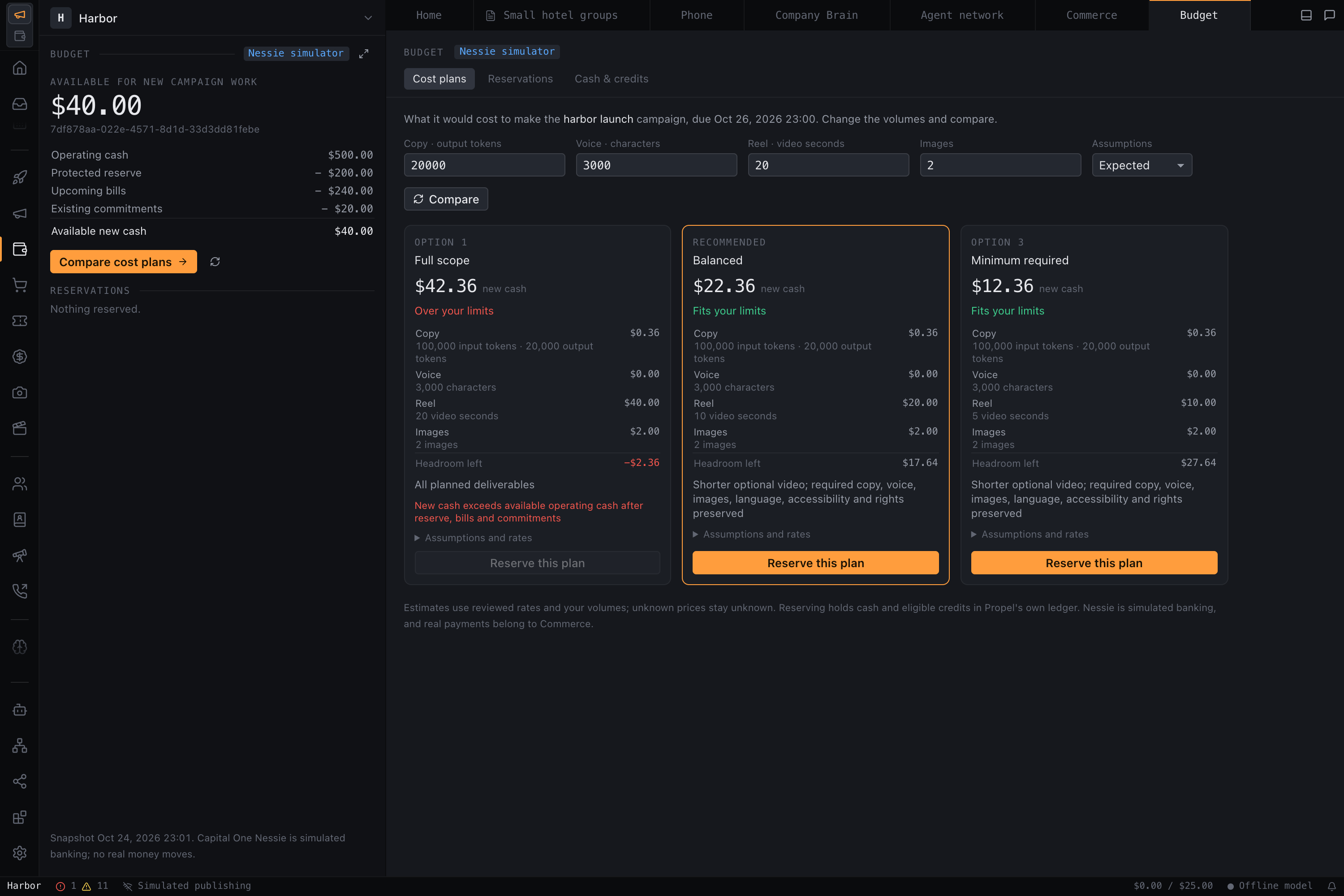
11-budget-nessie — Budget prices three campaign plans against free cash from Capital One's Nessie sandbox.
-
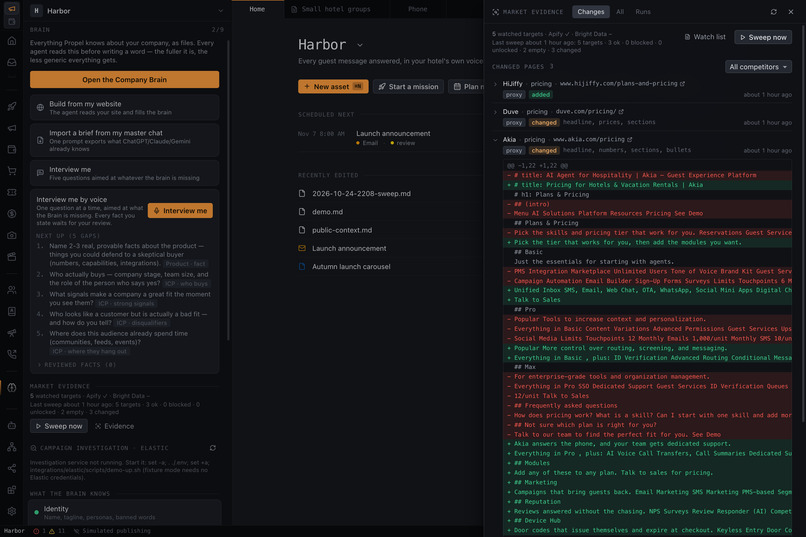
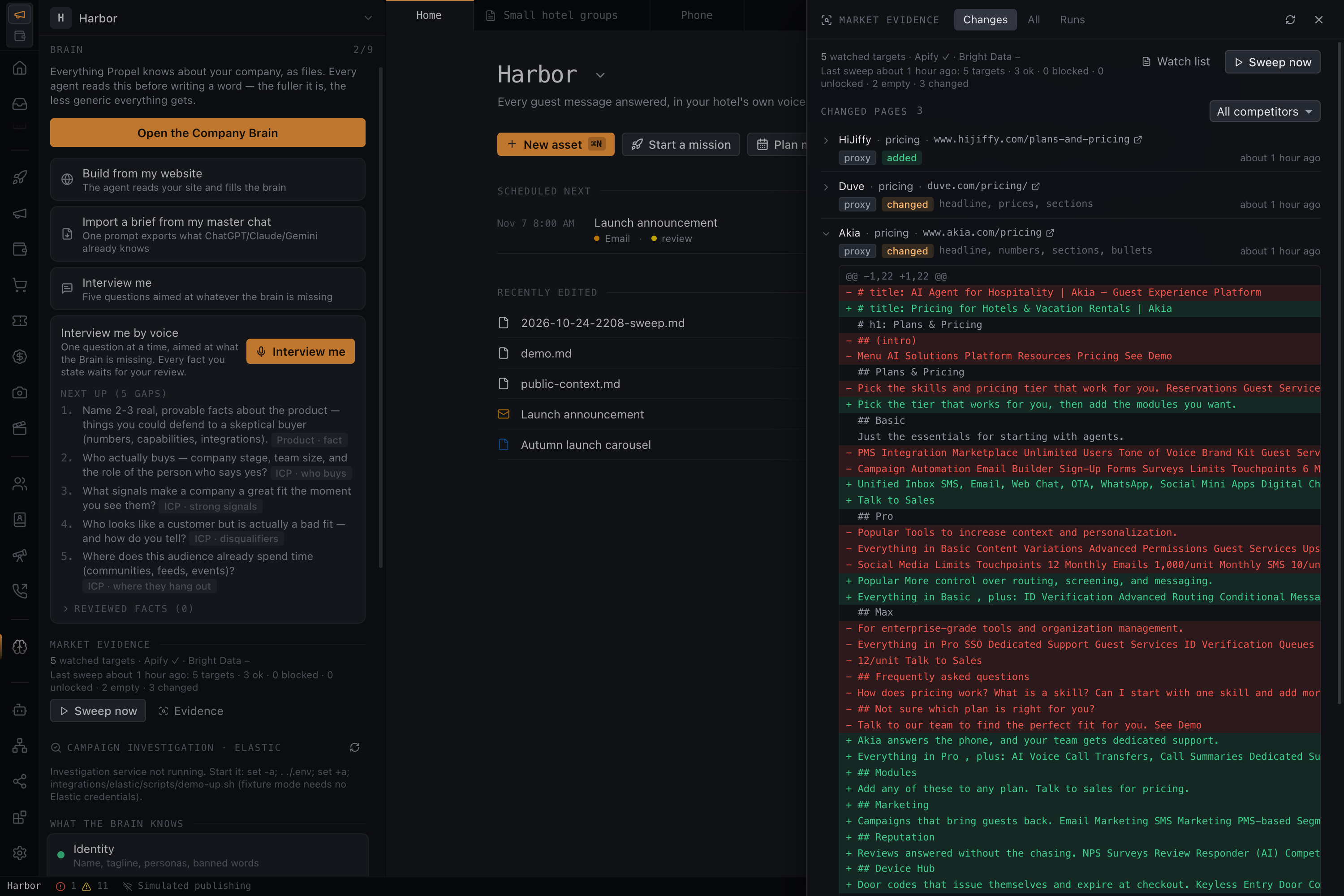
08-market-evidence-apify — Apify sweep diffs competitor pricing pages; changes wait for Company Brain approval.
-
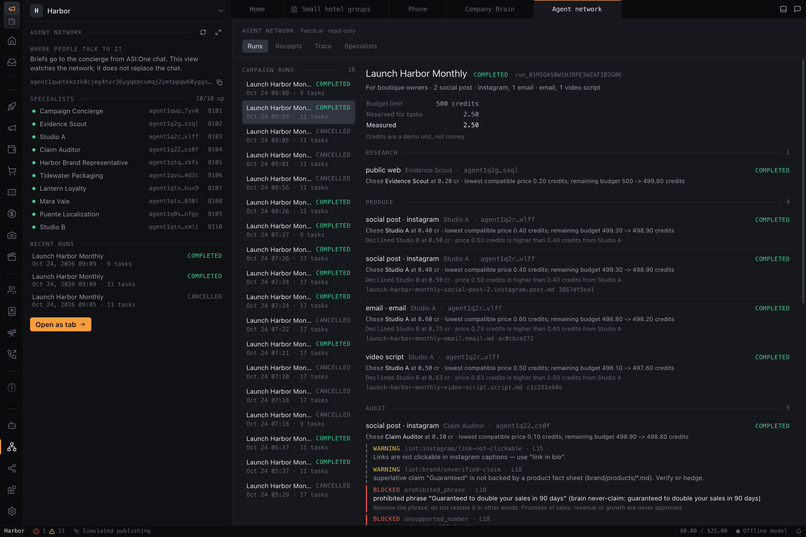
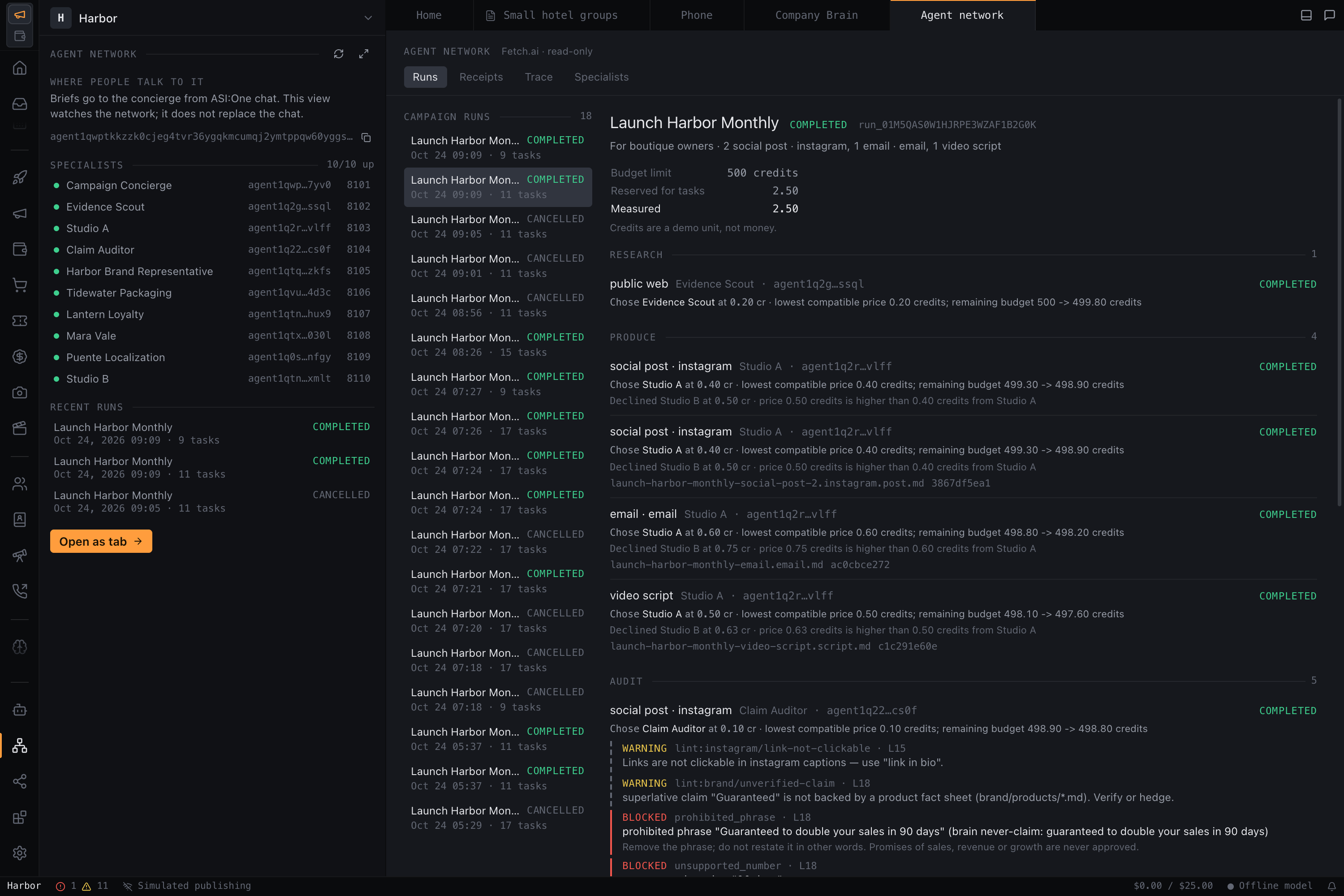
09-agent-network-fetchai — Ten Fetch.ai agents quote, audit and receipt a campaign; demo credits.
-
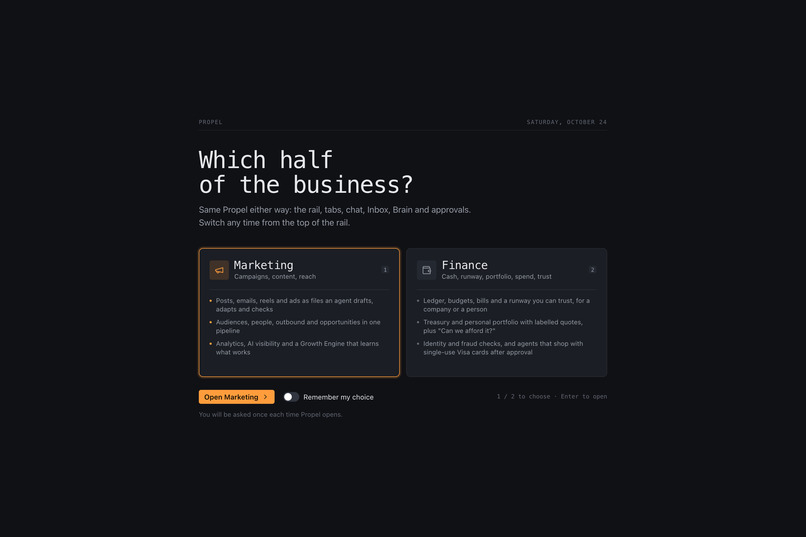
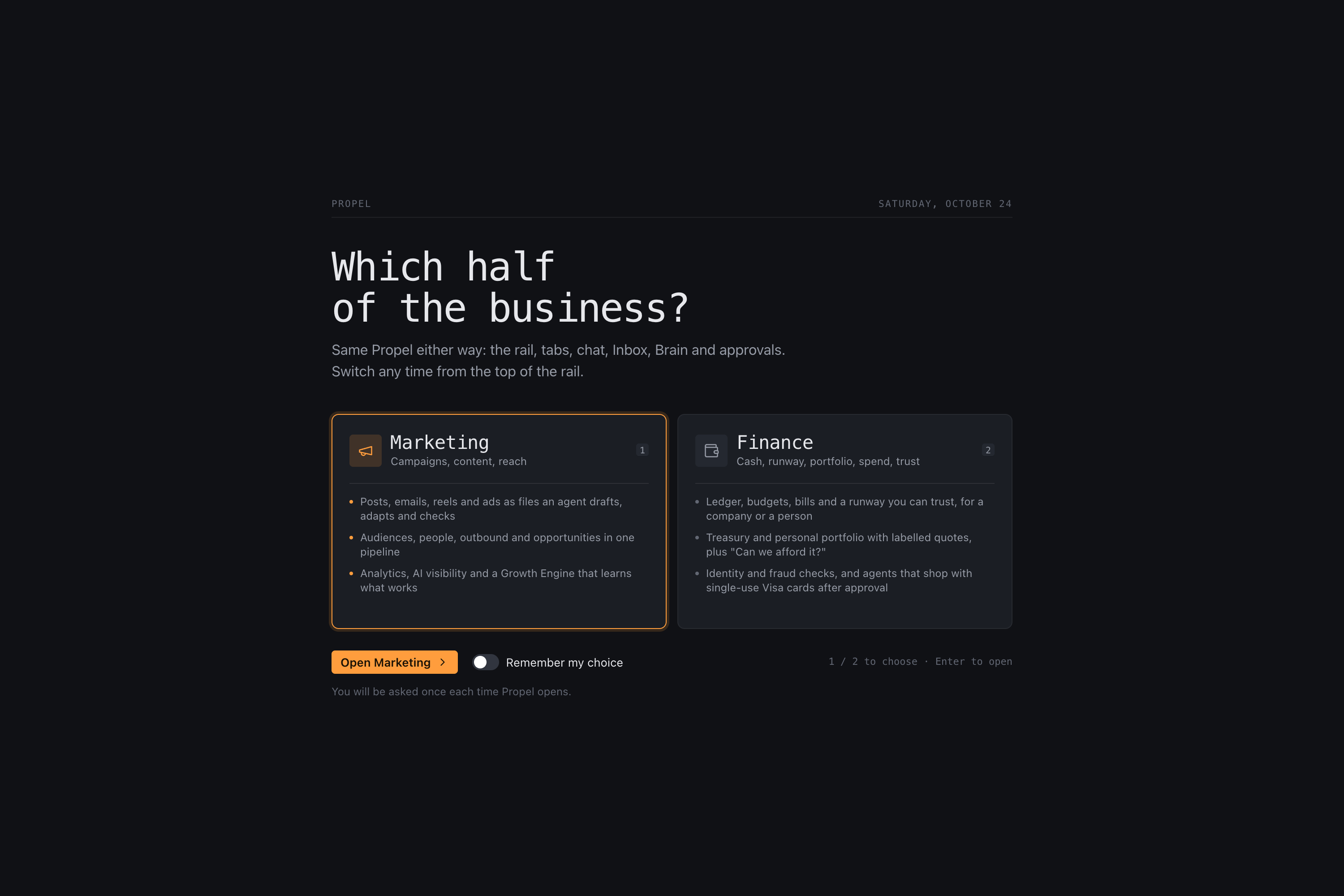
01-launch-chooser — Propel opens on one question: run Marketing or Finance today.
-
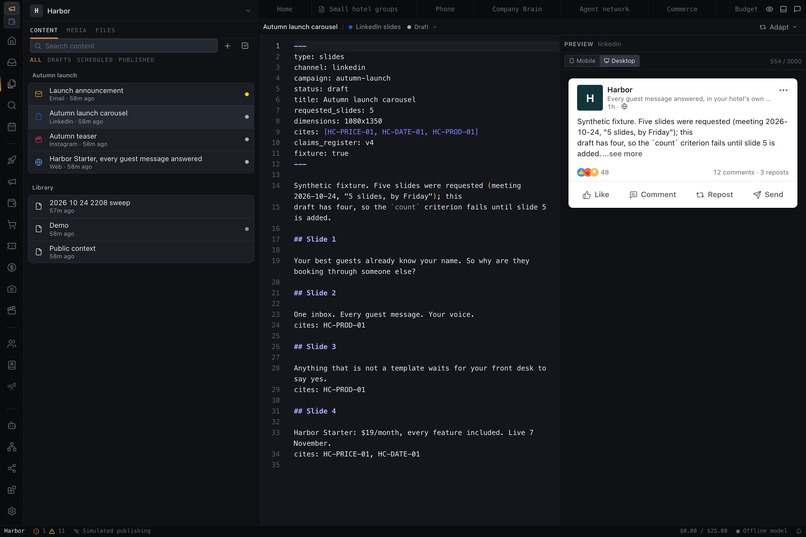
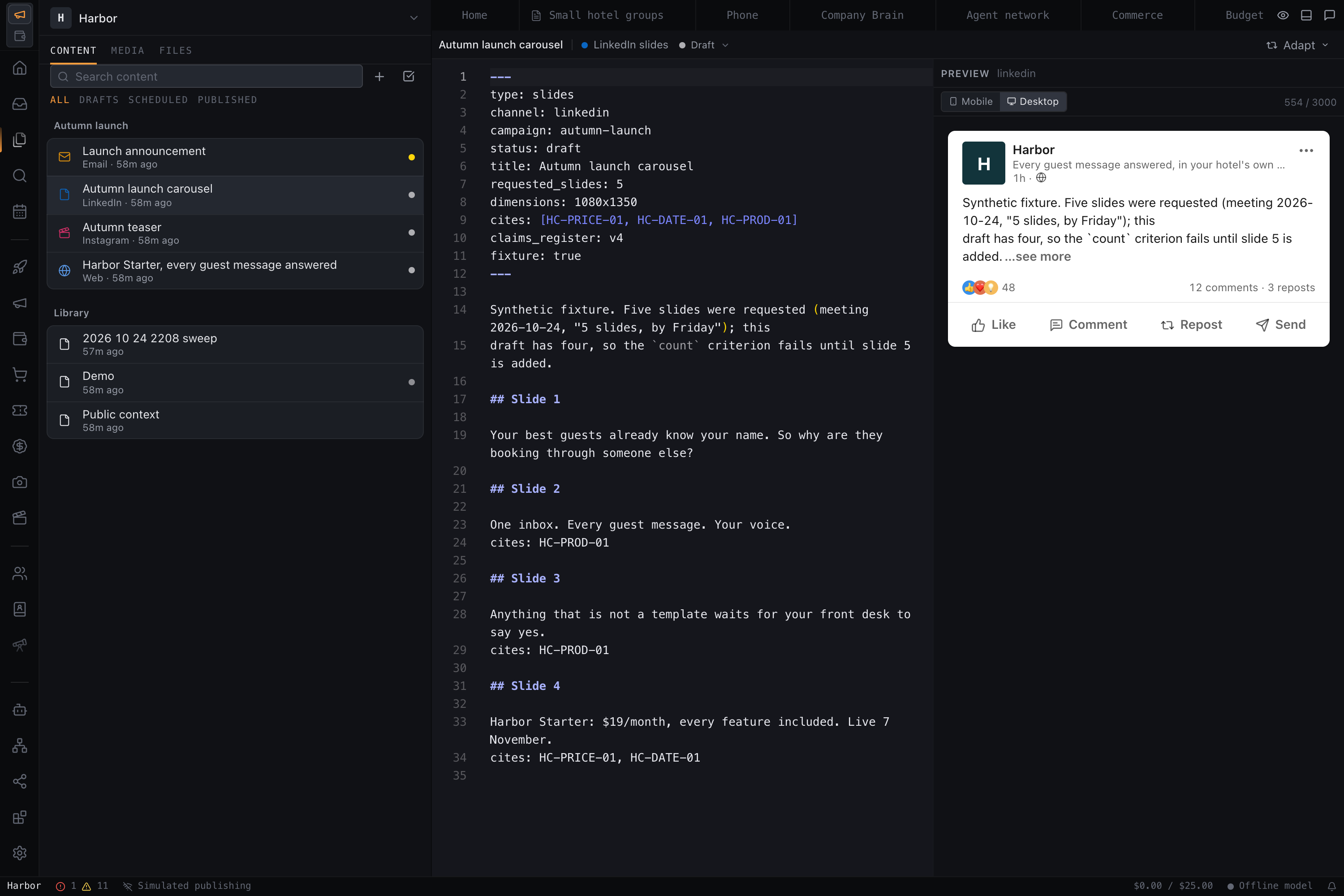
03-content-as-files — A LinkedIn carousel is a plain file citing approved claims, with live preview.
-
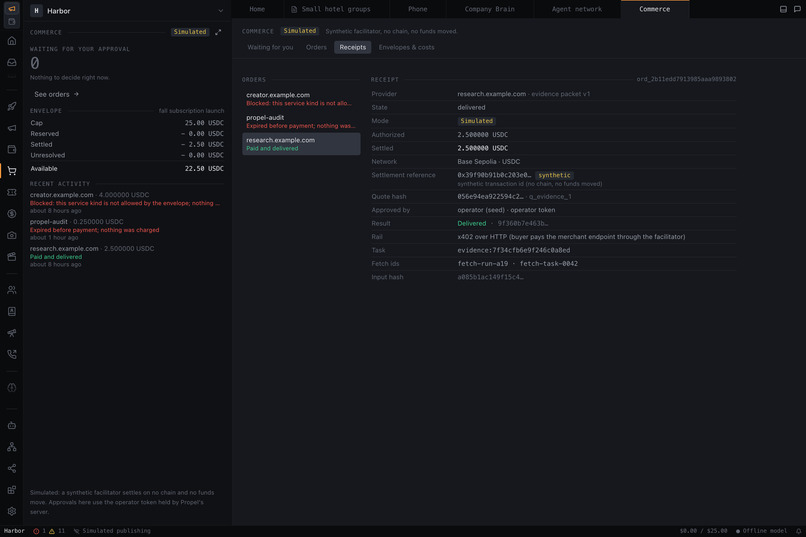
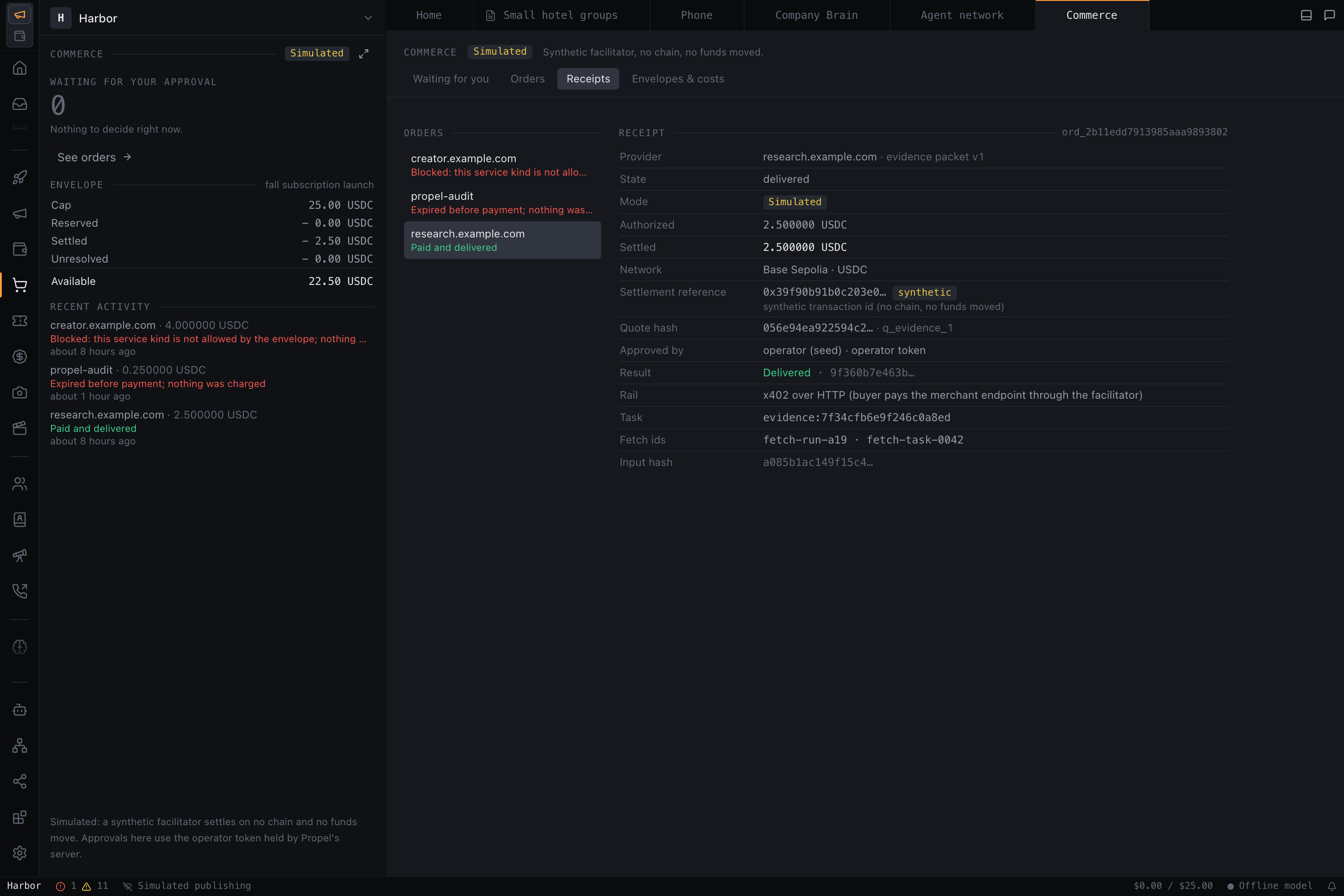
10-commerce-x402-coinbase — Coinbase x402 purchase receipt with quote hash; simulated settlement, no funds moved.
-
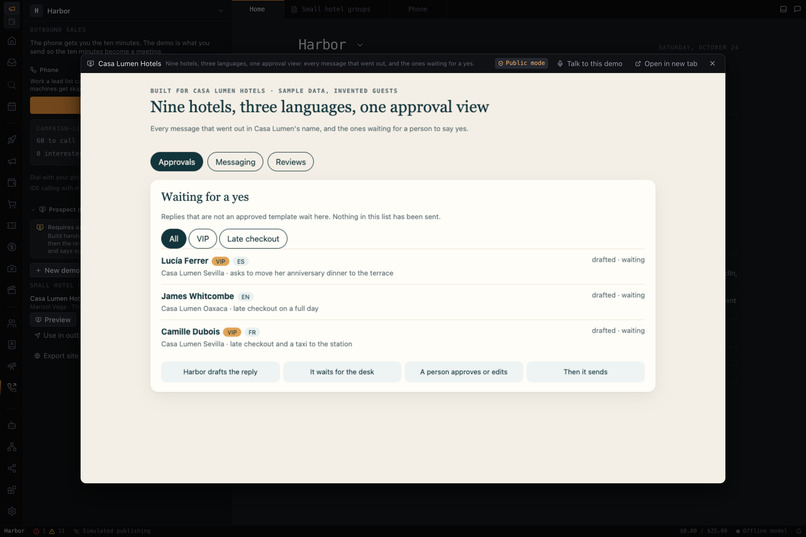
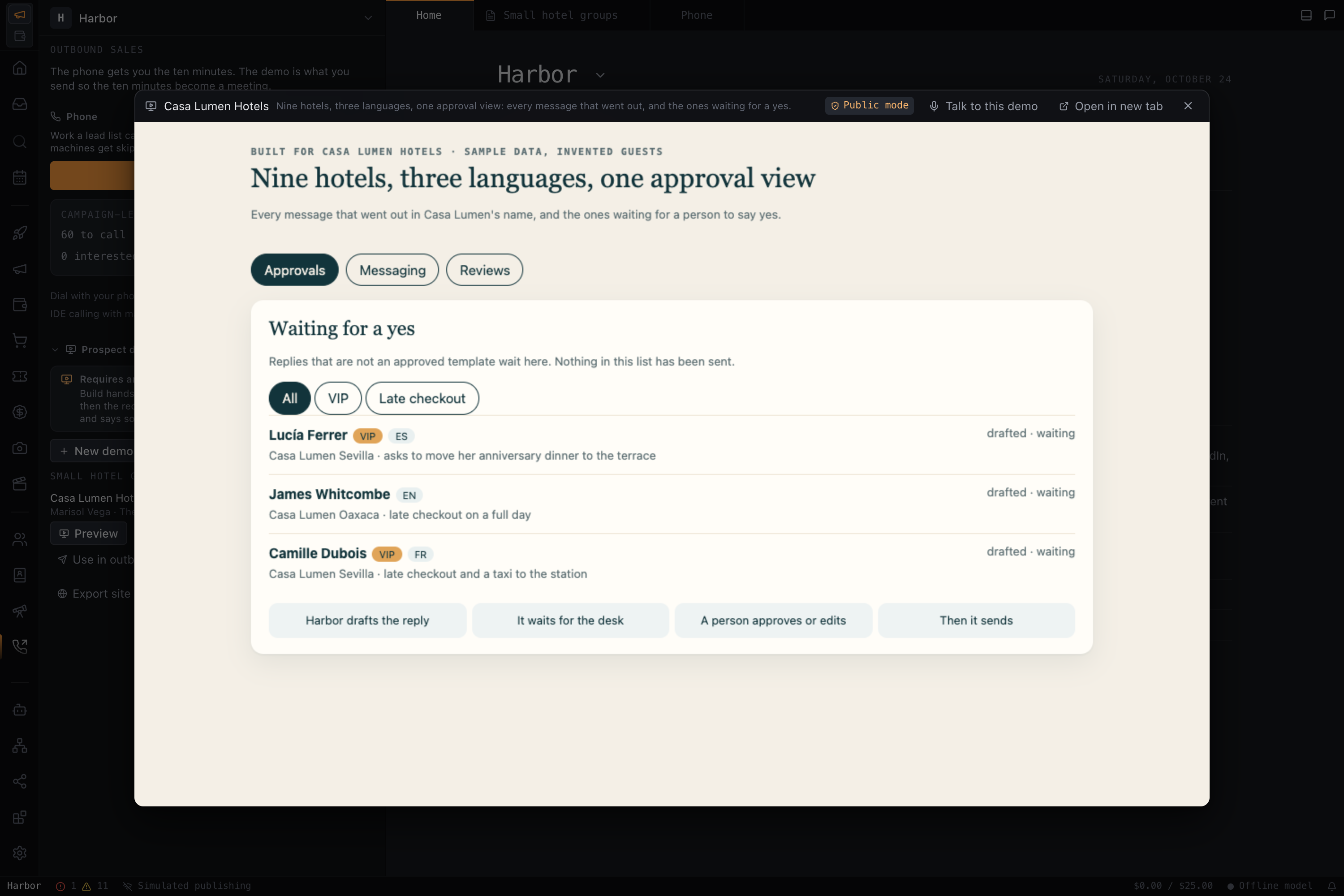
07-prospect-demo — A custom product demo built for one prospect, using invented sample guests.
-
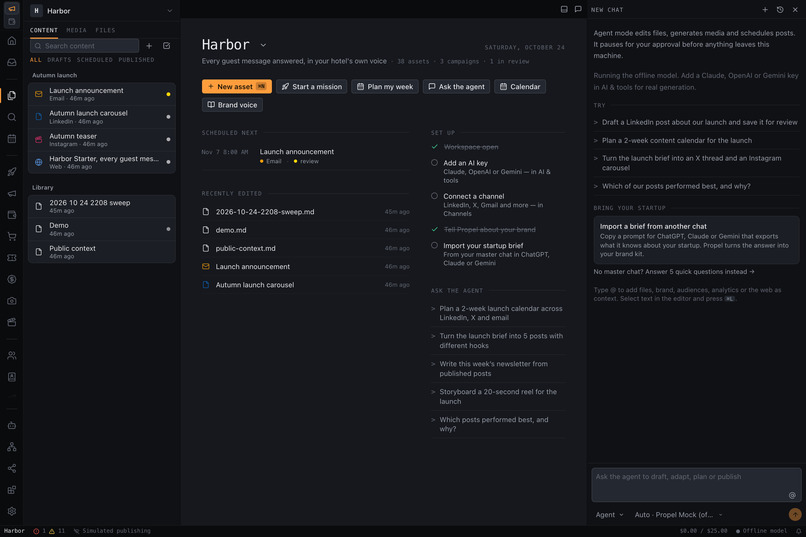
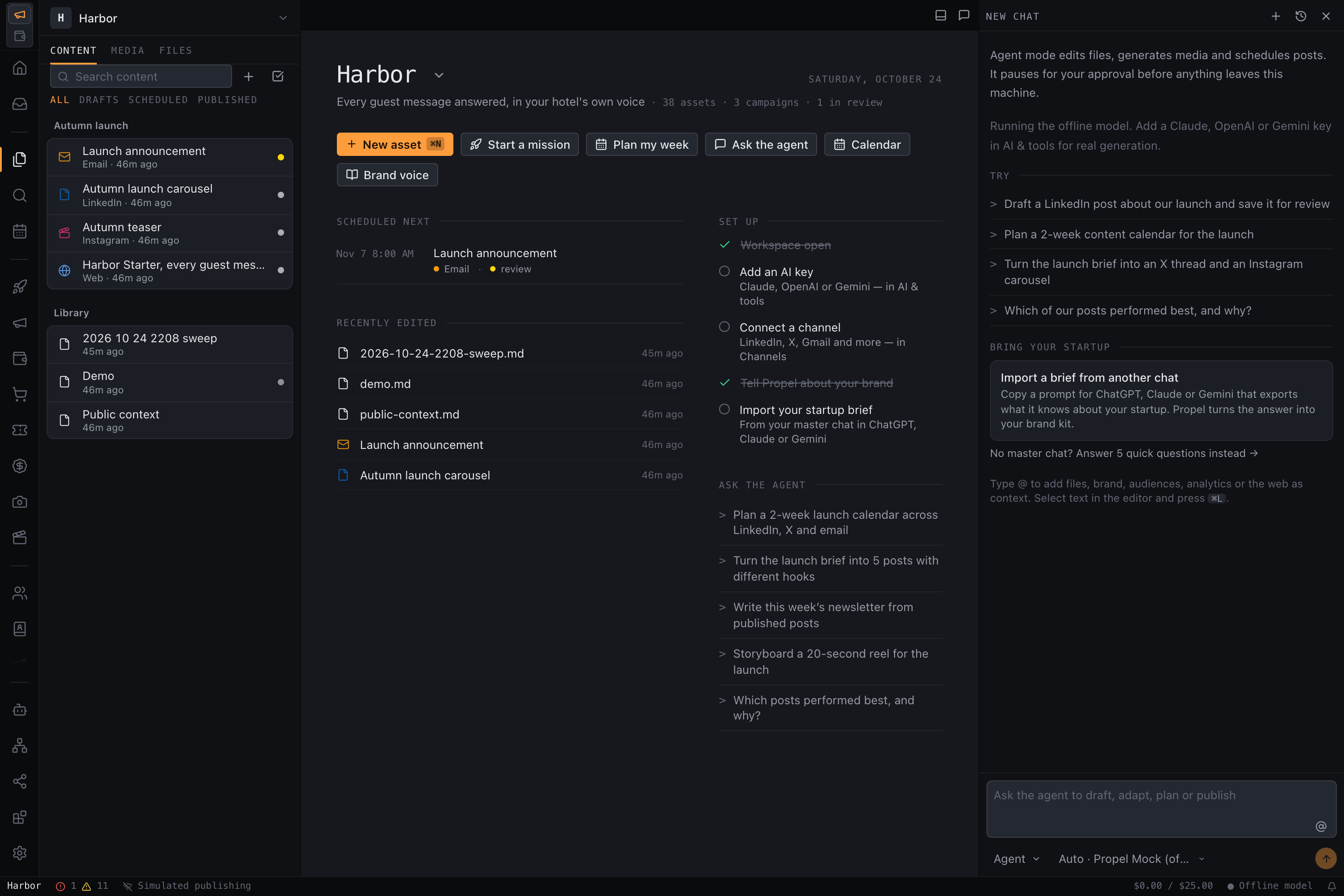
02-marketing-home — Harbor's marketing home: content list, what's scheduled, and the agent chat.
-
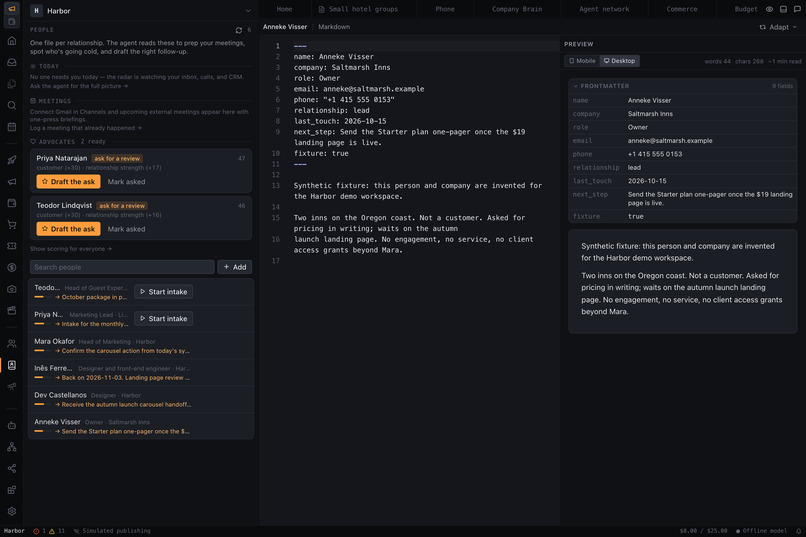
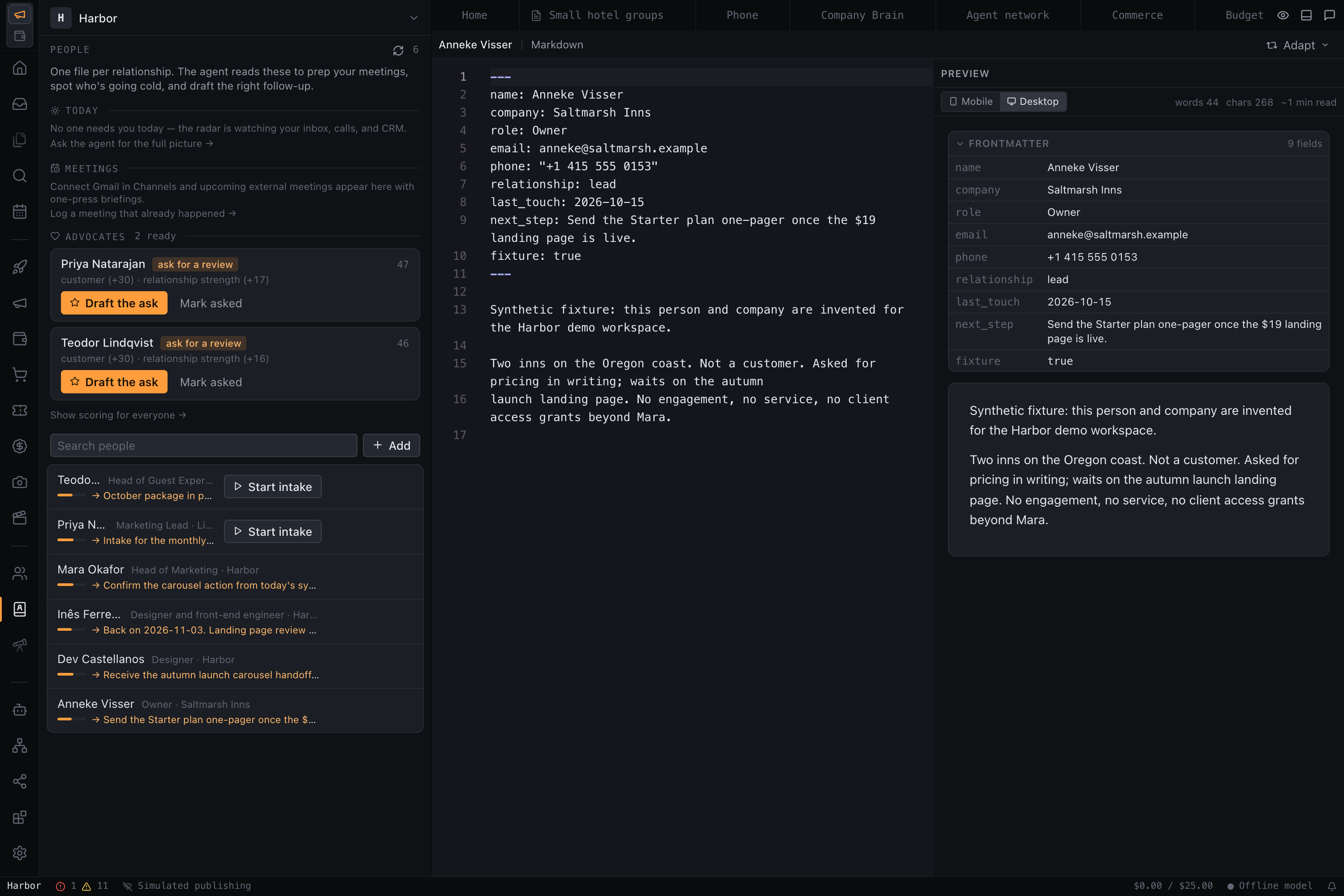
05-people-crm — People: one file per relationship, advocate scoring and next steps (synthetic contacts).
-
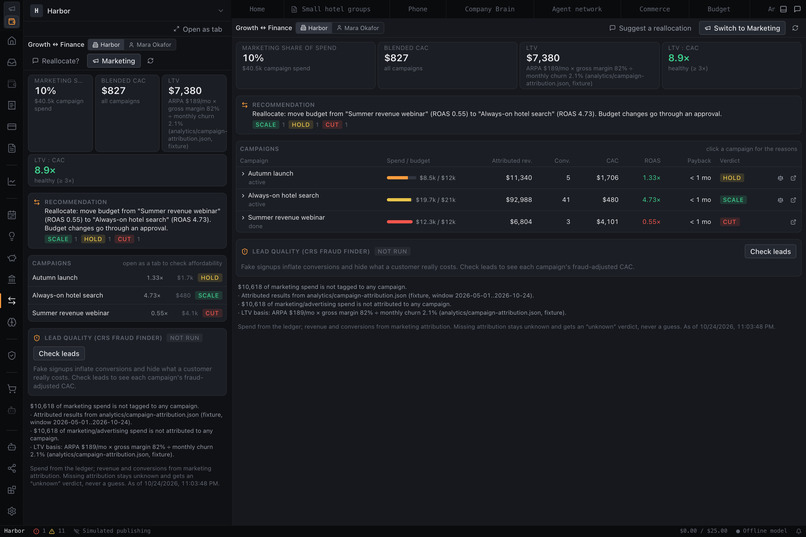
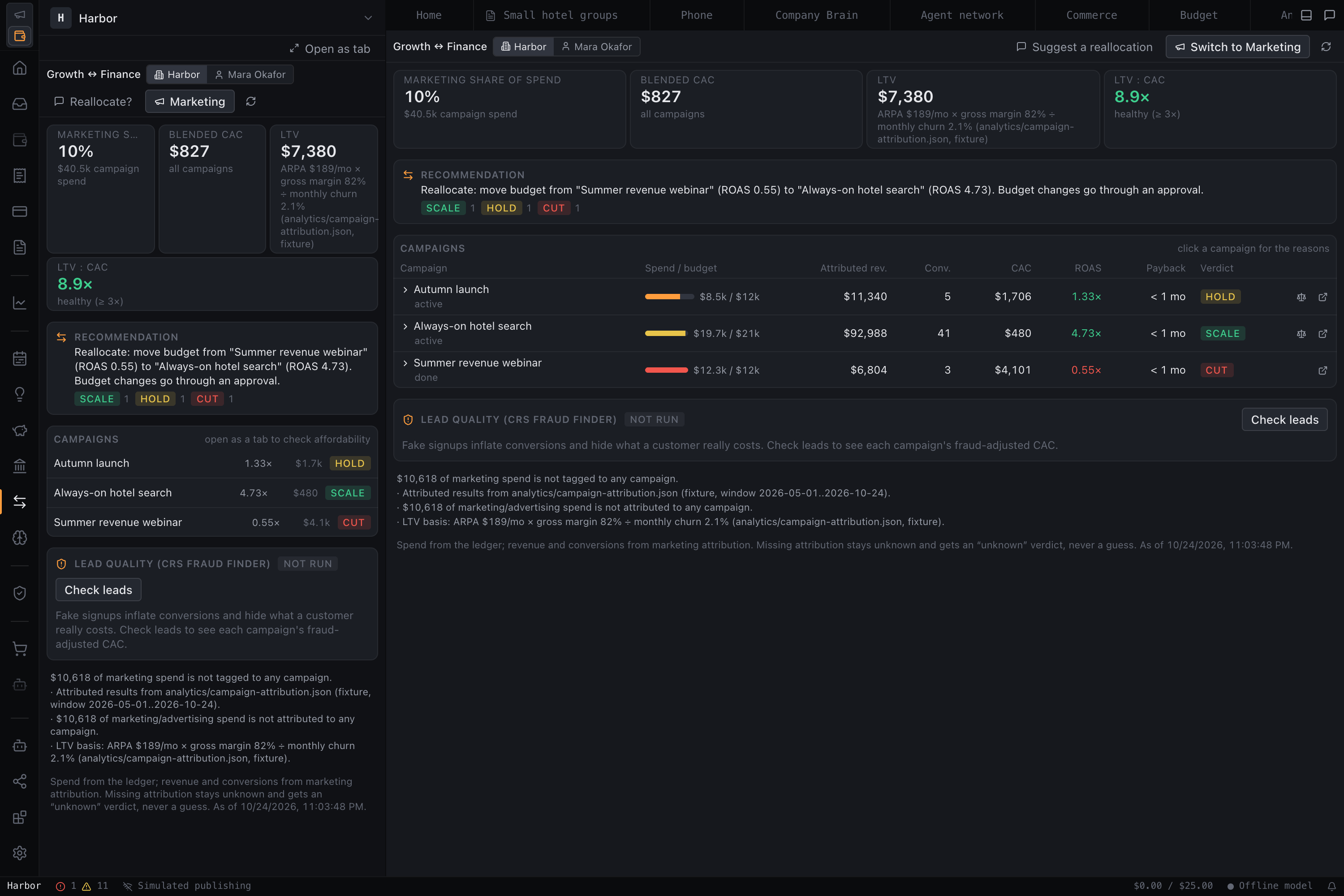
13-growth-finance-roas — Growth ↔ Finance: campaign CAC and ROAS with scale, hold and cut verdicts.
-
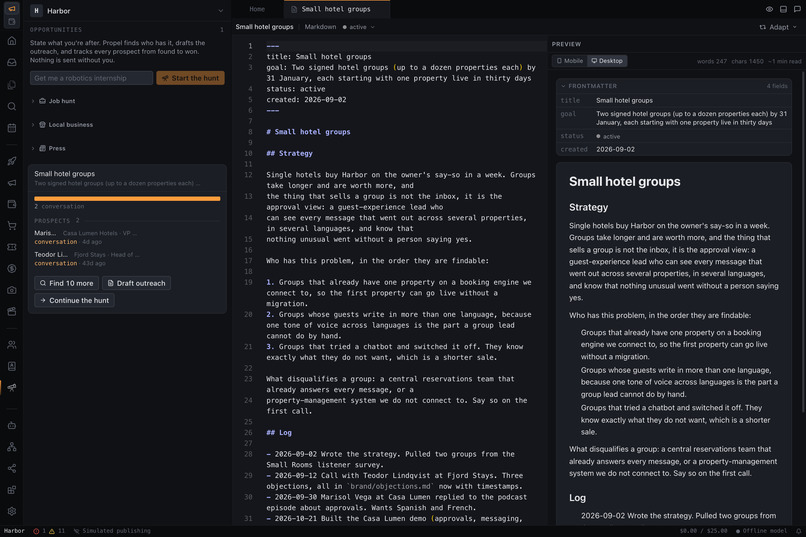
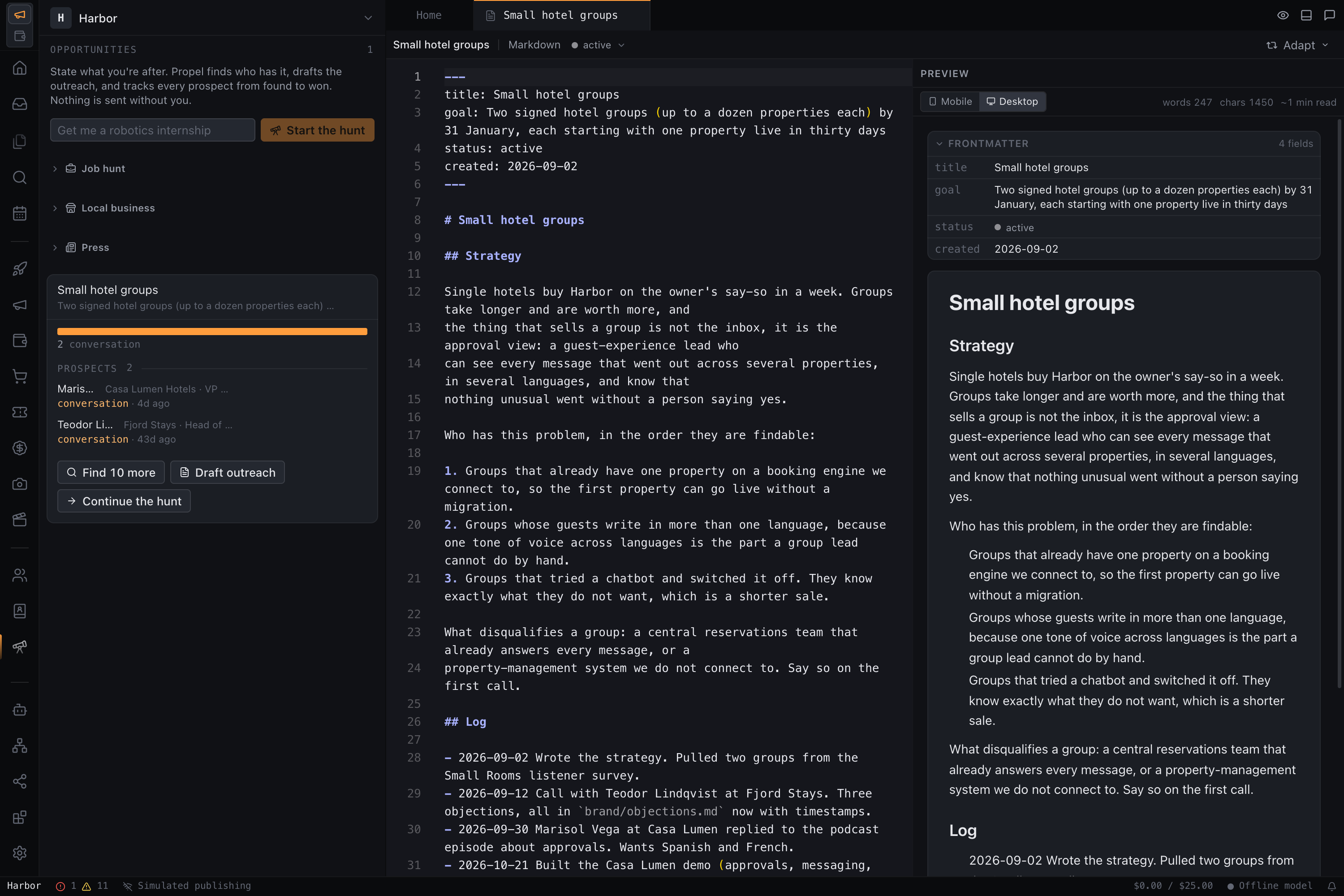
04-opportunities-hunt — Opportunities hunt for small hotel groups: written strategy, prospects, pipeline.
-

14-trust-and-plan — Trust holds a vendor's changed bank details; Plan answers "can we afford it?"
-

15-finance-agents-portfolio — Finance agents work under limits and never move money; treasury portfolio with delayed quotes.
-
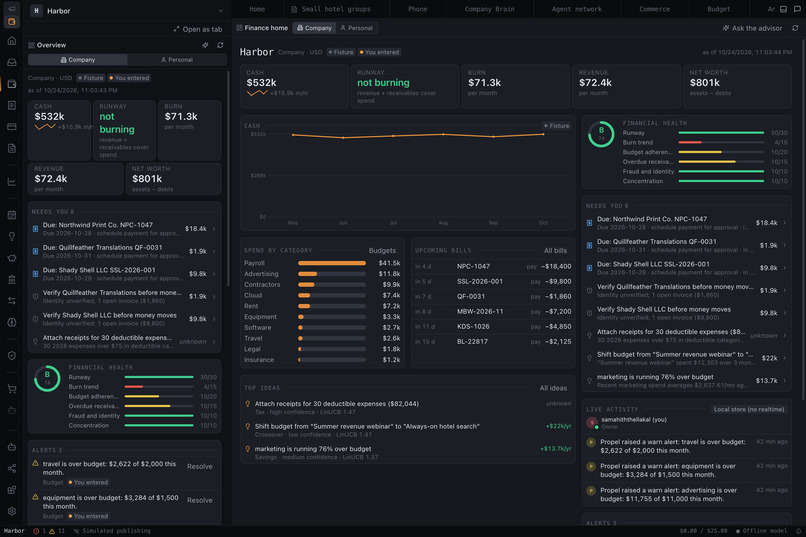
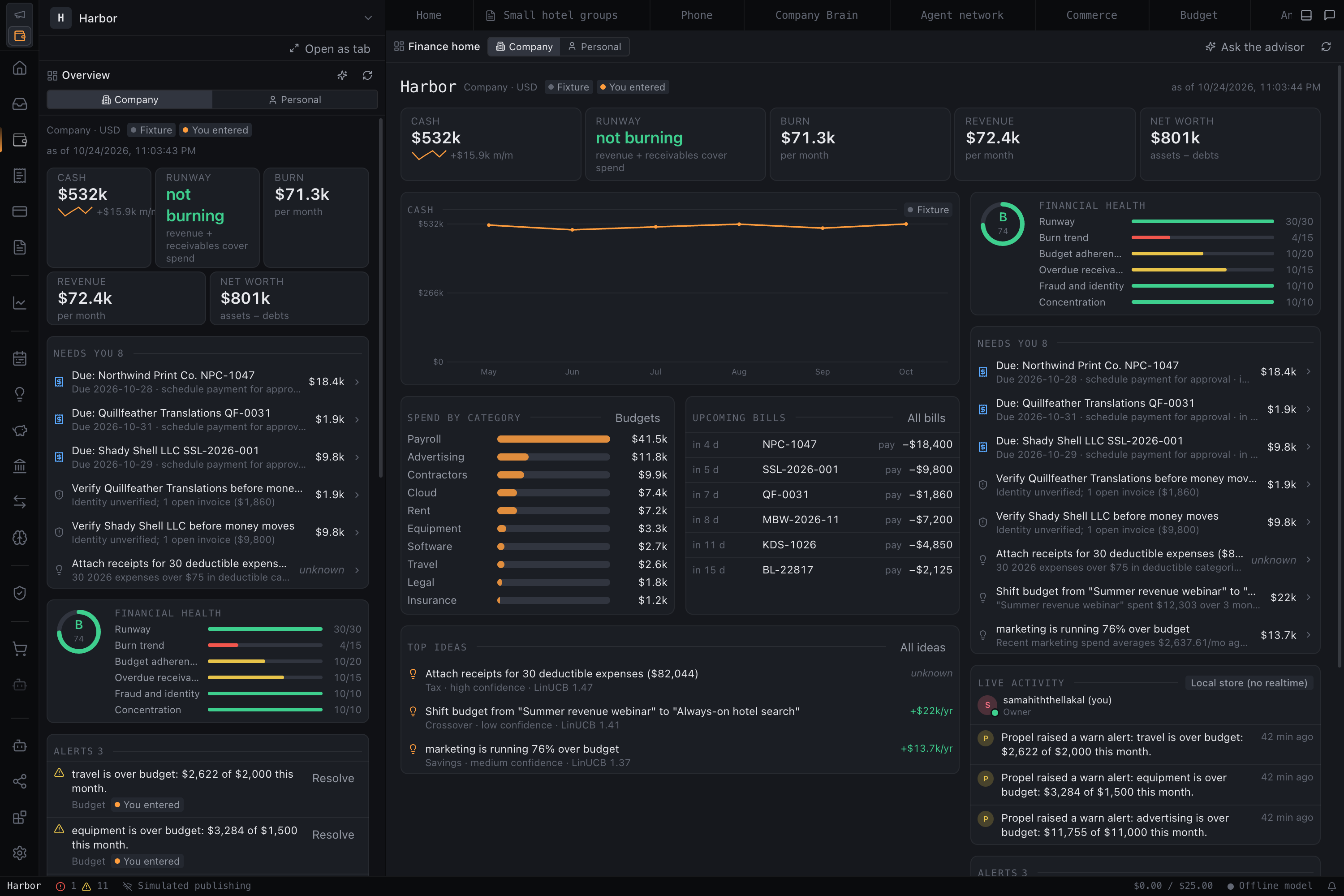
12-finance-home — Finance home: cash, runway, burn, health score and what needs you.


Inspiration All 4 of us on the team kept running into the same problem: we could build a product or do something technical, but getting it in front of people and keeping track of outreach, marketing, and finances was a whole separate challenge. Samahith ran into this while growing Monkeyless (a meditation app) because he had to post daily on Instagram and TikTok while creating and tracking content across multiple platforms without any context connecting them. Athena ran into the same problem fundraising for her FRC robotics team, spending hours finding grants and potential sponsors, personalizing emails, and manually tracking follow-ups. Jiewen had it as a software engineer for his EdTech startup 24/7 TEACH, where he struggled to reach potential schools and manage partnerships with them. Dharshini had this problem with her Founders, Inc. startup during offseason while trying to find potential customers and users. Also all of us had todo a lot of cold outreach in highschool to find internships or research opportunities. So we wanted to build something we could leave open next to our code that already understood what we were building and could help us get it in front of people while managing growth, outreach, and finances. That’s where Propel came from: Cursor for marketing and finance which anyone can use not just companies.
What it does
Our ICP is essentially the ENTIRE startup ecosystem, especially small technical teams that don’t have the budget or need for entire marketing and finance departments. We want a couple of people using Propel to handle that work while everyone else focuses on building.
Propel is basically Cursor for marketing and finance. Its Company Brain keeps track of your product, audience, positioning, customer objections, and campaign results, giving your tools shared context without constantly re-explaining your company. We have over 50 extensions most are bring your own key so you can connect all these extensions like canva, figma, cartesia and many other sponsors to propel to gain access to the context. We have this bring your own key system right now because many incubators give out compute and api credits to these teams which they can connect to propel and use.
We have missions which are like “get five design partners” into campaigns you can review and execute. The marketing side combines content creation, scheduling, lead management, email sequences, analytics, and reusable playbooks etc etc. The finance side tracks spending, budgets, bills, revenue, and runway. You can model how hiring or increased spending affects your cash and prepare financial reports and investor updates. Both sides connect inside campaigns, letting you compare spending, customer acquisition costs, and attributed revenue. You can also track how much marketing campaigns that propel or yourself come up with.
Propel also supports individuals so its b2c as well not only b2b, from creators finding sponsors, clippers finding customers, and students managing internship outreach to even people tracking personal budgets and financial goals.
How we built it We worked on Propel using TypeScript, React, Tailwind CSS, and Node.js, with Codex and Claude helping with development, debugging, and iteration. The IDE structure was very intentional. First to begin with thats what most technical founders are most comfortable with and are more likely to get used to it/use it. Also this way the company knowledge and campaign assets just stay as .mds or plain files that you can push to github and use git for version control and such. You can inspect and edit the context the agents work from, along with the content they produce. The architecture connects the Company Brain to agent workflows and external tools for research, content, outreach, and publishing. It uses a bring-your-own-key setup so users can connect their own models and services with 50+ connections for all types of uses and needs in marketing and finance. Also since we couldn’t connect with companies over the hackathon and was working on building the product we simulated 9 companies and campaigns from completely different backgrounds using our product. Heres a list of them and what they used in propel:
- Northwind Coffee Marketing: Consumer brand using Propel for social content, email campaigns, Shopify inventory, events, and wholesale outreach. Finance: Consumer brand using it to track Shopify payouts and wholesale invoices, budget ad spend per campaign, see which campaigns pay back, and catch a fake wholesale buyer.
- Cadence Marketing: Indie developer using it for an app launch, building in public, press outreach, sponsorships, and tracking AI recommendations. Finance: Indie developer using it to track App Store payouts and sponsorship income, keep personal money separate from the app business, decide whether launch ads pay back, and spot a sponsorship overpayment scam.
- Ridgeline Marketing: B2B startup using it for cold emails, sales calls, CRM, company knowledge, and finding design partners. Finance: B2B startup using it to watch runway and burn, plan hires against cash, measure cost per customer by campaign, and catch a fake vendor tax form before paying it.
- Brightside Dental Marketing: Local business using it for missed-call follow-ups, reactivating patients, reviews, referrals, and local marketing. Finance: Local business using it to track insurance payments, payroll, and an equipment loan, see which local campaigns bring in patients, and catch a phishing email posing as an insurer.
- Maya Okonkwo Marketing: Job seeker using it to track applications, tailor and fact-check resumes, prepare for interviews, and manage networking. Finance: Job seeker using it for a savings runway while job hunting, an emergency fund and debt payoff, checking whether she can afford to wait for the right offer, and flagging a fake job offer that asks for a "laptop deposit." We have a ton more examples we can show you when you come to our booth
Challenges we ran into Getting all the tools to understand the company the same way was pretty hard. A post, an email, and a sales workflow all need different context and aren’t even connected to begin with, but they still have to agree on what the company actually does and their mission. If the company changes its positioning, we also need to update everything that used the old version. To help with that, we built a drift review system that checks campaigns for claims that contradict each other or are outdated. We also have an RL model so it self learns and betters itself to align with the companies values and find out which marketing techniques work best. Also especially challenging, we believe, was keeping AI-written text from morphing into fact after a few passes through AI, because if an agent writes one thing down, another agent can easily read it and misunderstand or believe it to be the truth. Our Company Brain stores where each piece of knowledge came from, and anything that is created by Propel is given an AI-generated label by default, so we have tried to minimize this issue as much as possible, and we believe we have achieved a great level of success in this task. In an attempt to make our tool feel as “alive” as possible, we wanted to allow approvals, budgets, and alerts to sync instantly between people. To do this, we moved Finance into SpacetimeDB and put rules like who can write what and who can approve things all there, instead of in different areas of the website. Through our use of SpacetimeDB, we also decrease the risk of overwrites, since shared records carry revision numbers: if two people edit the same thing at the same time, the second save will be rejected as stale. Working with 4 people across 34 branches at the same time in the same 36 hours was also an issue, and it took a lot of communication to streamline this process. Merging would sometimes cause issues (if I recall correctly, there was, for example, a .gitignore rule written to skip a data folder which also ended up hiding a source code folder so that Fetch.ai agents weren’t working correctly until we found and fixed it. Creating handoff notes so that another group member’s AI agent could have full context came in very handy, and clear dividing of duties/ownership of respective areas ensured that we had as little conflicts as possible.
What we learned We learned how much of marketing is keeping track of context and following through as well as being able to plan things well. Writing one good post is all good and well but you don’t know who to contact next, or what your next steps are. We also learned to be more specific about who we’re building for. Starting with small technical teams gives me a problem I’ve experienced myself and a workflow we can actually build around. We also learned how important it is to earn trust. What we mean by that is, it might have seemed fine to trust the AI to reply to customers, since the responses seemed fine on average. But when we ran our Probation system to check an office’s AI assistant responses against that office’s real history of responses, we found that our model actually didn’t meet any of the requirements to act autonomously without causing issues; for instance, it would sometimes invent details or sign for the office. It was also interesting to observe how efficient it was to test as if you were some sort of attacker. A sort of red-team approach for stress-testing our code revealed issues pretty easily, like a double click that would send a patient two texts. Breaking seems just as easy as building, if not easier, and trying to break a system to its very limits is what will give way to a good system.


Log in or sign up for Devpost to join the conversation.