-
-
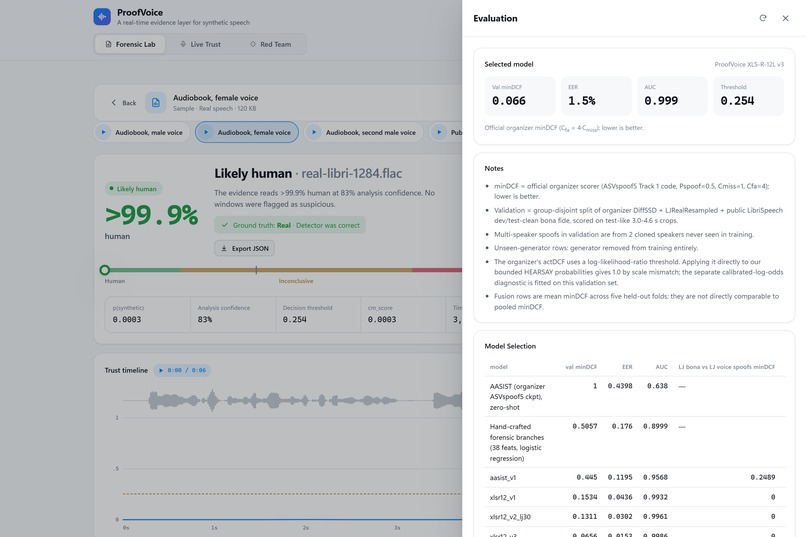
Evaluation
-
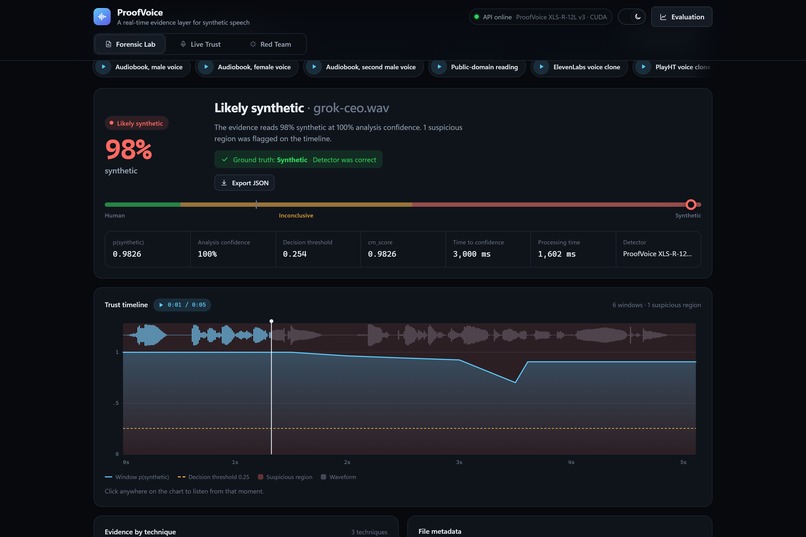
Forensic Lab Result
-
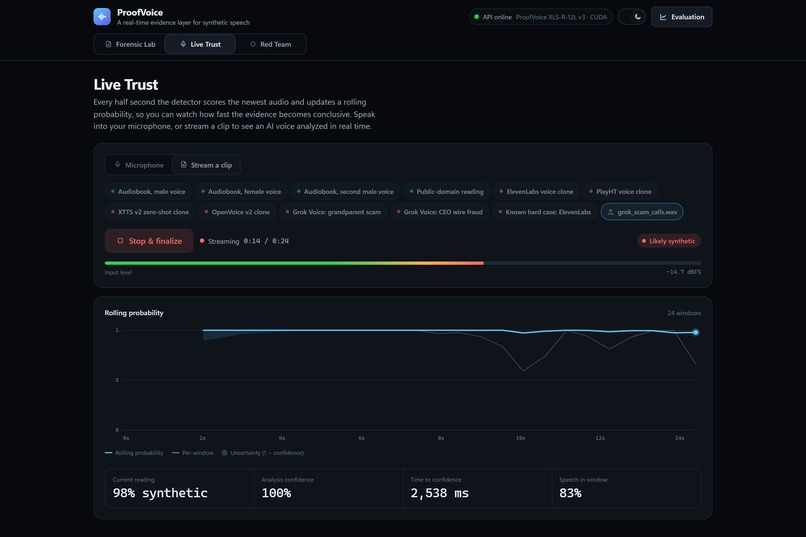
Live Trust Stream
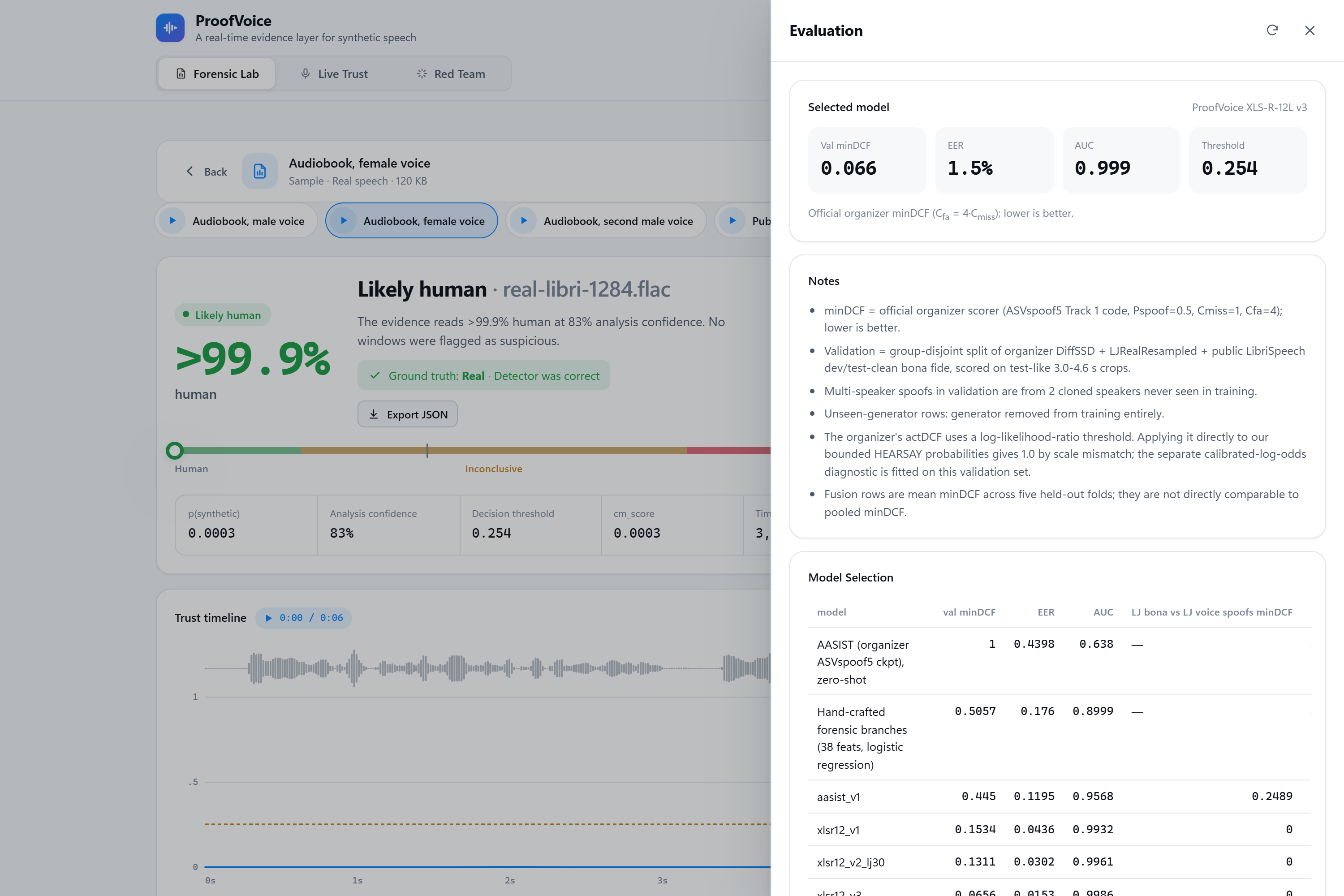
Inspiration
Three seconds of someone's voice is now enough to clone it, and cloned voices are already being used in "grandparent" scams, fake-CEO wire fraud and bank-alert phishing. Recognizing a voice used to be one of the oldest trust signals between people. I wanted to answer one question: how quickly can we know that the voice we're hearing is synthetic, and what evidence supports that? Generation is becoming real-time, so verification has to become real-time too.
What it does
ProofVoice is an evidence layer for synthetic speech. One forensic core powers four surfaces:
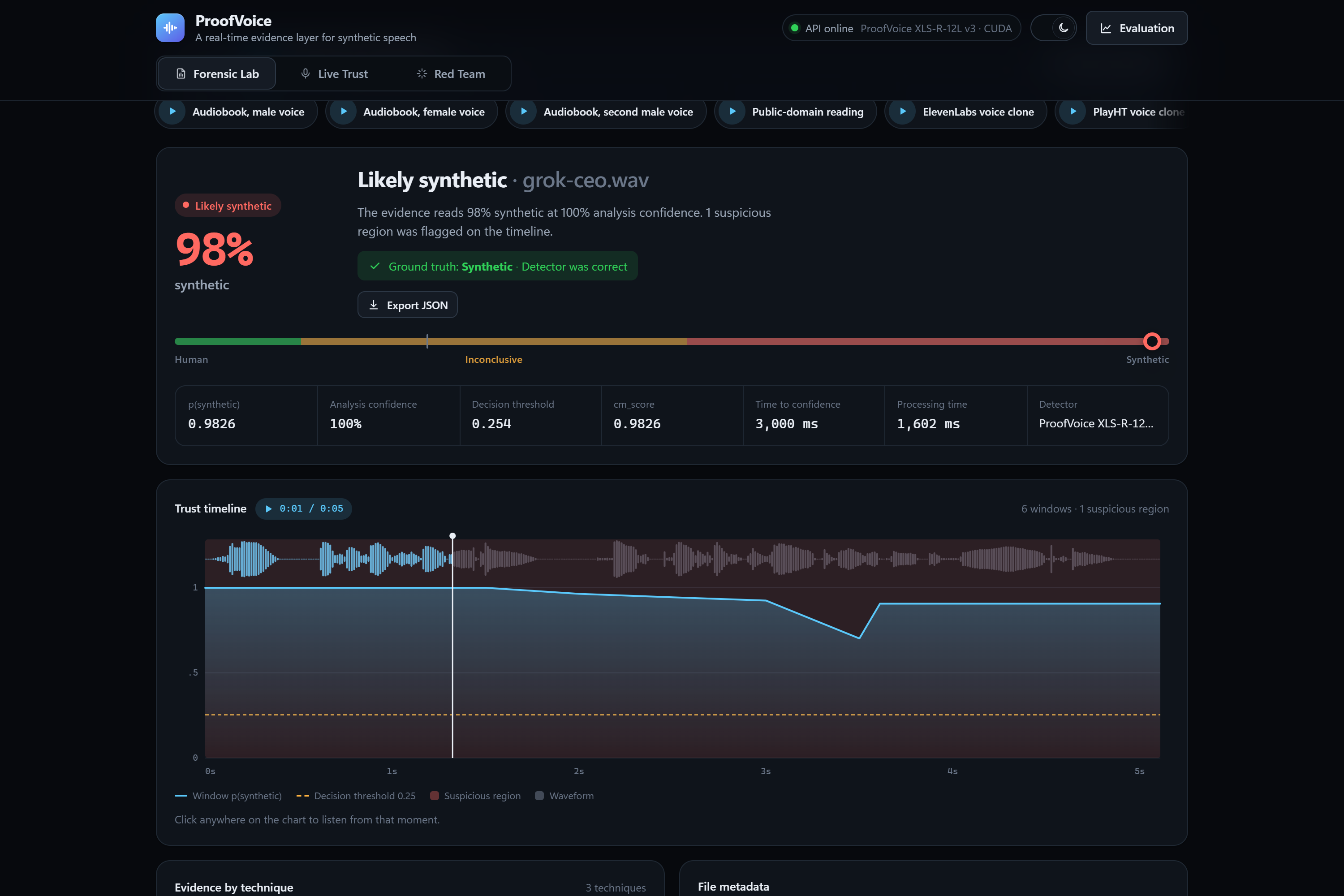
- Forensic Lab: upload any audio (or click one of 11 held-out demo clips) and get a verdict ("98% synthetic"), a per-window trust timeline you can listen along to, suspicious regions, evidence cards from each forensic technique, and a branch log explaining which techniques ran and why.
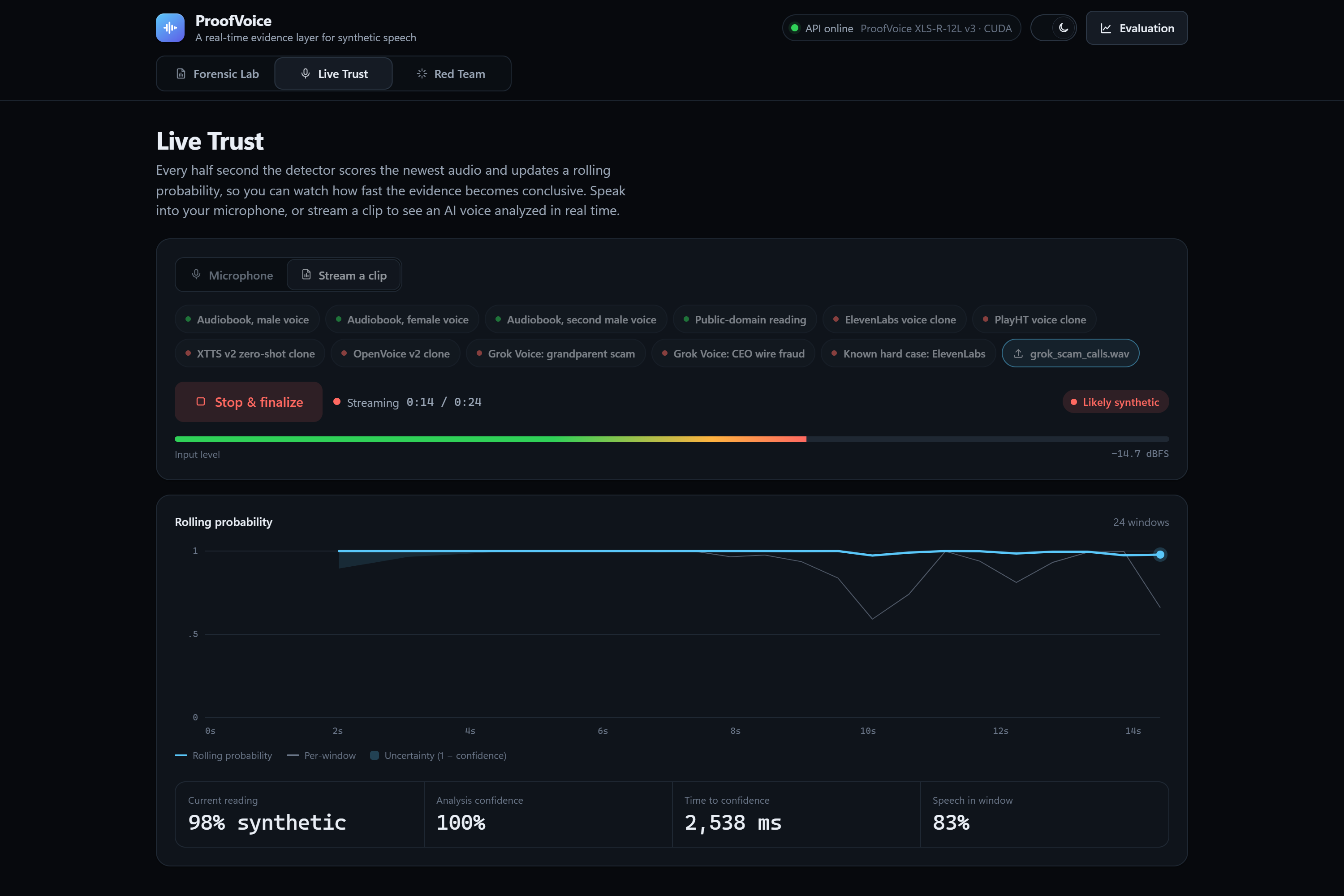
- Live Trust: stream from your microphone (or stream a clip digitally) and watch a rolling probability update every 0.5 s, including time-to-confidence.
- Grok Red Team: Grok Voice speaks a scam line, and the exact same audio bytes stream through the same detector in real time while you listen.
- NSA HEARSAY batch mode: a Docker container that scores the 1,671-clip held-out set offline and writes the prediction TSV.
Every result carries explicit uncertainty: likely human, likely synthetic, inconclusive (route it to a human analyst) or insufficient evidence.
How I built it
- Primary detector: a fine-tuned XLS-R (wav2vec 2.0) self-supervised front-end with attentive statistics pooling, calibrated with Platt scaling. Models were selected strictly on the official organizer metric, ASVspoof 5 minDCF (false alarms cost 4× misses), wrapped around the organizer's scorer with a bit-level parity test.
- Data: organizer DiffSSD (10 generators) + LJ Speech, plus public LibriSpeech as extra real speech, because 6 of the 10 generators clone LibriSpeech speakers. Otherwise a detector learns "not this one voice ⇒ fake". Splits are group-disjoint by speaker, chapter and sentence.
- Forensic branches from distinct families: container/metadata, spectral (LFCC, flatness, band limits), prosody (F0, jitter/shimmer, pauses), compression/transcoding, splice/discontinuity detection, and signal quality. A deterministic router runs the extra branches only when context calls for it (e.g. near-threshold decisions, lossy input) and logs the reason.
- Backend: FastAPI + WebSockets, PyTorch on CUDA (23 ms per 4 s clip on a laptop RTX 4060, ~345 ms on CPU).
- Frontend: Next.js + TypeScript with Web Audio (AudioWorklet) for live capture, custom SVG charts, and accessible, reduced-motion-aware UI.
Results (validation, lower minDCF is better)
| System | minDCF | EER | AUC |
|---|---|---|---|
| Organizer AASIST checkpoint, zero-shot | 1.000 | 44% | 0.638 |
| Hand-crafted forensic features alone | 0.506 | — | — |
| ProofVoice XLS-R (selected) | 0.066 | 1.5% | 0.999 |
- 6/6 live Grok Voice clips flagged, even though Grok was never seen in training.
- Robustness measured under MP3, Opus, AAC, μ-law telephone, noise, gain and clipping.
Challenges I ran into
- Shortcut learning. With only one real speaker in the organizer data, early models learned speaker identity instead of synthesis artifacts. Adding real LibriSpeech speakers and group-disjoint splits fixed the headline number, but a per-speaker audit still shows one cloned speaker is much harder than another (subgroup minDCF 0.24). I report it instead of hiding it; one of the demo clips is that known miss.
- More augmentation isn't automatically better. A v4 model trained with real codec transforms and harder generators scored worse (0.080) and was not shipped. Fusing the hand-crafted branches into the score didn't beat the neural detector out-of-fold, so they stay as explainable evidence, not score inputs.
- Replay is a different threat. Playing an AI voice from a phone speaker into a laptop mic adds room echo and speaker distortion the model never saw, and results become unreliable. I measured this, turned off the browser's call-processing filters for forensic capture, added a digital "stream a clip" path, and documented the limitation.
Accomplishments that I'm proud of
- Going from 1.000 → 0.066 minDCF against the organizer baseline, measured with the organizer's own scorer.
- An interface that explains instead of just scoring: timeline, evidence cards, a branch log, ground truth on demo clips, and an honest "inconclusive" state.
- A real-time loop where a frontier voice model attacks the detector live, byte for byte.
What I learned
Pooled metrics hide failure modes; subgroup and channel audits matter more than one headline number. Calibration and a well-designed "I don't know" state are as important as accuracy for anything an analyst acts on.
What's next
- Real recordings of the cloned speakers for identity-balanced training.
- Replay/room-acoustics augmentation for over-the-air calls.
- Leave-one-generator-out evaluation.
- A browser extension or phone-call integration.
Built With
- cuda
- docker
- fastapi
- ffmpeg
- grok
- hugging-face-transformers
- librosa
- next.js
- numpy
- python
- pytorch
- react
- scikit-learn
- scipy
- typescript
- uvicorn
- wav2vec2
- web-audio-api
- websockets
- xai
- xls-r


Log in or sign up for Devpost to join the conversation.