-
-
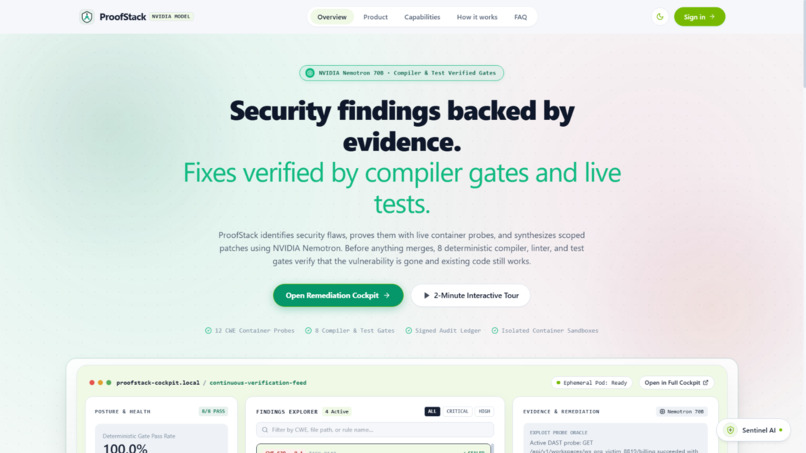
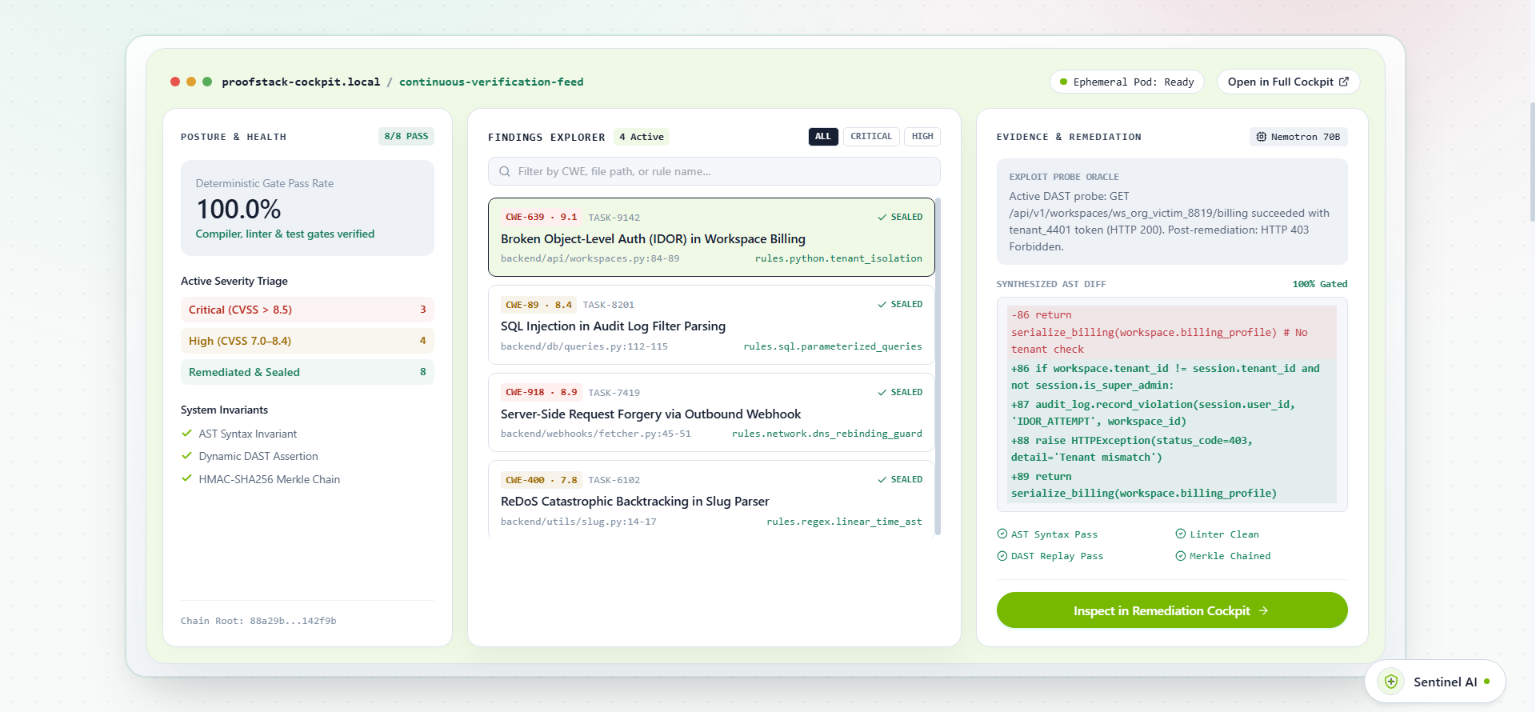
ProofStack Command Center — Unified visibility into vulnerabilities, remediation workflows, verification status, and security operations.
-
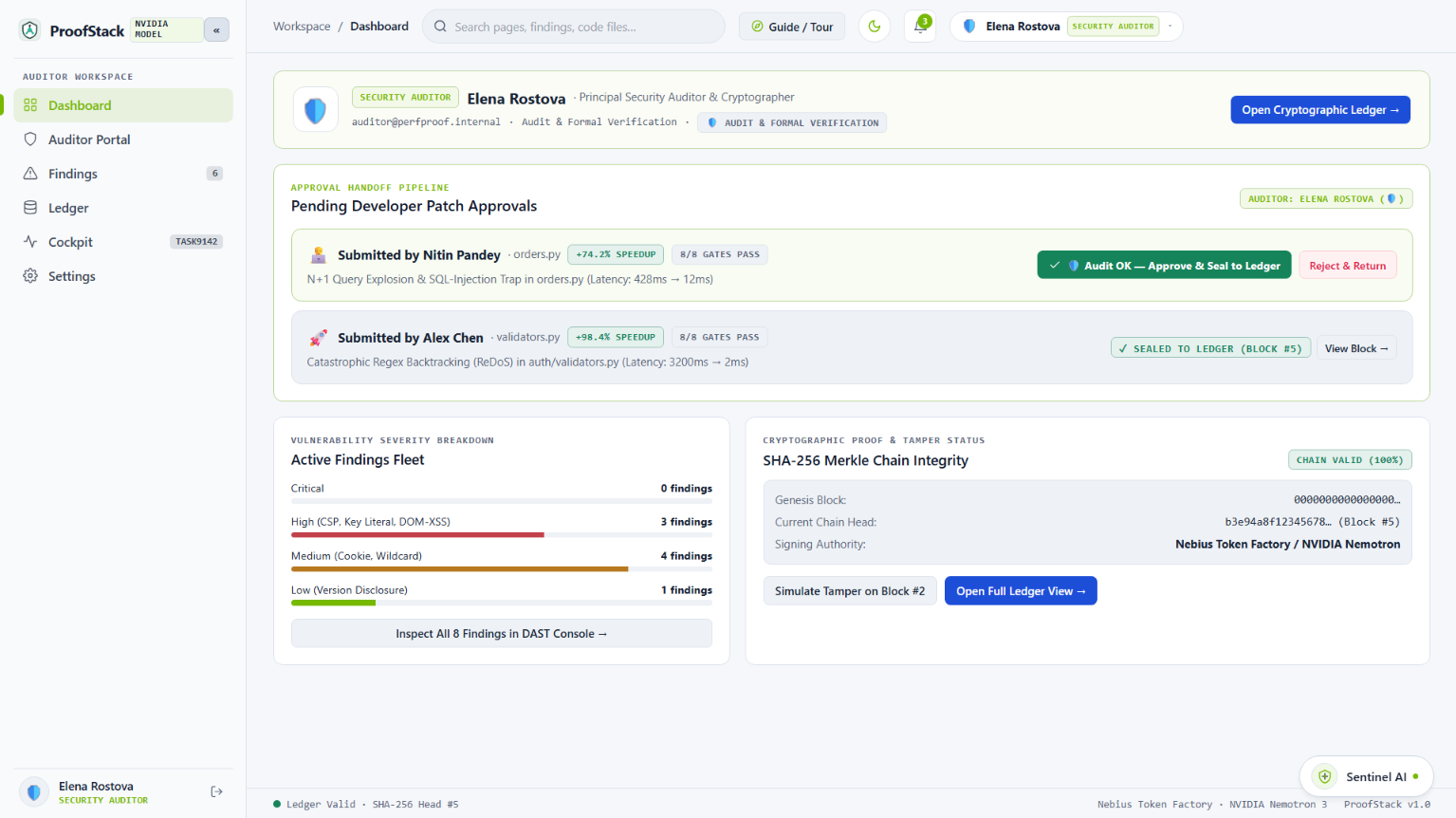
Security Audit Workspace — Inspect verification evidence, security findings, and patch approval decisions.
-
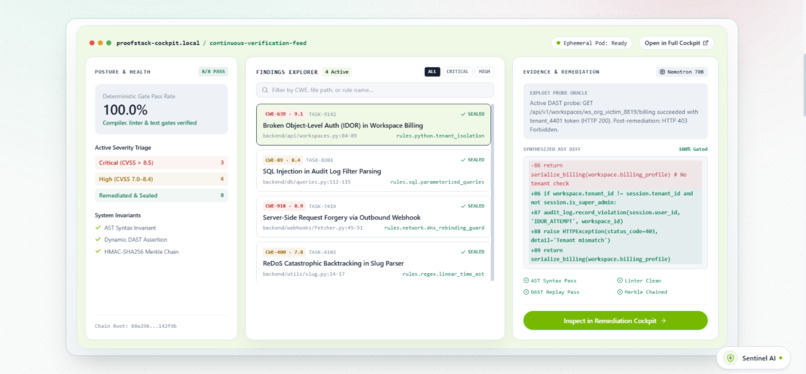
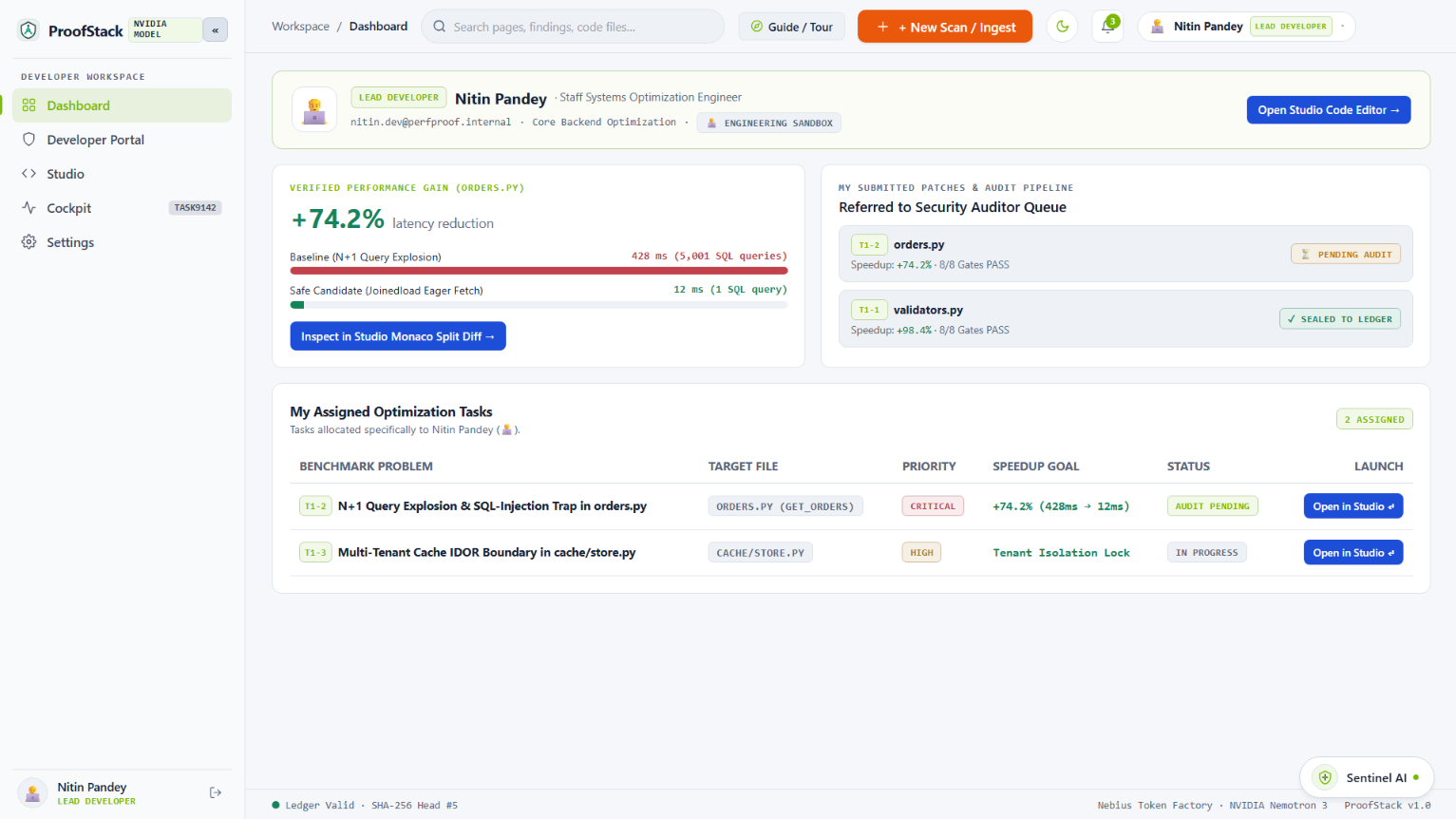
Developer Workspace — Review vulnerability findings, inspect proposed fixes, and manage remediation tasks.
-
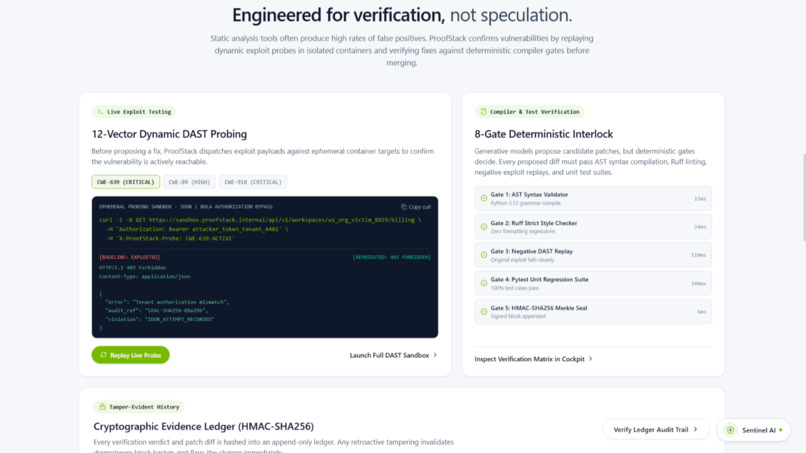
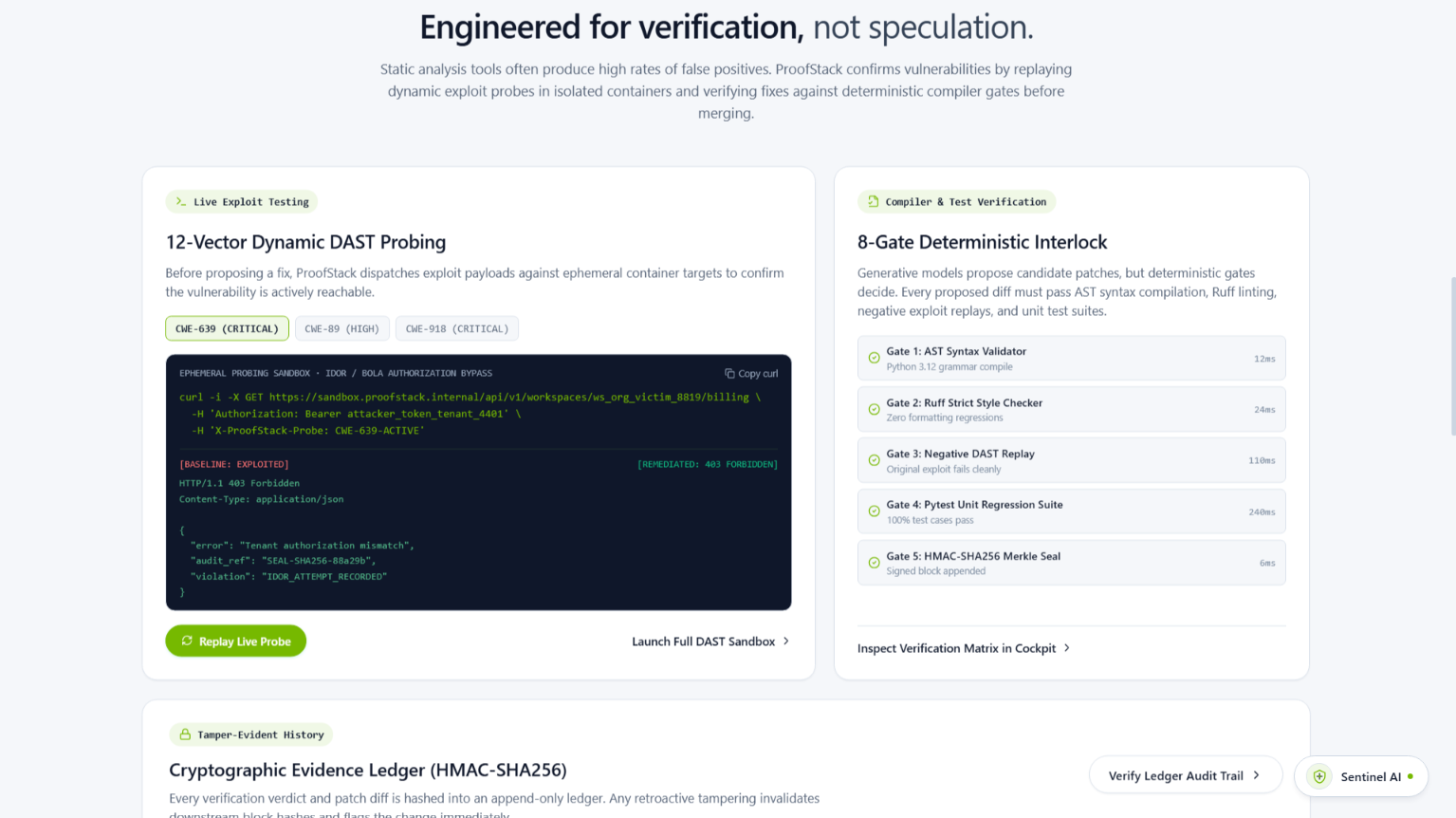
Independent Verification Engine — Compiler checks, security validation, and evidence-backed patch approval.
-
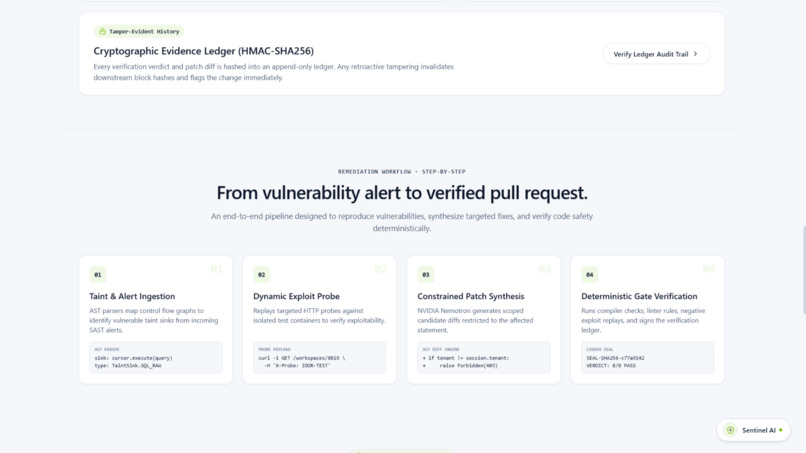
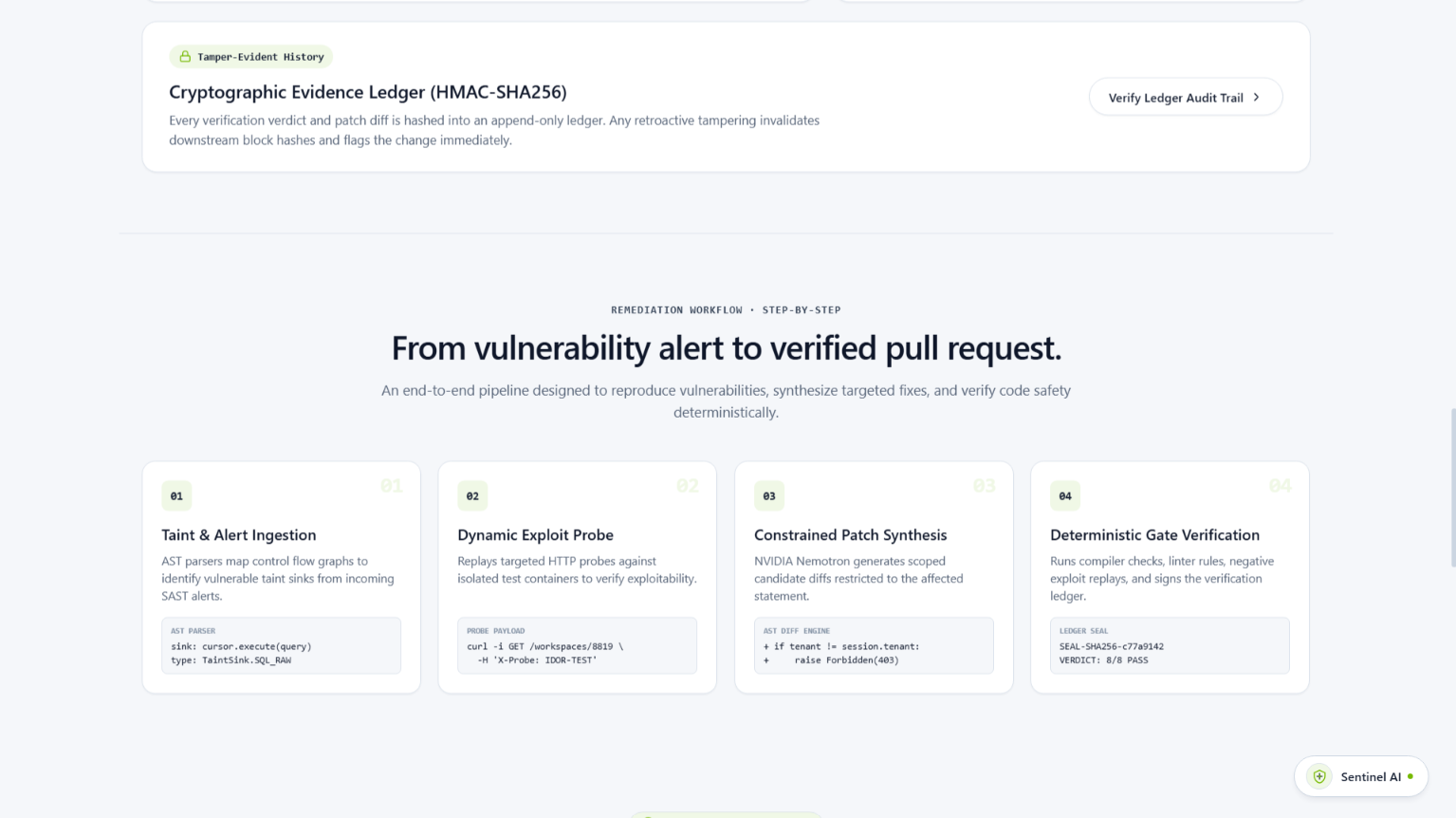
From Vulnerability to Verified Pull Request — The complete AI-assisted remediation and verification lifecycle.
-
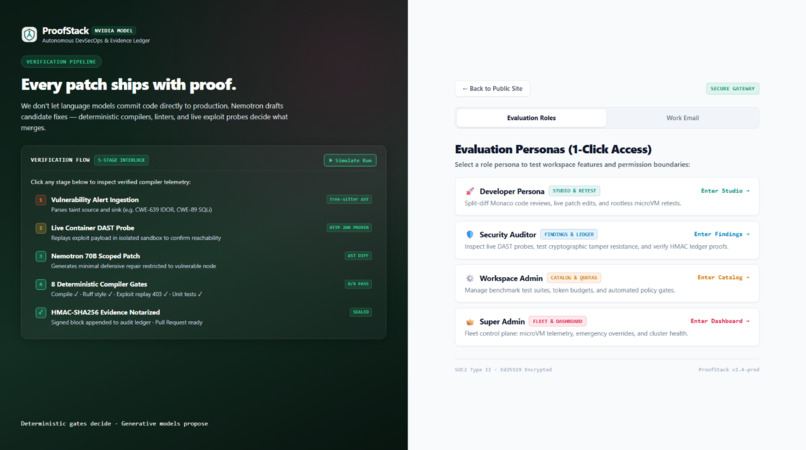
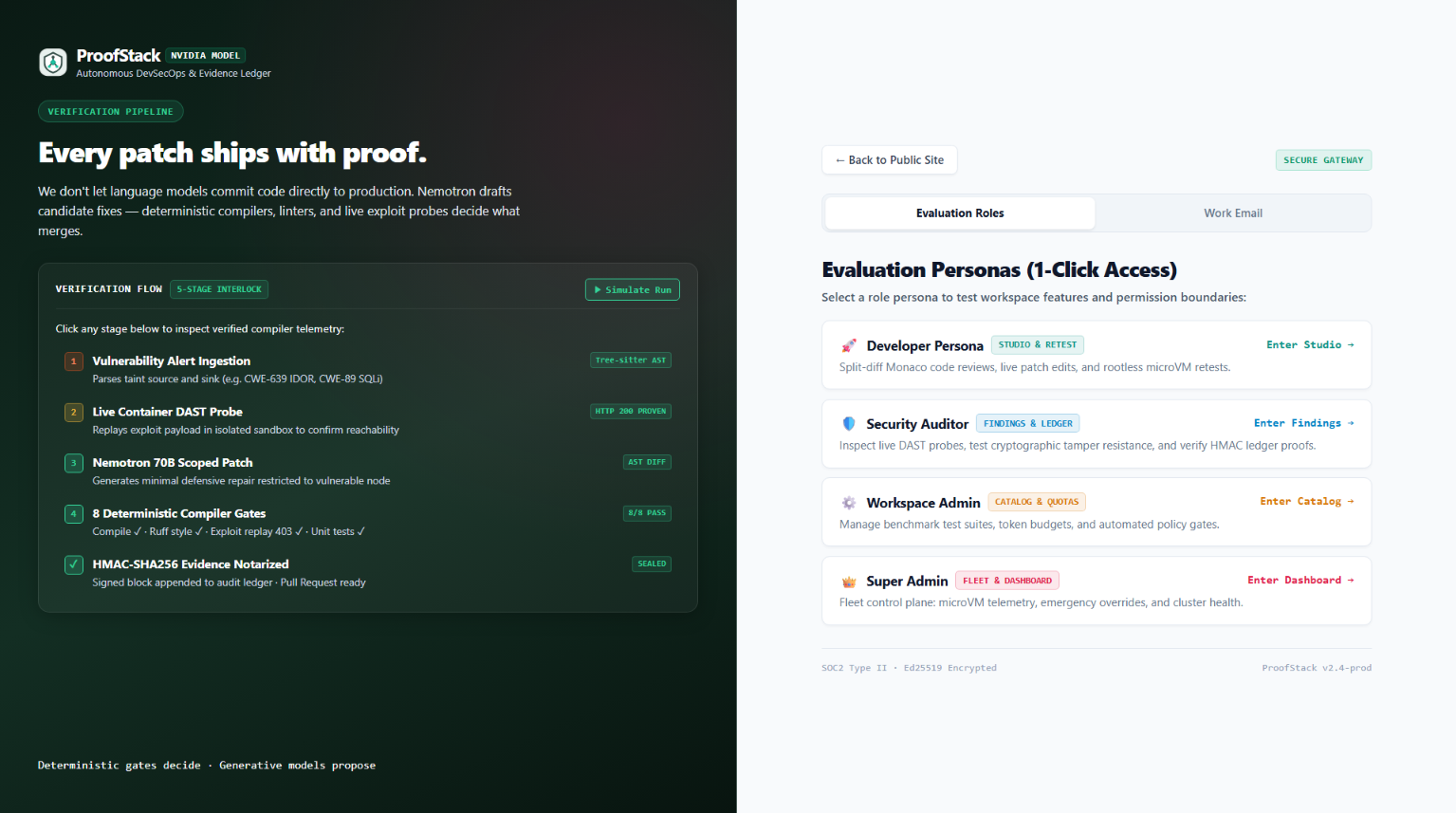
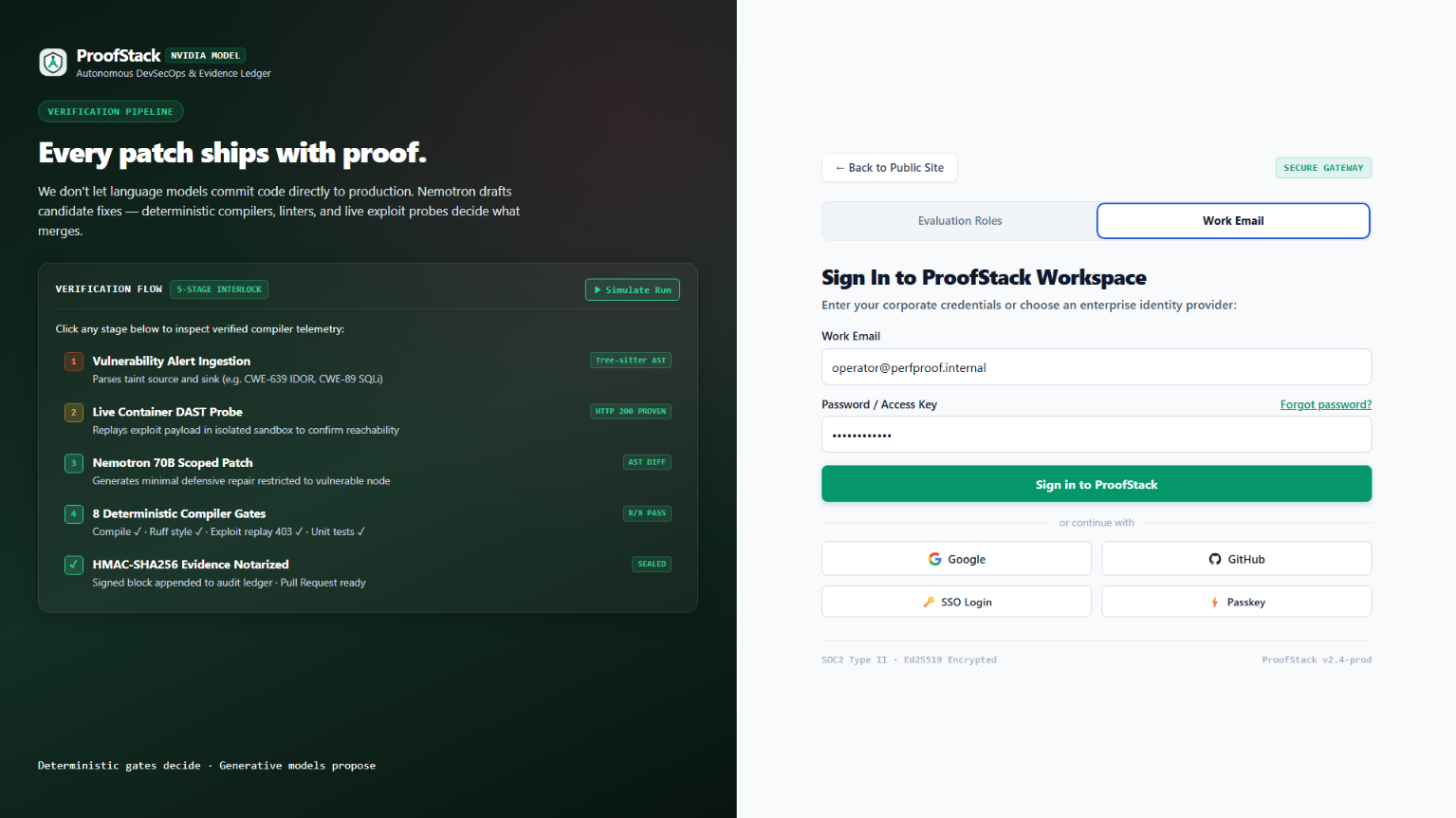
Role-Based Authentication — Secure entry into specialized developer, auditor, administrator, and CISO workspaces.
-
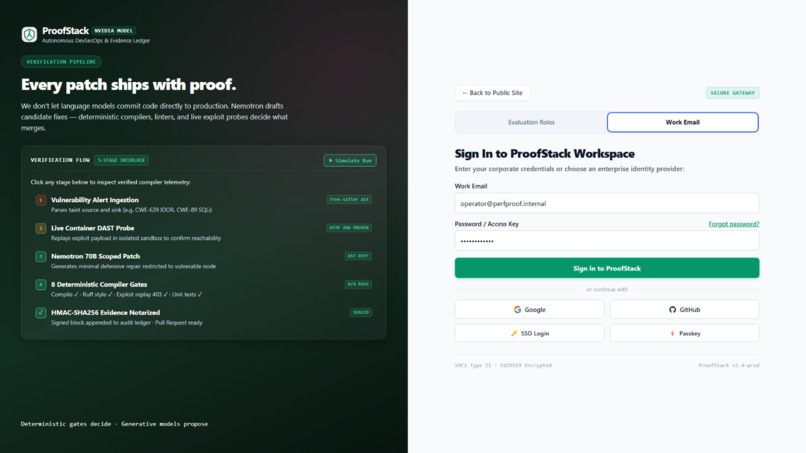
Authentication & Access Control — Role-specific access with controlled workspace routing and verification.
-
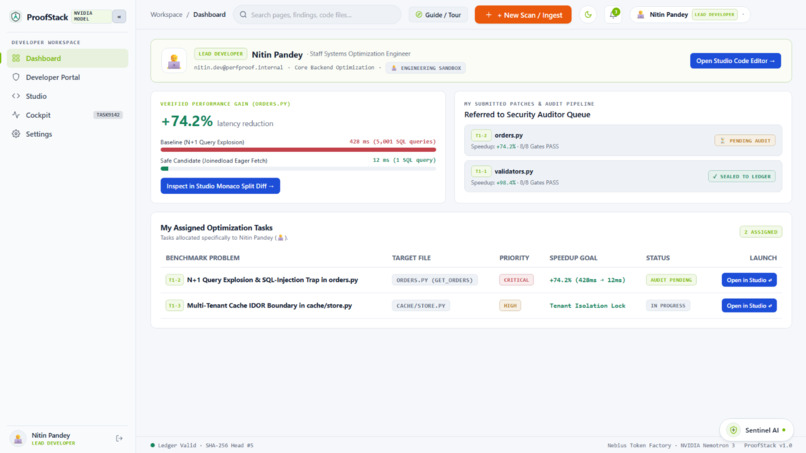
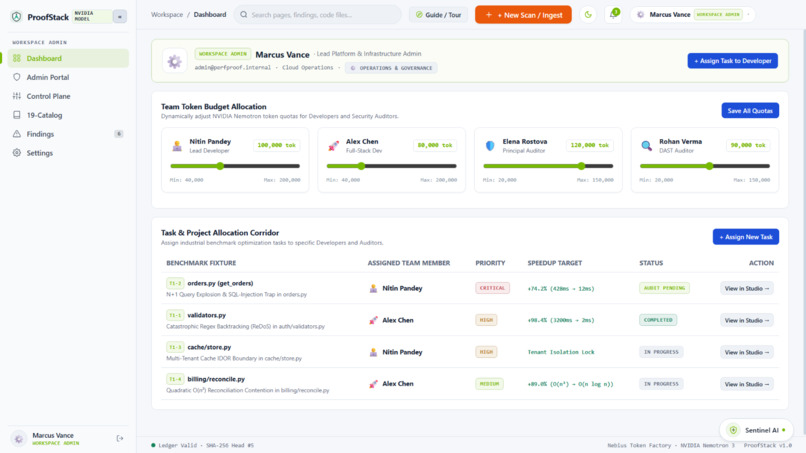
Security Operations Dashboard — Monitor vulnerabilities, remediation progress, and verification outcomes.
-
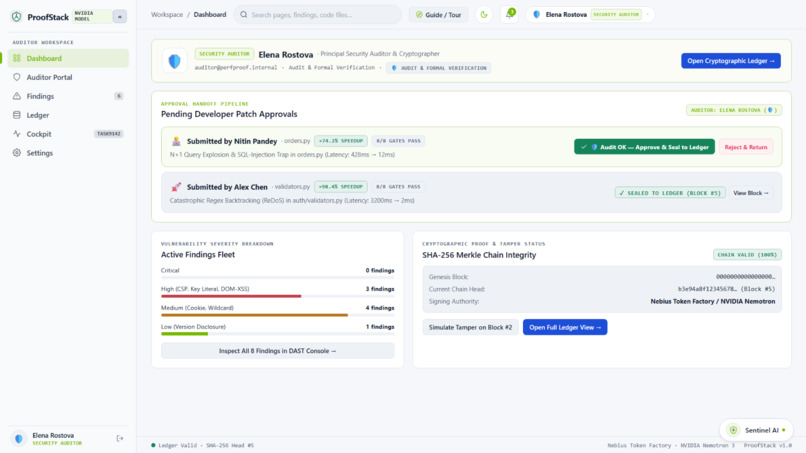
Vulnerability Management — Track security findings, severity, ownership, and remediation status.
-
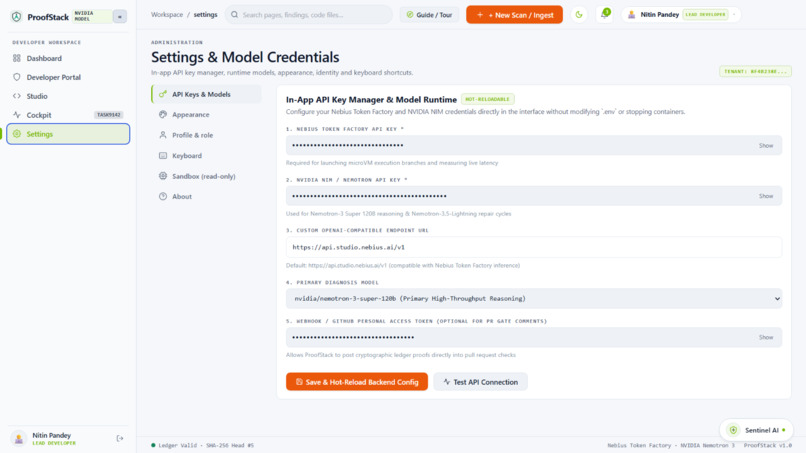
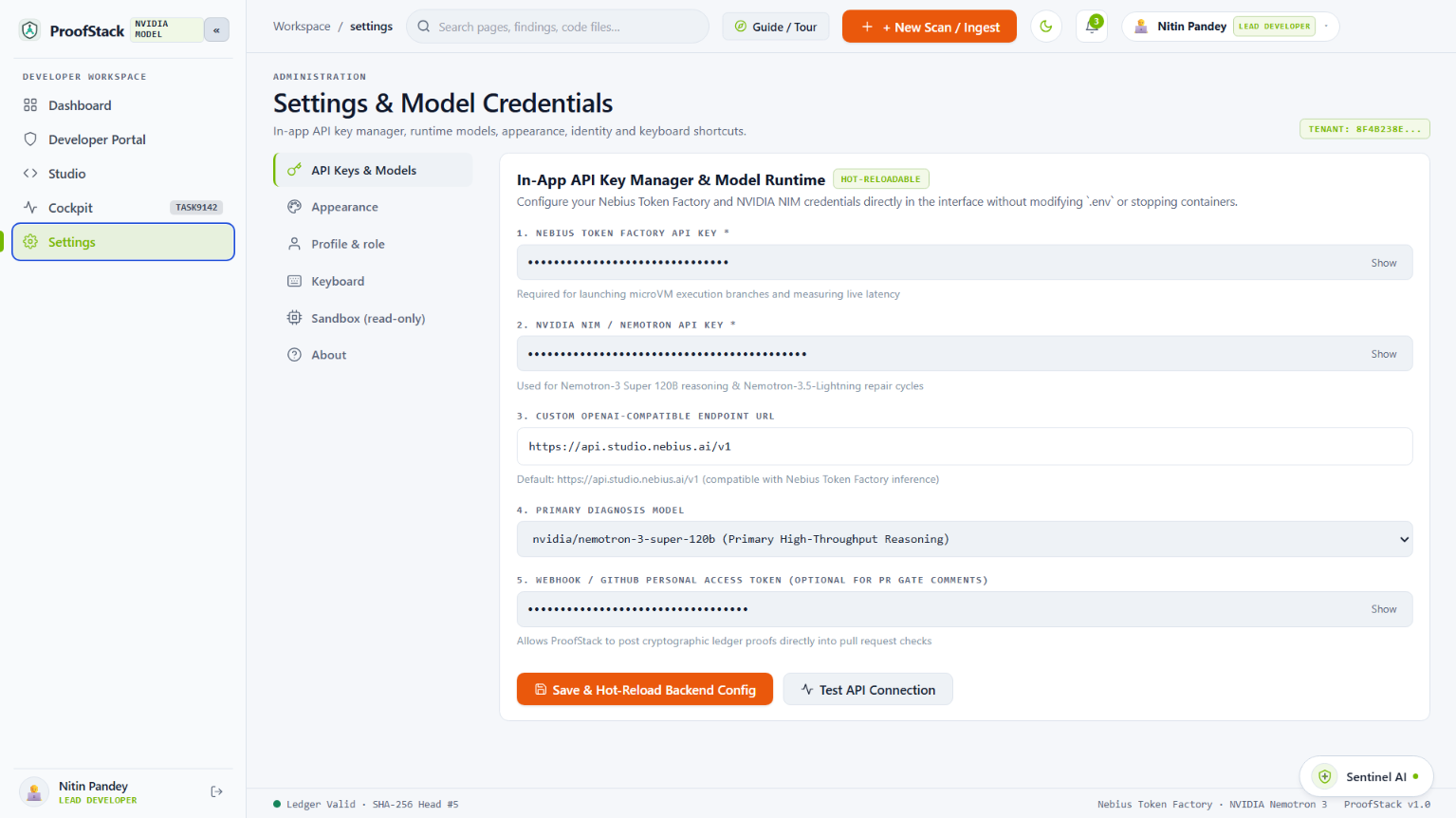
Model & Infrastructure Configuration — Configure inference connectivity, API credentials, and runtime settings.
Inspiration
AI coding tools have made generating code and fixing vulnerabilities faster than ever. However, generating a patch and proving that it is safe are two very different things.
We wanted to address a problem that developers and security teams increasingly face: AI-generated fixes can look convincing while introducing new vulnerabilities, breaking existing functionality, or silently removing important authorization checks.
We built ProofStack around one engineering principle:
Deterministic systems decide; AI only proposes.
A language model should be able to analyse a vulnerability and suggest a solution, but it should never be responsible for approving its own code.
What it does
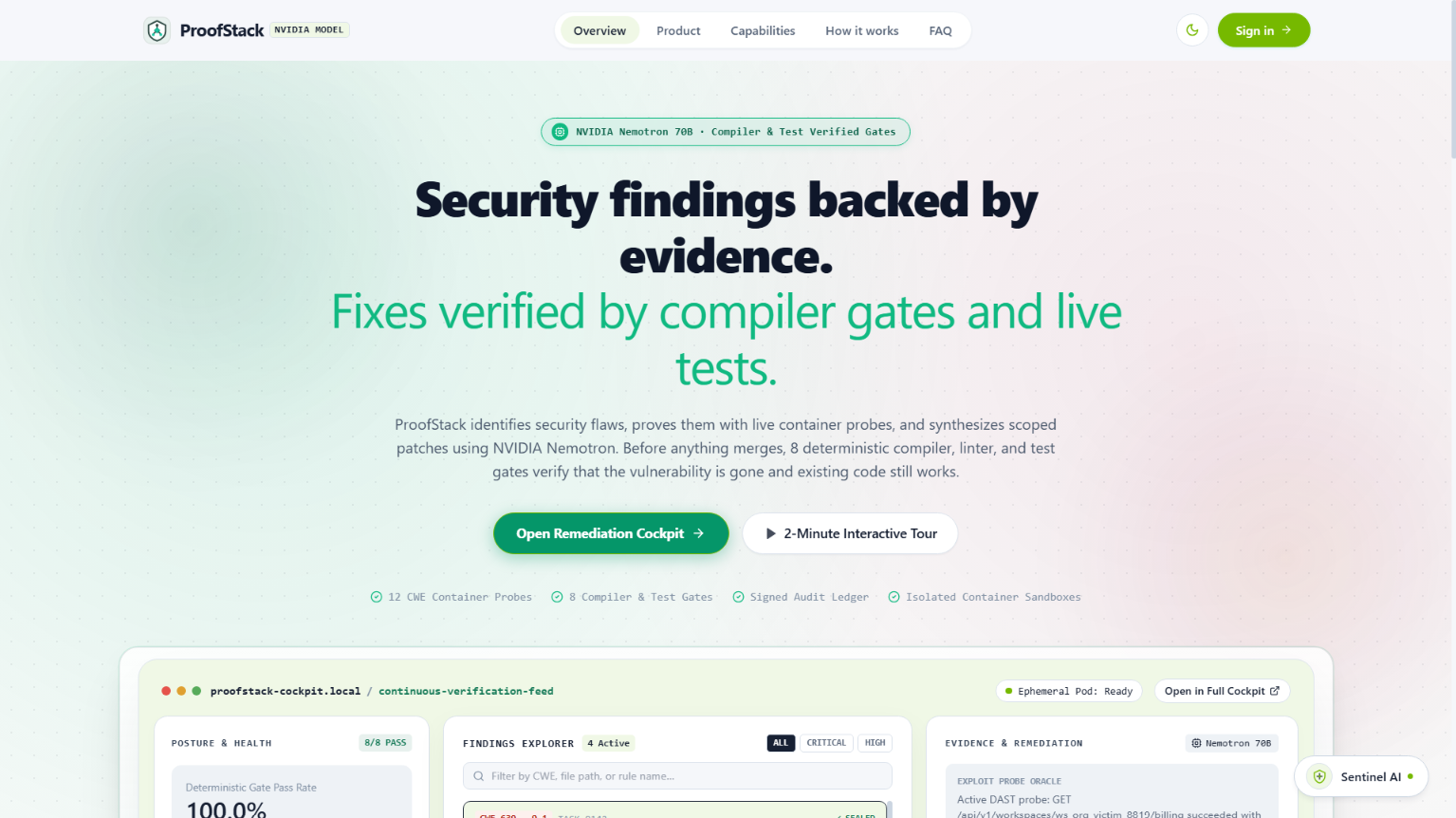
ProofStack is an AI-powered vulnerability remediation and independent code verification platform.
It combines NVIDIA Nemotron, running through Nebius Token Factory, with automated security testing and a deterministic verification pipeline.
The system follows four major stages:
Vulnerability Analysis: Uses AST parsing and taint analysis to identify potentially vulnerable code paths and understand how untrusted input reaches sensitive operations.
Exploit Verification: Uses isolated testing environments and a collection of 12 DAST attack vectors to determine whether reported vulnerabilities can actually be exploited.
AI-Powered Patch Generation: Uses NVIDIA Nemotron to analyse relevant code context and generate targeted remediation patches while restricting changes to relevant function boundaries.
Independent Verification: Evaluates proposed patches through an eight-gate verification pipeline covering syntax, linting, security regression testing, identity preservation, unit tests, performance invariants, concurrency, and cryptographic evidence recording.
Every patch must pass the required verification checks before it can be considered ready for human review.
ProofStack also maintains a tamper-evident SHA-256-based evidence ledger to preserve verification history and make changes auditable.
The central idea is simple: AI proposes the fix. Independent verification determines whether it can be trusted.
How we built it
We designed ProofStack as a modular application combining a modern web interface, backend orchestration, AI inference, security testing, and cryptographic verification.
NVIDIA Nemotron is integrated through Nebius Token Factory using the models configured for code analysis and patch generation:
nvidia/nemotron-3-super-120bfor deeper reasoning and vulnerability analysis.nvidia/nemotron-3.5-lightningfor faster, targeted patch generation.
The backend coordinates vulnerability ingestion, AST-based analysis, isolated exploit testing, model inference, patch validation, and evidence recording.
The verification engine uses Python AST capabilities, Ruff, pytest, performance checks, and cryptographic hashing to independently evaluate proposed changes.
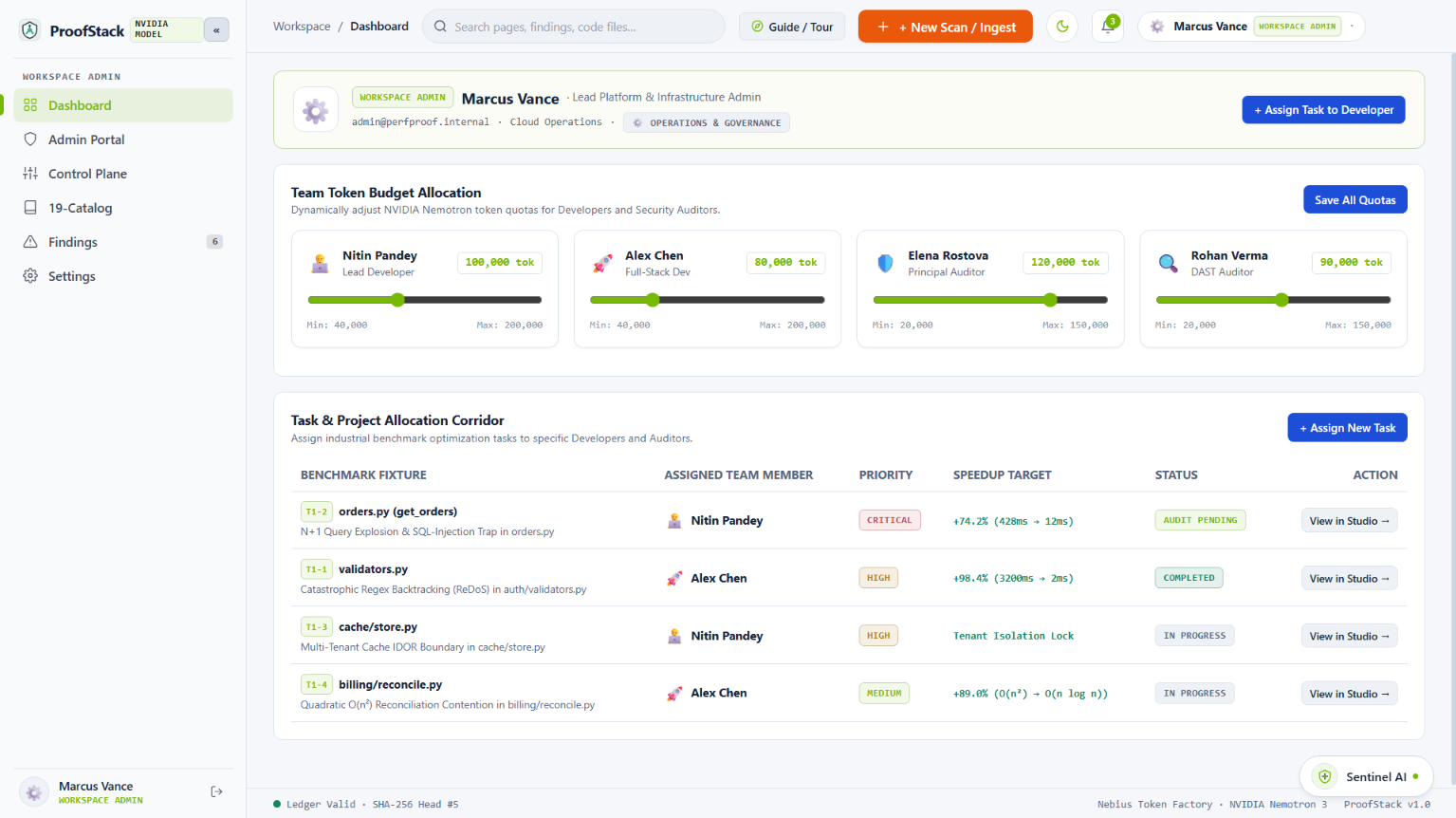
The frontend provides specialized workspaces for developers, security auditors, administrators, and security leadership. It includes code comparison, verification telemetry, security testing, and audit inspection.
We also implemented a configurable model gateway that supports live cloud inference when credentials are available and deterministic fallback workflows for offline evaluation.
Our goal was to make the entire remediation process observable, testable, and understandable rather than hiding everything behind a single AI-generated response.
Challenges we ran into
One of our biggest challenges was preventing AI-generated patches from introducing problems while attempting to solve existing ones.
A patch might resolve an SQL injection issue but accidentally remove a tenant-isolation condition or change an important function signature. This motivated the development of our identity-preservation verification gate.
Another challenge was establishing reliable exploit verification. A vulnerability report alone does not establish that an issue is exploitable, so we developed isolated testing workflows that replay attack payloads against the affected application.
We also had to coordinate multiple independent verification stages without making the application difficult to use. Compiler checks, regression tests, security probes, model responses, and audit records all needed to work together.
Finally, making the platform usable during demonstrations without requiring every evaluator to configure their own infrastructure required a configurable inference gateway and deterministic fallback capabilities.
Accomplishments that we're proud of
We are particularly proud of building a system in which AI-generated code is not automatically trusted.
Some of our key accomplishments include:
- Integrating NVIDIA Nemotron through Nebius Token Factory for AI-assisted vulnerability analysis and patch generation.
- Building an eight-gate deterministic verification architecture.
- Implementing AST-aware patch analysis and identity-preservation checks.
- Developing a 12-vector DAST testing environment for security verification.
- Creating a cryptographically linked evidence ledger for verification records.
- Building four specialized enterprise workspaces with role-based navigation.
- Providing configurable live inference and deterministic fallback workflows.
- Bringing the remediation, verification, and audit process together in one application.
Most importantly, we moved beyond simply asking AI to fix code. We built a workflow designed to produce evidence about whether a proposed fix actually works.
What we learned
This project taught us that integrating an AI model into an application is only one part of building a reliable AI-powered system.
The surrounding engineering architecture matters just as much.
We learned how to combine model inference with deterministic validation, work with AST-based code analysis, approach security testing through actual exploit attempts, and preserve application invariants when modifying existing code.
We also gained practical experience integrating NVIDIA Nemotron through Nebius Token Factory and designing systems where AI-generated outputs must satisfy independent technical requirements.
Our biggest takeaway was that confidence should come from evidence, not from how confidently a model explains its answer.
What's next for ProofStack — Trust, Verified in Every Patch
We see ProofStack evolving into a more comprehensive verification layer for AI-assisted software development.
Our next priorities include deeper multi-file repository analysis, broader language and framework support, stronger isolation for execution environments, expanded security testing, and more comprehensive verification reporting.
We also want to improve integration with existing developer workflows through GitHub pull requests and CI/CD pipelines, allowing patches to be evaluated as part of the normal software delivery process.
Ultimately, we want ProofStack to help development teams adopt AI-assisted coding without compromising the security, reliability, and accountability expected from production software.
Let AI write the patch. Make the evidence prove it.
Built With
- automated-testing
- cryptographic
- cybersecurity
- docker
- fastapi
- github
- javascript
- nebius-ai-studio
- next.js
- node.js
- nvidia-ai
- nvidia-nemotron
- postgresql
- python
- react
- redis
- rest-api
- static-analysis
- tailwind-css
- typescript
- vercel

Log in or sign up for Devpost to join the conversation.