Inspiration
AI has made information easier to access, but trusting that information remains a challenge. AI-generated answers can contain unsupported claims, outdated facts, or conflicting information from different sources. During research, users often struggle to distinguish verified evidence from plausible-sounding explanations.
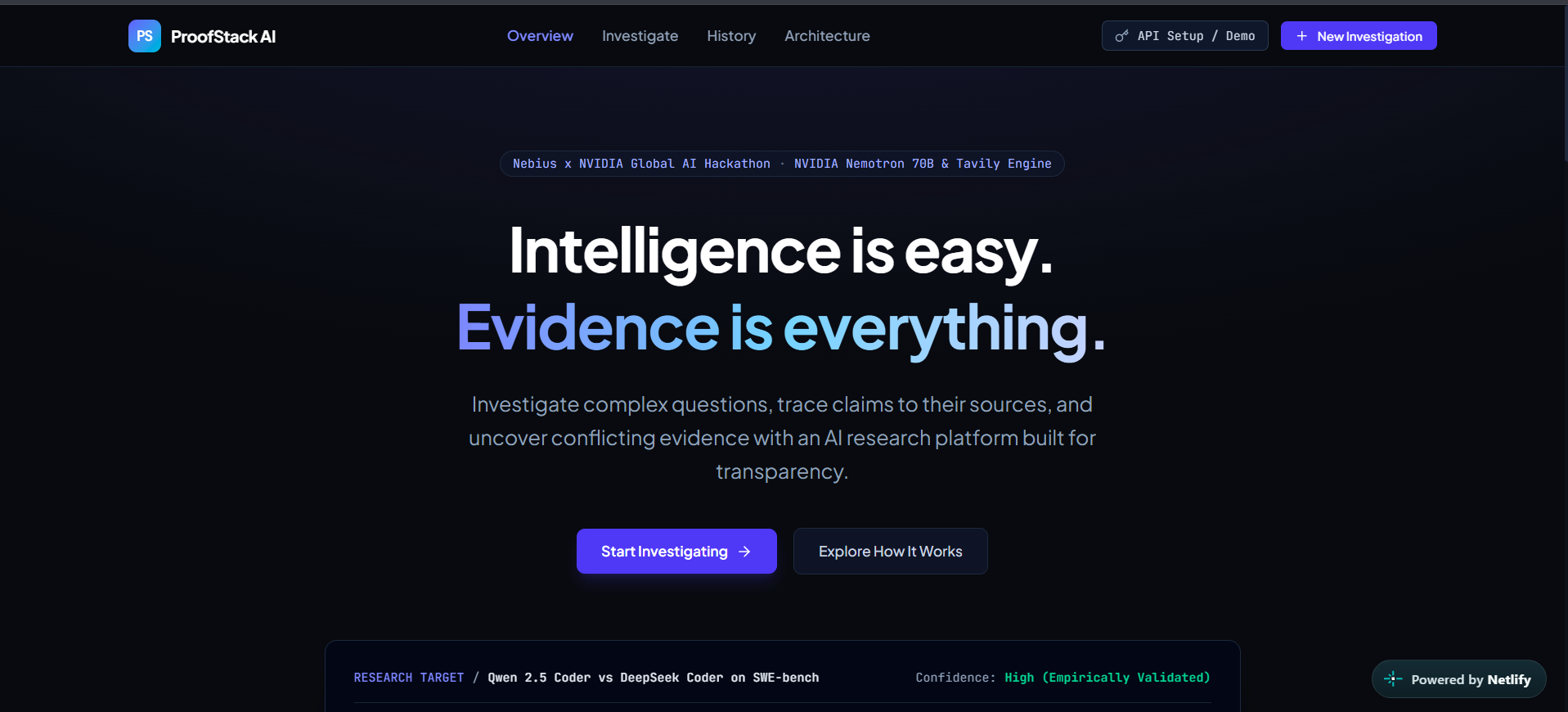
We wanted to build something beyond another AI chatbot: a research assistant that prioritizes evidence over confidence. This inspired ProofStack AI, a platform designed to help users investigate complex questions, verify important claims, identify conflicting sources, and make better-informed decisions.
What it does
ProofStack AI transforms complex research questions into structured, evidence-backed decision briefs.
Users submit a research question, and the system breaks it into smaller research tasks. It retrieves relevant information from web sources, extracts important claims, and connects those claims to supporting evidence.
Its key capabilities include:
- AI-Powered Research: Breaks complex questions into manageable research tasks.
- Source-Backed Claims: Connects important findings to their supporting sources.
- Evidence Verification: Evaluates whether available evidence adequately supports a claim.
- Conflict Detection: Highlights disagreements between sources instead of hiding inconsistencies.
- Uncertainty Awareness: Flags claims that lack sufficient evidence or require further investigation.
- Decision Briefs: Organizes findings, limitations, and recommendations into a structured report.
Our goal is to help users understand not only what an AI recommends, but also why that recommendation may or may not be trustworthy.
How we built it
ProofStack AI is designed around a modular architecture combining web research, language models, and structured evidence analysis.
The frontend uses React and Tailwind CSS to provide an interactive research workspace. A Python FastAPI backend manages research requests, coordinates the analysis pipeline, and structures the results.
Tavily provides web-search capabilities to retrieve relevant information. NVIDIA Nemotron models, accessed through Nebius Token Factory, power the AI-driven research and claim-analysis workflow.
The pipeline is designed to:
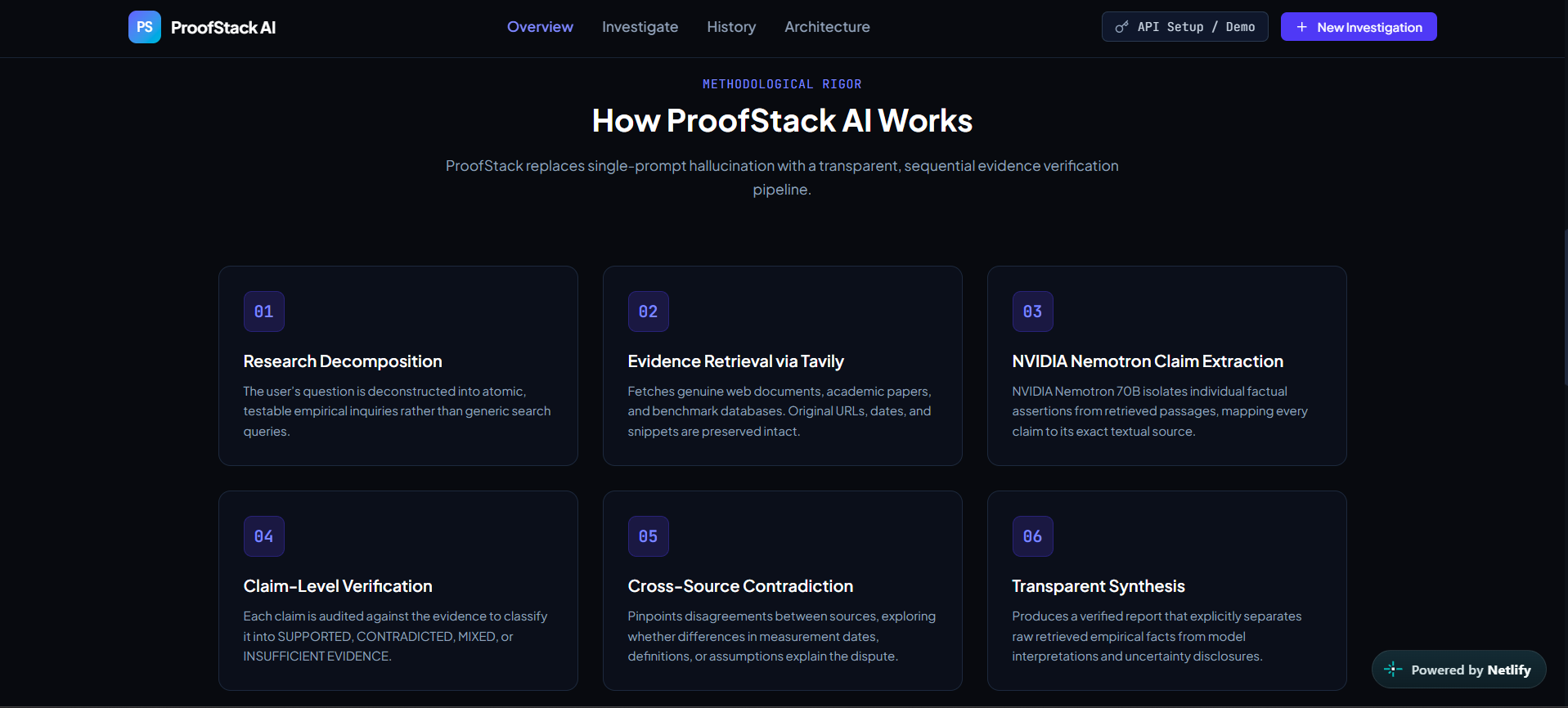
- Decompose a research question into focused subquestions.
- Retrieve relevant information from multiple sources.
- Extract claims and associate them with source references.
- Evaluate the relationship between claims and available evidence.
- Identify conflicting information and unresolved uncertainties.
- Generate a structured report containing findings, sources, and limitations.
The system separates retrieved information from AI-generated analysis to improve transparency. Its architecture also allows future integration of additional verification methods and research tools.
Challenges we ran into
One of our biggest challenges was designing a system that does more than summarize search results. A source mentioning a claim does not automatically prove that claim is true, so we needed to distinguish source relevance from actual evidential support.
Another challenge was handling contradictory information. Different sources may report different figures, rely on different assumptions, or reflect different publication dates. Combining these sources into a single confident answer could mislead users.
We also had to consider hallucinations, outdated information, incomplete search results, and the limitations of language models when evaluating evidence.
Finally, coordinating web retrieval, claim extraction, evidence analysis, and report generation introduced architectural complexity. We approached this by dividing the system into modular stages with clearly defined inputs and outputs.
Accomplishments that we're proud of
We are proud of developing a concept that addresses a fundamental challenge in AI adoption: the gap between generating an answer and establishing whether that answer is supported by evidence.
ProofStack AI is designed to make research more transparent by connecting findings to sources, surfacing disagreements, and communicating uncertainty rather than presenting every generated statement as a fact.
We are also proud of our modular approach, which brings together web research and language-model reasoning in a workflow that can be extended to different research domains.
Our broader accomplishment is turning trustworthiness into a central product feature rather than treating citations as an afterthought.
What we learned
Building ProofStack AI reinforced an important lesson: an AI-generated answer can sound convincing without being adequately supported.
We learned to treat research as a multi-stage process involving information retrieval, claim extraction, evidence evaluation, and synthesis rather than relying on a single model response.
We also recognized that citations alone are insufficient. A useful research assistant must help users understand whether the cited source actually supports a claim, whether other sources disagree, and what remains uncertain.
Another key lesson was the importance of modular architecture, transparent limitations, and measurable evaluation when developing AI-powered applications.
What's next for ProofStack AI
We envision evolving ProofStack AI into a comprehensive evidence-intelligence platform for students, developers, researchers, and decision-makers.
Our future roadmap includes:
- Stronger Claim Verification: Introduce more systematic entailment and contradiction checks.
- Source Quality Assessment: Evaluate factors such as source authority, publication date, and relevance.
- Cross-Source Fact Checking: Compare claims across independent sources and highlight unresolved disagreements.
- Research Knowledge Graphs: Connect related claims, sources, and evidence to reveal relationships that conventional summaries may miss.
- Domain-Specific Research: Adapt the platform for technical research, market analysis, academic literature, and technology comparisons.
- Evaluation and Benchmarking: Test the system against curated research questions with known supporting, contradicting, and insufficient evidence.
- Collaborative Research Workspaces: Allow teams to share findings, annotate sources, and maintain reproducible research histories.
Our long-term vision is simple: make AI-assisted research more transparent, traceable, and useful by helping people evaluate the evidence behind every important conclusion.
Built With
- ai-agents
- api-integration
- artificial-intelligence
- claim-analysis
- contradiction-detection
- data-visualization
- decision-intelligence
- evidence-verification
- fact-checking
- fastapi
- full-stack-development
- generative
- information-retrieval
- large-language-models
- natural-language-processing
- nebius-token-factory
- nvidia-nemotron
- python
- react
- research-automation
- responsible-ai
- source-attribution
- tailwind-css
- tavily
- web-search


Log in or sign up for Devpost to join the conversation.