-
-
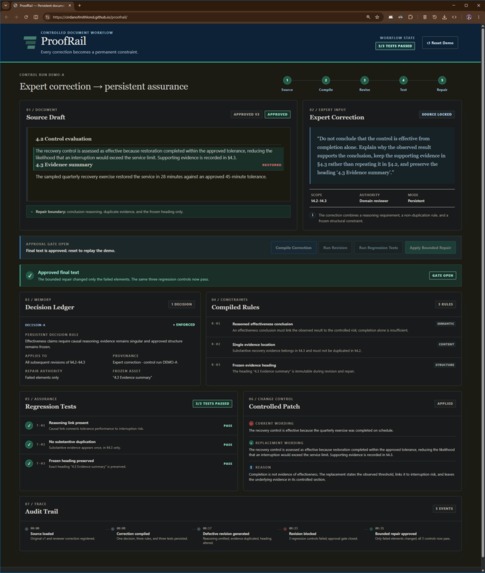
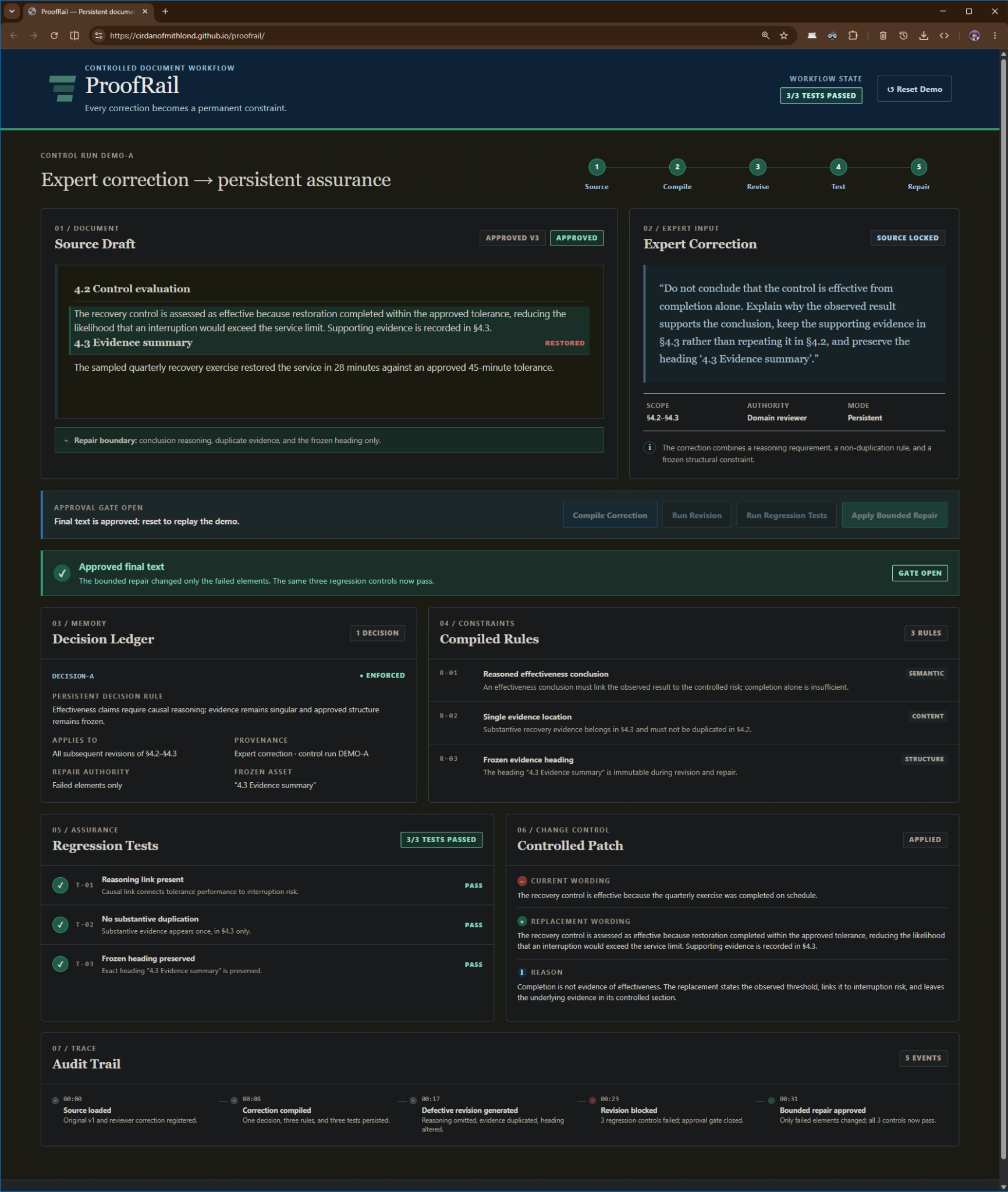
ProofRail after bounded repair: 3/3 tests pass, the gate opens, and every decision and change remains traceable.
Inspiration
High-stakes professional documents are rarely completed in one draft. Legal submissions, regulatory complaints, compliance reports, policy papers, consulting deliverables, and technical specifications may pass through dozens of revisions.
Across those revisions, accepted corrections can silently disappear. Required reasoning may be removed, evidence may be duplicated, an approved qualification may be weakened, or a structural decision may be changed without anyone noticing.
ProofRail was inspired by real drafting workflows in which expert decisions had to remain reliable across long and complex revision chains. A correction should not improve only the current draft. It should continue to protect every later version.
What ProofRail does
ProofRail is not another text generator. It is an executable revision-control model for long-form professional documents.
The demonstration shows a bounded example of a general revision-control model, designed to remain applicable across real-world document workflows.
ProofRail turns an accepted expert correction into persistent controls that later revisions can be tested against.
In the MVP, a correction is represented through:
- a decision recorded in a durable ledger;
- explicit rules describing what later revisions must preserve;
- executable regression tests;
- a controlled patch showing the original wording, replacement wording, and reason for the change;
- an approval gate that remains closed until the tests pass.
The demonstration intentionally creates a later revision containing three common failures:
- required causal reasoning has disappeared;
- supporting evidence has been duplicated;
- a previously approved heading has been altered.
ProofRail detects each failure separately and blocks approval. It then applies a bounded repair limited to the failed elements, leaving unaffected content unchanged.
The document is approved only when all three regression tests pass.
The result is not simply a better paragraph. It is a traceable revision process in which accepted decisions remain visible, testable, and reviewable.
Why it matters
Most AI drafting tools focus on generating the next version of a document. ProofRail focuses on a different problem: preventing the next version from undoing decisions that were already made.
This distinction is critical in professional work where correctness depends on structure, reasoning, and consistency over time, not only on fluent language.
Who it is for
ProofRail is designed for people working with long, high-consequence documents, including:
- lawyers and legal teams;
- regulators and regulatory affairs professionals;
- compliance, risk, and audit teams;
- policy authors and public-sector analysts;
- consultants and evidence-based researchers;
- technical writers, architects, and engineering teams.
In each of these contexts, once an expert decision has been accepted, later revisions should not silently reverse it.
How it was built
The MVP is a dependency-free static application built with HTML, CSS, and JavaScript.
It runs entirely in the browser and requires no backend, API key, package installation, credentials, or build process.
GPT-5.6 Sol and the OpenAI Work/Codex agent were used to:
- translate the underlying document-control approach into an executable system;
- implement the interface and state-transition logic;
- model corrections as decisions, rules, tests, and bounded patches;
- create the regression-detection and repair workflow;
- validate the complete failure-to-repair sequence;
- produce the repository documentation and demo script.
Challenges
The main challenge was turning a document-governance concept into a working system rather than a static demonstration.
Each action in the interface changes the application state. The defective revision is generated intentionally, each regression is evaluated independently, approval is blocked when tests fail, and repair authority is restricted to the failed elements.
A second challenge was expressing a rigorous professional-document methodology in a form understandable within a short demonstration.
What I learned
Expert feedback becomes significantly more valuable when it is represented as a reusable control rather than retained only as prose.
A robust correction should define:
- what must change;
- why it must change;
- what later revisions must preserve;
- what would constitute a regression;
- which elements may be repaired;
- what must be verified before approval.
This turns revision from an informal process into a controlled and auditable system.
Potential impact
ProofRail introduces an assurance layer for professional drafting workflows.
A production version could:
- compile larger decision ledgers from expert review;
- evaluate complete documents rather than a single bounded example;
- associate controls with sections, evidence, issues, and versions;
- detect omission, duplication, contradiction, and structural drift;
- integrate with document-management and version-control systems;
- generate reviewable bounded patches for human approval;
- preserve full provenance and decision history across revisions.
Privacy
The demonstration uses only fictional and anonymised material.
All processing occurs locally in the browser, and no document content is transmitted externally.
Built With
- ai
- chatgpt
- codex
- css
- github
- gpt-5.6
- html
- javascript
- productivity
- regression-testing

Log in or sign up for Devpost to join the conversation.