Watch the 2:21 demo video on YouTube · Open the interactive judge workspace
Inspiration
A payment timeout leaves a practical question: did the purchase fail, or did only the response disappear?
We built ProofPay around a small studio with a $300 allowance for outside review work. Two requests cost $180 and $160. Both may be useful, but they cannot both fit. The owner needs to approve the exact purchase, see what remains available and inspect the payment outcome when a response goes missing.
What it does
ProofPay connects a purchase request, owner approval, allowance reservation and checked provider outcome in one operation.
A model proposes an item from a controlled catalogue and explains its choice. Server code determines the seller, price and currency; the model cannot approve a purchase or declare payment complete. Owner approval reserves allowance before dispatch. PayPal's native buyer approval is a separate step.
If a capture response disappears, the purchase remains unresolved and its allowance stays reserved. Recovery reads the original order and checks the operation, seller, amount, currency and completed final capture before recording payment. A receipt inspector makes those stored comparisons readable and shows where information is missing.
Owners can renew expired approval for an unchanged purchase before capture dispatch, or cancel an untouched request before any provider dispatch. The allowance belongs to a workspace, not the owner's entire PayPal account.
The catalogue contains three synthetic digital-service packages: Workflow review ($180), Design review ($160) and Starter review ($90). No paid review service is delivered. The sandbox uses virtual funds.
Judge experience
Open https://proofpay-evaluation-lab.vercel.app and choose Open judge workspace. No login or payment credentials are required; each visitor receives an isolated, temporary rehearsal session. The complete workflow has been verified in the expanded public portal.
The expanded portal organizes Overview, Purchases, Approvals, Evidence, Controls, AI & backend and Evaluation lab. Judges can approve a $180 request, see the competing $160 request blocked, simulate a missing capture response, reload and recover the original outcome. Evidence keeps the purchase record and receipt inspector in the app. AI & backend is read-only; Evaluation lab tracks six observations for the current session.
This free workspace uses sample proposals and simulated payments with the application's approval, reservation and recovery logic. It never calls the model or PayPal and cannot spend provider credits. Saved external-run evidence is separate from each judge's rehearsal. Repeatable testing instructions explain the session and usage limits.
Workflow screens
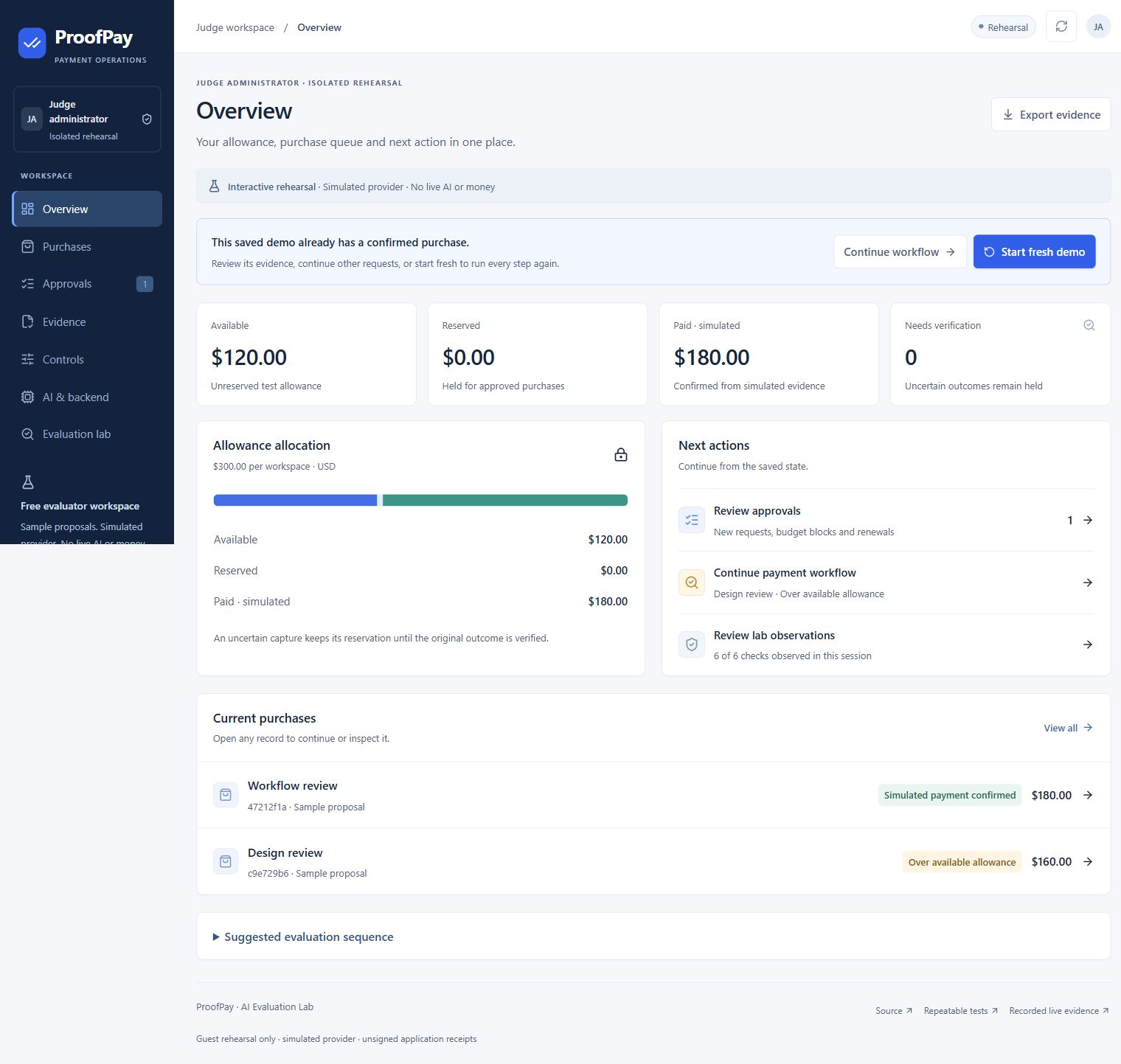
Public judge portal after recovery. This is the free rehearsal with simulated payments: $120 available, $0 reserved and $180 simulated paid.
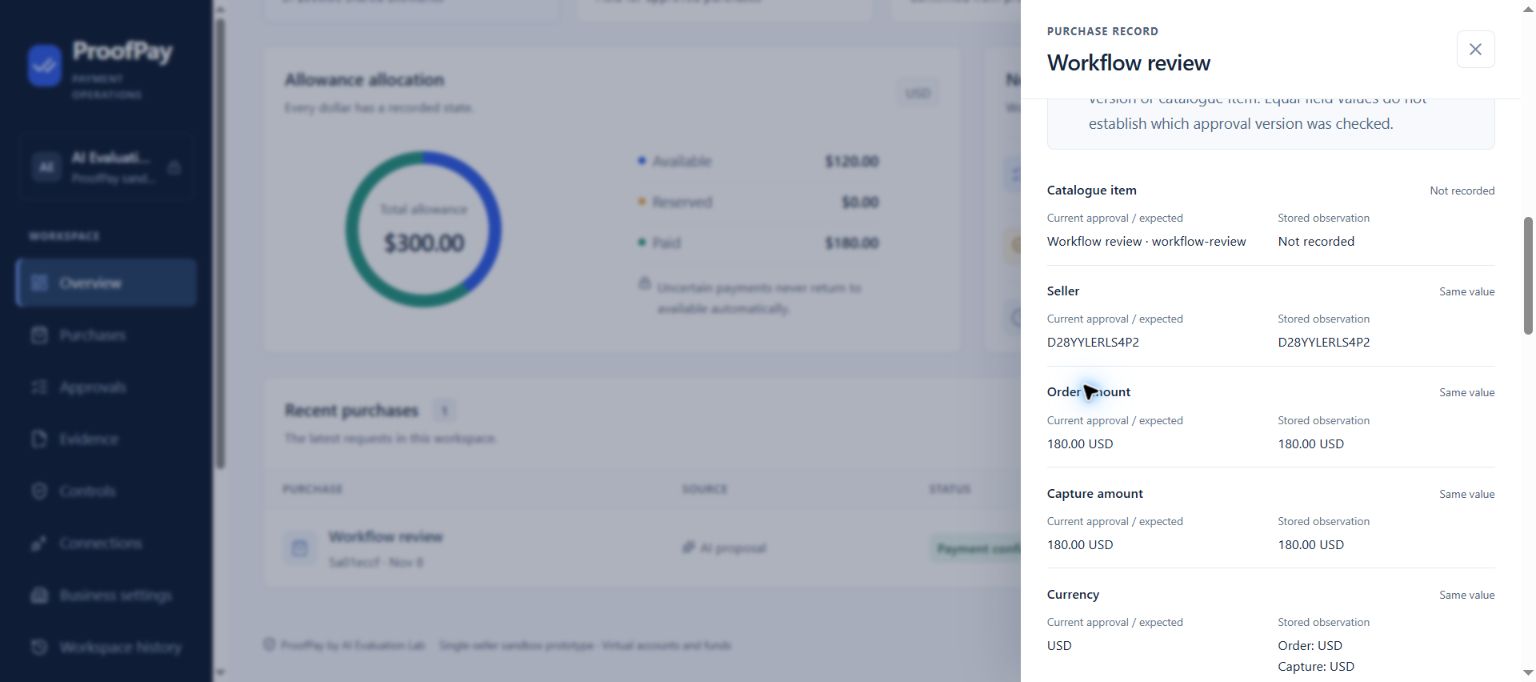
Saved PayPal sandbox evidence. This screen comes from the completed GPT-4.1-mini and PayPal sandbox run using virtual funds. The receipt inspector shows the stored comparisons and missing historical catalogue evidence. It is an unsigned application record, not a new transaction.
How we built it
The application uses TypeScript, Next.js 16 and React 19 on Node.js 24, deployed through GitHub and Vercel with Neon/PostgreSQL. Owner sessions use signed cookies. Approval binds the exact purchase and expiry; a conditional database transaction reserves the allowance. Create and capture request IDs are stored before provider dispatch.
PayPal OAuth and Orders v2 handle order creation, native buyer approval, capture and lookup. Confirmation and its limited verification snapshot are persisted together. The public judge deployment uses separate rehearsal storage and disables owner routes.
The runtime model route uses Vercel AI Gateway with a reviewed free-credit grant and a durable attempt limit. Failed attempts count; the application does not silently retry or switch to personal provider credentials. The grant's one model attempt has been consumed. We preserve that completed proposal instead of making another model call for a demonstration.
What we verified
On 8 November, the deployed owner application completed a genuine model-to-PayPal sandbox purchase. Gateway evidence records openai/gpt-4.1-mini, HTTP200, 242 input tokens and 48 output tokens, with a displayed USD0.0002 request cost. It used the reviewed Vercel free-credit route, with no personal OpenAI key or personal credits.
That proposal became a $180 purchase. The owner approved it, the sandbox buyer completed PayPal's native approval, and the application dispatched capture while deliberately dropping the response. A browser reload retained $180 reserved, $120 available and $0 paid.
A GET of the original order confirmed the matching completed final capture. The result became $180 paid, $0 reserved and $120 available. Repeated lookup retained the same capture and totals. This is one observed sandbox run; aggregate external request counts were not independently measured.
The seven-section source checkpoint 26893ed6 passed 210 local tests, TypeScript, full lint and build. The current cfd1d007 deployment passed nine real PostgreSQL checks with no skips, committed migrations, TypeScript and the Next.js build; both CI workflows passed. These checks are not live model or payment calls.
The new browser review completed the six-step rehearsal at cfd1d007: approve $180, block $160, lose the simulated response, reload with the reservation intact, confirm the original order and check again without changing the result. Overview reopened the same unresolved purchase; Evidence displayed its matching references and recorded limits. Evaluation lab showed 6/6 observed, and the captured application console was empty.
All seven views were checked at 360, 768 and 1280 pixels: 21 responsive views, with no horizontal overflow and 16px main text. Those measurements were taken at 26893ed6; the later cfd1d007 change affects the preferred workflow selection, not the layout.
Separately, the earlier release passed 21 independent HTTPS checks across two guest sessions, including isolation and recovery. An actual guest receipt downloaded over HTTPS passed the offline consistency verifier. Those HTTP results remain dated evidence; they are a different set of checks from the new 21 responsive views.
The earlier owner browser CSV/Blob download remains unverified. The successful guest HTTPS receipt check does not replace that missing evidence.
What we learned
An application decision and an external payment effect need different evidence. A missing response cannot justify releasing allowance or issuing another purchase. A model's explanation, a return link and a completed provider capture are not interchangeable.
The receipt is useful for inspection, but it is unsigned application evidence. Its provider verification snapshot lacks the historical approval version and catalogue SKU. Matching current fields and passing the offline verifier establish limited internal consistency, not provider authenticity, historical authority or service fulfillment.
What's next
The next commercial test is whether owner-led agencies, consultancies or studios will pay for a reusable approval, allowance and recovery workflow. Customer demand, time savings and pricing remain hypotheses.
The current build covers one controlled seller, US dollars and a workspace allowance. Production payments, refunds, webhooks, fulfillment, multi-user roles and provider portability remain outside this build. Our immediate focus is learning from repeatable evaluations before expanding that scope.
Team credits
Rama Chandra M — Founder and Principal Researcher, AI Evaluation Lab
Prof Nithya Ravi Kumar — Principal Advisor for ProofPay
Built With
- next.js
- openai
- paypal
- postgresql
- typescript
- vercel
