Inspiration
A lot of people use GitHub to build projects, report bugs, and contribute to other people's work. But finding meaningful contributions and getting rewarded for solving real issues isn't always easy.
We wanted to build something that connects developers with GitHub issues that need to be solved and gives them an opportunity to earn money for their work. That's how OpenProofPay started.
What it does
OpenProofPay is a bounty platform for GitHub where developers can earn money by solving issues in existing repositories.
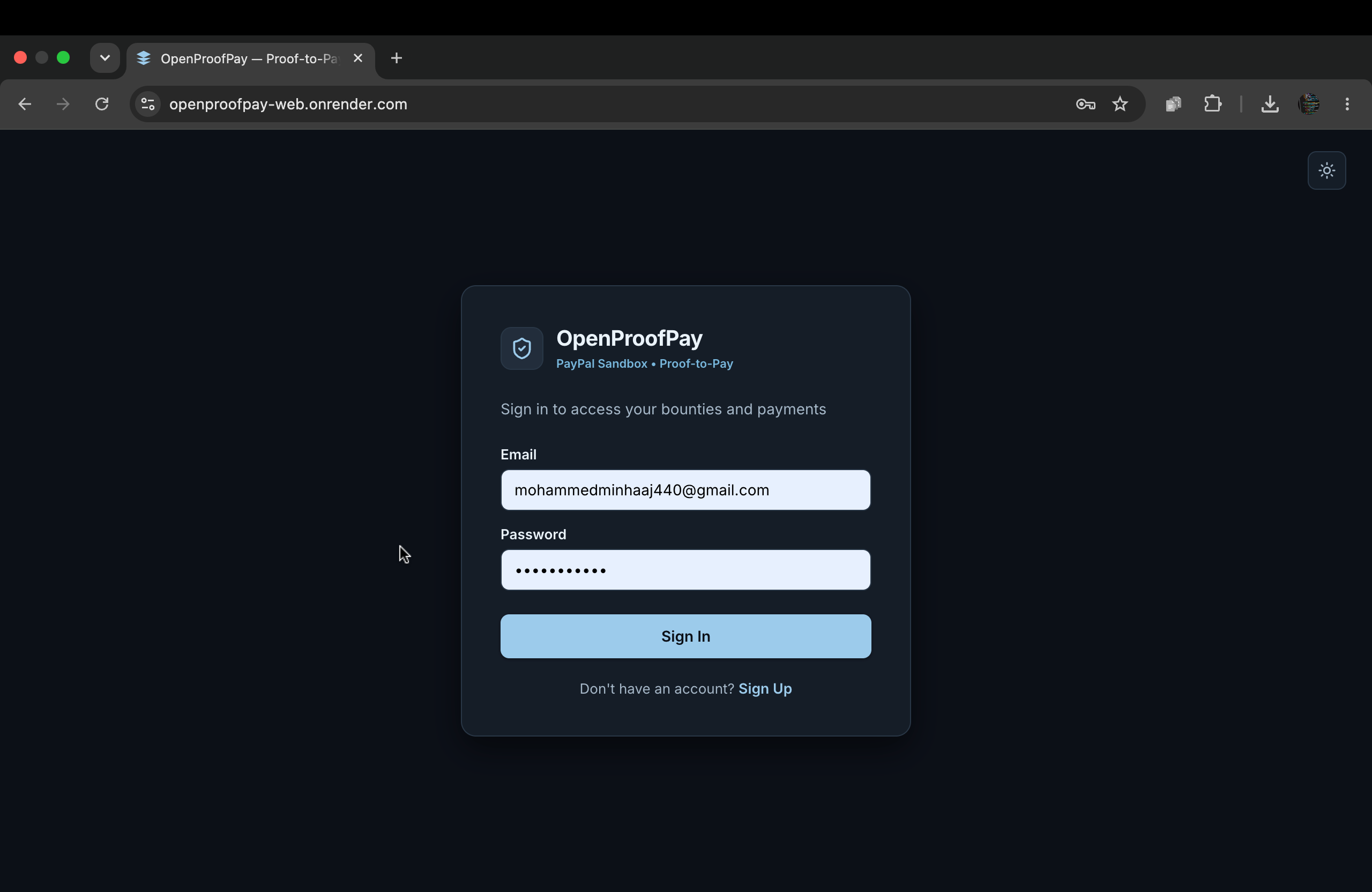
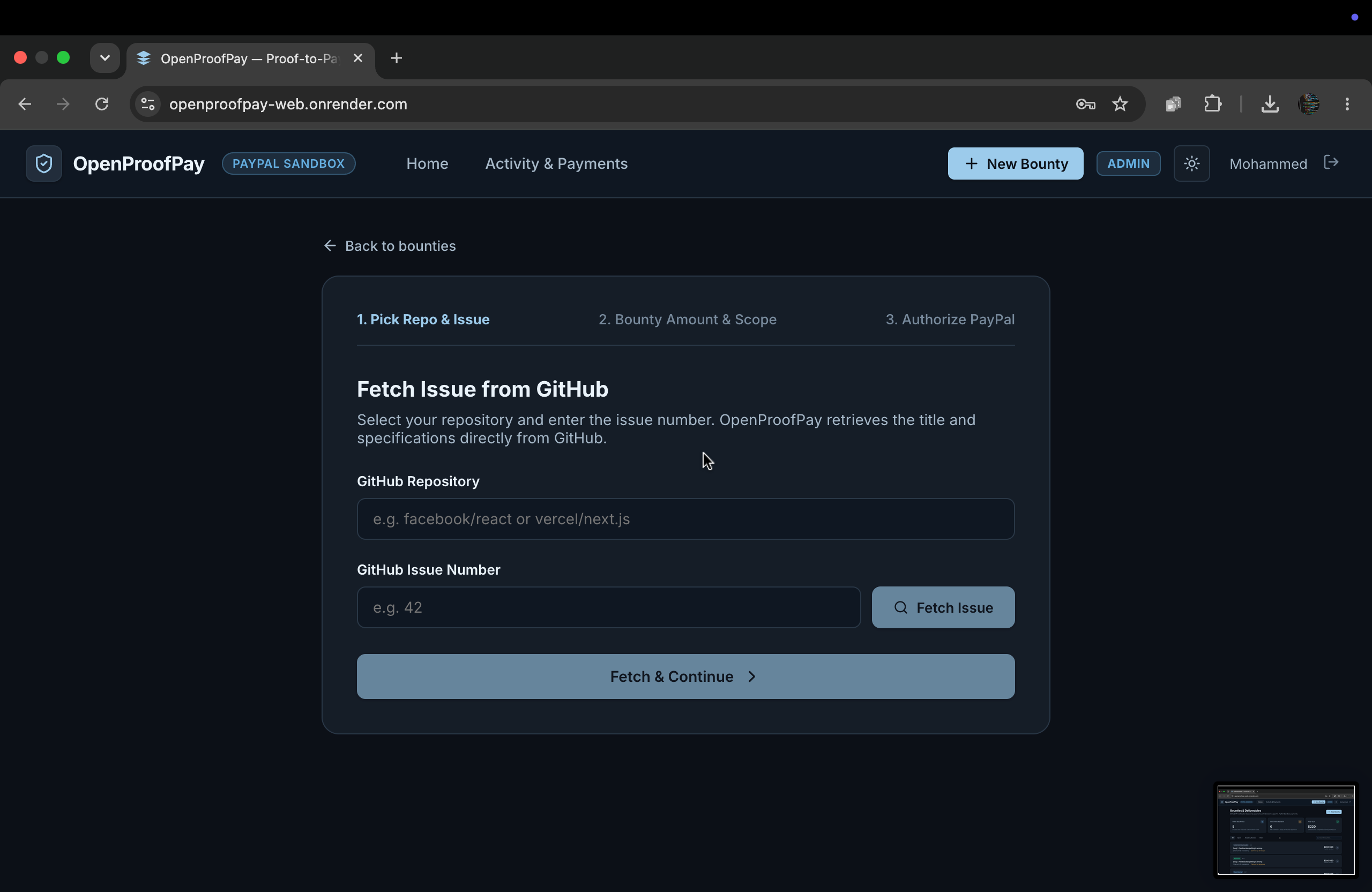
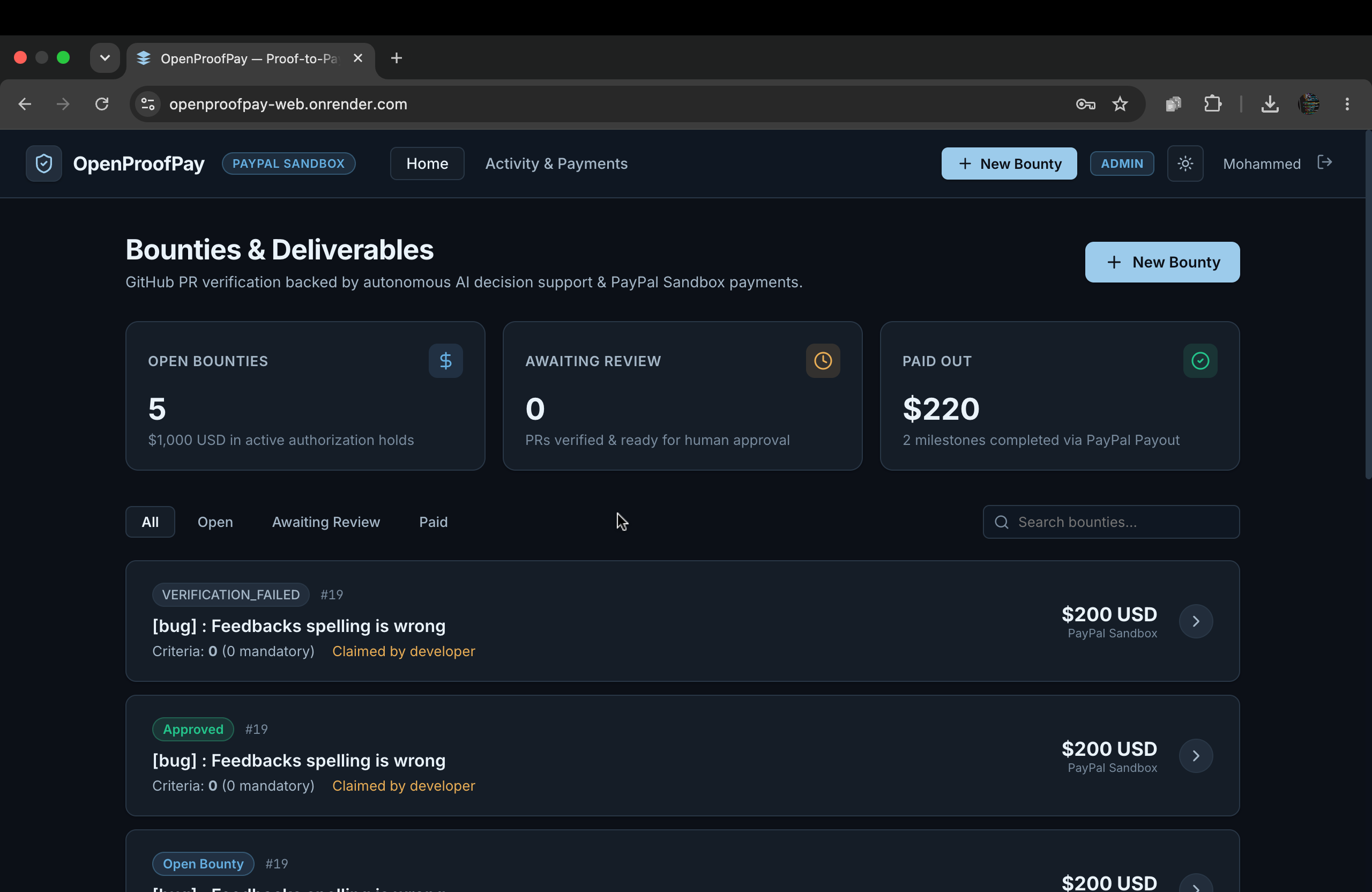
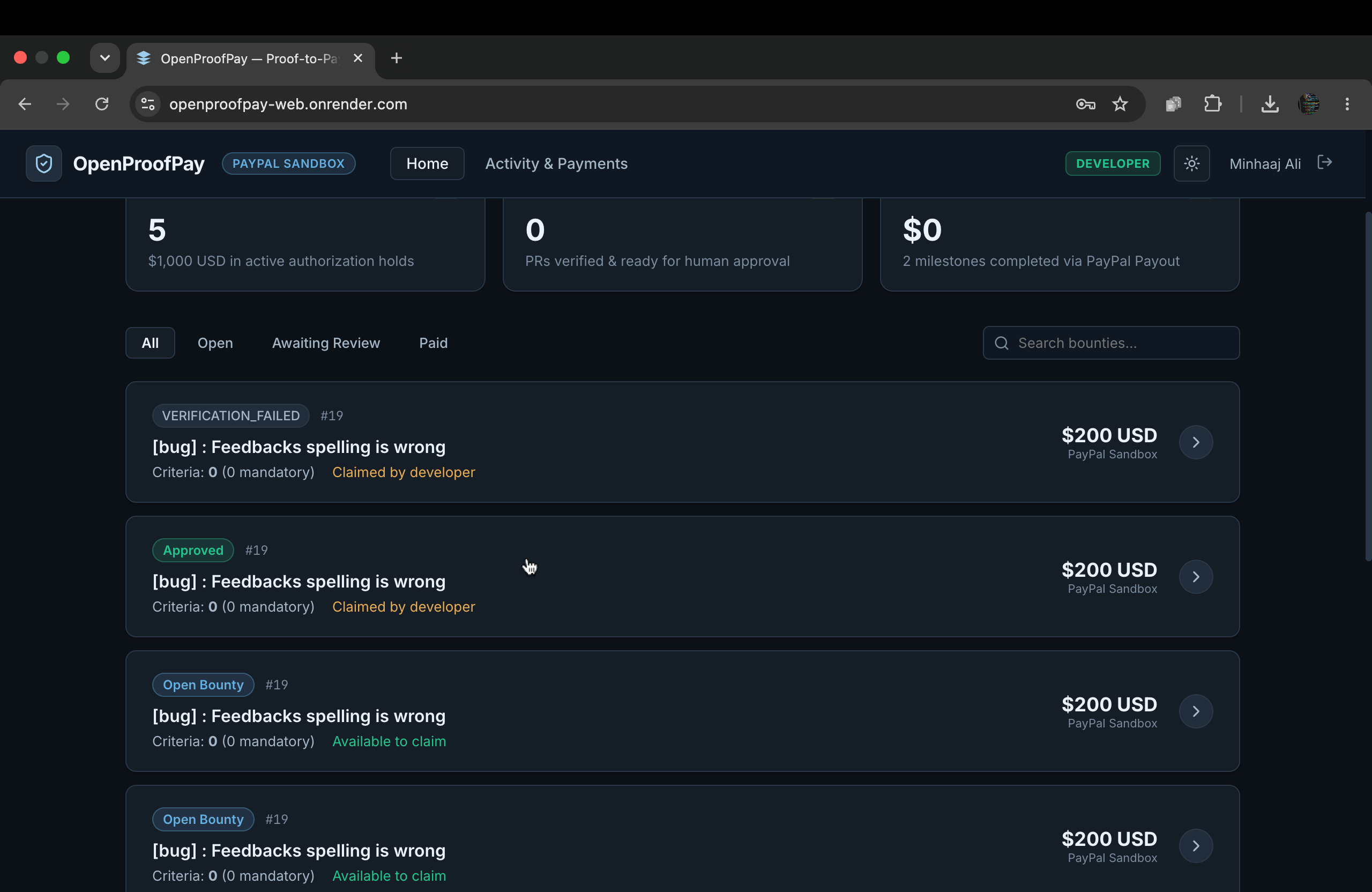
Project owners can create bounties by linking GitHub issues and setting a reward for solving them. Developers can browse available bounties, pick issues that match their skills, work on them, and submit their solutions through GitHub pull requests.
AI helps review submitted code against the original issue requirements, and automated tests provide another layer of verification. Once the work is reviewed and approved by an admin, the bounty payment can be released through PayPal.
The idea is simple: solve real problems on GitHub and get paid for your work.
How we built it
We built OpenProofPay using React, Node.js, Express, and MongoDB.
GitHub integration allows us to fetch issues and connect submitted pull requests to their original bounties. We use AI to review code changes and check whether they address the requirements of the issue. Automated tests help verify the submitted work.
For payments, we integrated the PayPal Developer Platform using Sandbox. It allows us to authorize bounty payments first and capture them after the work has been reviewed and approved.
We also built an admin approval step so that payment decisions aren't left entirely to AI.
Challenges we ran into
One of our biggest challenges was connecting GitHub contributions with the payment process.
A pull request being submitted doesn't necessarily mean the issue is completely solved. We had to think about how to verify the actual code changes, compare them with the issue requirements, and make sure payments happen only after proper approval.
Integrating PayPal Sandbox and understanding the authorization and capture flow was another challenge. Getting all these parts to work together as one workflow took quite a bit of debugging.
Accomplishments that we're proud of
We're proud that we built a working bounty platform that connects GitHub issues with actual payments.
Some things we're particularly happy about:
- Creating and managing bounties directly through GitHub issues.
- Allowing developers to discover bounties and earn rewards for solving real problems.
- Integrating AI-based code review with automated test execution.
- Implementing PayPal Sandbox authorization and payment capture.
- Adding human approval before releasing payments.
Most importantly, we didn't want to build just another platform for listing tasks. We wanted to connect the entire process, from finding an issue to getting paid for solving it.
What we learned
We learned a lot about integrating third-party platforms like GitHub and PayPal into a full-stack application.
Working with PayPal's authorization and capture APIs helped us understand how payment flows work beyond simply sending money.
We also learned that AI-based code review has its limitations. It can help identify problems and evaluate submissions, but human judgment is still important when deciding whether work should be approved.
Building OpenProofPay also gave us a better understanding of how different services can work together to solve a real problem.
What's next for OpenProofPay
We want to make OpenProofPay a platform where developers can find more opportunities to contribute to GitHub projects and earn through their work.
Some features we'd like to add include:
- More GitHub repository integrations and easier bounty creation.
- Better matching between developers and bounties based on skills.
- Improved code verification and test execution.
- Support for more payment methods.
- Developer profiles, contribution history, and bounty leaderboards.
- A dispute resolution system for handling disagreements between project owners and contributors.
Our long-term goal is to make contributing to projects on GitHub more accessible and give developers another reason to participate, learn, and build.
Built With
- ai
- api
- artificial
- automated
- bounty
- code
- development
- express.js
- github
- integration
- intelligence
- javascript
- mongodb
- node.js
- open
- payment
- paypal
- platform
- react
- rest
- source
- testing
