Inspiration
Most of the world's small jobs never touch a marketplace. A neighbour paints a wall, a college student tutors maths, a cousin does a delivery run. The deal is a WhatsApp message, and payment rests on trust. Someone always has to go first: the client pays and hopes, or the worker finishes and chases. Formal escrow platforms are too heavy and too expensive for a $40 job. We wanted the trust of escrow with the effort of sending a text.
What it does
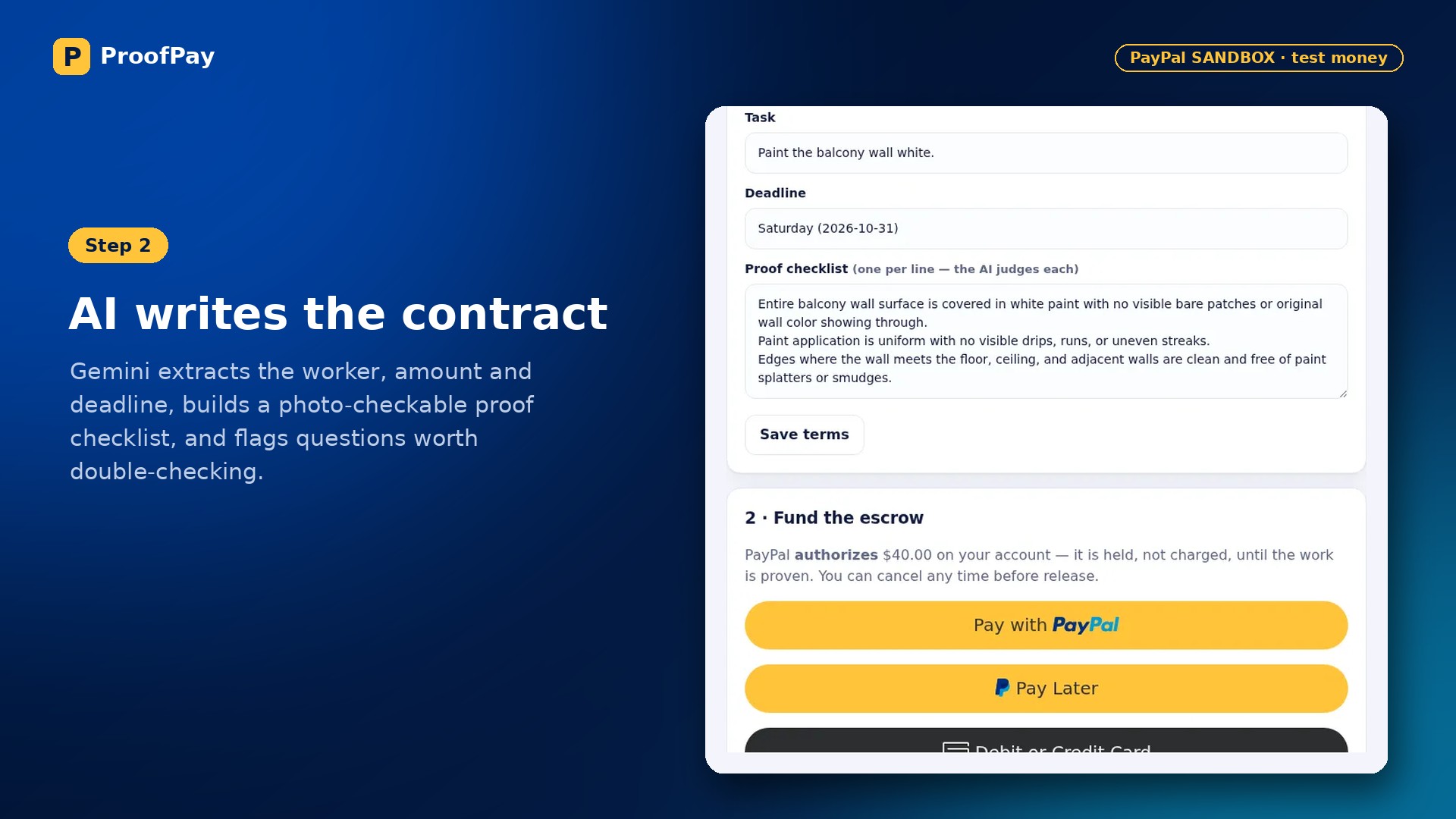
- Describe the deal in plain language. For example: "Ravi will paint my balcony wall white for $40 by Saturday." A Gemini agent turns it into structured terms (worker, task, amount, deadline) and a checklist of proof criteria a photo can verify. The client can edit everything before funding.
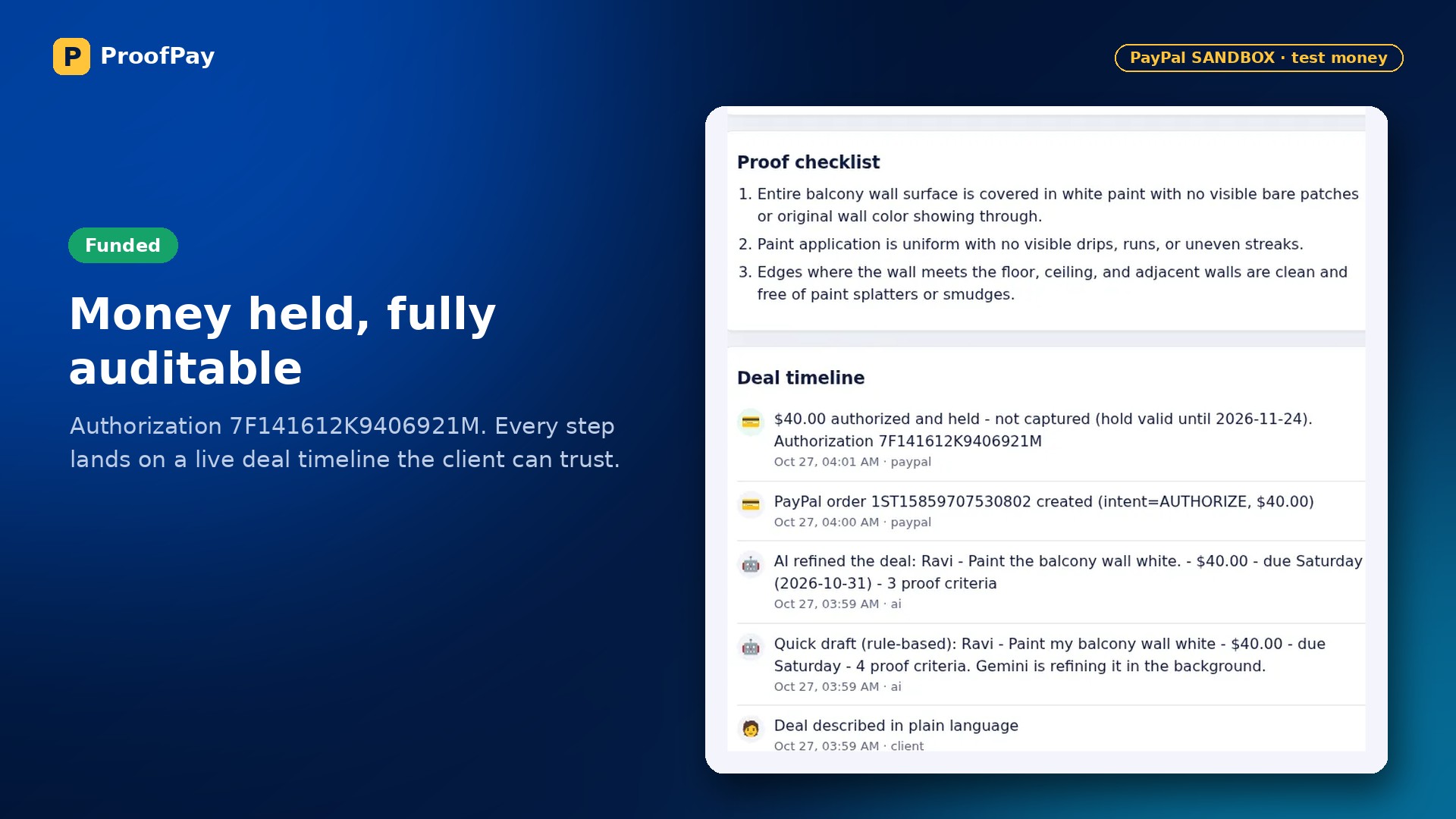
- Fund with PayPal, held and not charged. The client pays with PayPal Smart Buttons. The order uses Orders v2
intent=AUTHORIZE, so the funds are authorized and held, not captured. - The worker proves the job. A share link shows the worker the checklist and lets them upload photos and a note from their phone.
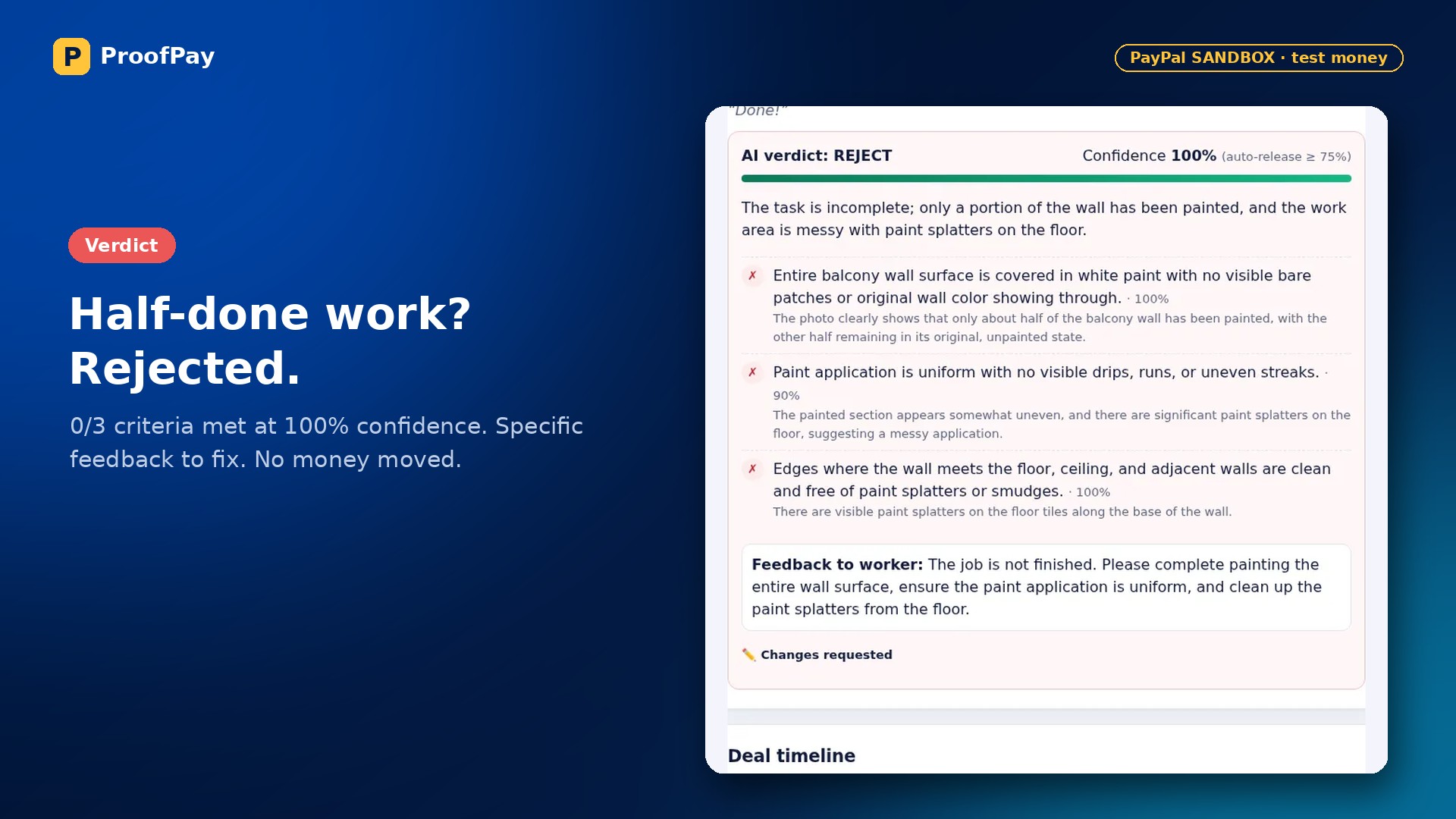
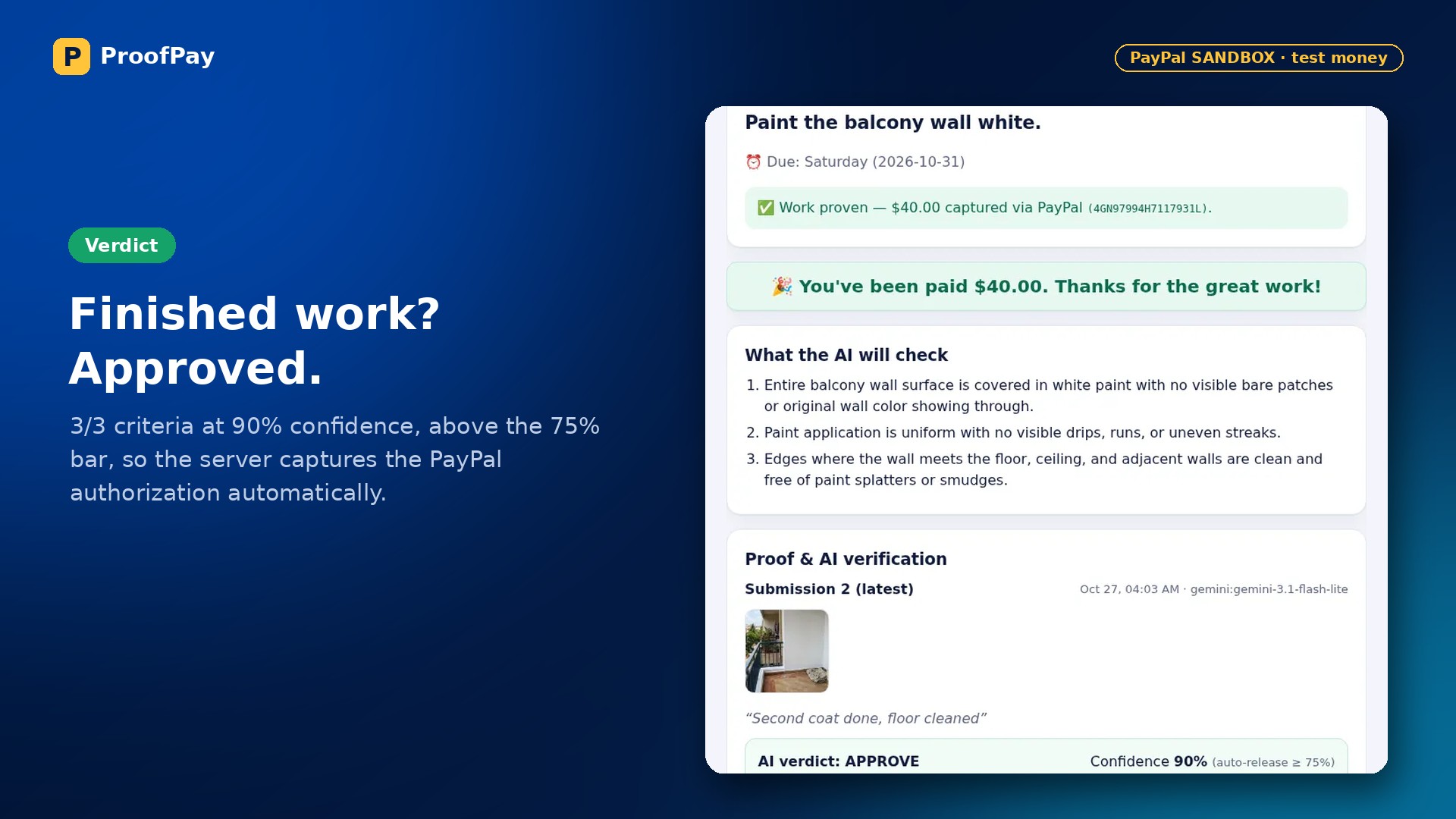
- AI vision verification. Gemini judges the proof item by item, giving pass/fail, a confidence score and reasoning for each, an overall verdict, and feedback for the worker. It flags suspicious proof such as stock-photo style images, screenshots, a photo that doesn't match the note, or (checked on the server by hash) a photo reused from another deal.
- Money moves only on proof. - Approved with high confidence → the server captures the authorization (
/v2/payments/authorizations/{id}/capture). - Rejected → the worker gets specific fixes and resubmits. - Unsure or suspicious → the client reviews and can release, ask for changes, or void the hold (/void). - Every step lands on a live deal timeline / audit log. ## How we built it
- Backend: Python FastAPI with a small, explicit escrow state machine (
draft → funded → verifying → paid | changes_requested | needs_review | voided) on SQLite. Atomic compare-and-set status updates stop double-captures when requests race. - PayPal: OAuth client-credentials, Orders v2 (create with
AUTHORIZE, then authorize), and Payments v2 (capture withfinal_capture, and void). Every money-moving call sends aPayPal-Request-Idfor idempotency. The front end uses the PayPal JS SDK withintent=authorize. - AI: The Google Gemini REST API (
gemini-3.1-flash-litewith an automatic fallback chain, configurable) withresponseSchemastructured JSON output for both agents, and images sent inline for vision. We never trust model output blindly. A normalisation layer clamps confidences, lines verdicts up with the checklist, and downgrades any "approve" that has a failing item. - Async AI: deal creation and proof upload respond instantly; Gemini refines and reviews in the background and the page updates live. A single-capture guard means a verdict can only ever release money once.
- Frontend: Jinja and vanilla JS, mobile-first, no build step. Pages poll for updates, so the client sees the verdict land live.
Judge-friendly: a mock mode turns on automatically when keys are missing (simulated PayPal authorize/capture/void and a deterministic AI stub), so anyone can run the full flow in under a minute. There are pytest tests for the whole parse → authorize → verify → capture/void flow, and the real PayPal and Gemini clients are tested against fake HTTP transports. The repo includes a Render blueprint for a free hosted demo.
Challenges we ran into
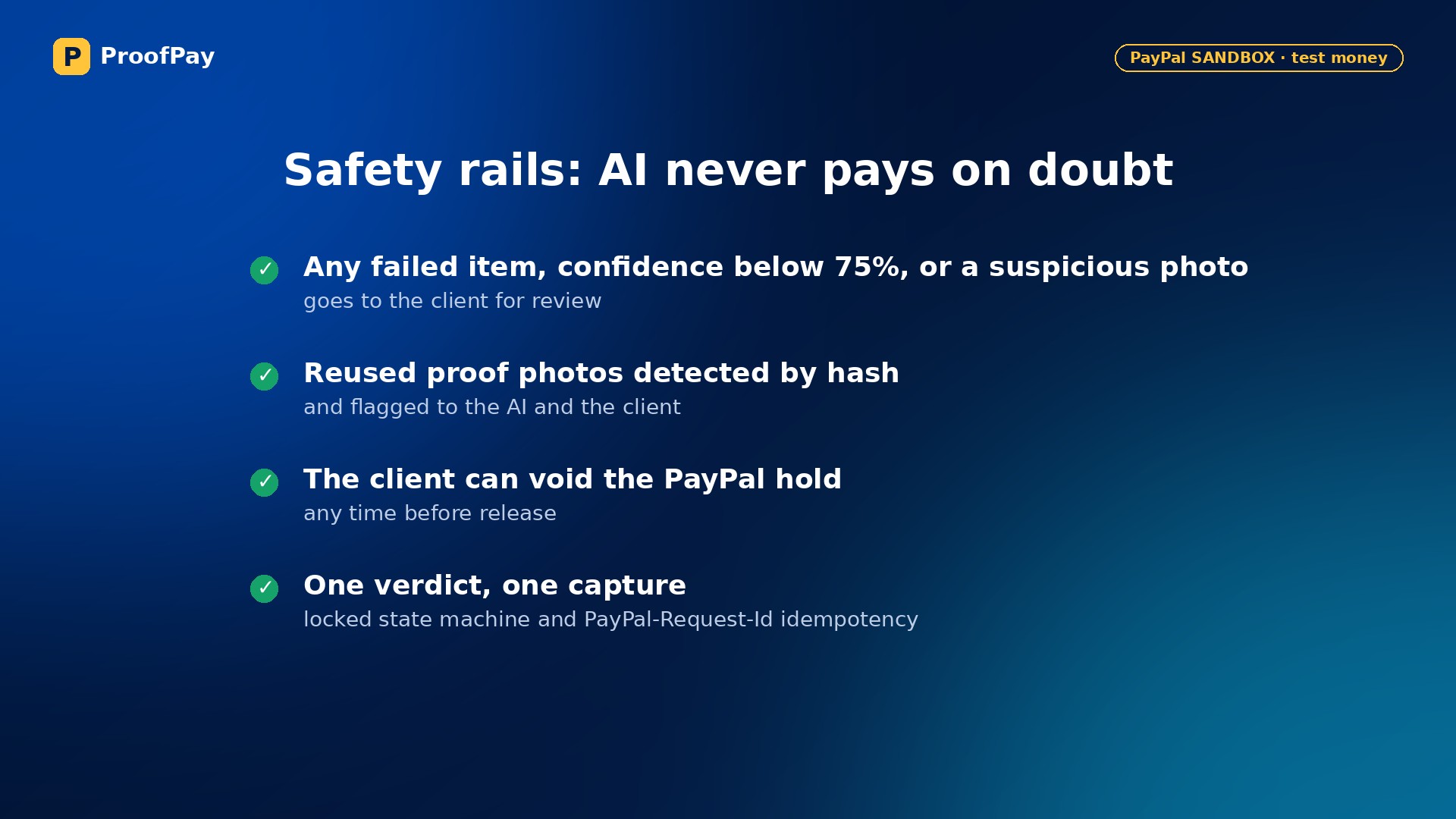
Deciding when an AI may move money. A verdict and a payment are different things. We split them: the AI produces evidence (per-item confidence and reasoning), and a separate, auditable policy decides whether to capture, ask for changes, or escalate to a human. AI errors fail safe and send the deal to client review.
Writing checklists that can be checked. "Do a good job" can't be verified. Prompting Gemini to produce criteria that are objective and photo-checkable made verification far more reliable.
Authorization lifecycle. Handling authorize vs. capture vs. void correctly, plus idempotent retries and race conditions, so a double-click can never pay twice.
Cheap fraud resistance. Hashing photos to catch proof reused across deals, and feeding that fact to the model as context.
Accomplishments that we're proud of
A full escrow loop on real PayPal sandbox rails, with AI in the money path and humans in control.
Feedback a worker can act on ("the right half of the wall is still unpainted") instead of a bare "rejected".
One command to run, with no keys needed to try it.
What we learned
- PayPal's authorize-then-capture model is a natural fit for "trust but verify" commerce.
- Structured output (
responseSchema) turns an LLM from a chatbot into a component you can rely on. - Confidence thresholds plus human override are a practical way to put AI in charge of real money.
What's next for ProofPay
- Milestones: partial captures per checklist item for bigger jobs.
- Direct payouts to workers via PayPal Payouts, plus worker reputation built on verified jobs.
- Stronger proof: live-camera capture, EXIF time and location checks, before/after pairs, short video proof.
- WhatsApp and SMS deal links, deadline reminders, and automatic void when a deadline passes.
- Dispute mediation where the AI summarises the evidence for both sides.
Built With
- fastapi
- gemini-3.1-flash-lite
- google-gemini
- javascript
- jinja
- paypal-js-sdk
- paypal-orders-v2
- python
- render
- sqlite

Log in or sign up for Devpost to join the conversation.