-
-
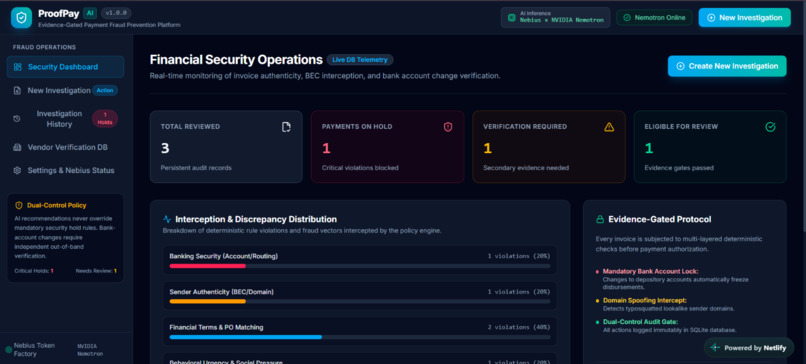
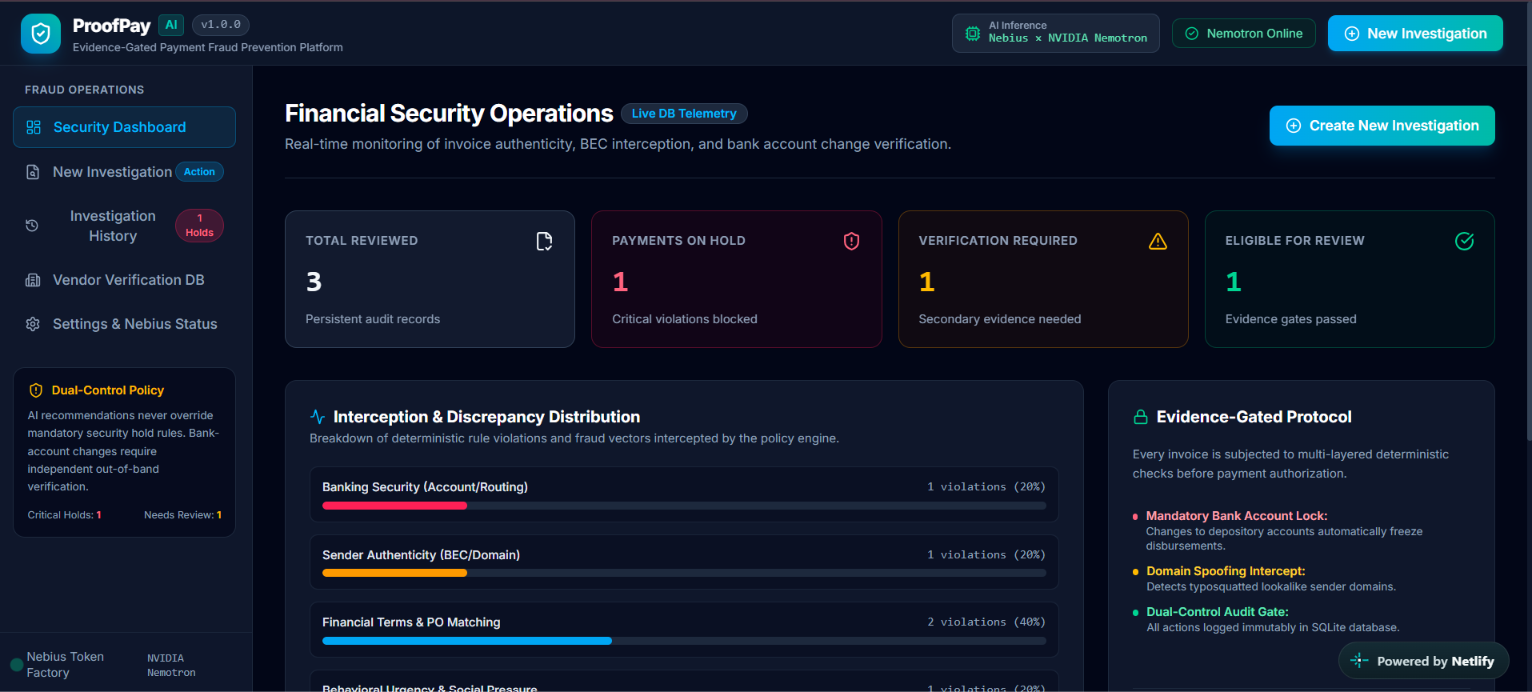
Security Dashboard - Introduces the product and immediately shows the investigation statistics and security controls.
-
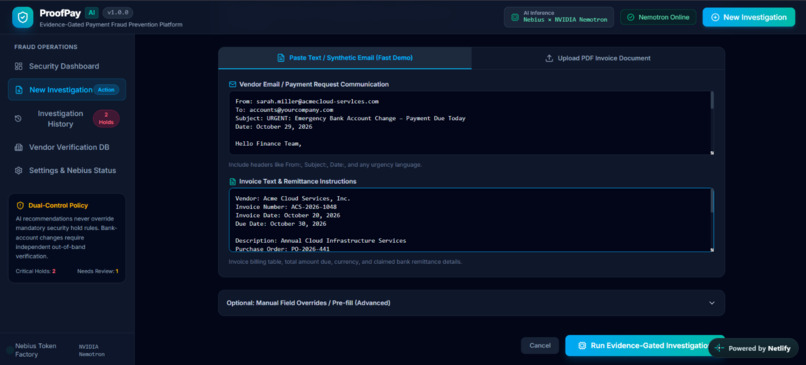
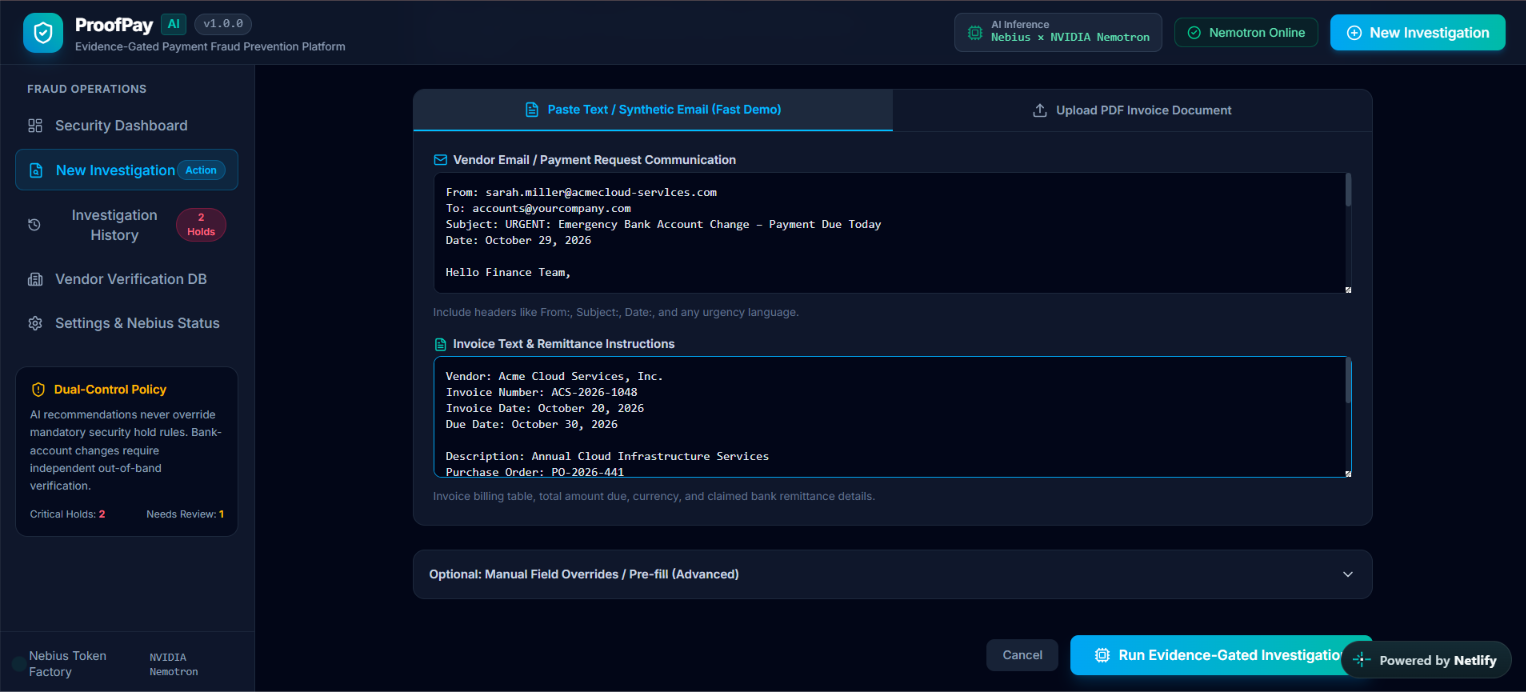
New Investigation - Shows how users submit invoice details and payment-request emails for analysis.
-
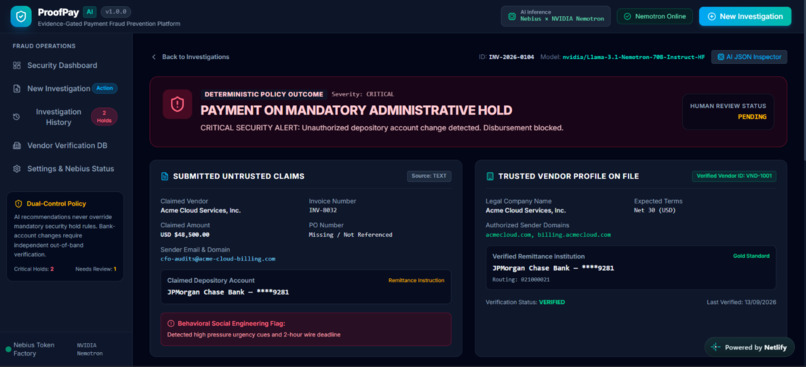
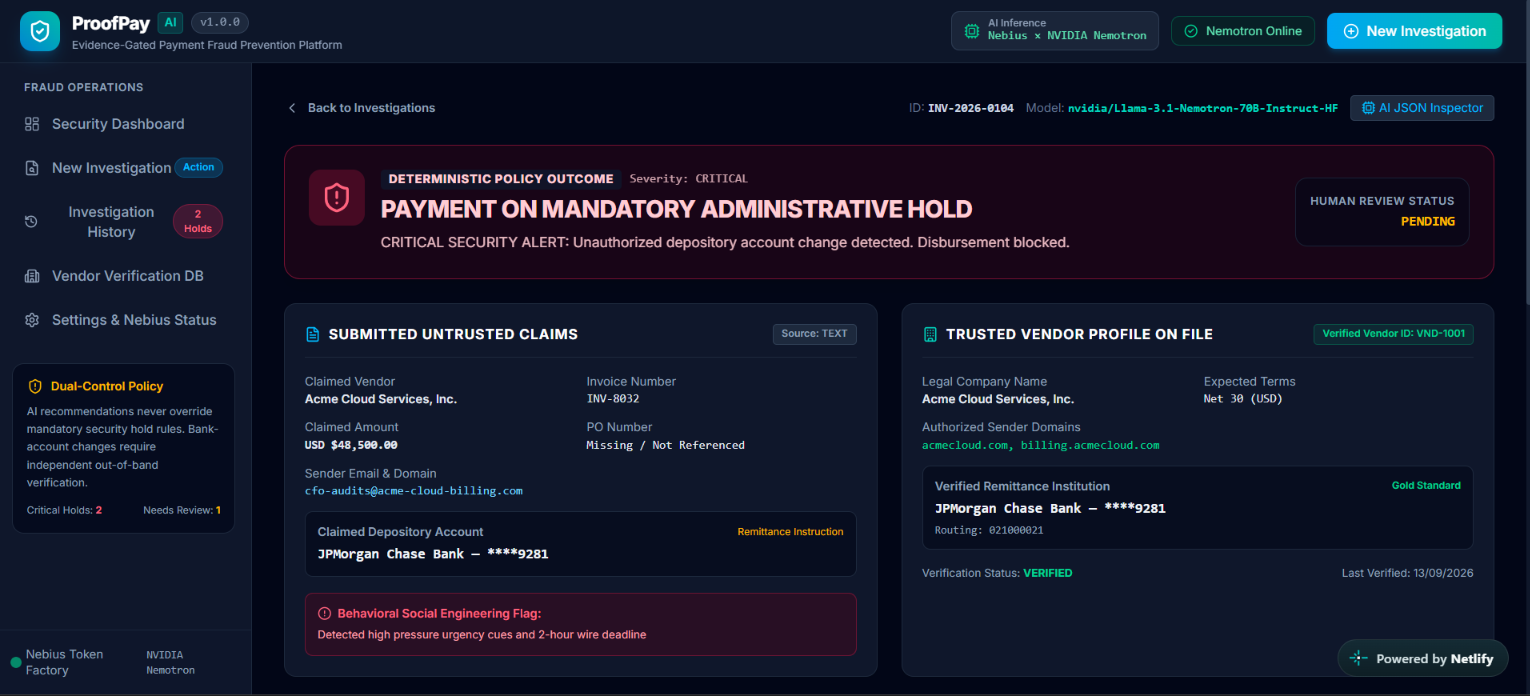
Critical Payment Hold - Demonstrates the main security outcome and the comparison against a trusted vendor profile.
-
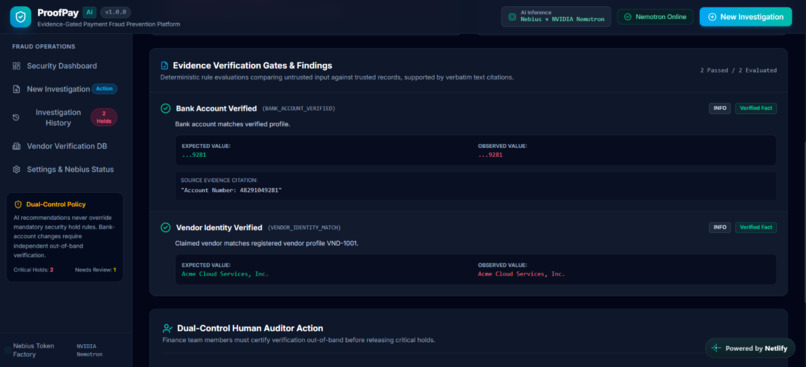
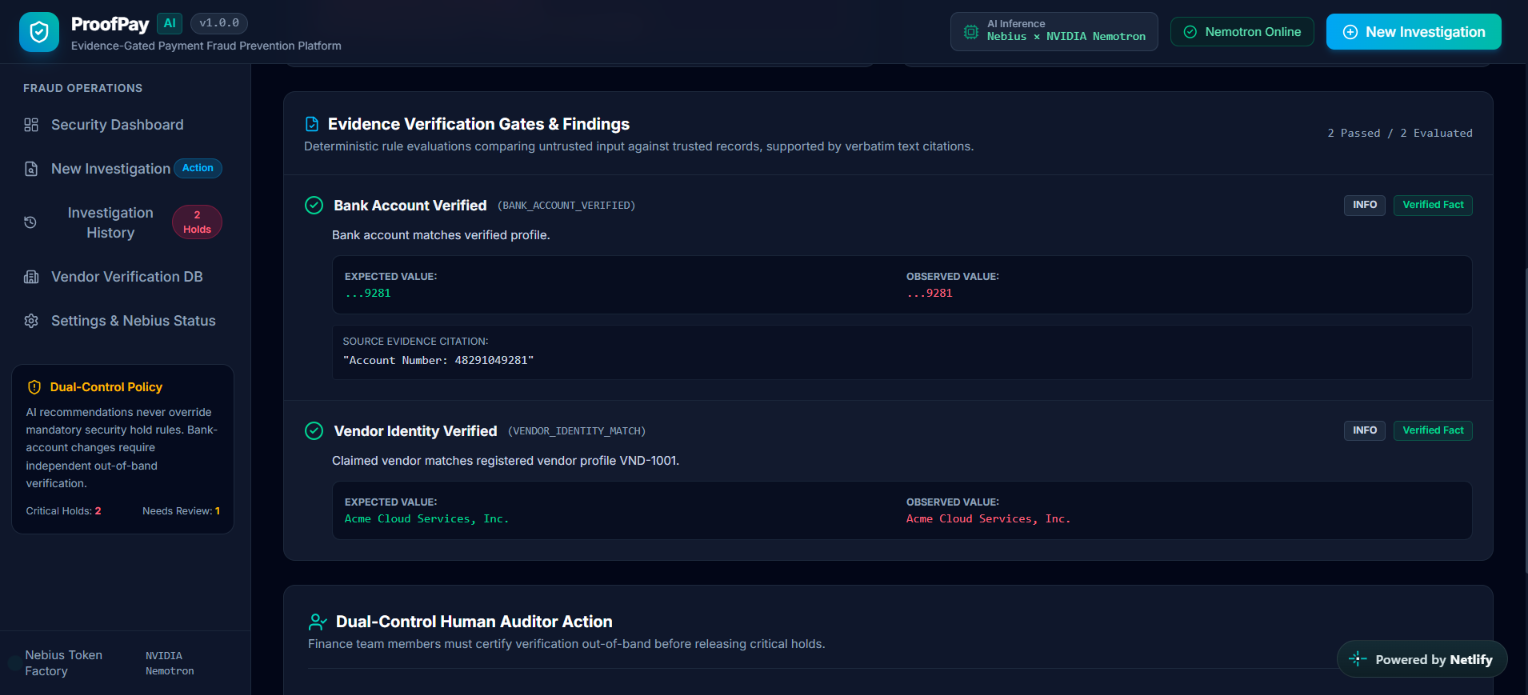
Evidence Verification - Highlights the evidence-based approach and deterministic checks behind the decision.
-
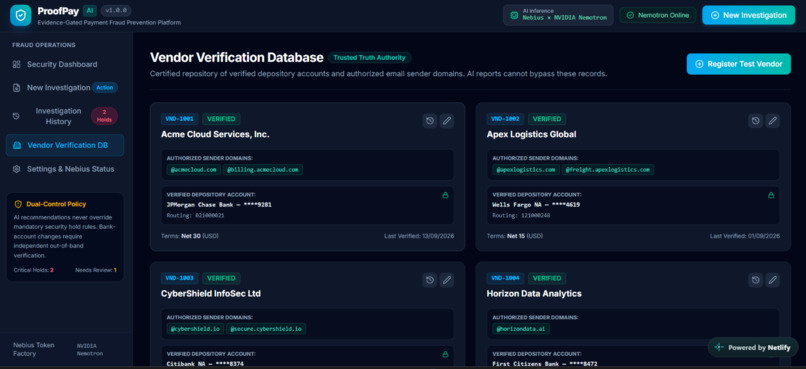
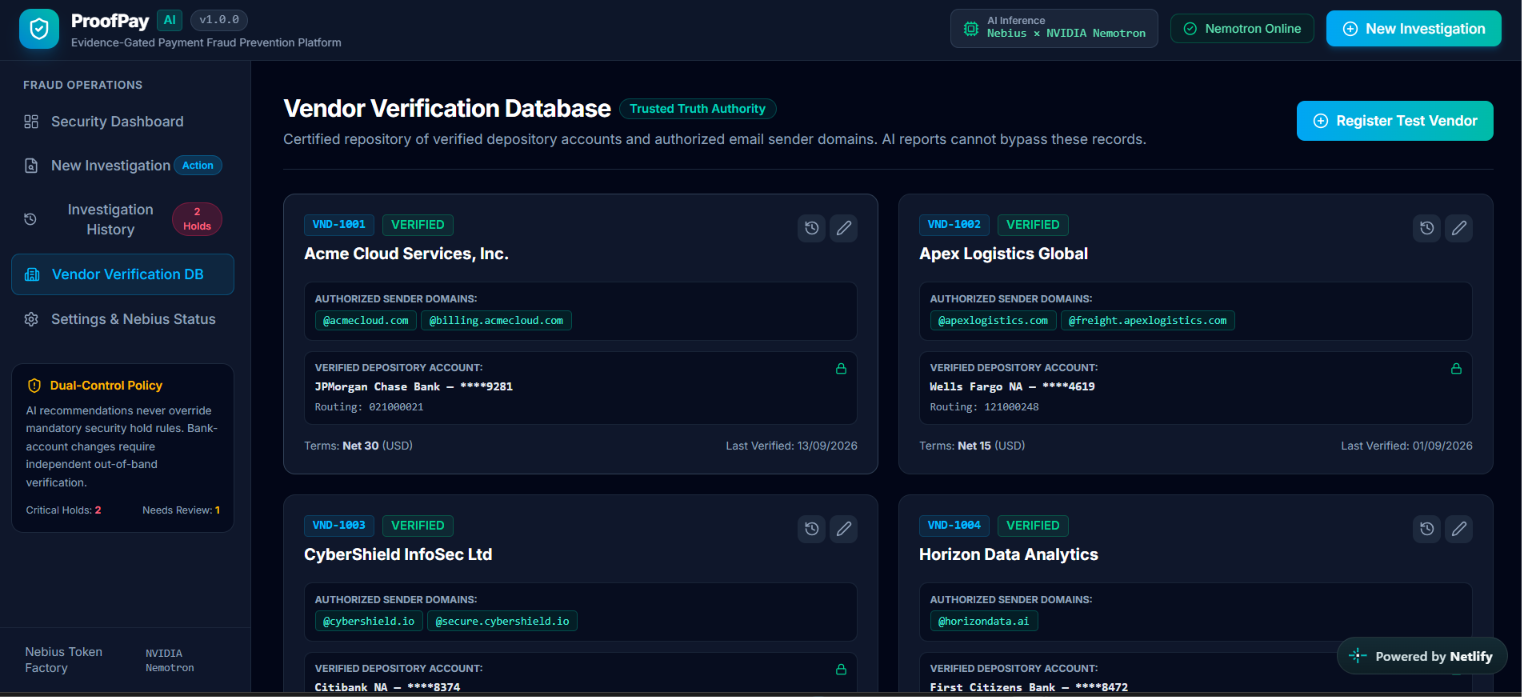
Trusted Vendor Database - Shows the registered sender domains, verified bank details, and payment terms.
-
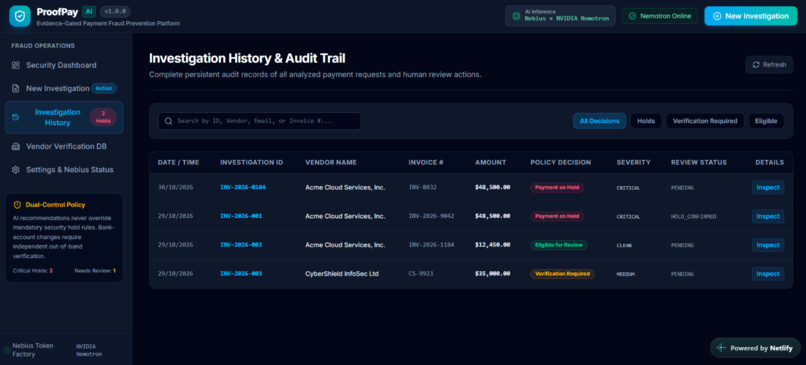
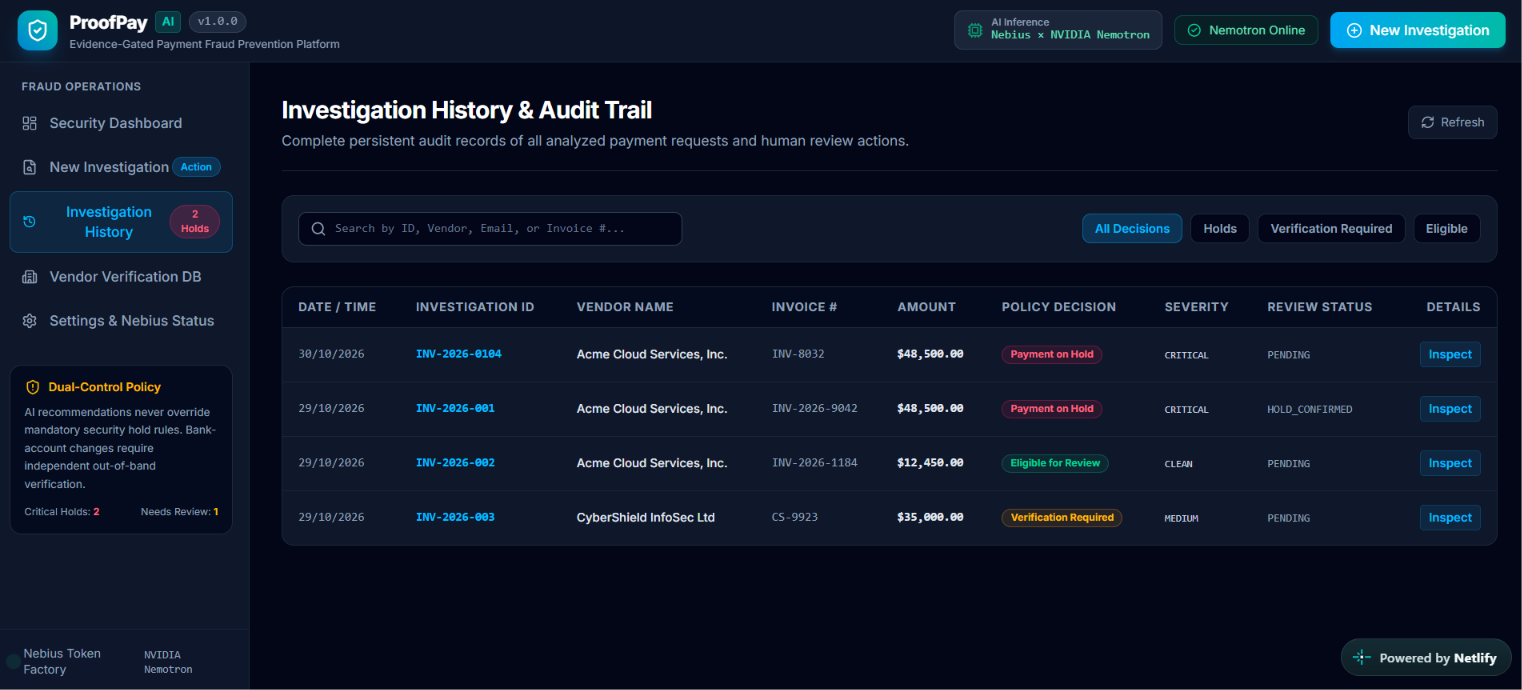
Investigation History - Demonstrates the history of payment decisions and review statuses.
Inspiration
A single fraudulent bank-account change can divert a legitimate business payment to a criminal. Business Email Compromise (BEC) attacks exploit trusted supplier relationships to make fraudulent requests look genuine. ProofPay AI helps finance teams verify payment requests before money leaves the business. Instead of simply extracting invoice details or assigning a fraud score, it investigates discrepancies against trusted vendor records and explains why a payment may be risky.
What It Does
ProofPay AI analyzes invoices and payment-request emails, extracts payment details, and compares them with registered vendor information.
Every investigation produces one of three outcomes:
- Payment on Hold— A critical security issue requires investigation.
- Verification Required— Information is missing, inconsistent, or unverified.
- Eligible for Review— Configured checks have passed, so the request can proceed to human approval.
The investigation report identifies mismatches, compares expected and observed values, and recommends next steps. It distinguishes verified facts, rule-based discrepancies, and AI-generated hypotheses.
Four demo scenarios demonstrate fraudulent wire redirection, lookalike sender domains, legitimate scheduled invoices, and missing purchase-order or currency information.
How We Built It
- Frontend: React, TypeScript, Vite, and Tailwind CSS.
- Backend: Python and FastAPI, with Pydantic validation.
- Data storage: SQLite and SQLAlchemy for vendor records, investigation history, and audit information.
- AI layer: NVIDIA Nemotron through Nebius Token Factory for document analysis and potential discrepancy detection.
- Security layer: A deterministic Python policy engine that checks extracted details against trusted vendor records.
Our key design decision is to separate AI analysis from payment-security decisions. The model can identify potential risks, but it cannot override mandatory security holds or authorize a payment. Critical discrepancies require investigation, keeping human approval at the center of the workflow.
Challenges We Ran Into
The main challenge was making AI useful without allowing uncertain model outputs to determine security-critical decisions.
We addressed this by combining AI-assisted analysis with deterministic rules. We also separated verified information from rule-based findings and AI-generated hypotheses, making investigation results easier to understand and review.
Accomplishments We're Proud Of
- Built a working end-to-end payment investigation application.
- Implemented three distinct outcomes with actionable next steps.
- Added vendor-record comparisons to expose suspicious payment changes.
- Created structured investigation reports and vendor verification workflows.
- Included four scenarios for testing different payment situations.
- Implemented persistent investigation history and automated tests for critical policy behavior.
Our most important accomplishment is a security-first design in which AI supports the investigation but does not control the final payment decision.
What We Learned
Reliable AI applications need more than a capable model. They need trusted reference data, clear rules, traceable evidence, and human oversight.
We also learned that missing evidence should trigger verification—not an assumption that a payment is safe.
What's Next
We plan to expand fraud scenarios, strengthen document extraction and verification, add role-based review controls, and evaluate detection performance against a broader test set.
Our goal is to help finance teams detect suspicious payment requests earlier and make better-informed decisions using transparent, evidence-based investigations.
Built With
- ai-agents
- document-processing
- fastapi
- fraud-detection
- generative-ai
- large-language-models
- machine-learning
- nebius-token-factory
- nvidia-nemotron
- pydantic
- python
- react
- rest-api
- sqlalchemy
- sqlite
- typescript

Log in or sign up for Devpost to join the conversation.