-
-
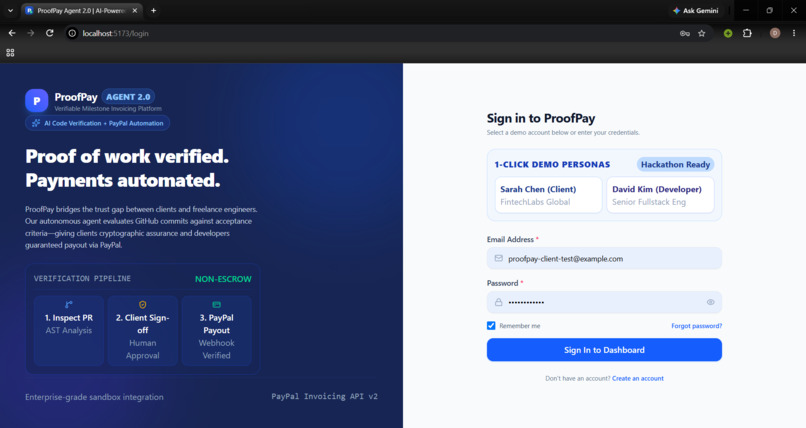
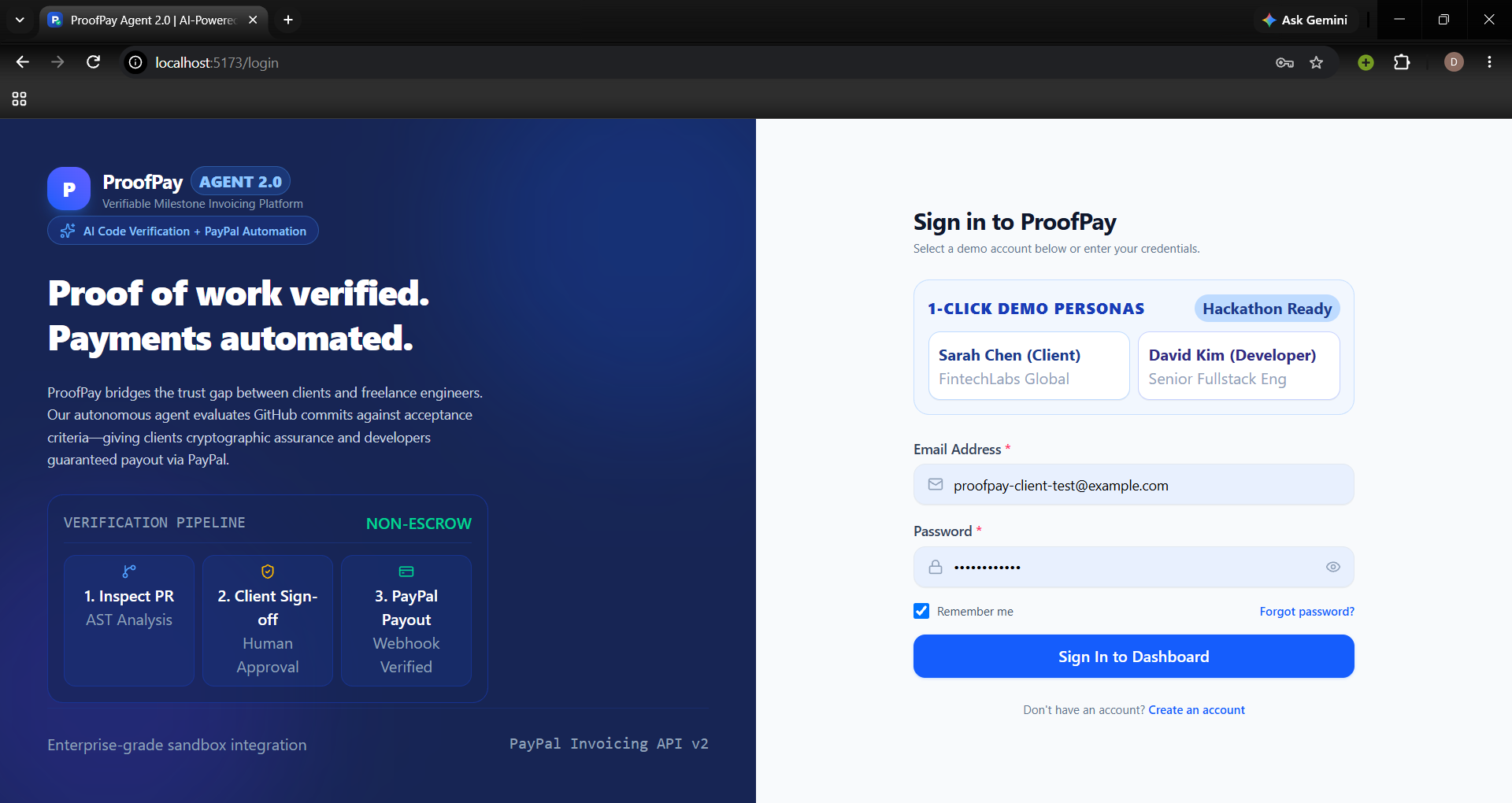
login page
-
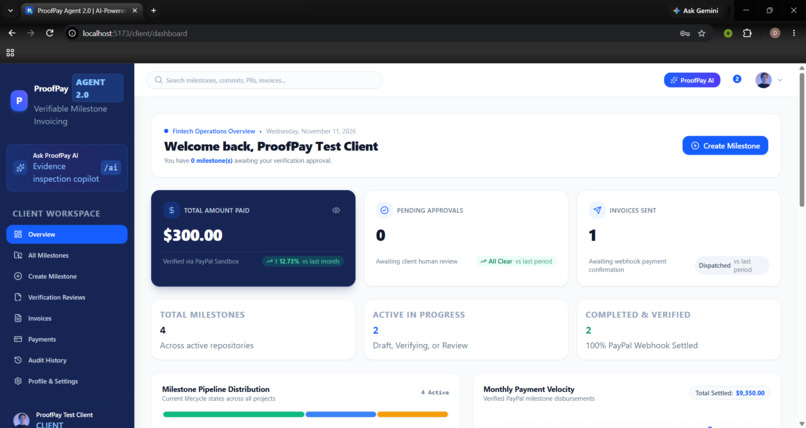
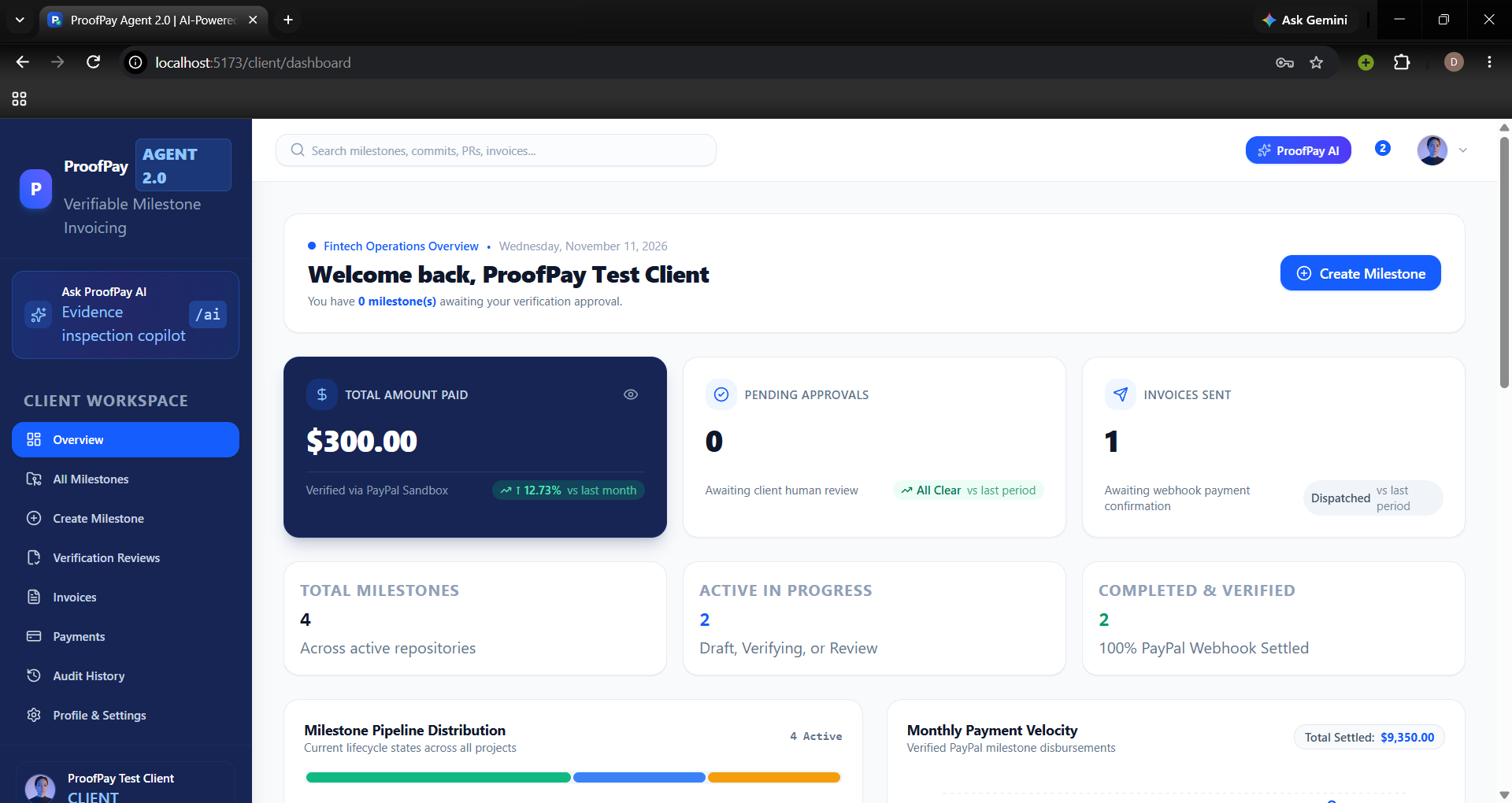
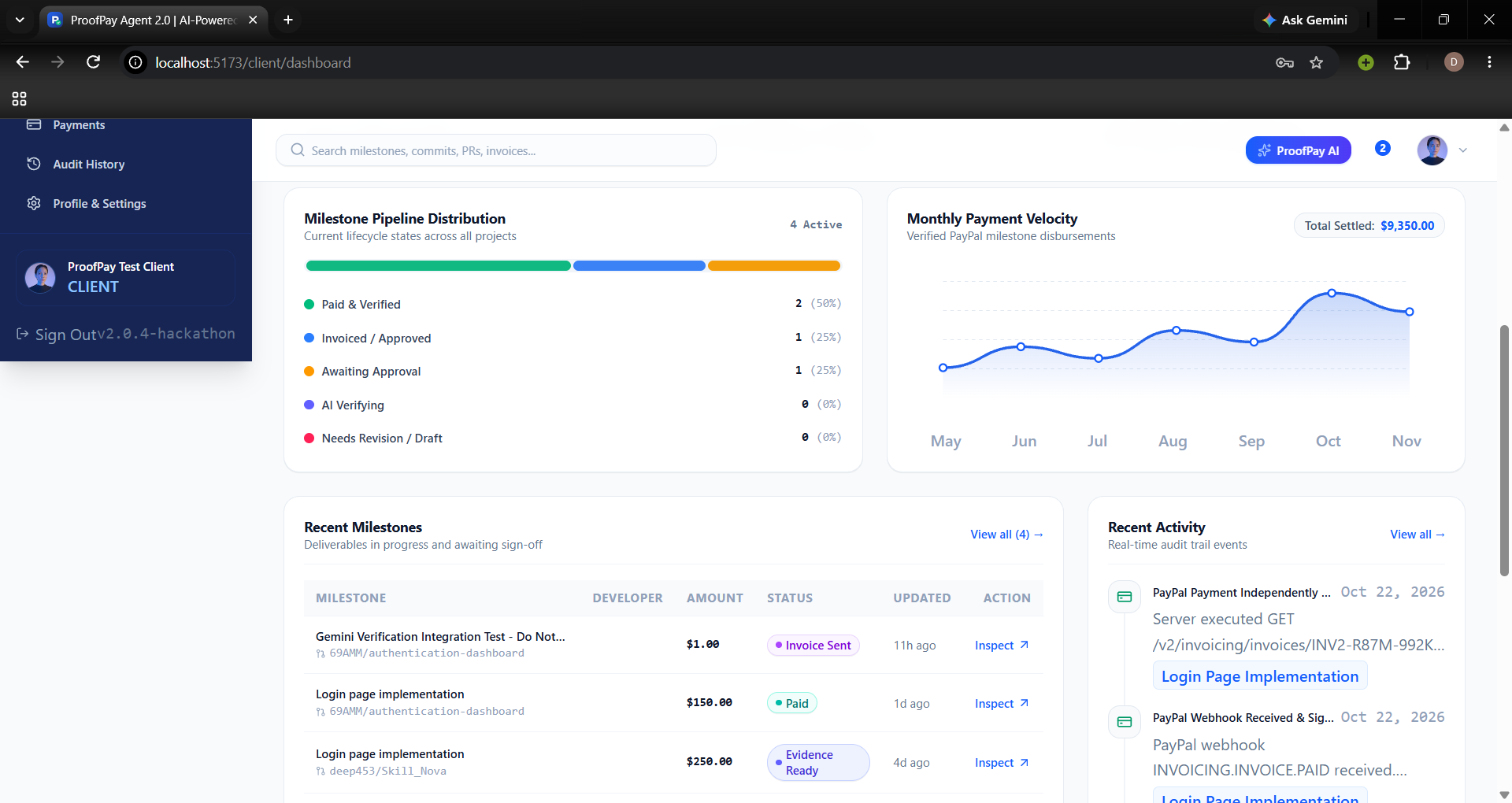
client overview page
-
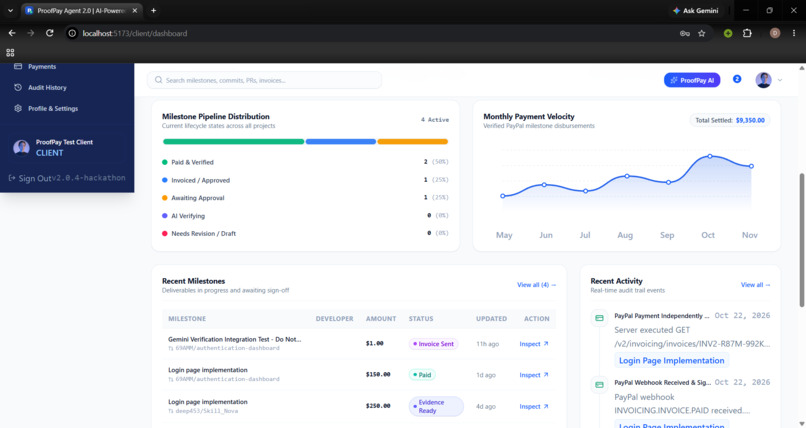
other view of that page
-
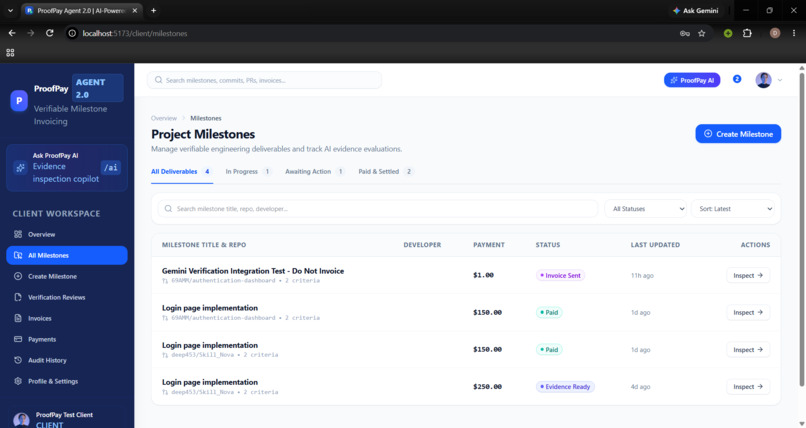
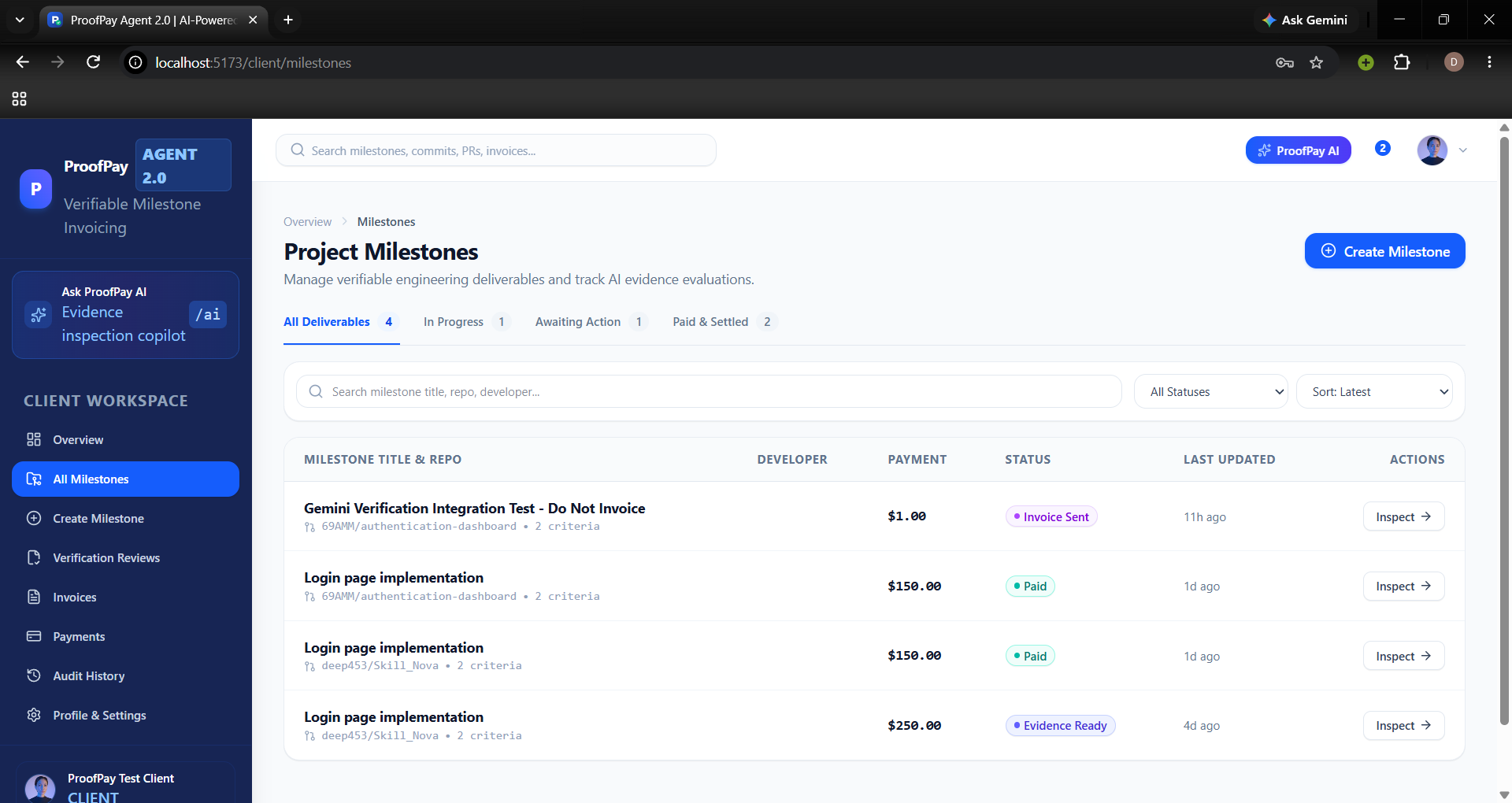
milestone page
-
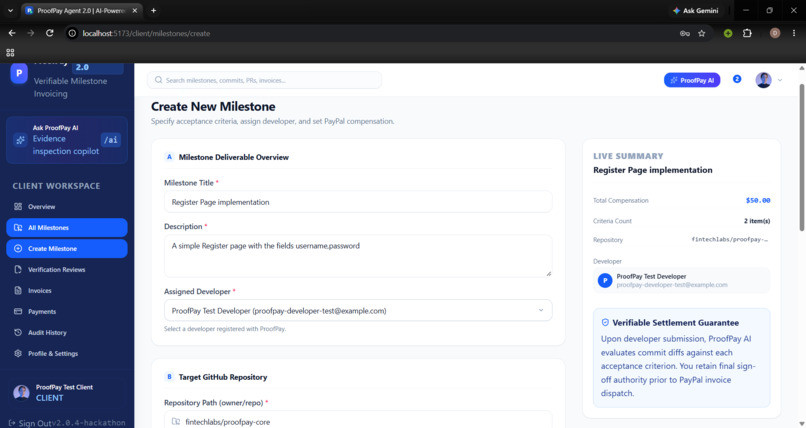
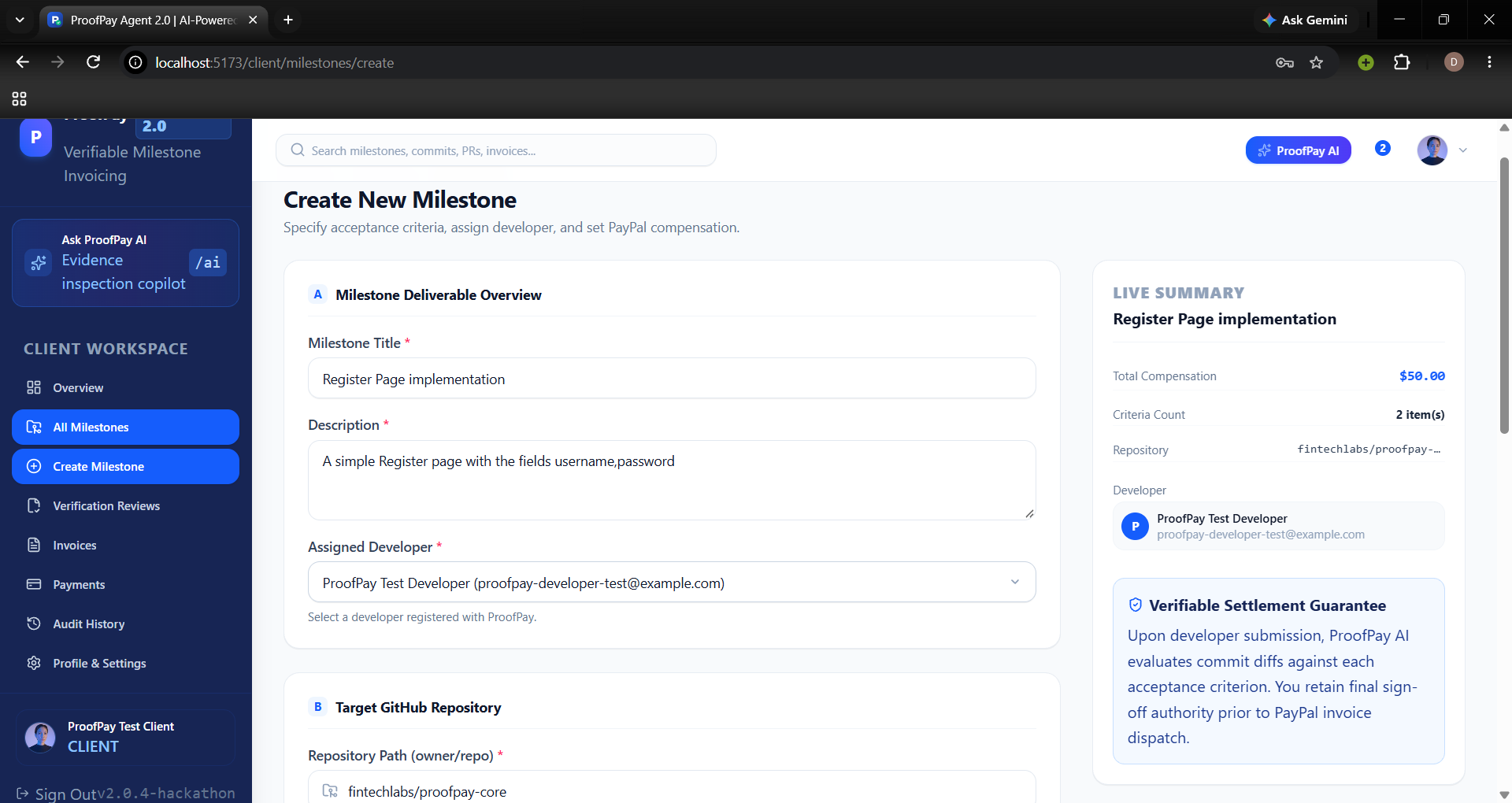
create milestone page
-
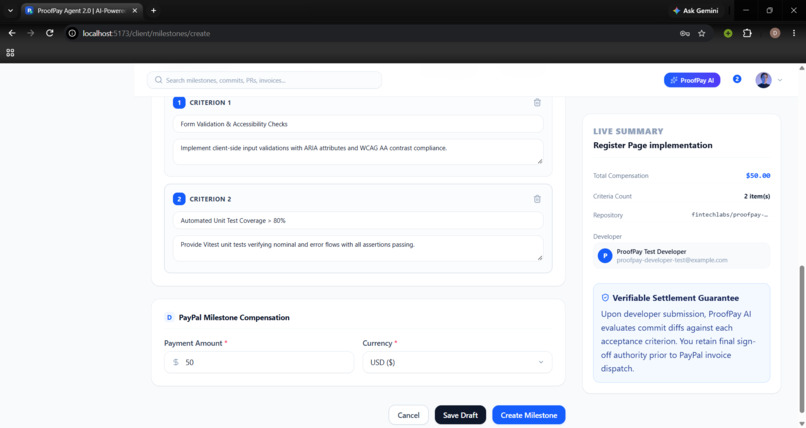
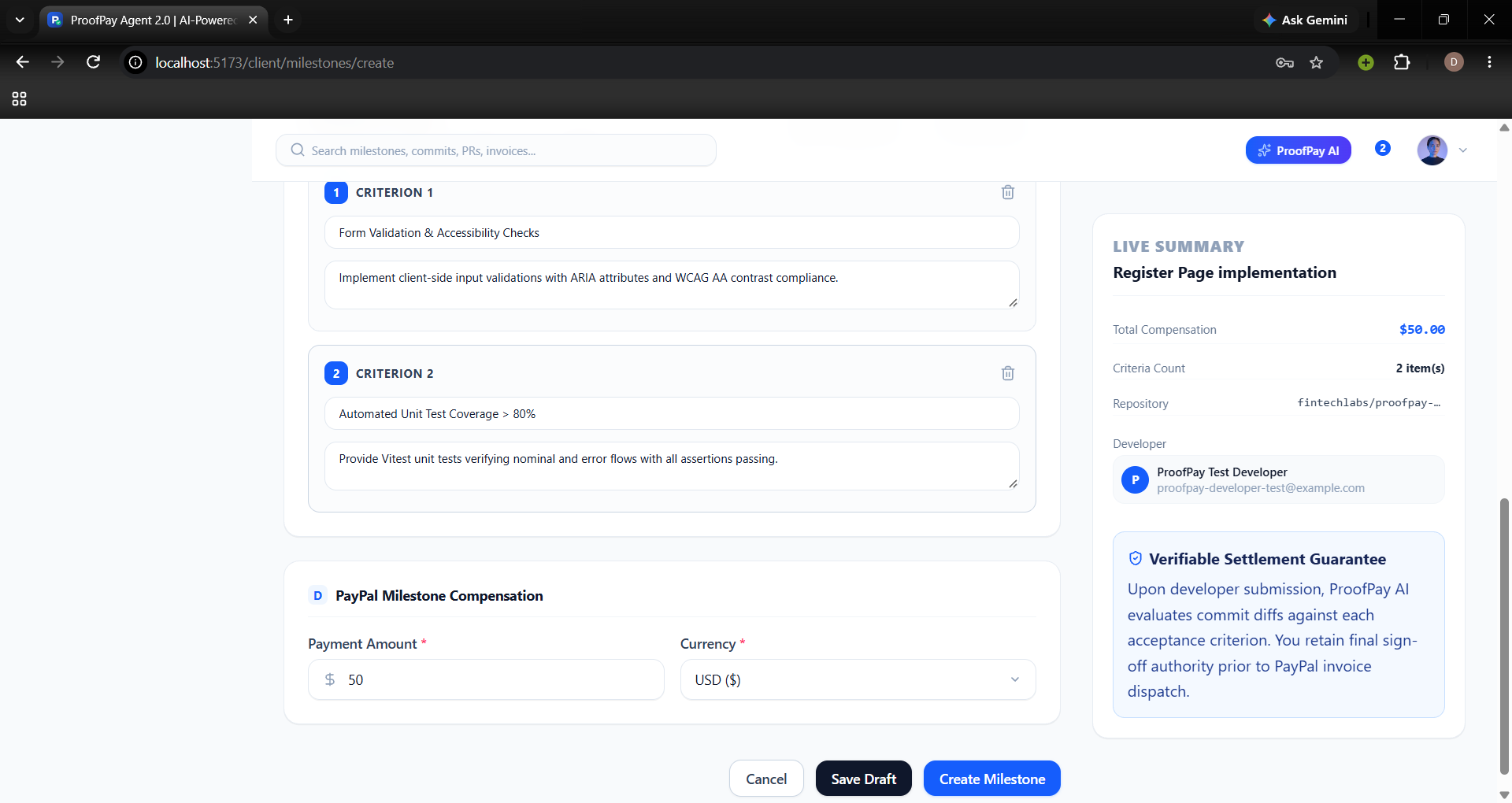
fields on milestone page
-
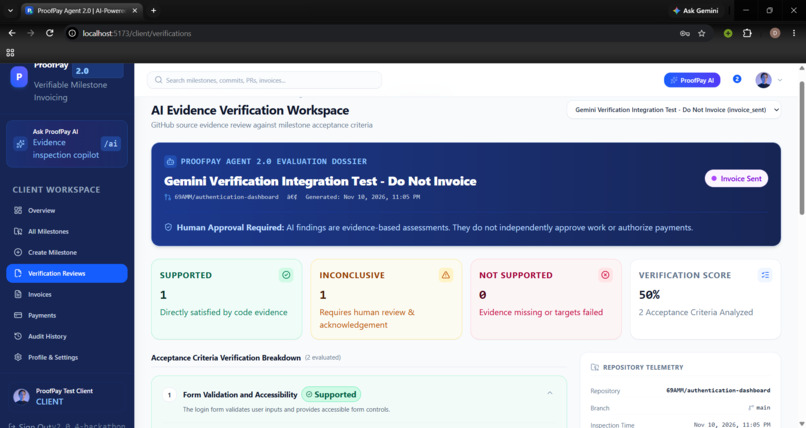
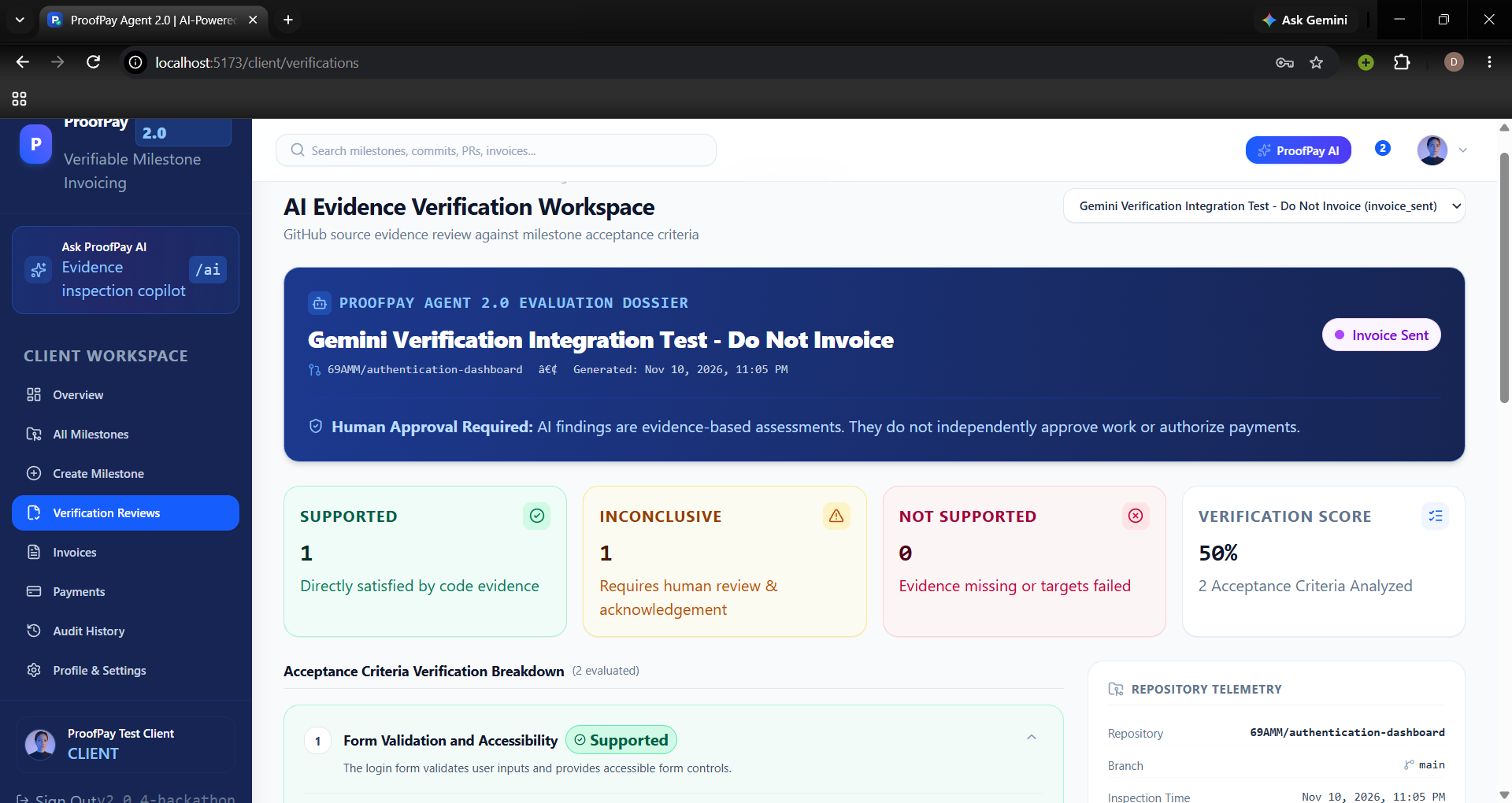
verification page
-
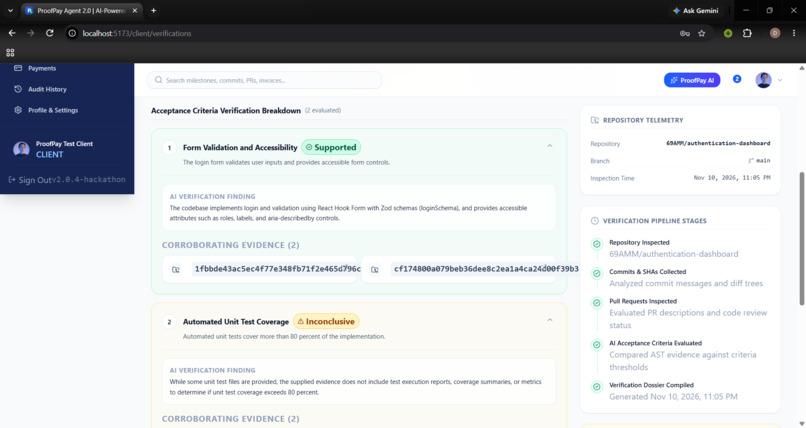
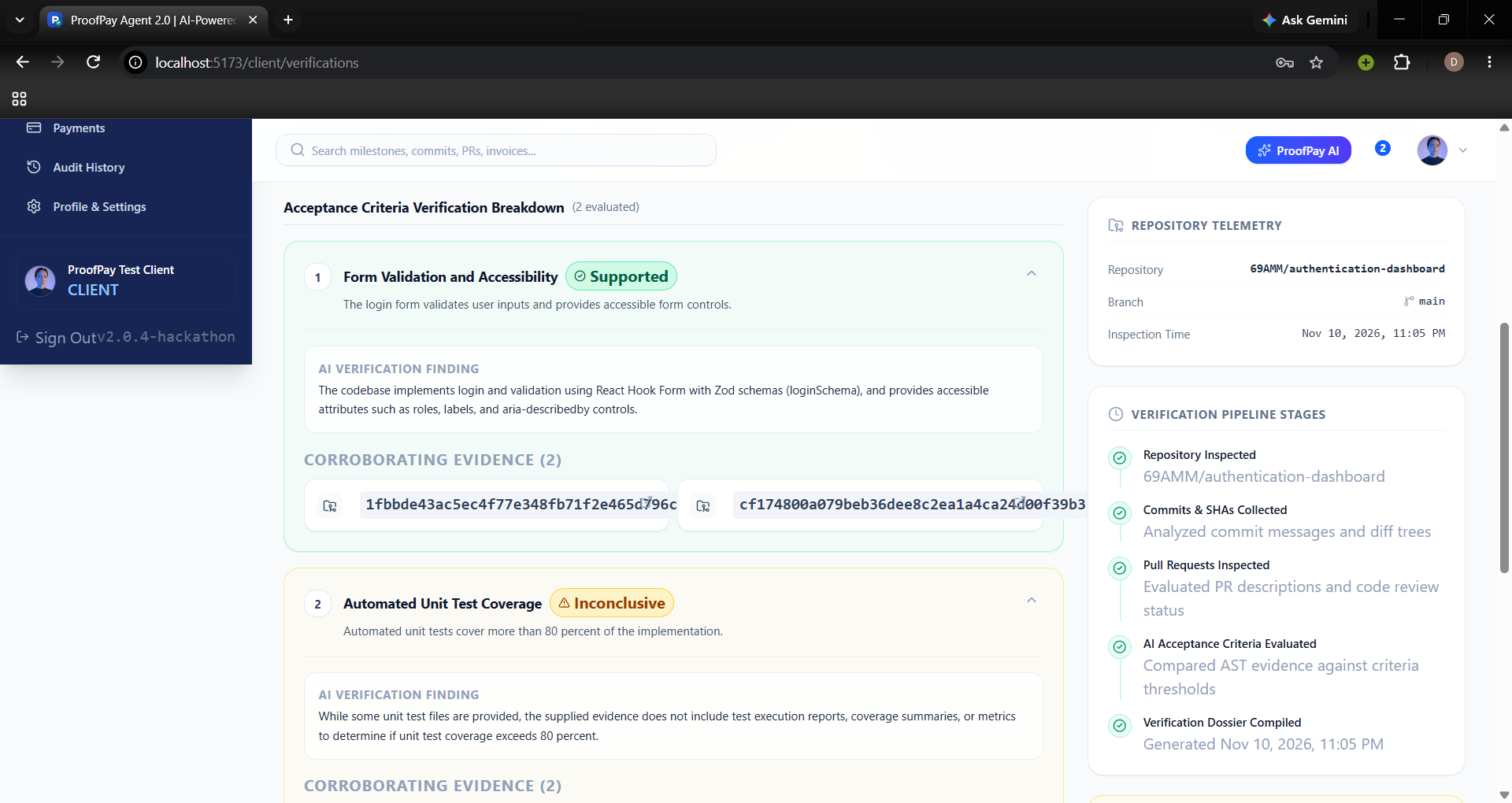
other view of verification page
-
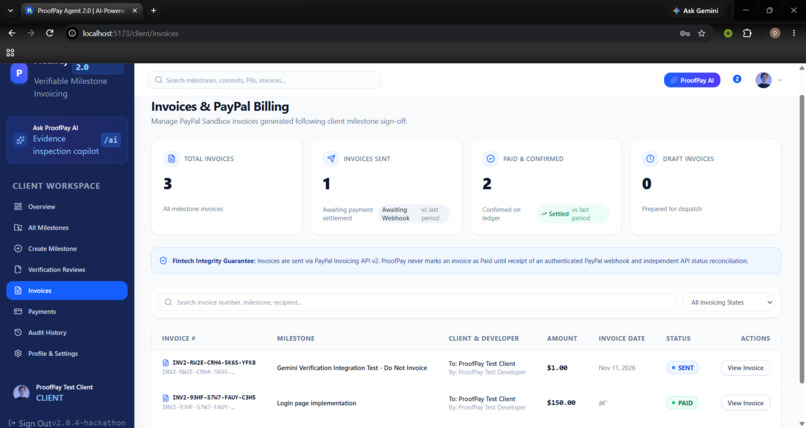
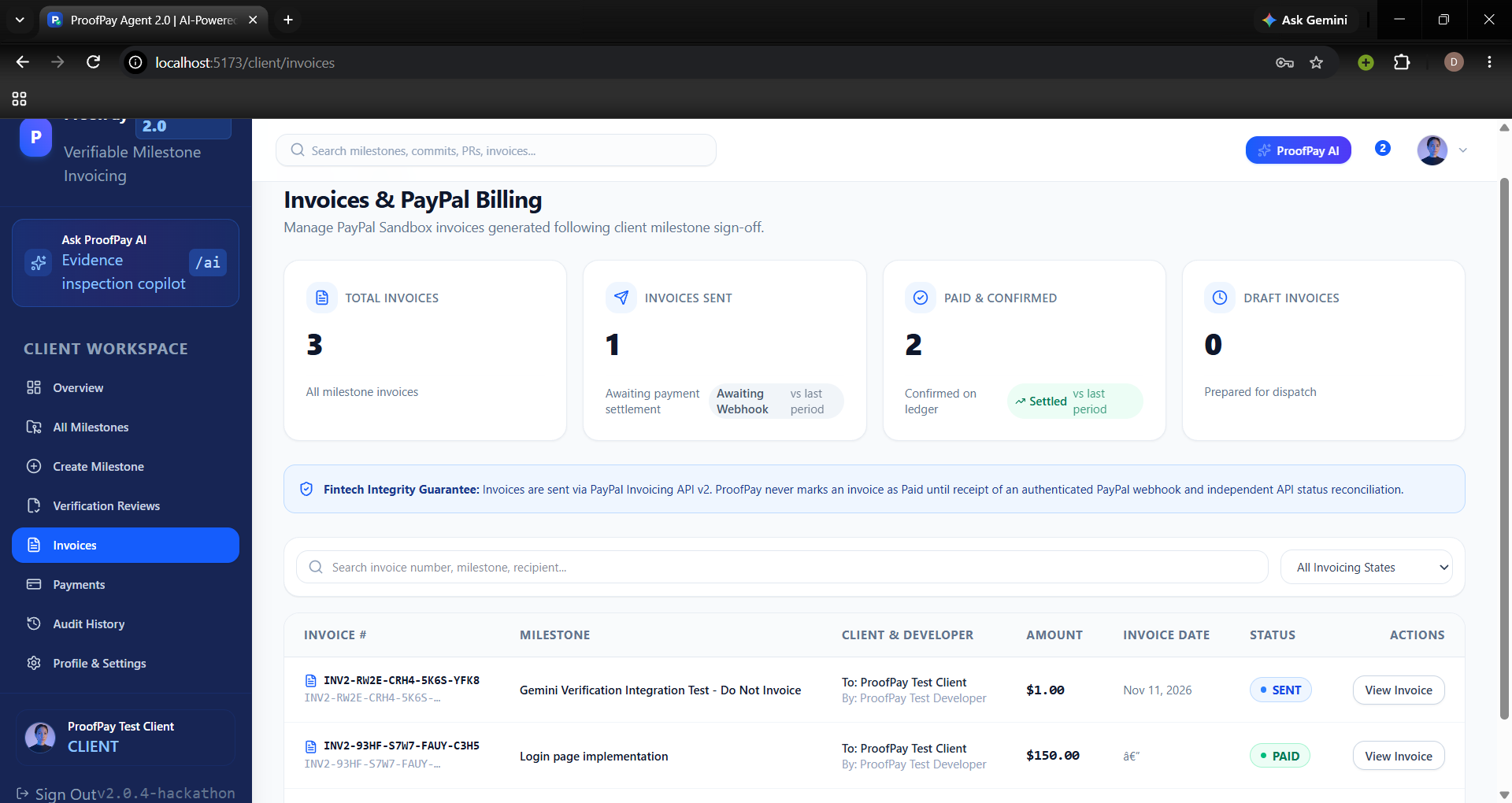
Invoice page
-
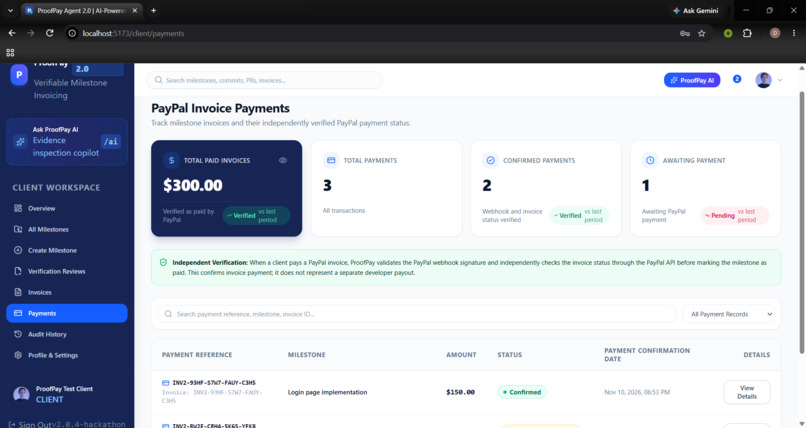
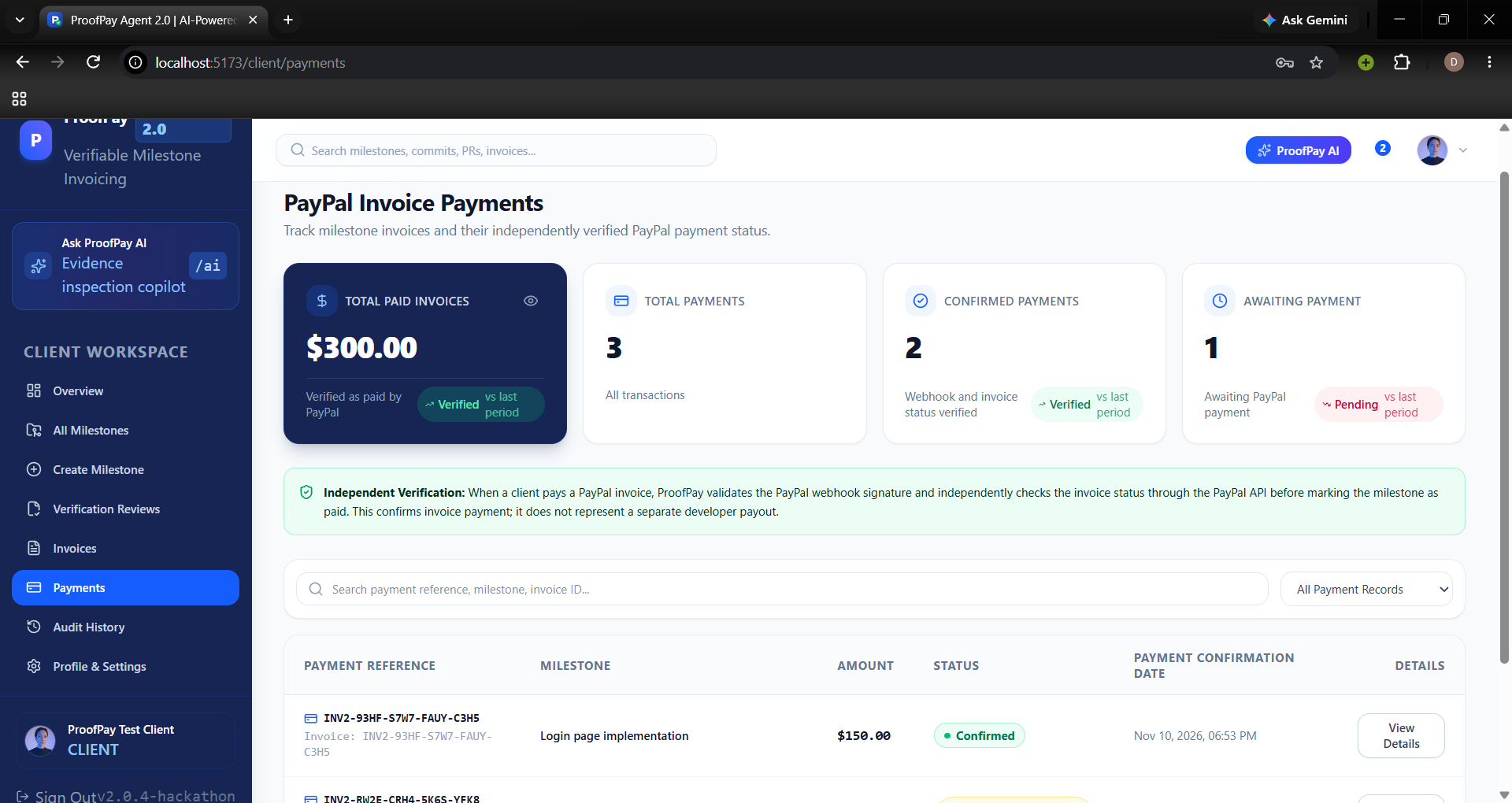
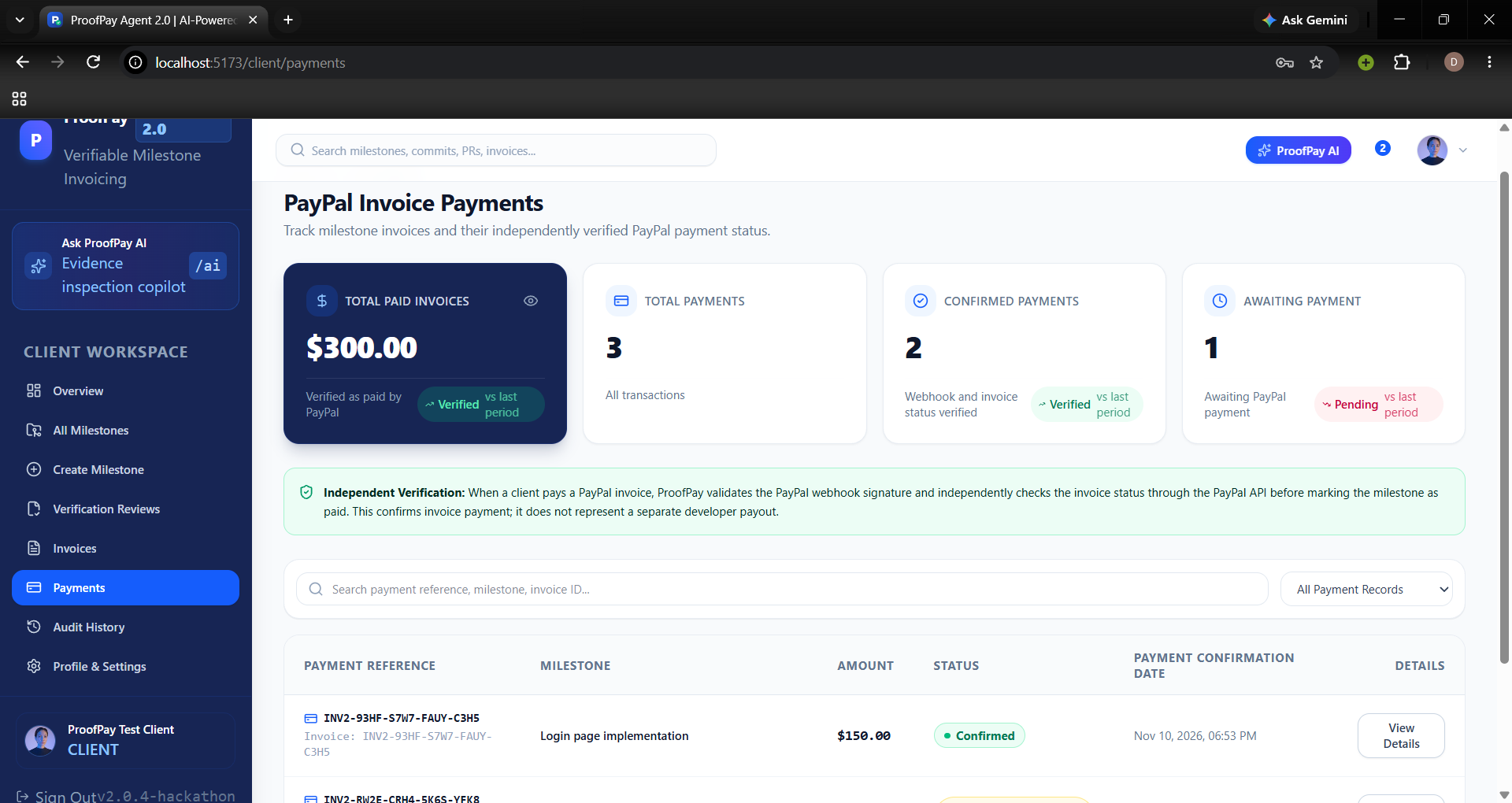
Paypal invoice payments
-
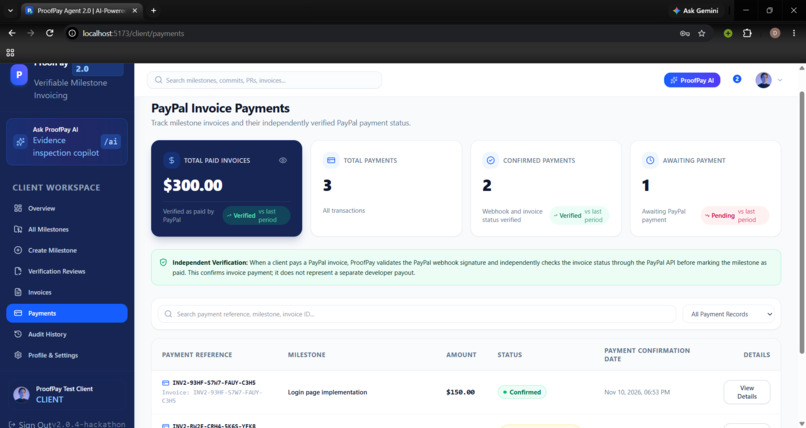
Paypal invoice additional view
-
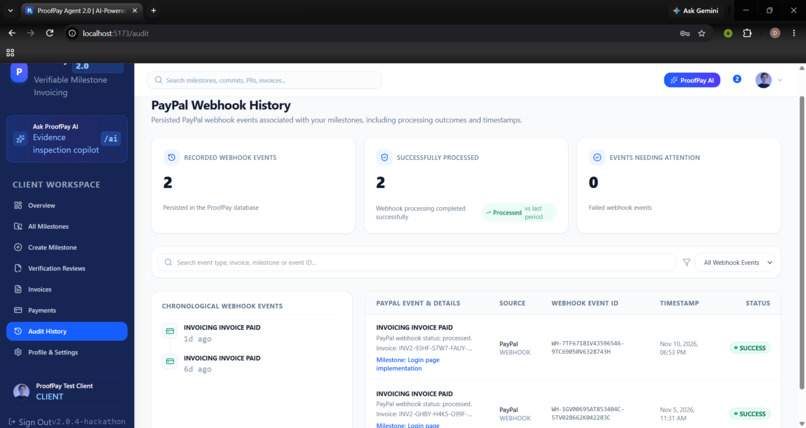
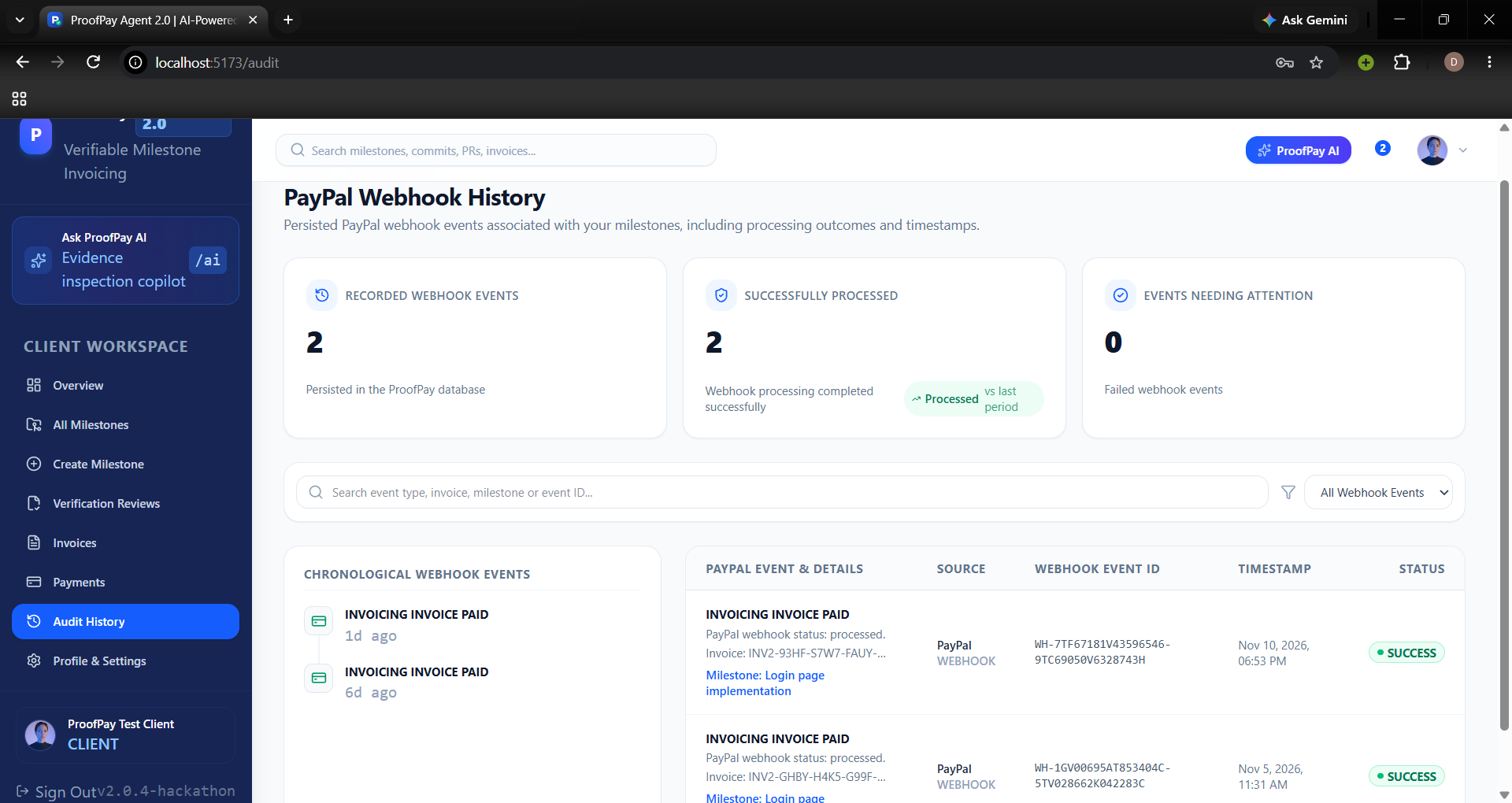
Audit page
-
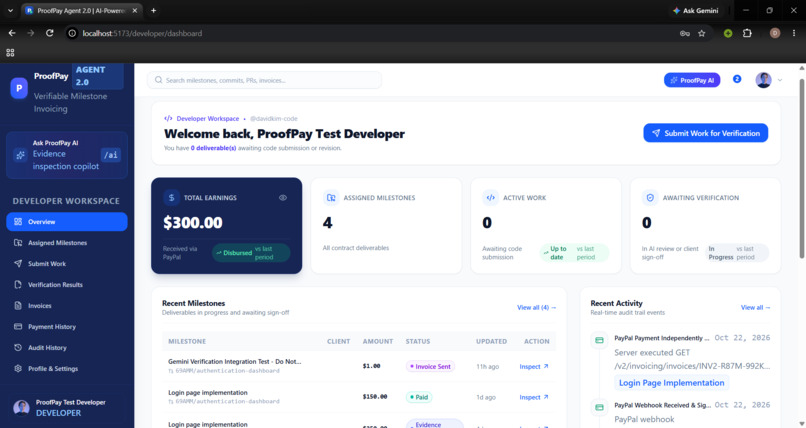
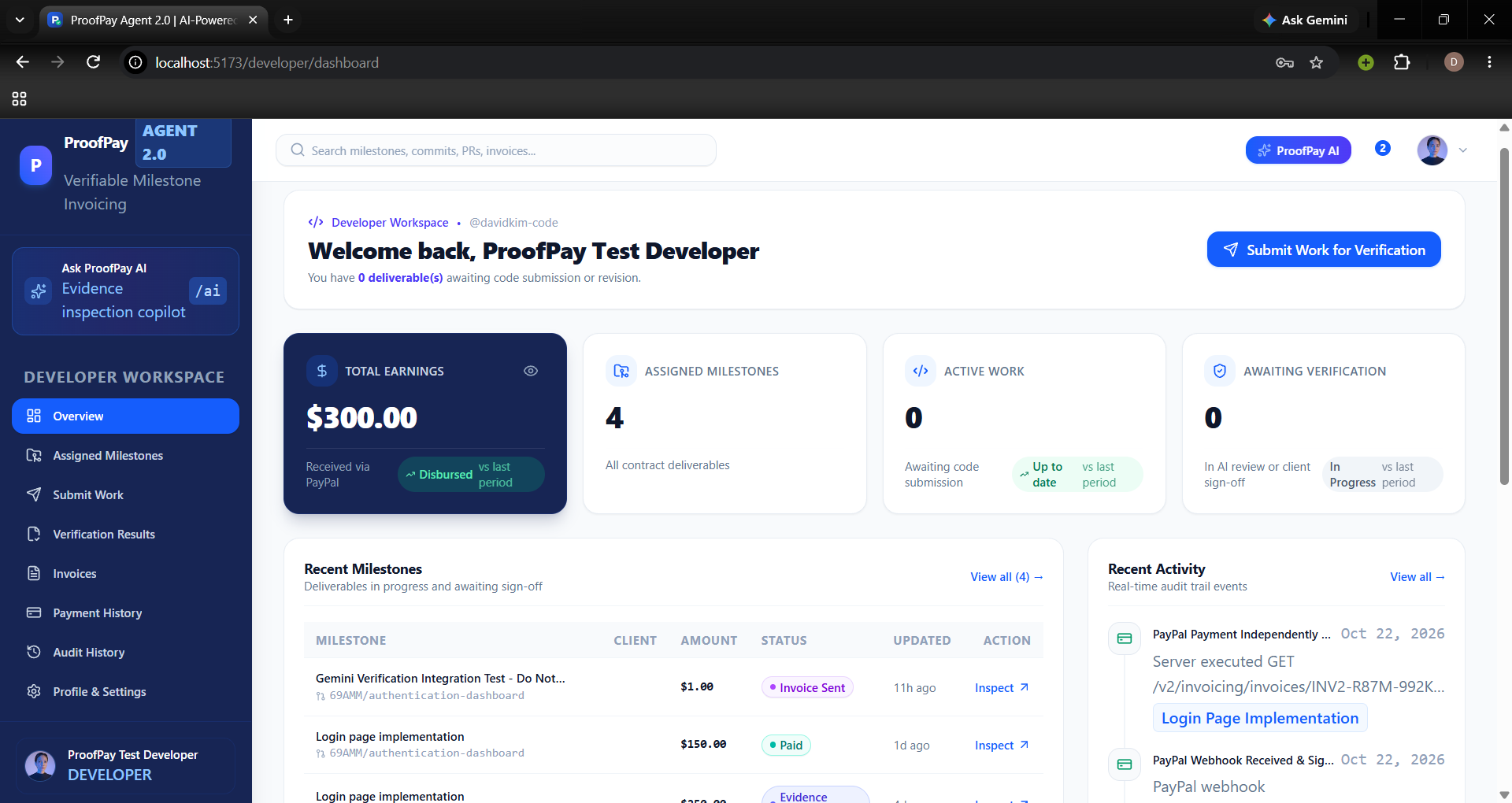
client page view
-
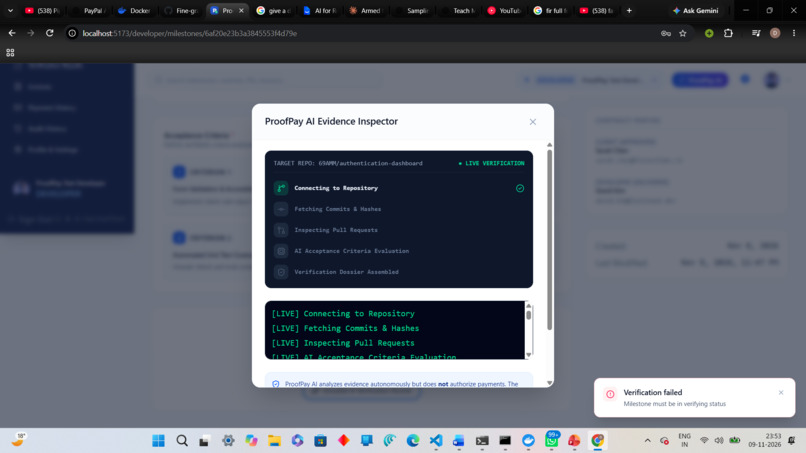
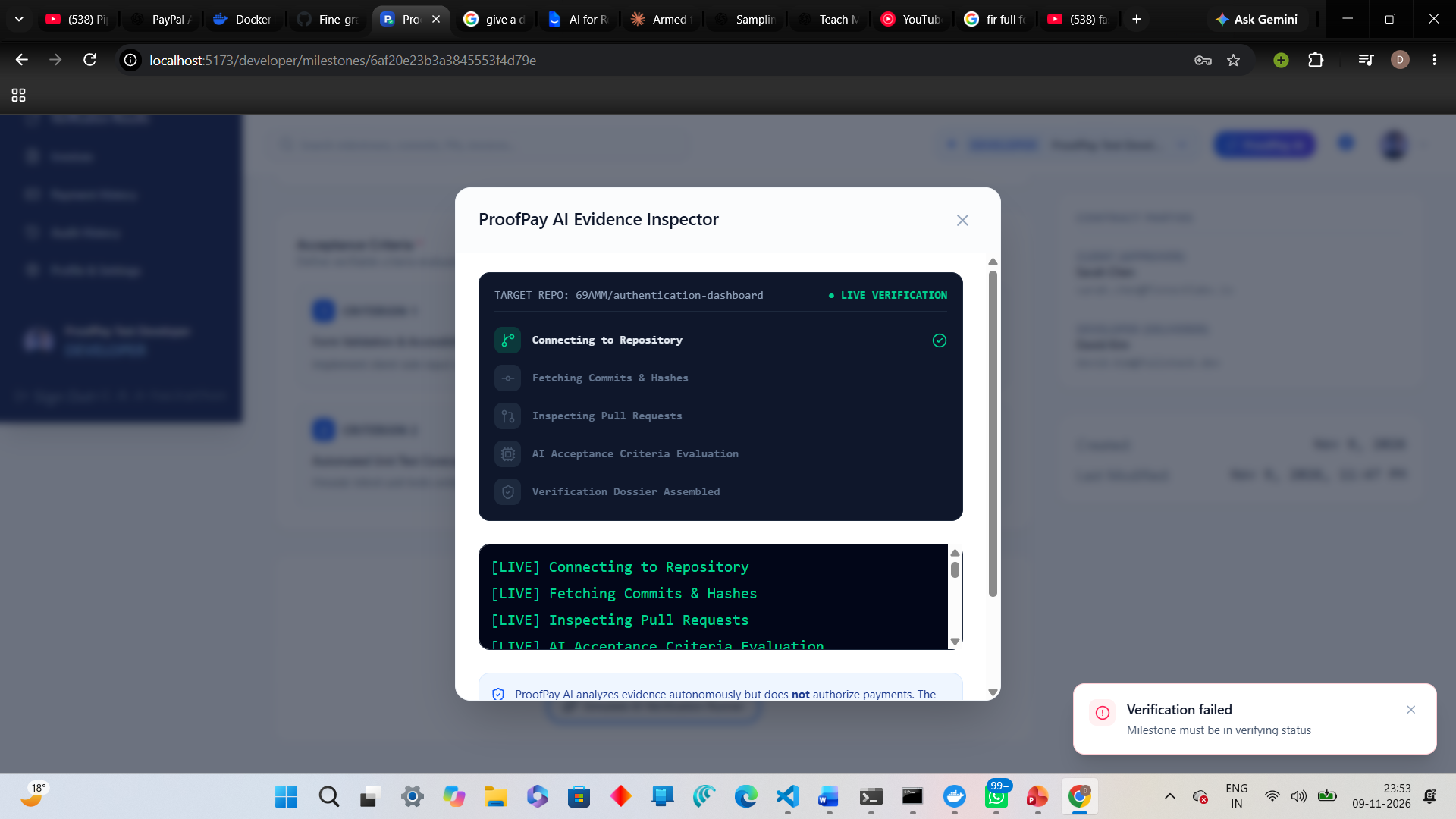
verification process
Inspiration
In freelance software development, one of the biggest challenges is trust. Clients pay for deliverables, but how can they confidently know whether the agreed work has actually been completed? Developers also need a fair way to demonstrate their progress and receive payment without unnecessary disputes. We realized that defining a milestone, verifying its completion, and processing its payment are often treated as separate activities. We wanted to connect all three. That idea led to ProofPay AI — a platform where software delivery is evaluated using repository evidence, reviewed by the client, and connected to PayPal payments. Our guiding principle was simple: **Don't just pay for promises. Pay with evidence.
What it does
ProofPay AI is an AI-assisted milestone verification and payment coordination platform connecting clients and software developers. It provides an end-to-end workflow:
- Create milestones:Clients define deliverables, assign developers, connect GitHub repositories, specify payment amounts, and establish acceptance criteria.
- Collect development evidence: ProofPay retrieves relevant repository evidence, including source files, commits, and available pull-request information.
- AI-powered verification: Google Gemini analyzes the collected evidence against each acceptance criterion and generates structured findings:
- Supported
- Not supported
- Inconclusive
- Transparent approval:** Clients review the AI-generated report before approving a milestone. Inconclusive findings require explicit acknowledgement before approval.
- PayPal invoicing:** After approval, ProofPay creates and sends an invoice through PayPal Invoicing.
- Verified payment confirmation:** The backend verifies PayPal webhook signatures and checks the invoice's actual payment status before marking the milestone as paid. The result is a connected workflow for delivery evidence, human approval, invoicing, and payment confirmation. ## How we built it We developed ProofPay AI as a full-stack web application with separate experiences for clients and developers. Frontend — React and Vite: Built the dashboards, authentication screens, milestone management, verification reports, invoice views, and payment history. Backend — Node.js and Express.js: Implemented REST APIs, authentication, role-based authorization, milestone management, verification workflows, and payment processing. Database — MongoDB and Mongoose:Store user accounts, milestones, acceptance criteria, verification reports, invoice information, and payment-related records. AI — Google Gemini API: Analyze collected GitHub evidence against individual acceptance criteria and generate structured, evidence-referenced findings. GitHub API:** Collect repository files, commits, and available pull-request information for verification. PayPal Invoicing and Webhooks: Handle invoice creation and payment confirmation. The backend validates webhook signatures and independently checks invoice payment status before updating milestone state. We also implemented controlled milestone state transitions to ensure that verification, approval, invoicing, and payment follow a defined workflow. ## Challenges we ran into One of our biggest challenges was making AI-generated verification reliable enough to support a financial workflow. An LLM can produce convincing explanations even when the available evidence is incomplete. For example, finding a test file does not prove that the tests passed or that code coverage exceeds a particular threshold. We addressed this by introducing three distinct findings: supported, not supported, and inconclusive. We also implemented backend validation to ensure that:
- AI findings correspond to the actual acceptance criteria.
- Evidence references point to items that were genuinely collected.
- Invalid or inconsistent AI responses are rejected.
- Inconclusive results cannot silently become positive approvals. Another challenge was coordinating asynchronous GitHub collection, Gemini analysis, milestone transitions, PayPal invoice creation, and webhook processing. We addressed this through controlled state transitions, webhook signature verification, invoice-status checks, and idempotent webhook handling. These challenges taught us that integrating AI into financial workflows requires more than a good model. It requires careful backend validation, security, and predictable system behavior. ## Accomplishments that we're proud of
- Built a working full-stack platform with separate client and developer workflows.
- Integrated GitHub repository evidence collection with Google Gemini-powered criterion-level verification.
- Implemented structured AI findings with supported, not-supported, and inconclusive outcomes.
- Added backend validation of AI-generated findings and evidence references.
- Implemented explicit client acknowledgement for inconclusive findings.
- Integrated PayPal Invoicing into the milestone approval workflow.
- Implemented verified PayPal webhooks with invoice-status checks and idempotent event processing.
- Successfully tested the Gemini verification flow and PayPal Sandbox payment-confirmation workflow.
- Built a complete application rather than stopping at a static prototype. Most importantly, we are proud that ProofPay does not treat an AI-generated answer as unquestionable truth. It makes uncertainty visible and keeps the final approval decision with the client. ## What we learned Building ProofPay taught us how to combine LLM-based reasoning with traditional software engineering. We learned that:
- AI outputs need validation before they influence important business workflows.
- Repository evidence must be interpreted carefully; missing evidence is not automatically proof of failure.
- Human approval is important when AI assessments involve financial decisions.
- Payment webhooks must be verified and processed safely to prevent incorrect or duplicate state changes.
- Reliable integrations require careful handling of asynchronous operations, external API failures, and application state. We also gained practical experience integrating React, Express, MongoDB, GitHub APIs, Google Gemini, and PayPal into one connected application. ## What's next for ProofPay-AI We see ProofPay as a foundation for more reliable evidence-based software delivery and payments. Our next priorities include:
- Secure automated testing:Execute repository test suites inside isolated environments to obtain stronger verification evidence.
- Deeper code understanding: Analyze code changes, commit history, and relationships between implementation and acceptance criteria.
- Evidence provenance: Build richer audit trails connecting every AI finding to its original repository evidence.
- Improved verification: Introduce more robust semantic analysis and deterministic checks alongside LLM assessments.
- Expanded integrations: Support additional development platforms, project-management tools, and payment workflows. Our long-term vision is to make software milestone payments more transparent, evidence-driven, and accountable. ProofPay AI — Define the work. Verify the evidence. Approve with confidence.
Built With
- artificial-intelligence
- express.js
- generative-ai
- github-api
- google-gemini
- javascript
- jwt-authentication
- large-language-models
- llm
- mongodb
- mongoose
- node.js
- paypal
- react
- rest-api
- vite
- webhooks

